

Most founders search “real estate masters dubai” and assume they're choosing a course. Often, they're deciding between two very different business moves.
One path is a brokerage relationship with Real Estate Masters Dubai, a firm operating in Business Bay. The other is a postgraduate degree in real estate, where the return comes from capability, credibility, and network rather than immediate deal flow. If you're building proptech, launching an investor-facing platform, or entering the UAE property space from another sector, mixing these up wastes time.
The smarter question isn't “which is better?” It's what bottleneck are you trying to remove. If your issue is distribution, inventory access, buyer conversations, or market reach, you're evaluating a partner. If your issue is underwriting, valuation logic, development feasibility, or strategic market knowledge, you're evaluating education.
For UAE and MENA founders, Real Estate Masters Dubai can mean one of two things.
It may refer to Real Estate Masters (REM) Dubai, the brokerage and investment consultancy. Or it may refer to a real estate master's degree in Dubai, usually sought by professionals who want deeper expertise in valuation, finance, development, and investment. Those are not adjacent choices. They solve different problems.
A useful way to separate them is by outcome:
Practical rule: Don't buy education to solve a distribution problem, and don't sign a channel partner to solve a capability problem.
Founders usually make the wrong call when they chase prestige instead of friction. A degree won't automatically create local commercial traction. A brokerage won't automatically teach your team how to assess pricing, unit economics, or project viability.
Use the term “real estate masters dubai” carefully. In founder terms, it doesn't describe a category. It describes a fork in the road.
Real Estate Masters (REM) Dubai is best understood as a scaled brokerage and investment consultancy built for transaction support, investor handling, and end-to-end property workflows.

According to its company profile, REM Dubai is headquartered in Westburry Tower 1, Business Bay, Office 2705, has a listed contact number of +971 52 211 7777, and shows a workforce size of 201–500 employees. The same profile notes that the firm describes itself as having over 150 professionals and focuses on end-to-end property solutions for international clients, which points to a brokerage model with enough operating depth to support multilingual sales activity and high transaction throughput (company profile for Real Estate Masters Dubai).
If you're building a proptech product, REM isn't just “an agency”. A brokerage at this scale can matter in three practical ways.
First, it may offer a distribution advantage. If your product depends on agent adoption, developer inventory visibility, or investor-facing workflows, a sizeable brokerage can give you faster feedback than a fragmented set of smaller firms.
Second, it may offer process density. Larger brokerages usually surface operational pain more clearly. Lead routing, viewings, CRM hygiene, off-plan inventory access, international buyer objections, and handover coordination all become visible faster when more agents touch more deals.
Third, it may offer decision-maker access, but only if you qualify the relationship properly. Founders often meet a brokerage, get excited by brand presence, and mistake polite interest for a commercial pathway.
A brokerage partner is valuable when they can move your product into real workflows, not when they merely agree your idea sounds useful.
REM is more relevant if your startup needs one of these:
A brokerage isn't a substitute for market strategy. It won't fix weak product positioning, poor onboarding, or a product that only works in a demo.
Here's a clean way to view it:
| Question | If the answer is yes | What it suggests |
|---|---|---|
| Do you already know your customer? | Yes | A brokerage may help with access and rollout |
| Are you still unclear on underwriting or valuation logic? | Yes | You may need capability building first |
| Do you need immediate channel relationships? | Yes | Partner evaluation matters more than formal study |
| Is your team selling into real estate without sector fluency? | Yes | Education, hiring, or advisory support may matter more |
The strongest reason to look at REM Dubai is not brand curiosity. It's the possibility that they sit at the point where founders can observe how Dubai property transactions operate.
The academic interpretation of real estate masters dubai is much more specific than many founders expect. Dubai doesn't offer a broad menu of interchangeable real estate postgraduate programmes. The strongest concrete example is Heriot-Watt University Dubai's RICS-accredited MSc Real Estate.
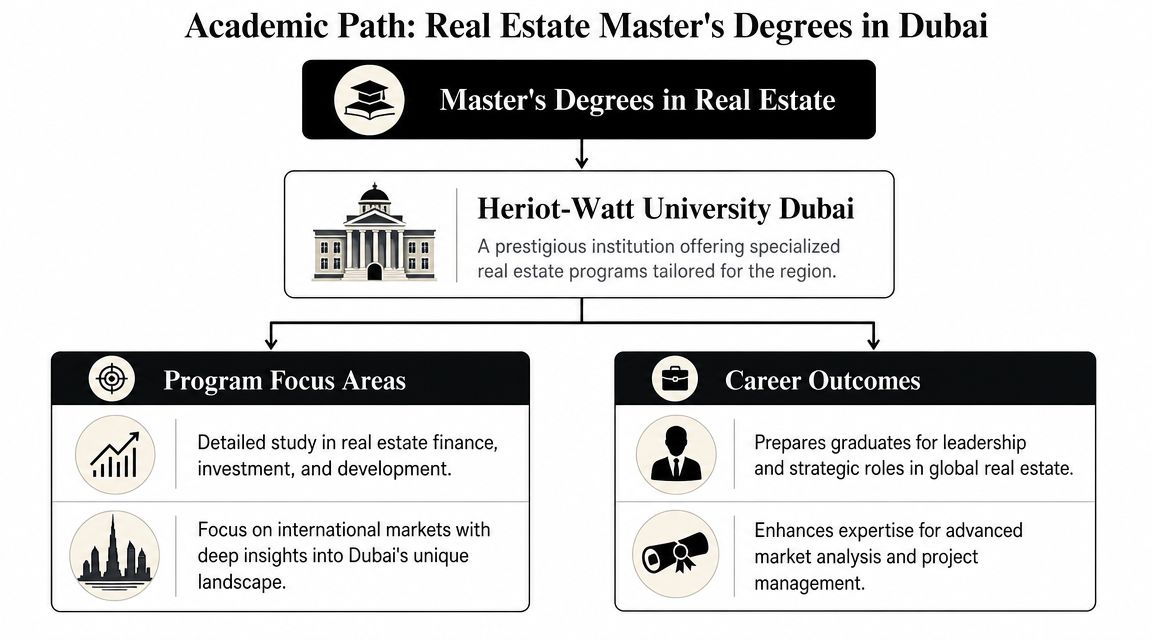
Heriot-Watt's Dubai campus offers this programme on campus in Dubai, with a 1 year full-time route. Tuition is listed at AED 99,528 for full time, and the curriculum includes advanced valuation, real estate management, development, and investment analysis (Heriot-Watt Dubai MSc Real Estate).
Founders often describe a degree as “learning the market”. That's too vague. A good real estate MSc gives you a more disciplined operating lens.
You're paying for structured exposure to:
RICS accreditation matters because it signals that the programme is tied to recognised professional standards rather than generic business coursework. For founders, that doesn't mean instant commercial advantage. It means the curriculum is built around how professionals in the sector think about assets, risk, appraisal, and performance.
That distinction matters in Dubai. Property here moves fast, but experienced participants still expect technical competence.
The main value of a specialised MSc isn't classroom prestige. It's learning how the people who price, assess, manage, and finance assets actually frame decisions.
The MSc route is expensive in both money and attention. AED 99,528 is only the visible tuition line. The hidden cost is founder bandwidth. A full-time programme changes how much time you have for hiring, customer development, fundraising, and execution.
That's why this route makes sense for a narrow set of founder situations:
If your startup already has traction, the degree has to justify the distraction. If your startup is still forming its thesis, the degree can sharpen that thesis materially.
Most founders are too polite in first meetings with brokerages. That's expensive. You don't need a pleasant conversation. You need evidence that the firm can help your business move.
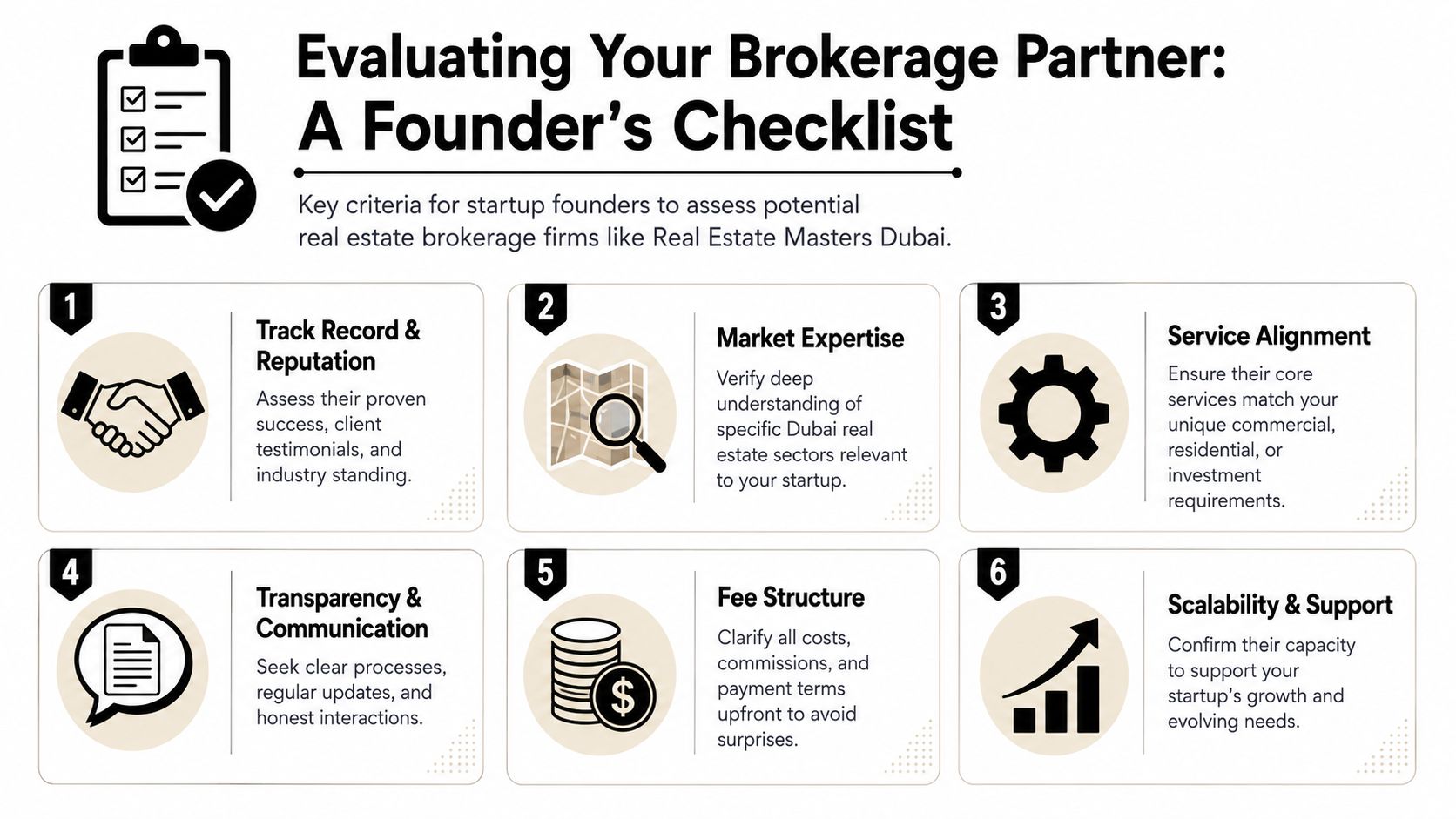
Start with this standard. A brokerage partner should improve one of four things: access, conversion, execution, or market learning. If it doesn't improve any of those, it's noise.
Before product demos or partnership excitement, verify operating basics.
If the commercial arrangement is still fuzzy, it helps to review a practical real estate partnership agreements guide before you put anything in writing.
Founders often ask, “Do you like our product?” Ask better questions.
Try these instead:
You're not testing whether they understand your vision. You're testing whether your product survives contact with their workflow.
If a brokerage can't describe where your product fits between lead receipt and deal closure, you don't have a partner. You have a friendly meeting.
Here's a useful companion read if your product touches community operations, service layers, or building stakeholders: owners association management companies in Dubai.
A brokerage may be large and still be a poor fit.
Look at specialisation through a founder lens:
| Area to assess | What to ask | Why it matters |
|---|---|---|
| Product segment | Do they focus on off-plan, secondary, leasing, or investor advisory? | Your startup may only solve one of these well |
| Client profile | Are they serving end-users, international investors, or institutional-style buyers? | Different users create different data and workflow needs |
| Internal process discipline | How do they manage follow-up, handovers, and reporting? | Weak process kills pilots |
| Tech readiness | What CRM or internal tools do they already rely on? | Integration friction can block adoption |
A broad brokerage can open doors, but a specialised brokerage often gives cleaner product insight.
To see how another operator frames brokerage economics and deal structures in Dubai, this video is worth reviewing before your next partnership call.
Don't start with “regional rollout”. Start with a bounded test.
A workable pilot usually has:
What doesn't work is vague access to “all agents” with no champion, no process map, and no consequence if nobody uses the product.
The founder advantage in Dubai is speed. Use that. Get to a live workflow quickly, then decide whether the brokerage is a partner, a prospect, or a dead end.
A real estate MSc can be a smart founder move. It can also be a polished form of delay.
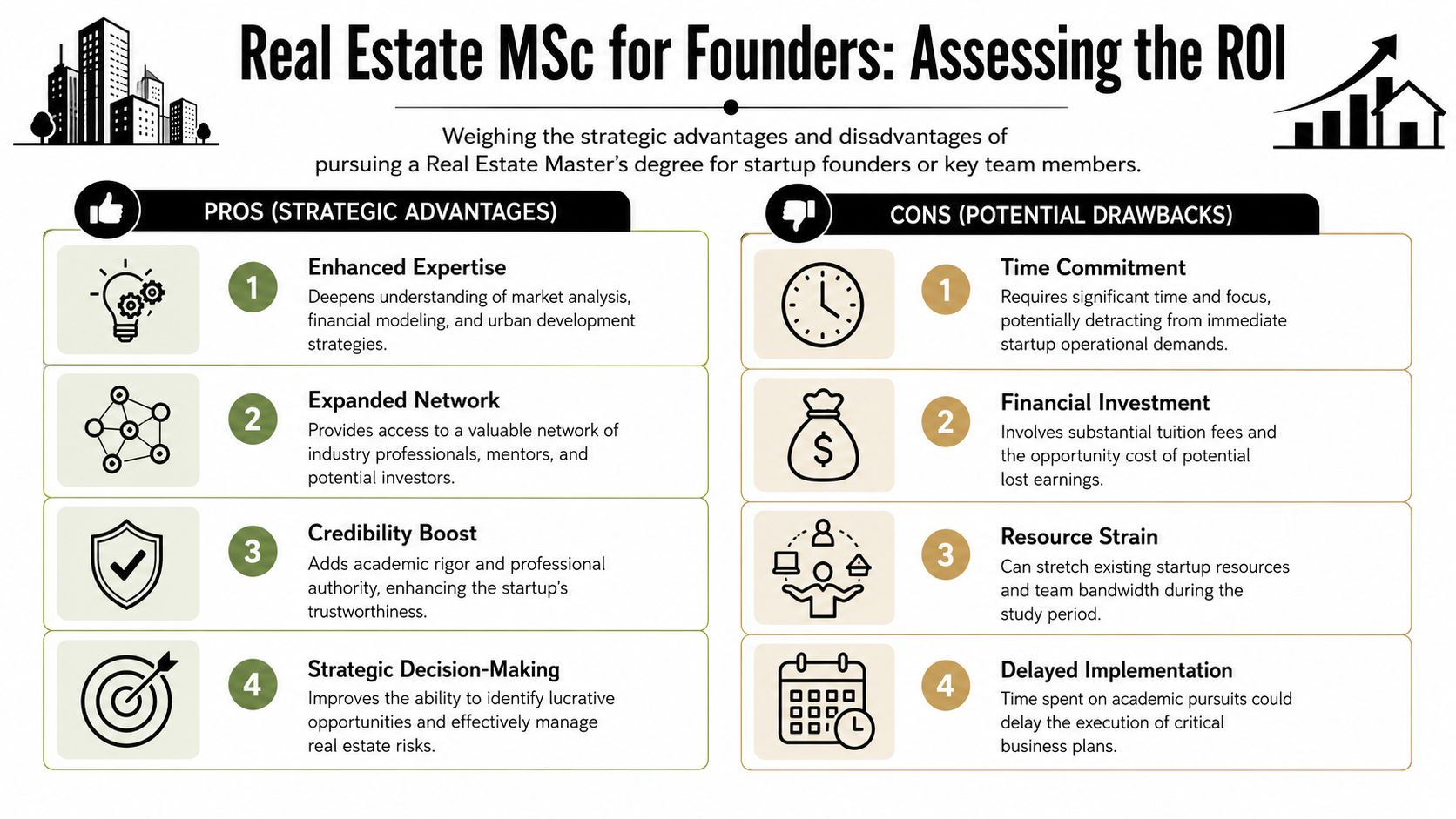
The answer depends on what your startup lacks right now. If the business is weak because you don't understand pricing, asset logic, development constraints, or investor language, education may foster improved judgement your team can't fake. If the business is weak because you haven't sold enough, haven't narrowed the ICP, or haven't built a workable product, a degree won't rescue you.
Dubai's pace makes this decision sharper. In 2024, residential sales prices in Dubai rose 20% and rents increased 19%, which is a useful reminder that even modest pricing assumptions can materially change returns, underwriting, and product viability in a fast-moving market (Deloitte on Dubai real estate predictions for 2025).
A specialised MSc tends to pay off when your company sits close to investment logic.
That includes founders building products for:
In those cases, deeper technical fluency improves product judgement, sales credibility, and internal decision-making.
There's also a network layer. For international students and career-switchers in particular, the bigger return in Dubai may come from relationships, internships, and exposure to the region's developer, brokerage, and capital ecosystem rather than a simple degree-to-job path, as noted in this overview of real estate and property development study options in the UAE.
A master's is usually poor founder ROI if:
Don't send a founder back to class when the company really needs sharper customer discovery.
Another way to judge it is by replacement cost. If one senior hire, advisor, or consultant can bring the missing capability into the business faster, the MSc may be the slower path.
A useful cross-check is whether your startup has reached proptech product market fit and real estate tech need. If the market problem is still blurry, formal study can help. If the problem is already validated, you may need execution support more than education.
Ask these three questions.
| Question | If yes | Likely direction |
|---|---|---|
| Does weak sector knowledge block product or investor conversations? | Yes | MSc may have strategic value |
| Can a hire or advisor fill the gap faster? | Yes | Hire before you study |
| Will the degree produce usable insight inside the next operating cycle? | No | Delay the degree |
The best reason to pursue a real estate MSc in Dubai isn't status. It's that your startup will make better decisions because someone inside it now understands the asset side properly.
The right choice comes down to your current bottleneck.
If you already have a product, a target customer, and a clear use case inside the property value chain, your next move is probably partner evaluation. Build a shortlist of brokerages, test workflow compatibility, and push for a tightly defined pilot. Don't spend months “learning the sector” in theory if the market can teach you faster through real usage.
If you have conviction about the sector but lack technical depth in valuation, finance, development, or investment logic, your next move may be capability building. That could mean a formal MSc. It could also mean hiring someone with that background, bringing in an advisor, or using shorter targeted learning routes.
The founders who move well in Dubai property don't treat education and partnerships as ideological choices. They use each at the right stage.
A brokerage helps when you need access to live demand, live objections, and live process friction. Formal study helps when bad assumptions are damaging product strategy, investment logic, or commercial trust. Mixing up those roles is where time disappears.
Choose the path that removes your next constraint, not the one that sounds more impressive in conversation.
There's also a third option that many founders overlook. Instead of choosing only between REM-style partners and a full MSc, build a hybrid path. Hire a sector operator. Join investor and developer conversations. Take focused short courses. Read the market from the perspective of cross-border buyers using practical resources like these insights for global investors in Dubai. Then decide whether you still need the degree or the brokerage relationship.
The immediate next step should be concrete. Write down your current bottleneck in one sentence. Then choose one action that matches it: shortlist three brokerages, book one programme discussion, or hire one domain expert for a short advisory sprint. That gets you further than another month of vague market research.
If you want sharper founder-to-founder perspective before making that call, Founder Connects gives UAE and MENA founders a place to pressure-test decisions with peers, get relevant introductions, and move from uncertainty to a clear next step.


