

Let's get straight to the point. Angel financing is when a successful individual—often an experienced entrepreneur—invests their personal cash into your early-stage startup. In return, they get an ownership stake (equity).
Think of them less like a bank and more like a seasoned co-pilot joining your journey. For founders in the UAE and MENA, angel investors provide the critical fuel when you're still too small and unproven for big venture capital firms.
Understanding angel financing is the first step to unlocking crucial early capital. Unlike institutional venture capital (VC) funds that manage other people's money, angel investors are putting their own skin in the game. This changes everything.
Their decisions are often faster and far more personal. They aren't just ticking boxes on a fund mandate; they're making a bet on you and your vision. It’s a significant personal risk they’re taking on your idea.

The best angel investors bring more than cash. They bring "smart money"—the strategic value that comes with the investment. In the MENA startup scene, this can be a game-changer.
Here’s what smart money looks like in action:
Founder's Takeaway: For an early-stage founder, the right angel investor isn't just a source of capital—they are your first major strategic partner. Their belief provides the market validation needed to build momentum.
Here’s a scannable overview of what angel financing typically looks like in the UAE, KSA, and Egypt. Use this as a cheat sheet for your fundraising conversations.
Knowing these fundamentals helps you frame expectations and approach your fundraising with confidence.
Not all angel investors are the same. You wouldn't use the same pitch for every customer, and the same logic applies here. Tailor your approach to the person across the table. In the UAE and MENA, you’ll typically meet a few key archetypes.
This investor has spent decades in your industry. They could be a retired executive from a major regional corporation or the founder of a successful company in your exact niche.
Often a successful founder, the Operator Angel has fresh, hands-on experience building a company from the ground up in the MENA region.
Next Action: When pitching an Operator Angel, frame your 'ask' as more than cash. Ask for their specific expertise. For example, "We're raising $150,000 to hire our first two sales reps in Riyadh, and we’d love your guidance on building a sales playbook for the Saudi market, given your success there."
This investor usually comes from a background in banking, private equity, or finance. They see your startup primarily as an asset class with the potential for massive returns.
Figuring out who you're talking to allows you to shape your story to what they value most, dramatically increasing your odds of getting that first cheque.
For most founders, "valuation" and "dilution" can feel intimidating. This is where you put a number on your company’s worth and decide how much of the pie you’re giving away. Let's break it down simply.
The startup scene across MENA is booming. According to Wamda, Saudi Arabian startups alone raised over $1.3 billion in 2023. This pool of capital from angels and VCs makes a solid grasp of deal mechanics essential.
Let's clear up the two most important terms you'll hear.
The Simple Formula: Pre-Money Valuation + Investment Amount = Post-Money Valuation. Nailing this is the foundation for calculating exactly how much equity you're giving up.
This infographic shows how different investor mindsets influence their focus during valuation talks.
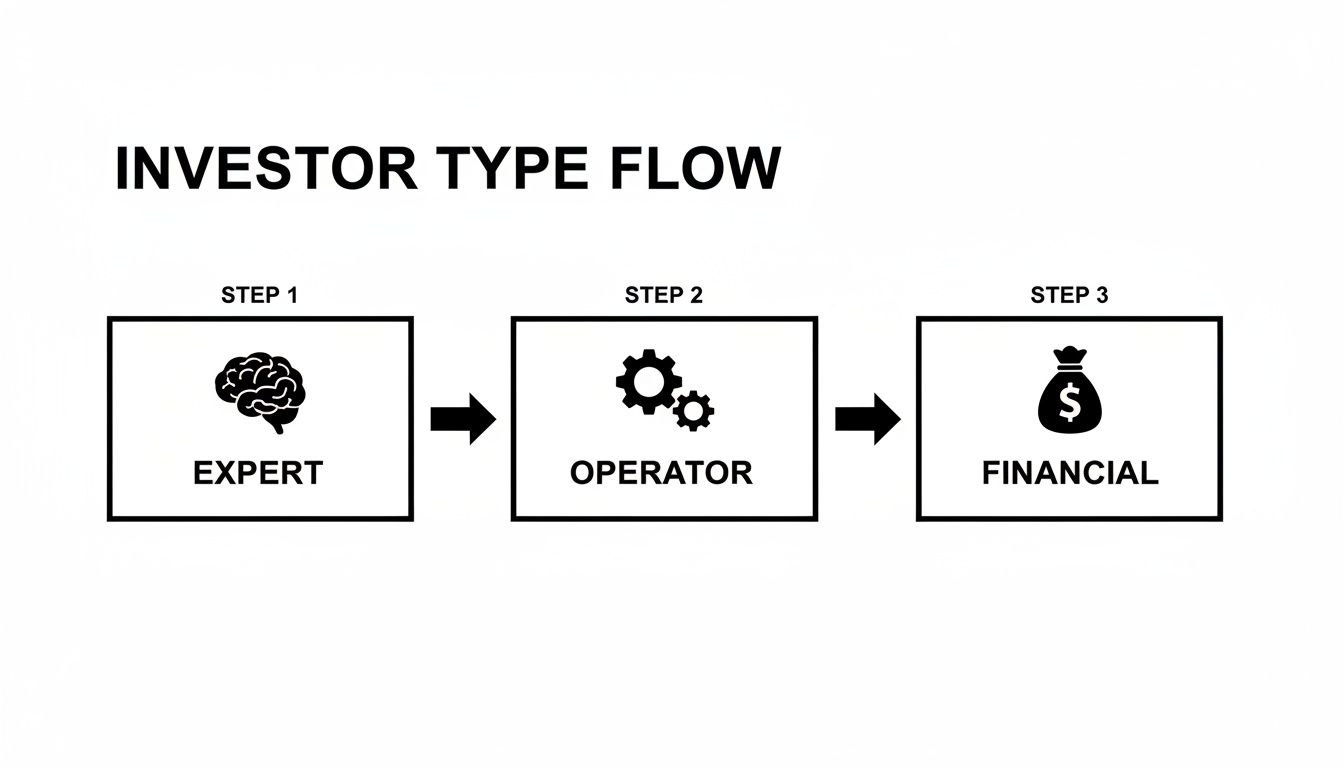
An investor’s priorities directly influence how they will view your startup's valuation and potential.
Dilution isn't a bad thing; it’s the trade-off you make for growth. You own a smaller piece of a much bigger, more valuable pie.
Let's use a hypothetical Dubai-based tech startup:
Your ownership percentage went down, but the company now has cash to hire engineers and launch a marketing campaign. Sometimes angel financing comes as a convertible note; in that case, understanding the terms of a promissory note is crucial as it impacts future valuation and dilution.
Angel financing can be rocket fuel, but it's a decision that demands careful thought. Accepting a cheque isn't just about cash; it's about bringing a new partner into your business.
This trade-off has massive upsides and serious potential pitfalls. Understand both sides of the coin before you start pitching.
When you land the right angel, the benefits go far beyond your bank account.
Walk in with your eyes open. A misaligned angel can create more problems than their capital solves.
Founder's Reality Check: The moment you take angel money, you're no longer the sole decision-maker. You are accountable to your investors, and their expectations will shape your strategy. Be ready for this shift.
Think hard about these potential negatives:
The UAE leads MENA funding, where angels often provide critical first fuel. But debt financing is also a major part of the capital raised, showing that founders must weigh equity against other options. You can learn more about the regional funding landscape on Arab News.
Every funding path has trade-offs. This table breaks down the key differences to help you decide which route fits your startup's stage and vision.
Choose the path that aligns with your personal goals and the kind of company you want to build.

Let's move from theory to action. Getting angel funding is about thorough preparation. This is your game plan—the non-negotiables to nail down before your first investor meeting.
Your pitch deck is your startup's story in 10-15 slides. It must be sharp, clean, and backed by a powerful narrative. Practice until you can confidently explain the problem, your unique solution, the market opportunity, and why your team can win. A great primer on how to pitch to investors is a must-read.
You don't need a hundred-tab spreadsheet. You need a simple model outlining your key assumptions.
Your model must include:
Don't spray and pray. Do your homework. Build a curated list of angels in the UAE and MENA whose investment history aligns with your sector and stage.
Next Action: Create a list of 20-30 target angels. For each, note their typical cheque size, industry focus, and a potential warm connection. A warm intro is worth a thousand cold emails.
Cold outreach rarely works. The best way to get a meeting is a warm introduction from someone the investor knows and trusts. This could be another founder in their portfolio, a lawyer, or a mutual professional contact. Start mapping your connections now. For a deep dive, check out our post on building relationships with angel investors.
Knowing what angel financing is is step one. The real game is getting a meeting. In the MENA ecosystem, genuine connections beat cold emails. Your goal isn’t just to find investors; it’s to earn their attention through smart networking.
The best path to an angel's inbox is a warm introduction from someone they trust. A personal referral makes your startup stand out from the noise.
Be intentional about where you spend your time. Focus on high-signal environments where you can build real relationships.
Here’s where to prioritize your efforts:
Next Action: Spend the next hour researching three upcoming industry events in the UAE or KSA. Register for at least one. Your goal: make three meaningful connections, not just swap business cards.
A systematic approach is everything. Use our complete directory of over 200 UAE angel investors to start building a targeted list. A short, well-researched list with a path to a warm intro is far more valuable than a massive spreadsheet for cold emailing.
Founders in the UAE and MENA often have the same questions. Here are direct, practical answers.
For an angel round in the MENA region, founders typically give away 10% to 25% of their company. The exact number depends on your valuation, how much you're raising, and the angel's "smart money" contribution.
Giving up 20% might feel like a lot now, but that investment should make your remaining 80% worth much more later. Don't give away too much too early, as it can create issues in future VC rounds.
It comes down to whose money they're investing. This one distinction explains everything.
Yes. Absolutely. While a cold email might get lucky, a warm introduction from someone the investor trusts changes the dynamic entirely.
An investor’s most limited resource is time. A warm intro signals that someone they respect has already vetted you, moving your pitch from the slush pile to the top of their list.
Ready to find the right investors and get the warm introductions that matter? At Founder Connects, we help founders in the UAE and MENA build meaningful relationships through curated peer groups, high-signal events, and intentional networking. Stop fundraising alone and start building with a community that has your back. Learn more and apply to join at https://www.founderconnects.com.


