

The Awok in UAE Story: Actionable Lessons for Founders

Building in MENA? You don't have to do it alone.
Join 300+ founders in the Founder Connects Residency. Monthly squad calls, warm intros, $3M+ in perks, and much more. All for less than your monthly coffee budget.

For founders in a hurry, here’s the short version: Awok.com was a massively popular, ultra-low-price e-commerce platform in the UAE that shut down in 2020. It collapsed under the weight of severe operational and financial problems, leaving behind a crucial lesson for startups on the dangers of chasing growth at all costs in the competitive MENA market.
The Rise and Fall of a UAE Discounter: A Founder's Case Study
Awok.com crashed onto the UAE e-commerce scene with a simple, aggressive strategy: sell products at rock-bottom prices. This immediately caught the eye of a huge, price-sensitive segment of the UAE market, kicking off a period of explosive growth.
The platform became famous for its "deal-of-the-day" model, creating a constant sense of urgency that drove massive traffic and sales. But this hyper-growth model was hiding deep-seated, critical problems. It was a value proposition built on a foundation that couldn't last.
This timeline shows Awok's journey, from its ambitious beginnings to its sudden and complete closure.
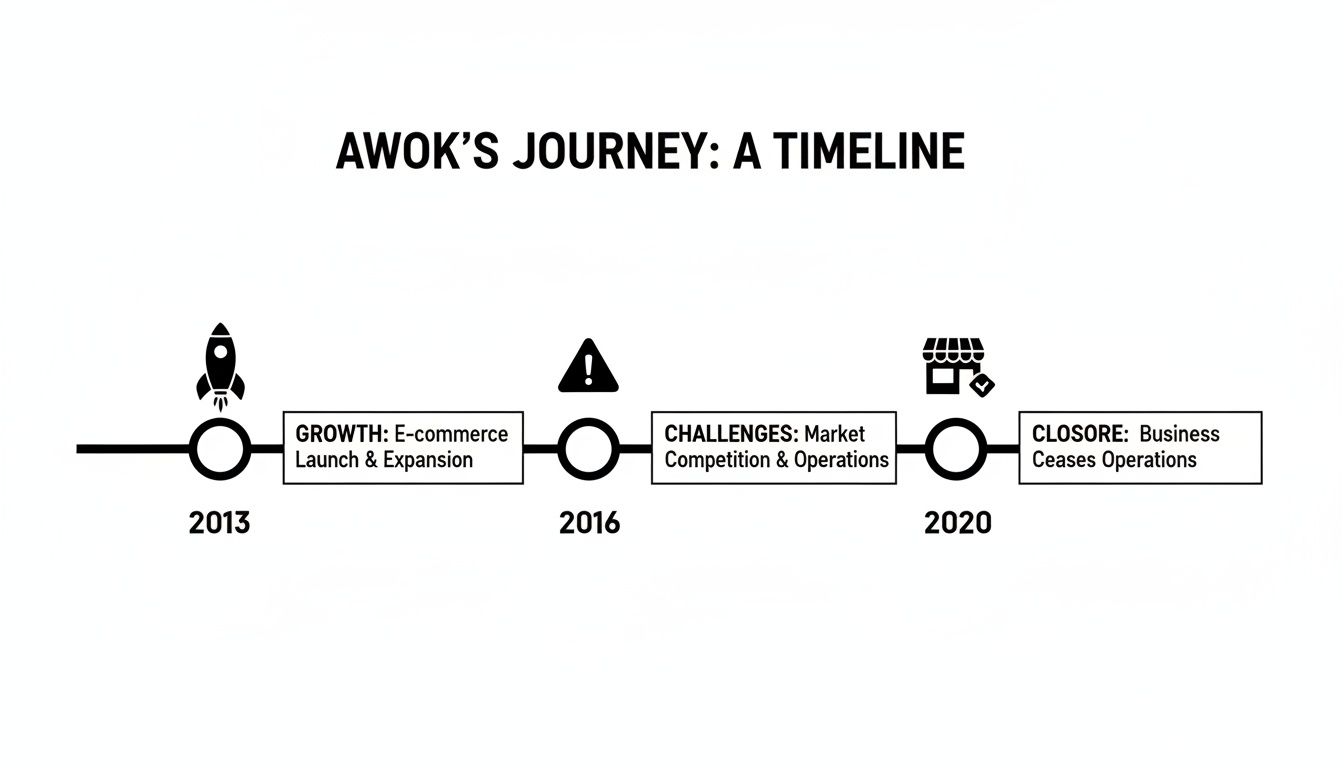
The image perfectly illustrates a classic startup pitfall: when aggressive customer acquisition runs miles ahead of building a solid operational backbone, the whole thing is destined to collapse.
Awok in UAE Timeline at a Glance
This table breaks down the key phases of Awok's story. It captures the rapid ascent and equally rapid descent of a brand that, for a time, seemed to have figured out the secret to budget e-commerce in the region.
PhaseTime PeriodKey Developments & Founder TakeawaysLaunch & Growth2013-2018Launched as a "deal-of-the-day" platform. Gained significant traction by targeting budget-conscious consumers with unbeatable low prices.Peak & Expansion2019Secured a $30 million funding round to fuel expansion into Saudi Arabia. Became a major player, validating its market fit.Operational StrainLate 2019Widespread customer complaints emerged about delivery delays, poor product quality, and non-existent customer service.Closure2020Abruptly ceased operations, leaving customers with unfulfilled orders and pending refunds. The website went offline permanently.
The timeline tells a clear story—one of a business that scaled its promises far faster than its ability to deliver on them, ultimately leading to its demise.
From Market Darling to Cautionary Tale
At its peak, Awok secured a massive $30 million Series A round, a clear signal of strong investor confidence in its high-volume, low-margin business model. The plan was to use that cash to expand across the GCC.
But money couldn't fix the fundamental problems brewing in its operations. Soon, social media was flooded with complaints from angry customers.
The issues were consistent and damaging:
- Crippling Delivery Delays: Orders took weeks, sometimes even months, to arrive, shattering customer trust.
- Poor Product Quality: What showed up at the door often looked nothing like what was advertised online, leading to a flood of returns.
- Unresponsive Customer Service: Getting an update or a refund became a nightmare, cementing a reputation for a terrible experience.
Next Action: Ask your operations lead this question: "If our order volume tripled overnight, where would our system break first?" Identify that single point of failure now and create a plan to mitigate it.
The Awok story is a stark reminder: customer experience is absolutely non-negotiable. To succeed, founders need to know the entire landscape, not just the failures. Learn more about the top e-commerce platforms for online retail startups in the UAE in our detailed guide. In the sections that follow, we'll turn Awok's mistakes into practical, actionable lessons for your own startup.
Why Awok's Low-Price Model Worked (At First)

To understand why Awok failed, we first have to understand why it was so successful. The strategy was brutally effective: offer products at prices that seemed too good to be true. This was an all-out blitz to win over a huge, price-sensitive slice of the UAE market. And for a while, it worked.
Awok's secret weapon was its "deal-of-the-day" model. By constantly featuring heavily discounted electronics, home goods, and accessories, Awok tapped into powerful psychological triggers: the thrill of snagging an unbeatable deal and the fear of missing out (FOMO). This combination created a powerful user acquisition engine, making Awok in UAE the go-to spot for deal hunters.
Tapping into a Key UAE Market Segment
While the UAE is often painted as a luxury-only market, there's a massive and frequently overlooked population of budget-conscious shoppers—blue-collar workers, young professionals, and families. Awok understood this group perfectly and built its entire brand around them.
Actionable Insight: Awok’s initial success is a textbook case study in finding product-market fit. They didn't try to compete with premium retailers. Instead, they found a specific, unmet need for extreme affordability and went all in. Your startup should do the same: identify your specific, underserved niche and own it.
This laser focus is what allowed them to acquire customers at a dizzying pace. While others competed on delivery speed or big-name brands, Awok kept its eye on one thing only: the price tag.
The Double-Edged Sword of Hyper-Growth
That low-price model was a fantastic tool for growth, but it also sowed the seeds of Awok’s eventual collapse. The sheer volume of low-margin orders put immense strain on the business.
Here’s where the cracks started to show:
- Logistical Overload: Managing thousands of daily orders for cheap items requires a world-class supply chain. Awok’s logistics simply couldn't keep up.
- Quality Control Issues: To hit those rock-bottom prices, sourcing was likely compromised, leading to the inconsistent and poor-quality products that later flooded customer reviews.
- Unsustainable Finances: A business model built on razor-thin margins is incredibly fragile. It needs flawless operational efficiency to survive, something Awok never achieved at scale.
In the end, the very strategy that fueled Awok's meteoric rise was precisely what made its downfall so inevitable. Breakneck growth without a solid operational and financial backbone isn't just risky—it's a countdown to disaster.
The Collapse: Where the Model Broke Down
Awok’s downfall wasn't a single event but a cascade of failures—a classic startup story of a great idea undone by poor execution. For founders, this is a critical case study of what happens when your marketing grows exponentially faster than your operations.
The entire business model was a high-wire act, built on processing an immense volume of low-margin orders with near-flawless efficiency. When that efficiency crumbled, the whole structure began to wobble.
The Operational Bottleneck
The most visible sign of trouble was the complete breakdown of its supply chain. Reports from customers painted a grim picture of a logistics network in total chaos.
- Crippling Delivery Delays: Orders weren’t just a bit late; they were lost in the system for weeks or months. This was a systemic failure to manage inventory and coordinate with couriers at the promised scale.
- Wrong and Damaged Items: Sourcing that focused on cost above all else meant customers received incorrect products, damaged goods, or items that barely resembled their online descriptions.
- A Non-Existent Customer Service Loop: As problems piled up, the customer service department effectively vanished. Phones went unanswered and emails were ignored, leaving thousands of customers stranded.
Actionable Insight: Your logistics and customer service are not cost centres. They are the core of your customer experience. Under-investing here is a fatal error, especially in a UAE market that expects reliability.
The Financial Strain of Unsustainable Growth
Behind the operational chaos was a financial model burning through cash at an alarming rate. Chasing "growth at all costs" without a clear path to profitability is a dangerous game, particularly with razor-thin margins.
At the heart of Awok's failure, you'll find unsustainable unit economics—a critical lesson for all e-commerce founders. Every sale, burdened by high customer acquisition costs, complex logistics, and frequent returns, was probably costing the company money. Even with $30 million in funding, this model was a ticking clock.
Founders must avoid this trap by focusing on profitable growth. Dig deeper into this by exploring lessons from other ventures and understanding the journey from startup failure to pivot and resilience. Awok's story is proof that a massive customer base means nothing if you lose money on every order you fulfil.
3 Critical Lessons for MENA E-Commerce Founders

The story of awok in UAE isn’t just a post-mortem; it's a playbook filled with hard-earned lessons. Here are three actionable takeaways to help you build a resilient e-commerce company in the fierce MENA market.
A solid grasp of how to start an e-commerce business the right way is non-negotiable. These lessons hammer home the crucial difference between a flashy idea and a truly viable business.
1. Master Unit Economics Before Scaling
If there's one massive lesson, it's this: chasing growth at any cost is a death sentence. A huge customer base means nothing if you're losing money on every sale.
Framework: The LTV > CAC Rule
Before you scale, have crystal-clear answers to these questions:
- What’s my true Customer Acquisition Cost (CAC)? Include ad spend, sales commissions, and related overheads.
- What is the Lifetime Value (LTV) of that customer? How much profit can you genuinely expect to make from them over time?
- Is my LTV significantly higher than my CAC (ideally 3x or more)? If the answer is no, your business model is broken. Scaling will only make you fail faster.
The "grow now, profit later" mentality is a gamble few startups can afford, especially in low-margin sectors. Awok is proof that no amount of VC funding can fix a business that's fundamentally unprofitable per transaction.
2. Scale Your Operations with Your Marketing
Awok’s marketing machine was incredible. The problem? Its operational backbone was nowhere near ready. The result was a disaster: endless delays, wrong items shipped, and a customer service meltdown that torched its reputation.
Next Action: Run a stress test. Ask your team: "What happens if we get 5x our daily order volume next Monday? Walk me through the entire process from click to delivery." This exercise will immediately reveal your weakest links. Your supply chain and customer support are just as important as your marketing funnel.
3. Protect Your Reputation Above All Else
What truly sank Awok was the total collapse of customer trust. Once social media was flooded with complaints, the brand became toxic. No discount could fix a reputation for being unreliable.
In a competitive market like Dubai's, with over 3,500 active startups valued at over $28 billion as of 2026, a bad reputation will get you left in the dust. This ecosystem, bolstered by hubs like In5 which has helped ventures raise over AED 7.70 billion, has no patience for poor execution. A great breakdown of this environment can be found on Dubai's startup landscape on ifzaregistration.com.
Building a Better E-Commerce Business in the UAE Today
After dissecting the collapse of awok in UAE, the path forward for new founders is clearer. It's not about finding an alternative; it's about understanding the e-commerce models that are actually winning in the region today.
The UAE's e-commerce scene isn't one big market. It's a dynamic arena filled with different players. Understanding them reveals where the real opportunities are.
The Marketplace Giants
First, you have the titans: Amazon.ae and Noon. Their power comes from sheer scale, slick logistics, and the enormous brand trust they’ve built. They have mastered fast, reliable delivery, setting a high bar for customer expectations.
Actionable Insight: Don't compete head-on with giants on price or a massive, generalized catalogue. The real game is in hyper-specialisation or creating a curated, expert-led experience they can't replicate at scale.
Niche Specialists and Q-Commerce Innovators
This is where things get interesting. Niche specialists prove that focus wins. Platforms like Cartlow (refurbished electronics) or Mumzworld (mother and baby products) have carved out loyal followings by serving a specific audience with deep expertise.
Simultaneously, Q-Commerce (Quick Commerce) players like Talabat Mart have changed the game on convenience. Their model isn't about being the cheapest; it’s about getting essentials to your door in under 30 minutes. This shows that UAE consumers will pay a premium for speed. For a deeper dive, check our guide on pricing strategies for the UAE market.
This ecosystem is buzzing with investor confidence. In Q1 2026 alone, UAE tech startups pulled in a staggering AED 3.20 billion, an 865% surge year-over-year. With Dubai-based startups claiming 96% of that total, the capital is there for solid, scalable businesses. You can find more insights on this from sources like Seed Group on Dubai's business landscape.
UAE E-Commerce Platform Comparison for Founders
This table breaks down the core models of major players and what founders can learn from each.
PlatformPrimary ModelKey Consumer ValueStrategic Insight for FoundersAmazon.aeHorizontal MarketplaceUnmatched selection, speed, and trust. The "everything store" with Prime benefits.Compete on curation, not catalogue size. Leverage FBA for logistics if it fits your margin structure.NoonRegional MarketplaceRegion-specific focus, strong local partnerships, and aggressive pricing.Understand the local consumer better. Noon's success shows the value of hyper-local marketing and partnerships.MumzworldVertical Niche MarketplaceDeep expertise and a curated catalogue for mothers and children. Community-driven.Own a niche. Become the go-to authority for a specific demographic to build a loyal, high-value customer base.Talabat MartQuick Commerce (Q-Commerce)Ultimate convenience. Speed over selection, delivering essentials in minutes.Speed can be your product. If you can't be the cheapest, can you be the fastest or most convenient?
The market isn't just about selling things online; it's about solving a specific problem for a specific customer better than anyone else.
Common Questions About Awok in UAE

Here are clear, straightforward answers to the most common questions about the Awok in UAE saga.
Is Awok Still Operating in the UAE?
No, Awok.com is completely defunct. The company shut down all operations in 2020, and its website has been offline ever since. The brand now exists only as a cautionary tale for the region's e-commerce founders.
What Happened to Unfulfilled Orders and Refunds?
When Awok went under, thousands of customers were left with pending orders that never arrived and refund requests that were never fulfilled. Once the company closed, all official channels for resolution vanished, leaving customers with few, if any, options for recourse.
Founder Takeaway: The chaos that followed Awok’s collapse drives home a crucial lesson. When you fail to manage customer refunds and order fulfilment, you don’t just create unhappy customers—you incinerate your brand’s trust and leave behind a negative legacy.
Can I Still Contact Awok Customer Service?
No. All official customer service channels for Awok were shut down when the company ceased operations. There is no formal entity left to contact about past issues with Awok in UAE.
The situation is a stark reminder for consumers to use secure payment methods that offer buyer protection, like credit cards, which often provide a way to dispute charges for undelivered goods.
Building a startup is tough, but you don't have to do it alone. Founder Connects is a private community for UAE and MENA founders who want meaningful support, peer accountability, and real progress. Join a trusted network built to help you make smarter decisions and grow your business. Learn more and apply to join.

Building in MENA? You don't have to do it alone.
Join 300+ founders in the Founder Connects Residency. Monthly squad calls, warm intros, $3M+ in perks, and much more. All for less than your monthly coffee budget.
Popular posts





Founder Connects is a premium MENA tech founder community. Meetups in Dubai and across MENA, Residency Squads of 8–10, and 400+ vetted WhatsApp founders (apply and screened).