

Bayut Properties Dubai: A Founder's Guide to Renting

Building in MENA? You don't have to do it alone.
Join 300+ founders in the Founder Connects Residency. Monthly squad calls, warm intros, $3M+ in perks, and much more. All for less than your monthly coffee budget.

You land in Dubai with a company to build, meetings to take, and a housing problem that immediately starts stealing time. Every generic relocation guide tells you to browse listings, shortlist communities, and book viewings. That advice is too soft for a founder.
The better approach is to treat bayut properties dubai as an operating tool. You're not just finding somewhere to sleep. You're choosing commute friction, cash flow pressure, networking access, work-from-home reliability, and in some cases an asset that supports a longer-term UAE plan.
Most founders waste time in one of two ways. They either over-optimise for image and pick a neighbourhood that looks right on Instagram but breaks their routine, or they chase “cheap” and end up with a daily operational tax in the form of long drives, weak building management, or a flat that's painful to work from. Bayut can help you avoid both, but only if you use it with a tighter process than the average renter.
Your Next Move A Strategic Decision Not Just a Search
Dubai's founder scene is growing fast, and that changes how you should think about housing. 15,234 new SMEs were registered in Dubai between May 2025 and April 2026, while 62% cited housing and logistics as top barriers, and 70% of solo founders reported feeling isolated according to the Bayut buying FAQs reference to recent Dubai data. That's not just market colour. It means your location choice directly affects execution and resilience.
A flat can either remove friction or multiply it. The wrong one gives you a poor commute to DIFC, DTEC, or your free zone office, unreliable space for calls, awkward guest access, and a social setup that makes solo building harder. The right one does the opposite. It shortens the gap between home, work, and useful people.
What founders need that generic renters don't
Most rental advice assumes you have predictable employment paperwork, fixed office hours, and no reason to care about nearby founder density. Founders often have the opposite.
You may need:
- Lease flexibility: because startup plans change faster than annual contracts.
- Workable layouts: space for calls, a monitor, and long stretches of focused work.
- Location logic: close enough to business districts without paying for prestige you don't use.
- Documentation realism: some landlords and agents still think in salary-certificate terms.
- Strategic upside: if buying later becomes relevant, Golden Visa pathways may matter more than generic lifestyle perks.
Practical rule: Don't start with “Which area is nicest?” Start with “What setup gives me the fewest weekly points of friction?”
The founder filter
Before you open Bayut, define these essential requirements on one page:
Primary work zone Where do you need to be most often. DIFC, DTEC, Business Bay, a free zone, or mostly home.
Operating style
Are you mostly in meetings, mostly deep work, or constantly moving between both.Cash flow preference
Is lower monthly burn the priority, or are you willing to pay more to buy back time.Personal constraint
Family, pet, co-founder visits, investor dinners, or need for community.
That short list will save more time than hours of scrolling.
Mastering Bayut Search for High-Signal Results
Most Bayut users search too wide, save too many listings, and then wonder why every call feels unproductive. The fix is simple. Reduce noise at the start.

Build a founder-grade search stack
Use Bayut like you'd use a sales pipeline. Narrow inputs. Tighten criteria. Review only what deserves attention.
Start with these filters and habits:
- Verified first: Prioritise listings that have stronger signs of authenticity. It won't remove every weak listing, but it improves the quality of what reaches you.
- Recent authentication signals: If Bayut shows checks such as recent validation or authentication markers, use them to favour fresher inventory.
- Hyper-local search: Don't begin with a giant district unless you're still mapping options. Once you know your target, search building by building or at least by micro-community.
- Saved alerts: Set alerts for specific communities you can imagine signing in this week, not a broad list you'll never review properly.
- Keyword scans: Search practical terms that affect cash flow and comfort, such as chiller free, flexible cheques, furnished, unfurnished, balcony, study, and close to metro.
Search for operational fit, not just price
Founders often focus too early on rent and ignore hidden operational drag. Better search terms are the ones that expose whether a listing matches your working life.
For example:
- “Chiller free” matters if you want cleaner recurring costs.
- “Flexible cheques” matters if preserving cash matters more than headline rent.
- “Study” or “maids room” can signal usable workspace, even if you don't care about the original room label.
- “Close to metro” can be more useful than parking if your week includes repeated central meetings.
If you work with property visuals or need to interpret how listings are presented, the Roomstage AI real estate guide is useful for understanding how property marketing frames spaces and where presentation can influence perception.
Bayut works best when you decide first, then search. It works badly when you search first and try to decide from the feed.
My preferred daily workflow
Keep this tight. It shouldn't take over your day.
- Morning pass: Review only new alerts in your top target areas.
- Fast reject: Skip listings with weak descriptions, unclear layouts, or obviously mismatched location logic.
- Call shortlist only: Contact a small number of agents with specific questions, not open-ended interest.
- Viewing batch: Cluster viewings by area so one afternoon covers one neighbourhood properly.
If you're also comparing marketplaces, this breakdown of Dubizzle classifieds in Dubai helps clarify where Bayut tends to fit in a broader search process.
Choosing Your Neighbourhood A Founder's Matrix
A founder's choice of neighbourhood is an operating decision. It shapes commute time, meeting density, hiring convenience, visa planning, and how much cash gets tied up in rent and deposits.
Bayut helps you compare inventory fast, but the right area depends on how your company runs. A solo operator building a business needs a different setup from a founder spending three days a week in DIFC, Dubai Internet City, or investor meetings across Downtown and Business Bay. If a Golden Visa, remote work status, or a longer UAE base is part of the plan, read Inpro's guide to UAE visas before you lock yourself into a short lease that solves this quarter and creates friction next year.
Founder-Friendly Neighbourhood Comparison
| Neighbourhood | Founder Archetype | Avg. 1-Bed Rent (AED/yr) | Commute to DIFC | Vibe |
|---|---|---|---|---|
| JVC | Bootstrapped operator | Qualitatively mid-tier | Moderate | Practical, residential, value-led |
| Business Bay | Scaling founder | Qualitatively higher | Short | Central, fast-paced, meeting-heavy |
| Dubai Hills | Family founder | Qualitatively premium | Moderate | Organised, calmer, family-oriented |
| International City | Yield-focused buyer or ultra-lean renter | Qualitatively affordable | Longer | Budget-first, functional |
| Al Furjan | Balanced builder | Qualitatively mid-tier | Moderate to longer | Residential, improving convenience |
JVC, Al Furjan, and the practical middle
JVC works well for founders who want to keep burn under control without ending up in an area that drains time. There is enough apartment stock to stay selective, enough everyday convenience to live without fuss, and enough pricing spread to find a unit with a usable second room or work corner.
Al Furjan belongs in the same conversation. It usually suits founders who can tolerate a longer trip to central business districts in exchange for a more residential setup and better space for the money. If your schedule is mostly calls, team sessions, and two in-person meetings a week, that trade-off can work.
Both areas reward disciplined searching. The difference between a good building and an annoying one is large. Building management, parking flow, gym quality, road access, and service charge culture all affect day-to-day life. This overview of owners association management companies in Dubai is useful if you plan to buy later or want to understand how building operations influence resident experience.
Business Bay and DIFC access
Business Bay is the default shortlist for founders in active selling, fundraising, or partnership mode. The logic is simple. Shorter trips to DIFC, Downtown, and central meeting points save hours every week. That matters when your calendar is dense and your day gets reshuffled constantly.
The trade-off is cost, noise, and inconsistency between towers. Some units look strong in photos and feel cramped, dark, or traffic-exposed in person. Paying for location can be rational. Paying premium rent for a tower that makes focused work difficult is usually a bad deal.
Dubai Hills for stability
Dubai Hills tends to suit founders who want a cleaner split between work pressure and home life. That often includes married founders, founders with children, or anyone planning to stay in Dubai long enough that school runs, green space, and weekend routine start to matter as much as proximity to meetings.
It can also fit a founder who wants a base that feels settled while the company remains volatile. That psychological separation matters more than people admit.
Budget-first areas, with clear eyes
International City can work if cash preservation outranks everything else and central access is a secondary concern. It also appears often in buy-versus-rent thinking because lower entry pricing changes the math for some founders who are already committed to staying in the UAE.
The catch is operational drag. A cheaper apartment loses its appeal if the commute eats your morning, limits who will visit you, or turns every in-person meeting into a logistics exercise.
A simple filter helps. Choose the neighbourhood that reduces the most expensive constraint in your week. For some founders, that is rent. For others, it is time to DIFC, access to tech corridors, room for a home office, or a lease structure that leaves enough flexibility for the next company stage.
Vetting Listings and Agents Like A Due Diligence Pro
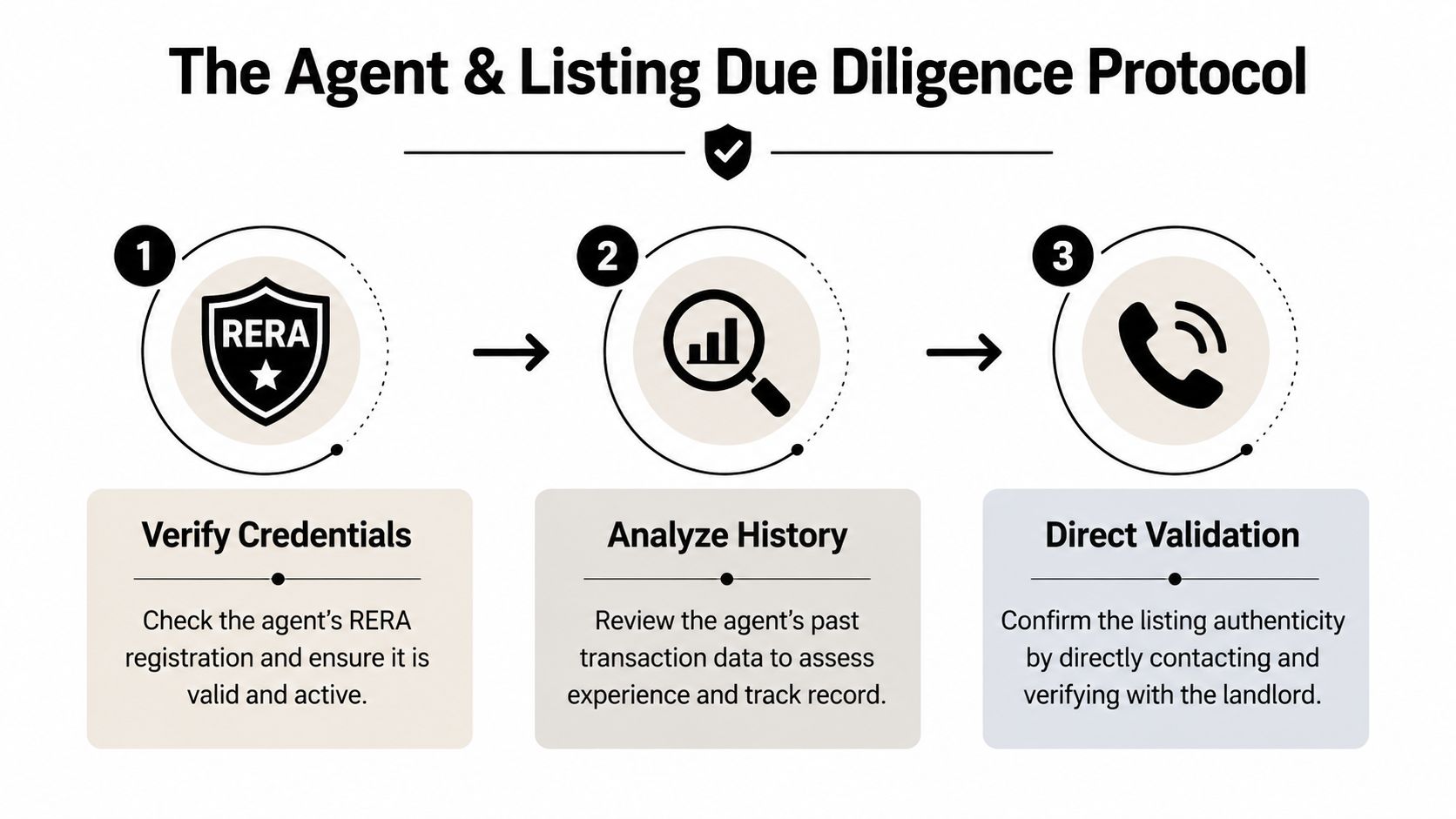
The fastest way to lose time in Dubai property is to trust the listing at face value. Treat each listing the way you'd treat a vendor pitch. Assume the photos are selective, the copy is polished, and the asking position is designed to anchor you.
Read the listing like a founder
The words matter, but the gaps matter more.
Look for signs such as:
- Photos that avoid windows or views: this can hide road noise, poor outlook, or another building directly opposite.
- No clear floor plan or room flow: often a sign the unit's layout is harder to sell than the description suggests.
- Overuse of lifestyle language: “luxury”, “exclusive”, and “stunning” tell you less than details about condition, furnishing quality, and building management.
- Mismatched visual cues: if the kitchen, bathrooms, and flooring look from different eras, ask whether the unit has been partially updated rather than properly maintained.
If you want to sharpen your eye for how agents use visuals, the complete guide to property photos is useful because it shows how framing, angles, and editing can influence what you think you're seeing.
Verify the agent before you trust the pitch
A good agent saves time. A weak one multiplies it. Ask for the broker's full name, agency, and Broker Number early, then verify through the appropriate official channels before you invest energy in repeated calls or negotiations.
Use this mini-screen:
Ask direct questions
Is the listing currently available. Is the landlord ready to sign. Is the exact unit in the photos the one you'll view.Check consistency
If the same agent gives different answers over two calls, don't rationalise it.Force specificity
Ask about building age, maintenance status, current occupancy, and any restrictions that matter to your lifestyle.
For practical context on building operations and what affects day-to-day living after move-in, this piece on owners association management companies in Dubai is worth reviewing.
Run your own CMA before discussing price
Bayut transforms into more than a listing portal. Bayut's Dubai Transactions tool gives you a way to pressure-test asking prices using actual transaction context.
According to Bayut's guide on using Dubai Transactions, an effective comparative market analysis should focus on a single building and the last 6 months of data, while trimming outliers sold 15% to 20% outside the median price per square foot. The same guide notes Downtown Dubai averaged AED 2,637 per sq ft in the luxury segment in its example methodology, as explained in Bayut's Dubai Transactions analysis guide.
That matters because broad district averages can mislead you. Building-level data is what gives you negotiating credibility.
Due diligence test: If an asking price only makes sense when the agent compares it to a whole district rather than the building itself, push harder.
A practical CMA workflow
- Pull recent transactions for the same building or the closest true comparable.
- Match property type and size as closely as possible.
- Ignore obvious one-off sales that sit far outside the median range.
- Ask the agent to justify any premium in plain language. Renovation, floor, view, furnishing, or urgent landlord expectations.
If they can't justify the spread cleanly, you've learned something important.
The High-Efficiency Property Viewing Checklist
Most wasted viewings happen because founders inspect flats like tourists. You're not there to admire a lobby. You're there to check whether the place supports output.

What to test inside the unit
Don't walk through passively. Open things. Stand in corners. Check signal. Listen.
Use this checklist:
- Mobile signal: test it in every room, especially where you'd take calls.
- Natural working light: check where your desk would realistically go.
- Noise exposure: pause speaking and listen for roads, lifts, construction, and hallway traffic.
- Power point placement: useful if you need a monitor, charger, and lighting without extension-cord chaos.
- Kitchen practicality: not because you need a chef's kitchen, but because daily convenience affects routine.
- Water pressure and air conditioning: basic, but they matter more than decorative finishes after week one.
What to inspect in the building
A building can ruin a good flat. Spend time in the common areas and ask questions that expose operational quality.
Check:
- Lift waiting time during busy periods
- Reception responsiveness
- Parcel and food delivery flow
- Parking logic for guests or co-founders
- Gym or shared space usability if you'll rely on it
- General maintenance standard in corridors and service areas
If the corridor outside the unit feels neglected, assume small issues inside the building may also move slowly.
Here's a useful visual walkthrough before you start your own viewing rounds:
If you're viewing with investment in mind
Some founders arrive intending to rent first, then quickly start evaluating purchase options. If that's you, challenge broad return claims in person. The off-plan pitch can sound compelling, but transaction-backed yield assumptions are more reliable.
A useful benchmark from a Dubai property investment analysis using Bayut API data is that International City offers around 8.10% gross rental yield, while Dubai Residence Complex is closer to 7.90%, as noted in the Bayut API investment analysis reference. Use figures like those to pressure-test claims during viewings instead of accepting sales language at face value.
Negotiating and Securing Your Lease in Dubai
Founders often negotiate hard on product deals and then become oddly passive at lease stage. Don't. Your rental contract shapes cash flow and flexibility for months ahead.
Negotiate for operating flexibility
The first thing worth pushing on is structure, not just headline price. A landlord may hold firm on annual rent but move on terms that matter just as much.
Prioritise:
- Number of cheques: this directly affects cash flow.
- Break clause language: especially if your company setup or family situation may change.
- Minor fixes before move-in: get them agreed before signing, not as a verbal promise after.
- Included items: appliances, maintenance commitments, access cards, parking, and furniture details.
A startup-friendly lease is one that still works if your next two quarters don't unfold exactly as planned.
Prepare documents before you negotiate
You'll usually move faster if your paperwork is ready before the final round of discussion. Depending on whether you're renting personally or through a company, the exact stack can vary, but have the obvious items organised and easy to share.
That usually includes:
- Passport copy
- Visa copy
- Emirates ID
- Trade licence if leasing through the business
- Any supporting identification the agent or landlord reasonably requests
If someone else may need to sign or act for you, sort authority early. This guide on power of attorney in Dubai cost and process is useful if your move or signing logistics are more complex than a standard lease.
Don't leave key terms vague
Verbal reassurance is not a contract term. If a landlord agrees to repaint, replace something, or allow a certain flexibility, get it written into the lease or into a clear attached record before payment and signing.
Use direct questions:
- What exactly is included with the unit.
- Who handles each maintenance category.
- What happens if either side needs early adjustment.
- When is Ejari being completed, and who is handling the process.
Good negotiation in Dubai property isn't about theatrics. It's about removing ambiguity before money moves.
Ejari also matters. Make sure it's handled properly because it underpins the legal recognition of the tenancy and connects to practical tasks after move-in.
From Search to Settled Your Next Action
You land in Dubai on a Sunday, want to be close to DIFC or Dubai Internet City by the next workweek, and do not have time to waste on vague listings, slow agents, or a lease that creates problems for your visa or company setup. Bayut works best when you use it with that level of clarity.
Founders who get settled quickly treat the platform like an operating tool. They set a tight brief, screen for location and lease fit, and ignore everything that does not support how they live and build. That matters if you care about commute time to tech hubs, a building profile that fits Golden Visa planning, or lease terms that work for a founder whose business may scale or change shape within a year.
Focus is typically the true expense.
Set up your next move in one focused session. Pick two neighbourhoods that match your work pattern. Write down five filters you will enforce, such as max commute, furnished or unfurnished, chiller inclusion, landlord flexibility on cheques, and whether the unit works for personal leasing or a company-backed contract. Then create two Bayut alerts narrow enough that you would call the agent the same day if the right listing appears.
A good setup should reduce options, not expand them. If a listing sits outside your founder criteria, skip it. Saving two hours on dead-end viewings is often worth more than squeezing a small discount out of the wrong flat.
If you're building in the UAE and want a stronger support system around decisions like this, Founder Connects is worth a look. Founder Connects is designed around curated peer groups, practical conversations, and high-signal introductions that help you make better calls faster, without figuring everything out alone.

Building in MENA? You don't have to do it alone.
Join 300+ founders in the Founder Connects Residency. Monthly squad calls, warm intros, $3M+ in perks, and much more. All for less than your monthly coffee budget.
Popular posts





Founder Connects is a premium MENA tech founder community. Meetups in Dubai and across MENA, Residency Squads of 8–10, and 400+ vetted WhatsApp founders (apply and screened).