

Top Budget Allocation Strategies for 2025

Building in MENA? You don't have to do it alone.
Join 300+ founders in the Founder Connects Residency. Monthly squad calls, warm intros, $3M+ in perks, and much more. All for less than your monthly coffee budget.

For UAE startups in 2025, smart budgeting is more important than ever. With new corporate tax rules, a drop in seed funding, and a surge in late-stage investments, founders must prioritise financial discipline. Here’s what you need to know:
- Regulatory Costs: Startups must register for corporate tax (9% on income above AED 375,000) and VAT (mandatory for revenue above AED 375,000). Small businesses earning under AED 3 million benefit from a 0% tax rate until 2026.
- Funding Trends: Q1 2025 saw AED 3.2 billion raised by tech startups, but 96% of this went to Dubai-based firms, with late-stage funding dominating.
- High-Growth Sectors: Enterprise Applications and FinTech are booming, attracting AED 2.53 billion and AED 791.5 million respectively.
- Cost Management: Lean hiring, outsourcing, and AI-driven spend tools can cut costs. Free zone packages (starting at AED 5,500/year) offer affordable licensing options.
- Cash Reserves: Maintain six months of liquidity and a 20% buffer for unexpected expenses or opportunities.
- Tech Investments: Focus on scalable infrastructure, cybersecurity, and automation to support growth.
With limited seed-stage funding and investor focus on execution, startups need clear financial planning, compliance readiness, and targeted spending to thrive in 2025.
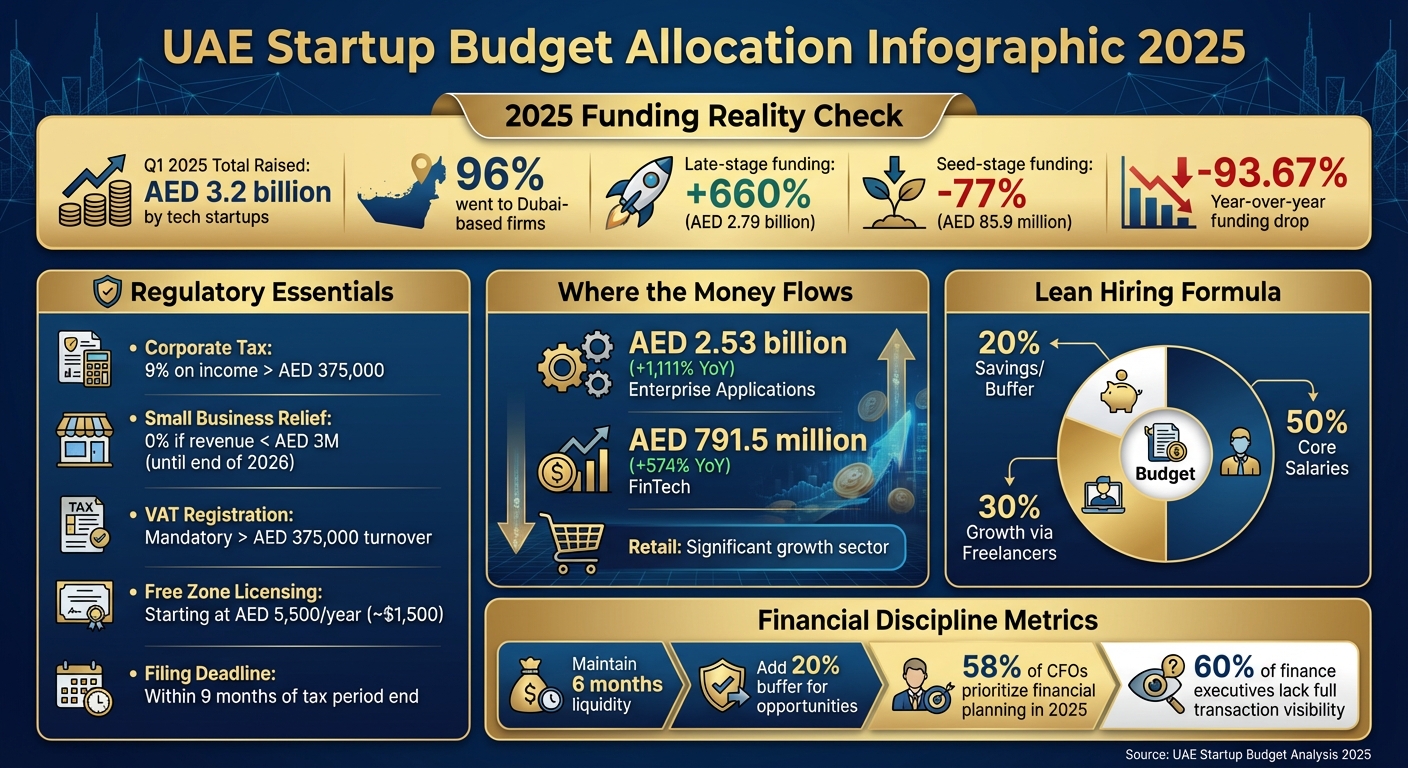
UAE Startup Budget Allocation Guide 2025: Key Costs and Funding Trends
How to Plan Your Startup's Budget as a Tech Founder
1. Set Aside Regulatory and Compliance Costs First
When planning your budget, the first priority should be regulatory and compliance costs. For startups in the UAE, including those operating in Free Zones, registering for Corporate Tax is mandatory. Every business must obtain a Corporate Tax registration number [6]. The standard tax rate is 9% on taxable income exceeding AED 375,000. However, startups with annual revenue below AED 3 million can take advantage of the 0% Small Business Relief programme, available through the end of 2026 [1]. Keep in mind, even if your business qualifies for this relief, you must still register - and missing deadlines can result in penalties that cut into your working capital. Securing funds for these obligations is a critical first step in creating a disciplined budget for 2025.
After registering for Corporate Tax, VAT compliance comes next. VAT registration is mandatory for businesses with an annual turnover exceeding AED 375,000, while those below this threshold are exempt [1]. Corporate Tax returns and payments must be submitted within nine months after the end of your tax period [6]. This timeline provides a liquidity buffer, but it’s essential to stay organised. With 58% of CFOs now prioritising financial planning and analysis to handle shifting regulatory demands [7], compliance has evolved into a strategic priority rather than just a back-office task.
Licensing fees are another recurring cost to account for, and these vary depending on your location. Startup-friendly hubs like Dubai Silicon Oasis, ADGM, and RAKEZ offer packages starting at approximately $1,500 per year [1]. Don’t forget to include ongoing expenses such as accounting software, VAT filings, and advisory fees to ensure you remain audit-ready. In 2025, investors are placing a high value on financial discipline. Failing to maintain proper documentation could jeopardise your chances during funding rounds.
| Expense Category | Threshold/Rate | Key Requirement |
|---|---|---|
| Corporate Tax (Standard) | 9% on income > AED 375,000 | Mandatory registration for all [6] |
| Small Business Relief | 0% if revenue < AED 3M | Available until the end of 2026 [1] |
| VAT Registration | Mandatory > AED 375,000 | Periodic filings as per FTA [1] |
| Licensing Fees | Starts ~$1,500/year | Annual renewal (Free Zones) [1] |
| CT Filing Deadline | N/A | Within 9 months of tax period end [6] |
It’s also wise to set aside an emergency cash reserve to cover unexpected regulatory changes or tax law adjustments [7]. To streamline compliance, consider using AI-driven spend management platforms. These tools can help reduce manual errors, lower advisory costs, and free up resources for growth [7]. By laying this compliance groundwork, you minimise financial disruptions and set the stage for allocating the rest of your budget effectively.
2. Focus Budget on Revenue-Generating Activities
After covering compliance costs, the next step is to channel resources into activities that directly contribute to revenue growth. In the UAE, investors are now more inclined to support businesses that demonstrate clear market traction, product-market fit, and disciplined financial management [5]. This shift means every dirham spent must deliver measurable results.
For startups, identifying high-return spending areas is essential. Sectors like Enterprise Applications, FinTech, and Retail have shown impressive growth in the UAE, making them prime opportunities for investment. For example, Enterprise Applications attracted AED 2.53 billion (around $688.1 million) in Q1 2025, reflecting a staggering 1,111% increase compared to the previous year [3]. FinTech followed with AED 791.5 million ($215.6 million), up 574% year-over-year [3]. If your startup operates in these industries, it’s wise to prioritise spending on customer acquisition, product development, and proven sales strategies.
To determine which expenses yield the highest returns, conduct a simple cost-benefit analysis. For instance, if spending AED 50,000 generates AED 200,000 in new sales, that’s a 300% ROI. Keep an eye on metrics like Customer Acquisition Cost (CAC) and Lifetime Value (LTV) to ensure your marketing efforts are sustainable. If CAC rises faster than LTV, it’s time to refine your approach - whether that’s improving your conversion funnel or reallocating funds to more efficient channels. Leveraging AI-powered tools can also enhance personalisation and operational efficiency, especially as 89% of UAE consumers now rely on digital-first banking solutions [12].
A performance-driven approach is key. Link every expense to a measurable outcome, such as acquiring new customers, boosting product adoption, or increasing repeat purchases [10]. Adopting performance-based budgeting with SMART goals - Specific, Measurable, Achievable, Relevant, and Time-bound - can help you stay focused. For example, aim to "increase monthly sales by 40% within 12 months" [7]. Regularly track your budget variance and spending forecasts to catch inefficiencies early. With 60% of finance executives admitting they lack full visibility into their transactions [8], using digital spend management tools can uncover hidden costs like unused subscriptions or unapproved expenses. Redirecting these funds toward impactful revenue-generating activities ensures your budget works harder for your business.
3. Build a Lean Talent and Outsourcing Model
Hiring decisions can make or break your budget. In the UAE, where startup funding saw a staggering 93.67% drop year-on-year by early 2025 [5], investors are increasingly drawn to businesses that demonstrate financial discipline. This means every hire must serve a clear purpose and align directly with your core business priorities. As a result, outsourcing non-core functions has become a smart way to optimise costs.
A practical allocation approach is to divide your revenue into 50% for core salaries, 30% for growth via freelancers, and 20% for savings [14]. Reserve full-time roles for critical areas like product development, customer success, or leadership - positions that require a deep connection to your company’s vision. For specialised, short-term projects such as financial modelling, creative campaigns, or tech sprints, freelancers provide the flexibility you need without long-term commitments. The UAE's freelance visa system makes it easy to tap into talent from international professionals in sectors like tech, education, and creative industries [15].
Outsourcing is an effective way to manage non-core functions. Tasks like bookkeeping, VAT compliance, and tax filings can be handled by external providers, allowing you to keep your financial records investor-ready without the overhead costs of hiring a full-time finance team. For critical periods, such as funding rounds, you can bring in fractional CFOs who offer expert guidance at a fraction of the cost [5]. By combining flexible, project-based talent with essential fixed roles, startups can preserve capital for high-impact initiatives. In fact, startups adopting Zero-Based Budgeting - where every hire is justified - have reported cost savings of up to 30% [14].
Free zones like Dubai Silicon Oasis (Dtec) and RAKEZ provide affordable startup packages starting at just AED 5,500 (US$1,500) per year. These packages often include co-working spaces and visa options, helping you build a lean team without the burden of expensive office leases [1]. To decide when to hire full-time or bring in temporary support, use a 13-week rolling forecast. If a role is essential for long-term operations, it belongs in your fixed cost category. For project-based needs, outsourcing is the way to go [14]. This approach keeps your salary commitments sustainable while freeing up resources for strategic growth opportunities.
4. Plan Your Budget Around Tax and Compliance Rules
Once you've laid the groundwork for compliance, effective tax planning becomes a critical part of managing your finances. For instance, the AED 3 million Small Business Relief cap provides some breathing room for budgeting. By understanding such thresholds, you can adjust your tax provisions throughout the year, keeping cash flow steady and avoiding unexpected financial hiccups [1][16].
Make sure to file your Corporate Tax returns within nine months of your financial year-end and submit VAT returns within 28 days after the tax period ends [17][18]. With these deadlines in mind, structure your budget to take advantage of strategic deductions and timing adjustments. For example, consider making significant purchases or issuing employee bonuses before the year ends to maximise deductible expenses [17].
It's also a smart move to consult UAE-based tax advisors early on. The Ministry of Finance strongly advises businesses to rely solely on official publications from the MoF and the Federal Tax Authority to avoid misinterpretations [6]. Advisors can help you model scenarios for Free Zone structures or Small Business Relief claims, enabling you to decide whether to defer income or accelerate deductions based on your business's growth plans [17]. If you're a freelancer or sole proprietor earning over AED 1 million annually, remember that you must register for Corporate Tax by 31 March 2025 to sidestep a penalty of AED 10,000 [18].
Invest in compliance tools that automate tasks like VAT receipt tracking and creating audit-ready reports. These tools can significantly reduce manual errors and ensure you're always prepared for filings [7]. Additionally, it's wise to maintain a tax buffer by setting aside funds in a separate account. Budget quarterly to cover your projected tax liabilities, ensuring smooth operations without financial strain [17]. With the UAE moving towards stricter tax enforcement, proactive planning can set your business apart, making it more attractive to investors and better positioned for growth [5][18].
5. Maintain a Cash Reserve and Runway Buffer
Having a solid cash reserve is essential for navigating uncertain times. With seed-stage funding in the UAE plummeting by 77% in Q1 2025 to just $23.4 million [3], relying on external capital may not always be an option. To stay prepared, aim to keep at least six months’ worth of liquidity on hand. This cushion can help you manage delays in client payments, unexpected regulatory expenses, or prolonged investor decision-making timelines. It’s the safety net every startup needs to stay afloat during challenging periods.
On top of this, consider adding a 20% buffer to your budget for unforeseen opportunities. Alaa Mohra, Founder of Alaa Mohra Properties, highlights how this extra reserve allows startups to "capitalize on opportunities or manage CAC variations" [20]. Whether it’s seizing a unique marketing opportunity or addressing sudden changes in customer acquisition costs, this proactive step can make all the difference. With 58% of CFOs in 2025 increasing their focus on financial planning to avoid cash flow surprises [7], this level of foresight separates well-prepared startups from those struggling to react.
For accurate runway planning, use a 13-week rolling cash flow model. Here’s how it works: track actuals weekly for the first week, daily for the next 2–4 weeks, and weekly again for the remaining 9–11 weeks. Apply the 80/20 rule to prioritise key contract values [19]. This approach keeps you laser-focused on the most impactful financial elements.
"Managing cash flow is an ongoing mindset and not a tool to adopt purely in critical business moments." - Dubai Future District Fund [19]
To further refine your financial strategy, stress-test your runway by simulating downside scenarios for the next 3–6 months. Establish clear mitigation triggers to address potential issues before they escalate. Centralising payment authorisation - whether with a single individual or a fractional CFO - can help you maintain tight control over spending and reduce your burn rate [19]. With investors increasingly prioritising capital efficiency and sustainable economics over aggressive growth [5], maintaining a disciplined cash reserve not only ensures stability but also makes your startup more appealing during funding discussions.
6. Budget for Technology, Infrastructure, and Security
Once you've secured funds for compliance and revenue-focused initiatives, it's time to allocate resources toward technology, infrastructure, and security. These are the backbone of scalable operations. For early-stage startups, free zone incubator packages can be a cost-effective way to get started. As your company grows, you’ll likely need to invest more in advanced technology stacks, automation tools, and robust security systems to support your expansion.
For tech startups in the UAE, staying focused is essential. By examining the funding trends discussed earlier, you’ll have a clear idea of which sectors are attracting the most attention. If your startup operates in one of these high-growth areas, prioritising scalable cloud infrastructure and secure payment processing tools from the beginning is a smart move. FinTech startups, in particular, should allocate a significant portion of their budget to cybersecurity and regulatory compliance to meet the UAE’s stringent financial standards.
To keep software costs in check, consider digital-first banking solutions that come with built-in accounting and VAT tools, such as Wio Bank or Mashreq NeoBiz [1]. Additionally, take advantage of government-backed ecosystems like Hub71+ AI, which provide access to key partners like Nvidia, AWS, and Google for Startups. These partnerships can help AI-focused startups secure specialised infrastructure without the need for hefty upfront investments.
AI-powered spend management tools can also help you manage your budget more effectively. They can identify "quiet leaks" like unused software subscriptions or duplicate vendor payments. For example, in 2025, UAE-based startup Invygo saved AED 100,000 by using Alaan’s platform to streamline corporate spending [8]. With 60% of finance executives lacking full visibility into their organisation's transactions [8], automated expense tracking can be a game-changer in preventing budget overruns.
"Cost management is no longer a back-office function. It is a strategic driver of profitability when supported by clarity, control, and actionable insights." - Alaan [8]
If your startup’s revenue is below AED 3 million, you can benefit from the Small Business Relief programme, which offers a 0% corporate tax rate until 2026 [1]. Use these savings to reinvest in critical areas like AI infrastructure, cybersecurity, or cloud services. Additionally, disciplined and strategic tech spending can make your startup more appealing to investors [5]. By demonstrating a strong focus on cost efficiency and revenue growth, you set the stage for further financial optimisation and long-term success.
sbb-itb-f597d8f
7. Invest in Community and Ecosystem Connections
In the UAE startup ecosystem, trust is often the foundation for funding. Investors tend to support founders they’ve built relationships with over time, making community and ecosystem connections one of the smartest areas to allocate your budget in 2025. Instead of seeing networking as a secondary expense, think of it as an investment in relationships that can lead to funding, mentorship, and partnerships. The financial benefits of these connections often become evident through funding trends.
A significant portion of capital in the UAE flows through established networks. Founders who have earned trust within key hubs like Hub71, in5, or the DIFC FinTech Hive are often the ones securing late-stage funding. These opportunities are rarely spontaneous - they’re the result of years spent building credibility and strong ties within the ecosystem.
For startups, UAE free zone packages start at AED 1,500 per year, providing access to co-working spaces, advisory services, and networking events [1]. Government-backed initiatives like the Mohammed Bin Rashid Innovation Fund (MBRIF), with AED 2 billion allocated to support innovation, offer equity-free mentorship and direct links to investors [4]. Meanwhile, in5 incubator startups collectively raised AED 3 billion in 2023, marking a 25% year-over-year increase [22]. These numbers highlight the clear return on investment that comes from engaging with the ecosystem.
Just as lean hiring and revenue-focused spending help streamline operations, investing in ecosystem connections can secure long-term growth. For instance, FinTech startups should focus on the DIFC FinTech Hive to navigate regulations and tap into the AED 367 million DIFC FinTech Fund [4]. Similarly, AI startups can benefit from Hub71+ AI, which connects them with major players like Nvidia, AWS, and Google for Startups. The most impactful contributions often come from founders who give back to the ecosystem - whether through capital, expertise, or by connecting others to top talent [23].
Platforms like Founder Connects simplify this process by offering UAE founders virtual mastermind groups, curated networking opportunities, and access to a handpicked list of investors. By integrating tools like these into your strategy, you can build valuable relationships and gain critical industry insights without heavy upfront costs. These connections not only open doors but also strengthen your position within the ecosystem.
8. Invest in Financial Data and Reporting Tools
After establishing strong foundations in technology and security, the next step is investing in advanced financial tools. These tools have become critical, especially in a market where startup funding has plummeted by 93.67% year-on-year [5]. With fewer cheques being written, investors are prioritising founders who demonstrate financial discipline through real-time data rather than outdated quarterly spreadsheets. This underscores the importance of performance-based budgeting.
The financial tools you choose should align with your startup's growth stage. For early-stage companies, cloud-based accounting software like Xero or QuickBooks is ideal for basic bookkeeping. As you move to Series A, platforms such as Alaan provide real-time visibility into transactions and automate receipt matching [7][8]. At the expansion stage, comprehensive ERP systems like Oracle NetSuite or Microsoft Dynamics become indispensable for managing complex, multi-entity operations and strategic financial planning [8]. These integrations between accounting and operational tools create a streamlined workflow, complementing earlier discussions on optimised budgeting.
Here’s a staggering insight: 60% of finance executives report lacking full visibility into their organisation's transactions, while 36% express deep concerns about corporate spending [8]. Modern tools address these challenges by syncing expenses with accounting software in real time, eliminating blind spots that can lead to budget overruns. AI-powered solutions now offer rolling forecasts, replacing static budgets by analysing historical data and market trends to predict cash flow [8][9].
For startups in the UAE, automation plays a crucial role in ensuring compliance. Tools that automate receipt capture and VAT calculation not only make you audit-ready but also help you claim refunds without manual errors [7][8]. If your revenue is under AED 3 million and qualifies for Small Business Relief, your system should automatically track these thresholds [1]. Digital banking solutions like Wio Bank or Mashreq NeoBiz integrate seamlessly with accounting platforms, simplifying financial data management [1].
"In 2025, raising capital in the UAE is a strategic, high-stakes process. [Investors] respond to clarity, structure, preparation, and a business model that holds up under scrutiny." - CE Interim [5]
The shift in expectations is evident: by 2025, 58% of CFOs increased their focus on financial planning and analysis [7]. Investors now demand dashboards that provide instant insights into burn rate, runway, and budget variance - no more waiting for Excel files days after month-end. Just as disciplined tech investments enable scalable operations, robust financial reporting builds investor trust, ensures compliance, and demonstrates the financial acumen necessary for sustainable growth.
9. Time Your Spending Around Funding Rounds
The funding landscape in the UAE saw a dramatic shift in 2025. In Q1 alone, late-stage funding skyrocketed by 660%, reaching AED 2.79 billion (USD 760 million), while seed-stage funding plummeted by 77%, dropping to just AED 85.9 million (USD 23.4 million) [3]. This stark contrast signals a new investor mindset: prioritising execution over mere ideas.
"Investors in 2025 aren't investing in ideas - they're investing in execution." - CE Interim [5]
To align with this mindset, timing your spending has become more critical than ever. Start by mapping out your capital needs before pitching to investors. Assign every dirham to specific milestones, whether it's launching a product, entering a new market, or hitting revenue goals [9]. This level of financial planning not only demonstrates discipline but also ensures you avoid raising insufficient funds or burning through your capital too quickly. Take Tabby as an example: in Q1 2025, the company secured AED 587.2 million (USD 160 million) during a Series E round led by Blue Pool Capital. By showcasing clear traction in retail and fintech, they achieved a valuation exceeding AED 12.1 billion (USD 3.3 billion) [3].
Hold off on significant expenses - like office expansions, large-scale marketing, or senior hires - until after securing funding. With 36% of executives expressing serious concerns about corporate spending [8], demonstrating resourcefulness and extending your runway between funding rounds can set you apart. Monthly rolling forecasts are a great tool to adjust spending based on actual funding timelines rather than overly optimistic projections [9].
To stretch your runway even further, explore non-dilutive funding options. For instance, the AED 7.35 billion (USD 2 billion) Mohammed Bin Rashid Innovation Fund offers grants for R&D and public-impact projects. These grants allow you to reach critical milestones without giving up equity, making your business more attractive to private investors down the line [4][5]. By strategically combining government grants for early validation and venture capital for scaling, you can adopt an execution-first approach that resonates with the funding environment of 2025.
10. Adjust Costs and Pricing for the UAE Market
Setting the right price for your product or service in the UAE isn't as simple as copying what works in other markets. The local business environment has its own unique factors that require careful consideration [5]. Start by benchmarking your costs against similar businesses in your industry. Work closely with your finance and operations teams to assess spending on key areas like talent, infrastructure, and marketing. This comparison with UAE industry standards will help you shape a pricing strategy that aligns with local cost structures.
The UAE's tax policies provide opportunities to fine-tune your pricing. For example, the Small Business Relief programme offers a 0% tax rate for businesses with revenue under AED 3 million until 2026. On the other hand, income above AED 375,000 is subject to a 9% corporate tax, and the mandatory 5% VAT must be incorporated into your pricing to protect your profit margins [1]. Make sure your customer prices include VAT to avoid unexpected hits to your bottom line.
Understanding local purchasing power is equally important. The UAE's federal budget for 2025 allocates 39% (AED 27.859 billion) to social development and pensions, which reflects strong government support for initiatives that enhance consumer spending power [2]. Use tools like market research and expert interviews to gauge what customers are willing to pay [9]. Digital tools can also help you monitor VAT-inclusive costs, while attending industry workshops can provide valuable market insights [14]. Your pricing should also balance customer expectations with the need to meet investor demands and maintain operational flexibility.
As you plan for 2025, focus on pricing strategies that show financial discipline and a clear route to profitability. With startup funding activity down 93.67% year-on-year [5], demonstrating sustainable margins is more critical than ever. Consider using rolling forecasts instead of static annual budgets to adapt quickly to changing market conditions [9]. If you're operating in a free zone like Dubai Silicon Oasis or ADGM, take advantage of startup-friendly licensing packages that start as low as $1,500 per year - a great way to keep overheads low during the early stages [1].
| Pricing Consideration | Threshold/Rate | Impact on Budget |
|---|---|---|
| Corporate Tax | 9% on income above AED 375,000 | Factor into margin calculations |
| Small Business Relief | 0% tax for revenue under AED 3 million (until end of 2026) | Reinvest savings or offer competitive pricing |
| VAT Registration | Mandatory above AED 375,000 turnover | Add 5% to customer prices |
| Free Zone Licensing | From $1,500 per year | Lower fixed costs for early-stage startups |
Budget Comparison Tables
To help UAE startups plan their budgets effectively and allocate resources wisely, the tables below highlight key cost comparisons. These insights focus on regulatory expenses, hiring strategies, and technology investments, ensuring your spending aligns with growth goals for 2025.
Regulatory Costs: Free Zone vs Mainland
| Cost Category | Free Zone (e.g., RAKEZ, IFZA, Dtec) | Mainland UAE |
|---|---|---|
| License Fees | Starting from approximately AED 5,500 (Freelancer/Startup packages) [1] | Varies by activity and emirate |
| Corporate Tax | 0% (if revenue under AED 3 million via Small Business Relief) [1] | 0% (if revenue under AED 3 million via Small Business Relief) [1] |
| VAT Registration | Exempt if turnover below AED 375,000 [1] | Exempt if turnover below AED 375,000 [1] |
| Office Requirements | Virtual/flexi-desk options available [1] | Physical office usually required |
| Ownership Structure | 100% foreign ownership [13] | 100% foreign ownership (most sectors) [13] |
| Market Access | Ideal for tech, AI, and international services [1] | Required for government contracts and local trade [5] |
For startups weighing their options, free zones often provide cost-effective solutions, particularly for tech and service-based businesses. Mainland setups, however, are essential for those targeting government contracts or local trade.
Hiring vs Outsourcing: Cost and Flexibility
| Feature | Full-Time Hiring | Outsourcing / Freelance Talent |
|---|---|---|
| Visa Sponsorship | Company must sponsor visa and provide benefits | Talent can use self-sponsored Green or Freelance Visas [21] |
| Office Space | Often requires physical office space | Can utilise co-working or virtual office packages [11] |
| Cost Structure | High fixed costs (salary, benefits, visa sponsorship) | Variable costs; licenses start at approximately AED 5,500/year [1] |
| Flexibility | Lower; subject to standard labour contracts | Higher; easier to scale up or down based on project needs [21] |
| Average Software Engineer Salary | Approximately AED 200,000 per year [21] | Project-based rates vary |
For startups, outsourcing can be a more flexible and cost-efficient choice, especially for project-based work. Full-time hiring, on the other hand, is better suited for long-term roles requiring dedicated resources.
Technology Spending by Startup Stage
| Startup Stage | Median Funding | Key Tech/Infrastructure Focus |
|---|---|---|
| Seed | USD 900,000 [21] | MVP development, no-code platforms, free zone licensing |
| Series A | USD 10,000,000 [21] | Scaling infrastructure, AI integration, specialised talent hiring |
| Growth/Series B+ | USD 3.8 billion [21] | Sovereign cloud adoption, global API integration, advanced security |
In Abu Dhabi, the median seed funding is approximately USD 900,000, providing early-stage founders with a clear starting point for their tech and infrastructure budgets [21]. By Series A, the focus shifts to scaling operations, supported by funding that typically reaches around USD 10 million [21]. Notably, UAE FinTech startups secured about USD 265 million in 2024, accounting for a third of the country’s startup funding [12]. For AI and no-code development, startups can save up to 60% on implementation costs by using open-source models like Falcon [24].
Conclusion
The strategies outlined earlier highlight the importance of a focused approach to budget allocation for UAE startups in 2025. Effective budgeting means ensuring every dirham is spent wisely - prioritising activities that not only extend your runway but also lay the foundation for a resilient business. The ten strategies reflect the challenges and opportunities of 2025: an investor landscape that values execution over ambition, a new corporate tax framework that rewards compliance, and a funding environment where late-stage deals dominate, leaving early-stage capital in shorter supply.
Consider this: UAE tech startups raised an impressive $872 million in Q1 2025, a 194% jump from the previous quarter. However, 96% of that funding went to Dubai-based firms, with most of it directed toward late-stage rounds [3]. For early-stage founders, this underscores the need for precision in budgeting, longer runways, and demonstrable traction before seeking investor support.
Practical steps can make all the difference. For instance, if your revenue is below AED 3 million, applying for the Small Business Relief programme, as mentioned earlier, could provide much-needed breathing room [1]. Additionally, leveraging AI-driven spend management tools can help uncover inefficiencies - an area where 60% of finance executives still lack full visibility into their transactions [8]. Directing resources toward high-growth sectors like Enterprise Applications, FinTech, and Retail can also improve your chances of success [3].
Beyond financial planning, building connections within the UAE startup ecosystem can open doors to valuable resources, advice, and investor networks. Platforms like Founder Connects offer group-matched virtual masterminds, curated investor lists, and community events, all designed to help founders solve problems and grow without the hefty costs of traditional networking.
The UAE's 2025 federal budget of AED 71.5 billion - the largest in its history - demonstrates the government’s ongoing commitment to infrastructure and economic development [2]. By aligning cost management with sustainable growth, startups can develop a disciplined financial strategy that positions them to thrive. Those who budget strategically, ensure compliance, and focus on execution will be well-placed to tap into this momentum, secure funding, and scale effectively. These strategies form a roadmap for navigating the dynamic UAE startup ecosystem with confidence.
FAQs
What are the best ways for UAE startups to manage regulatory and compliance costs in 2025?
To keep regulatory and compliance costs under control, it’s important for UAE startups to include these expenses in their financial plans from the very beginning. A well-thought-out budget should account for obligations like Value Added Tax (VAT) and corporate tax, while also setting aside contingency funds for any unexpected regulatory changes. Tools that track spending down to the last dirham and automate approval processes can help ensure smooth compliance with VAT and other regulations.
On top of that, startups can take advantage of tax relief programmes aimed at small businesses. For instance, under the Small Business Relief initiative in 2025, companies with annual revenues below AED 3 million are exempt from corporate tax until the end of 2026. This exemption enables startups to redirect funds into growing their businesses instead of paying taxes. Staying on top of eligibility for such programmes and keeping accurate financial records is crucial to making the most of these opportunities.
Platforms like Founder Connects can also be a game-changer. These platforms offer UAE startups access to expert advice, networking opportunities, and tools to navigate regulatory requirements efficiently. By tapping into such resources, startups can minimise unnecessary expenses while staying fully compliant with local laws.
How can UAE startups build and maintain a cash reserve during periods of reduced seed funding?
To keep a solid cash reserve, startups in the UAE should zero in on essential expenses and keep a sharp eye on cash flow using a short-term rolling approach, like reviewing it every 13 weeks. A well-thought-out budget is key - make sure it includes a contingency fund that can cover at least 3 to 6 months of operating costs.
On top of that, adopt strict cost-control measures. Cut out unnecessary spending, negotiate extended payment terms with vendors, and delay non-essential projects to conserve cash. These steps can help maintain financial stability, even when the funding landscape becomes tricky.
What are the top sectors UAE startups should explore for high-growth investment opportunities in 2025?
In 2025, startups in the UAE should zero in on industries drawing major investments and government support. Recent figures highlight Enterprise Applications, FinTech, and Retail Technology as leading sectors, with venture capital investments reaching an impressive AED 872 million in Q1 2025 alone. These areas are booming thanks to strong market demand and favourable policies.
The UAE government is also prioritising artificial intelligence, e-commerce, and digital finance as cornerstones of its economic vision. Startups in these fields benefit from initiatives like tax breaks, simplified licensing in free zones, and access to a growing network of specialised investors.
For entrepreneurs looking to make an impact, here are some promising areas to explore:
- Enterprise software and SaaS platforms designed for large-scale organisations.
- FinTech solutions, including blockchain applications, payment systems, and wealth management tech.
- E-commerce and retail tech, such as AI-powered logistics and customer engagement tools.
- AI-driven services, focusing on analytics and tailored automation for specific industries.
By focusing on these thriving sectors, startups can seize funding opportunities and grow successfully within the UAE’s dynamic business landscape.
Related Blog Posts

Building in MENA? You don't have to do it alone.
Join 300+ founders in the Founder Connects Residency. Monthly squad calls, warm intros, $3M+ in perks, and much more. All for less than your monthly coffee budget.
Popular posts





Founder Connects is a premium MENA tech founder community. Meetups in Dubai and across MENA, Residency Squads of 8–10, and 400+ vetted WhatsApp founders (apply and screened).