

Your co-founder thinks the company is targeting enterprise. You think the fastest route is SMEs. Your ops lead assumes you’ll hire before fundraising. Your technical founder assumes no hires until product stability improves. Nobody is lying. Nobody is lazy. You’re just operating from different versions of the same startup.
That’s when friction starts showing up in places that look small at first. Delayed approvals. Repeated debates. Scope creep in weekly meetings. Investor conversations that sound polished externally but feel blurry inside the team.
A business charter template fixes that when it’s used properly. Not as a formal PDF you sign once and forget, but as the working agreement for how the company operates, decides, and holds itself accountable.
For founders in the UAE and wider MENA region, this matters even more because the ecosystem is maturing fast, regulatory expectations are tightening, and early alignment saves time when you move from idea to incorporation to scaling.
Most founding teams don’t fail because they lacked ambition. They get into trouble because they skipped alignment when things still felt manageable.
A business charter is the startup version of a constitution. It defines what you’re building, what sits outside scope, who owns which decisions, how disagreements get handled, and what progress looks like. It’s leaner than a full legal pack and more useful in day-to-day operating rhythm than a polished pitch deck.

Early-stage teams often run on goodwill and verbal agreement. That feels efficient until the first serious trade-off appears.
A good charter prevents the usual founder problems:
Practical rule: If a decision has come up more than twice, it belongs in the charter.
This isn’t only about internal clarity. It’s also increasingly part of how serious company formation works in the UAE.
According to Smartsheet’s write-up on project charter templates, 85% of new businesses registered via the Department of Economic Development in Dubai are required to have a standardised charter outlining objectives, scope, and milestones by 2025, up from 62% in 2020. The same source notes that active startups in the UAE grew from 1,200 in 2019 to over 6,500 by 2025.
That shift matters. It means formal operating documents are no longer something founders add later when lawyers or investors ask. They’re becoming part of the expected setup from the start.
A charter won’t replace your legal paperwork. It gives that paperwork a sharper starting point.
If you haven’t yet clarified how the founding team sees roles, authority, equity logic, commitment levels, and conflict handling, legal drafting gets slower and more expensive. That’s why it helps to review a solid comprehensive Founders Agreement before finalising legal documents. It forces the right conversations early, even if your own structure needs local adaptation.
The useful mindset is simple. Your charter is the operating agreement behind the legal agreement. If the operating agreement is weak, the legal agreement usually turns into a patch for unresolved founder tension.
Most founders overcomplicate this part. Your business charter template doesn’t need legal theatre. It needs clarity.
The strongest version is usually short enough that every founder can read it in one sitting and specific enough that the team can use it during real decisions. If it only contains mission language and generic values, it won’t help when a hire, partnership, budget call, or product pivot lands on the table.
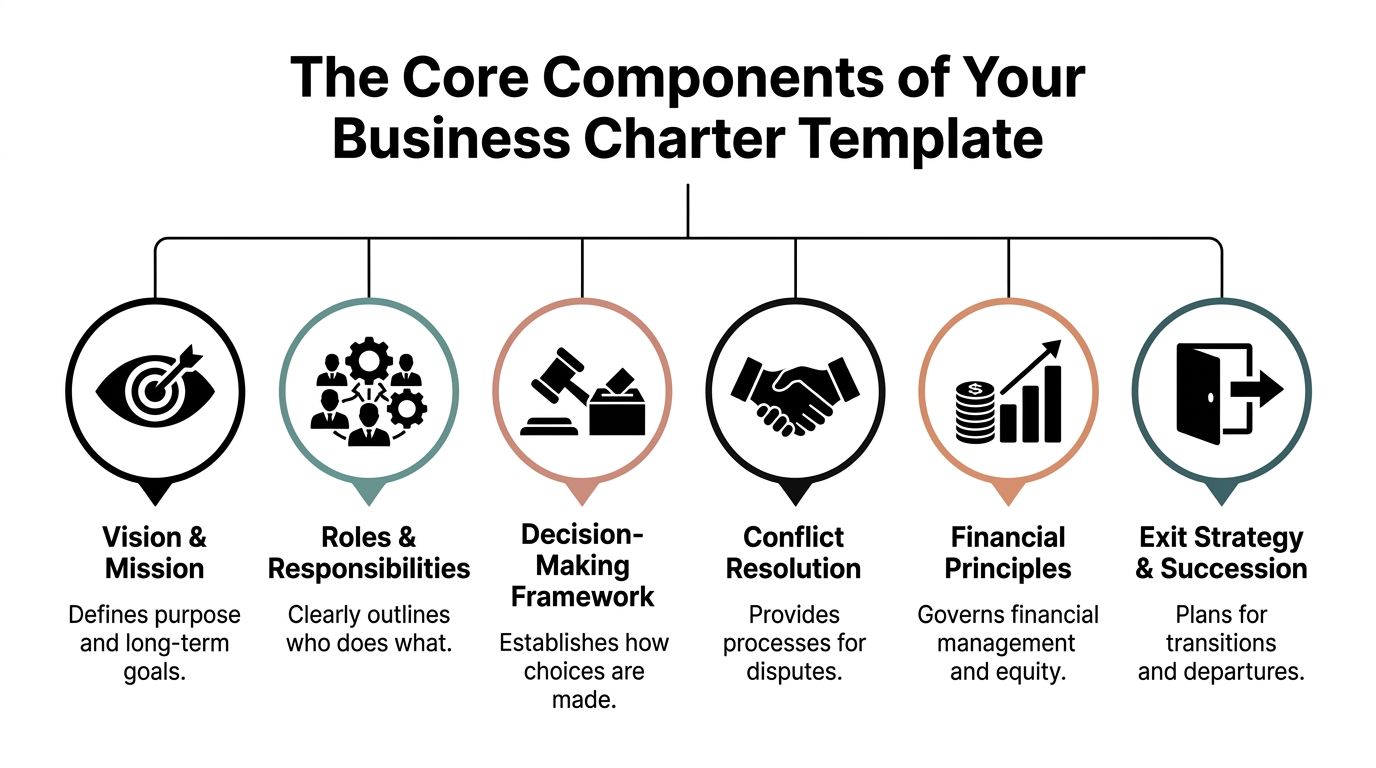
A useful charter usually includes six core parts.
| Charter Section | Purpose | Example Clause |
|---|---|---|
| Vision and mission | Clarifies why the business exists and what it is trying to achieve | “We exist to help UAE-based SMEs manage supplier payments with less manual admin.” |
| Roles and responsibilities | Assigns clear ownership across founders and key operators | “The CEO owns fundraising, partnerships, and hiring. The CTO owns product architecture and engineering delivery.” |
| Decision-making framework | Defines which decisions need consensus and which are delegated | “Pricing changes above an agreed threshold require founder approval. Day-to-day customer support changes sit with operations.” |
| Conflict resolution | Creates a process for handling disputes before they become personal | “If founders can’t agree after one dedicated discussion, the issue moves to a documented review with an external adviser.” |
| Financial principles | Sets rules for spend, approvals, runway mindset, and equity discussions | “Any new recurring tool spend requires prior approval from the founder who owns finance oversight.” |
| Exit strategy and succession | Reduces uncertainty around departures, handovers, and continuity | “If a founder steps back from active involvement, responsibilities transfer through a documented transition period.” |
Keep this grounded. Don’t write a slogan.
Your charter should state the market you serve, the problem you solve, and the near-term direction of the company. If you’re still validating, say that clearly. Founders waste time when the charter implies a business model the startup hasn’t earned yet.
Strong example:
Weak example:
The second sounds ambitious. It gives the team nothing to work with.
Many co-founders tend to stay vague because they want to be flexible. That usually backfires.
Founders can still collaborate heavily, but each critical function needs one directly accountable owner. One owner doesn’t mean one executor. It means one person has to carry the final responsibility when something slips.
Useful categories include:
The fastest way to create resentment is to share responsibility for everything and ownership for nothing.
This part should separate routine decisions from company-shaping decisions.
Operational decisions can move quickly when one person owns the area. Strategic decisions need a higher threshold. The charter should define both.
Good categories to define:
Many avoid writing this because it feels negative. That’s exactly why they need it.
You’re not planning for a fight. You’re building a process for when two reasonable people see risk differently. Include how disputes are raised, how quickly they must be discussed, what gets documented, and when an external input is needed.
This section should set rules, not predictions.
Document the basics:
This is also where founders should note any principles behind future equity discussions so nobody assumes those talks will happen informally.
Founders rarely think about this when everyone is motivated. They should.
If someone leaves, reduces their involvement, moves country, or stops executing, the business still needs continuity. A charter can outline the operational side of that transition even if the legal mechanics are handled elsewhere.
This is the section founders tend to postpone. It’s also the section that saves the most pain later.
If your business charter template stays vague on governance, the company starts making decisions through mood, hierarchy, or whoever spoke last in the meeting. That might work for a few weeks. It won’t hold under pressure.

Start with a simple split.
Operating decisions are day-to-day calls inside an owner’s area.
Major decisions change risk, control, or company direction.
That distinction matters because not every decision deserves a full founder debate.
A practical model looks like this:
| Decision type | Typical examples | Suggested approval model |
|---|---|---|
| Operating | campaign launch, feature prioritisation within roadmap, supplier selection | area owner decides |
| Cross-functional | new hire affecting budget, major pricing change, partnership with delivery burden | discussion plus agreement from affected founders |
| Major | fundraising terms, debt, equity changes, entering a new market, changing core model | full founder approval |
Two-founder setups move fast until they deadlock.
If you have two founders, don’t pretend “we’ll work it out” is a process. Write a tie-break mechanism before you need one.
Three models tend to work best:
Domain authority
One founder gets the final call inside a defined area.
Example: product decisions sit with the CTO, commercial decisions sit with the CEO.
Mutual consent for major decisions
Both founders must approve a short list of company-level decisions.
Escalation path
If both founders disagree on a major issue after a set discussion, the issue goes to a pre-agreed adviser, board member, or documented cooling-off process.
If every decision requires unanimity, the company slows down. If nothing requires shared approval, trust erodes.
Three-founder teams often assume majority voting solves everything. It doesn’t.
A pure two-versus-one model can create durable resentment, especially if the same founder keeps getting overruled. A better structure is to combine majority with protected categories.
For example:
This keeps speed where speed matters and caution where consequences are bigger.
A weak clause sounds like this:
A useful clause sounds like this:
The difference is enforceability in practice. The first expresses goodwill. The second gives the team an operating rule.
Deadlocks usually aren’t about logic alone. They happen when each founder is protecting a different risk.
One founder is guarding runway. Another is guarding growth. Another is guarding product quality. All can be valid.
A clean deadlock clause should answer four questions:
A useful external perspective also matters once investors arrive. If you’re preparing for that stage, this guide on working with your new investor successfully is worth reading because investor involvement changes how governance pressure shows up.
A short explainer can help teams discuss this without drifting into abstractions:
Founders don’t revisit clauses that read like policy manuals. Write something operational.
Try this structure:
That format keeps governance useful. The point isn’t to sound complex. The point is to make the next hard decision easier than the last one.
A charter that lives in Google Drive is dead.
The document only becomes useful when it shapes recurring conversations. That means your business charter template needs a meeting rhythm attached to it. Otherwise the team writes good intentions once, then returns to reactive operating.
Most early teams need two distinct cadences.
Keep this tight. Focus on movement, blockers, and ownership.
A practical weekly agenda:
This is not the place for philosophical debates. If a strategic issue appears, park it for the monthly review.
This meeting is different. It’s where founders check whether the company is still operating inside the agreement they made.
Review:
If they don’t, update the charter. A living document should change when the business learns something important.
A missed milestone shouldn’t trigger blame first. It should trigger diagnosis.
Accountability breaks when goals belong to “the team”.
A charter should connect each material objective to one accountable owner. That doesn’t stop collaboration. It just removes ambiguity when progress is slow.
Use language like:
Those labels make meetings cleaner. They also make it easier to spot whether the problem is execution, lack of clarity, or unrealistic planning.
Founders often handle misses in one of two bad ways. They either ignore them to keep morale high, or they overreact and make the conversation personal.
A better sequence is simple:
State the miss clearly
Name what didn’t happen.
Identify the reason
Was it lack of time, weak ownership, bad assumptions, or a changed priority?
Decide the response
Keep the milestone, revise it, remove it, or reassign ownership.
Document the change
If the team changed scope, the charter should reflect that.
That process keeps the charter credible. If the document never changes, it becomes fiction. If it changes every week without discipline, it becomes noise.
Teams use charters when they can access them during real work.
Store it somewhere obvious. Review it in live meetings. Reference it when a founder says yes to something outside scope. Pull it up when a disagreement appears. The more often the team uses it, the less likely it is to become a ceremonial file.
A generic business charter template misses local context fast.
Founders in the UAE don’t operate in an abstract startup environment. They’re setting up through mainland or free zone structures, working through incorporation requirements, and often juggling internal founder alignment with external legal documents at the same time. If your charter ignores that reality, it becomes disconnected from the business you’re building.

The charter is an internal operating document. Your legal formation documents define the company externally.
That distinction matters because founders often confuse the two. They either overestimate what the charter can do legally, or they underuse it because they assume the Memorandum and incorporation pack already cover founder alignment.
They don’t cover the same job.
Your charter should help answer questions like:
Your legal documents deal with formation, legal authority, shareholding structure, and formal obligations. If you need a practical primer, this guide to the Memorandum of Association (MoA) in the UAE is useful for understanding how that document sits within the company setup process.
Now, preparation stops being theoretical.
According to Airtable’s article on project charter templates, business charter templates have contributed to a 45% increase in successful scaling for UAE startups since 2022, with ADGM reporting 92% compliance in charters including KPIs. The same source notes that the UAE’s Business Charter Initiative digitised templates in 2023, boosting efficiency by 60%.
That tells founders something important. Clear operating documentation isn’t just administration. It’s part of scaling discipline.
A founder operating through ADGM, DIFC, DMCC, or a mainland route should make sure the charter language doesn’t conflict with how authority and signatory power work in formal documents.
If one founder handles incorporation, banking coordination, or licence renewals, put that in the charter. Startups lose time when these jobs sit in the background as assumed responsibilities.
When founders walk into legal drafting with an aligned charter, lawyers can turn that into clean documents faster. Without it, legal sessions become expensive alignment meetings.
Investors can usually tell whether a founding team has operating clarity or just presentation polish. A solid internal charter helps because the team answers governance questions consistently.
For founders still sharpening basics around company structure and terminology, this short piece on a business firm definition gives a helpful starting point before you formalise the internal charter.
Good local execution means your charter speaks to how the company actually operates in the UAE, not how a template written for another market says startups should behave.
Most charter guides stop at internal use. That’s too limited.
A founder doesn’t just need alignment inside the company. They also need external accountability from people who understand startup pressure and can challenge weak thinking early. That’s where the charter becomes more than a private document. It becomes a tool for sharper peer conversations.
Isolation distorts judgement.
According to Figma’s guide on writing a project charter, a 2025 Dubai Future Foundation survey reveals 42% of UAE startups fail pre-Series A due to isolation, while peer groups boost validation success by 51%. The same source notes that standard charter templates usually lack clauses for peer review milestones.
That gap is real. Most templates assume one team, one document, one internal review cycle. They don’t account for founders using trusted peers as a discipline layer.
A solo founder in the UAE is validating a B2B SaaS offer for operations teams. Their charter states three near-term priorities: close pilot conversations, refine onboarding workflow, and test pricing confidence in discovery calls.
On paper, that looks organised. In practice, the founder keeps shifting focus every week because customer feedback feels noisy.
Instead of bringing a general update to a peer session, they bring three charter items:
That changes the quality of feedback immediately. Peers aren’t reacting to random activity. They’re reviewing a defined operating plan.
One founder in the group asks why onboarding workflow is still a priority if no paid pilots are signed. Another points out that the pricing test has no owner because the founder keeps changing the script. A third suggests rewriting the milestone around paid pilot proof instead of feature completion.
The charter becomes the reference point. The conversation gets sharper because the group can challenge assumptions against a stated plan.
If you’re going to use the document in a founder community, write that into the charter itself.
Useful additions include:
This doesn’t make the company dependent on outside opinions. It creates a structured way to use outside perspective well.
Weak update:
Strong update:
The second version gives peers something useful to work with.
If you’re exploring whether structured founder groups improve decision-making, this piece on how founders benefit from peer groups is worth reading.
A peer community should help with:
It shouldn’t become the place where founders avoid responsibility for their own choices.
The charter helps with that balance. It lets a founder say, “Here is the plan we agreed to. Here is where reality is challenging it. Help me think clearly.” That’s very different from asking a room to decide the company’s future for you.
A strong business charter template does one job well. It turns vague founder alignment into visible operating rules.
That matters at formation stage, during early validation, and again when pressure rises. It matters when a co-founder’s role changes, when priorities drift, when investors ask harder questions, and when isolation starts weakening judgment. The document is simple. The effect is cumulative.
Don’t wait for a legal issue or a co-founder conflict to start this.
Take these steps this week:
Open a working draft
Use a simple document, not a polished deck.
Book a founder workshop
Give yourselves focused time to write the first version together.
Resolve the hard clauses first
Start with roles, decision rights, approvals, and conflict handling. Founders often waste time polishing mission language while avoiding the clauses that matter.
Limit version one
The first draft should be useful, not perfect.
Review it in a live meeting
If the team can’t discuss it clearly, the wording still needs work.
Use these prompts:
Write the charter for the stressful month ahead, not the calm week you’re having now.
A usable draft created this week is better than an ideal document postponed for another quarter. Once it exists, you can improve it. Until it exists, your team is still relying on memory, interpretation, and mood.
If you want a more structured way to turn this into action, Founder Connects gives UAE and MENA founders a practical environment to sharpen decisions, stay accountable, and get meaningful feedback from peers who are building too. Bring your first charter draft into that kind of room and it stops being a document. It becomes an operating advantage.


