

A Founder's Guide to Business Startup in Dubai (2024)

Building in MENA? You don't have to do it alone.
Join 300+ founders in the Founder Connects Residency. Monthly squad calls, warm intros, $3M+ in perks, and much more. All for less than your monthly coffee budget.

Setting up a business startup in Dubai boils down to one critical first decision: Mainland or Free Zone? This choice is the operating system for your entire venture, defining who you can sell to, what your ownership structure is, and how you'll operate for years.
Get this right, and you build on a solid foundation. Get it wrong, and you'll face friction at every turn. Let’s break it down into actionable steps.
Choosing Your Foundation: Mainland vs. Free Zone Setup

This isn't about which is "better"—it's about which is the right tool for your specific business model. Your job is to align your choice with your target customer and long-term vision.
A Mainland company, registered with Dubai’s Department of Economy and Tourism (DET), gives you unrestricted access to the entire UAE market. You can trade directly with any customer, anywhere in the country, and bid on lucrative government contracts.
A Free Zone company is based inside a designated economic area. With over 40 free zones across the UAE, many are hyper-specialized by industry—like Dubai Internet City for tech, Dubai Media City for media, or DMCC for commodities trading.
The Deciding Factor: Who Is Your Customer?
It all comes down to your primary market.
- Choose Mainland if: Your plan is to sell products or services directly to consumers or businesses inside the UAE. For example, an e-commerce brand delivering across Dubai and Abu Dhabi or a consultancy firm landing projects with local government entities must have a Mainland license to operate legally.
- Choose Free Zone if: Your clients are primarily outside the UAE, or your business is purely digital with no physical trading within the country. A global SaaS company with customers in Europe and Asia is a perfect fit for a Free Zone’s efficient, internationally-focused structure.
Next Action: Answer this one question before going any further: "Who is my primary customer and where are they based?"
- If the answer is "consumers and companies inside the UAE," focus your research on a Mainland setup.
- If it's "international clients," a Free Zone is your most likely path.
Key Factors at a Glance
Here’s a simple framework to compare the two options where it matters most for a founder.
Mainland vs. Free Zone: A Founder's Quick Comparison
FactorMainland (DET)Free ZoneMarket AccessUnrestricted access to the entire UAE market, including government contracts.Restricted to trading within the free zone and internationally. Requires a local distributor to trade on the mainland.Ownership100% foreign ownership now available for most business activities.100% foreign ownership has always been a core feature.Office SpacePhysical office was traditionally required, but rules are becoming more flexible.Highly flexible. Offers co-working, flexi-desks, and virtual office options ideal for lean startups.Visa ProcessHandled directly by DET and immigration authorities.Managed by the specific free zone authority, often a more streamlined, founder-friendly process.Setup CostGenerally higher initial setup and annual renewal costs.More cost-effective for startups not needing a large physical office.
The best choice is about strategic alignment. A Mainland company gives you room to grow within the local market, while a Free Zone provides an efficient, cost-effective launchpad for global ambitions.
For a deeper analysis of specific zones, our guide on the best UAE free zones for early-stage startups offers a detailed breakdown. Your goal is to find a jurisdiction that acts as a tailwind for your business, not a constant source of friction.
Decoding Licenses and Legal Structures
Once you’ve decided between Mainland and Free Zone, the next step is choosing your trade license and legal structure. This isn't just paperwork; it defines your company's operational DNA. A mismatch here can cause major issues with hiring, fundraising, and daily operations.
First, your trade license. This is your official permission from the government to operate and is directly tied to your specific business activities.
Match Your Business to the Right License
Your core business activity dictates your license type. The authorities require a precise match.
- Commercial License: For buying and selling goods. This is for e-commerce stores, import/export businesses, or general trading companies.
- Example: A founder importing sustainable packaging for the local F&B industry.
- Example: A marketing consultant helping other startups with their growth strategy.
- Example: A startup assembling electronic components in a dedicated facility.
Next Action: Write a single, precise sentence describing what your business sells. Is it a physical product, a professional service, or something you manufacture? This simple exercise will point you directly to the right license and prevent costly mistakes.
Choose Your Legal Structure
With your license type clear, pick a legal structure. This framework defines liability, ownership rules, and management. For most founders, the choice is between two main options.
Limited Liability Company (LLC)
The LLC is the default structure for most startups in Dubai. It establishes your company as a separate legal entity, protecting your personal assets from business debts. If the company fails, your personal finances are shielded. Investors almost always require the clean, protected framework of an LLC, making it the right choice if you have co-founders or plan to raise capital.
Sole Establishment (or Sole Proprietorship)
This is for the solo founder. While simpler and cheaper to set up, it comes with a major risk: unlimited liability. There is no legal separation between you and the business. If the business incurs debt, your personal assets—home, car, savings—are at risk. This structure can work for a low-risk solo professional, but founders with growth ambitions or operational risks should avoid it.
Civil Company
A Civil Company is a partnership designed for recognized professionals like doctors, lawyers, and engineers. Partners typically have unlimited liability. This is not a suitable structure for a tech startup or trading business.
Getting Registered and Sorting Your Visa: The Execution Phase
You've made the strategic decisions. Now it's time to execute. This is where you transition from planning to operating as a legally recognized company.
Remember, your company registration and personal visa are two parallel processes that must converge for you to live and work in the UAE. You can't fully complete one without the other.
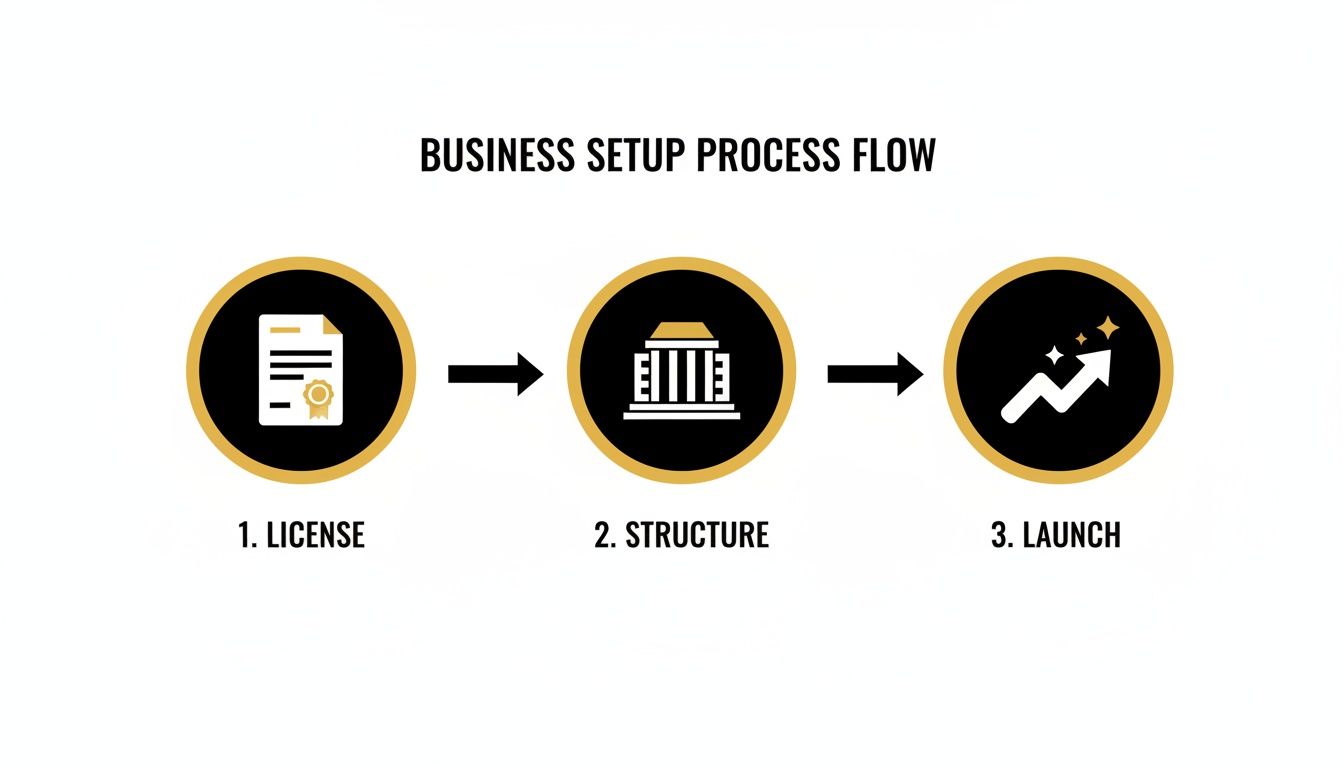
The Company Registration Playbook
Whether Mainland or Free Zone, the fundamental steps are similar. It's a checklist you must work through methodically.
- Reserve Your Trade Name: Your first step. Your proposed name must be unique and comply with UAE naming conventions (e.g., no religious references). Have at least three options ready.
- Get Initial Approval: The relevant authority (DET for Mainland or the specific free zone) reviews your business activity and shareholders, providing a preliminary green light.
- Draft Legal Documents: Prepare your Memorandum of Association (MOA) or a simpler Shareholder Resolution if you are a solo founder. This critical document outlines ownership, activities, and management structure. A common pitfall for foreign founders is document legalisation. Understanding the difference between an apostille vs notary public is crucial, as many documents from your home country will need to be properly attested to be valid here.
- Secure an Office Address: A registered physical address is mandatory. For most startups, a virtual office or a flexi-desk in a co-working space is sufficient, especially in free zones.
- Final Submission & Payment: Submit all collated documents and pay the license fees. After a final review, your official trade license is issued.
Founder Tip: The biggest delays are almost always caused by incorrect or incomplete paperwork. Double-check every document. Ensure passport copies are crystal clear and that any required document attestations are completed weeks in advance. A small mistake can easily cost you a month of progress.
Connecting Your Company to Your Residency
Your trade license is your key to obtaining a UAE residency visa. As soon as the license is issued, you can begin the immigration process.
Your Visa and Emirates ID Checklist
This is the path from trade license to a residency visa stamped in your passport:
- Establishment Card: First, apply for your company's Establishment Card. This registers your company with the immigration department, enabling it to sponsor visas—starting with you.
- Entry Permit (Employment Visa): Next, you apply for your own entry permit. This temporary visa allows you to stay in the UAE while completing the remaining steps. If you're already here on a tourist visa, you'll need to do a "status change."
- Medical Fitness Test: A mandatory step for all new residents, involving a quick blood test and a chest X-ray at a government health center.
- Emirates ID Application: You'll visit an Emirates ID center for biometric data capture (fingerprints and photo). Your Emirates ID is your primary identification in the UAE, required for everything from opening a bank account to renting an apartment.
- Visa Stamping: The final step. Your passport is submitted to immigration authorities, and the official residency visa is placed inside. You are now officially a UAE resident.
For more detailed information, our UAE startup visa guide breaks down all the options for early-stage founders.
Realistically, budget 4-8 weeks from license issuance to visa stamping, assuming no document-related delays.
Laying Your Financial Foundations

With your company registered and visa in process, it's time to build your financial infrastructure. A trade license is meaningless until you can send invoices, receive payments, and manage cash flow.
Securing a corporate bank account for a new business startup in Dubai is a common and significant hurdle. UAE banks operate with high levels of scrutiny, which can feel like an impossible barrier for a lean startup.
How to Open a Corporate Bank Account
The primary reason applications are rejected or delayed is an incomplete or messy file. You must present a clear, compelling story of a legitimate business.
Here is the essential document checklist:
- Company Documents: Trade license, Memorandum of Association (MOA), share certificates.
- Founder & Shareholder IDs: Passport, visa, and Emirates ID copies for all shareholders and signatories.
- Proof of Address: Recent utility bill for your personal residence and your company's registered office.
- Business Plan: A concise summary of your business model, target customers, and financial projections.
Beyond paperwork, provide evidence of business legitimacy, such as a company website, updated founder LinkedIn profiles, or letters of intent from potential clients. For a step-by-step guide, review our UAE banking guide for pre-seed startups.
Founder Tip: Some banks are more startup-friendly. Digital-first banks like Wio often provide a faster onboarding experience. Among traditional banks, Emirates NBD and Mashreq are generally more receptive to new ventures, provided your application is flawless.
Setting Up Online Payments
A bank account stores your money; a payment gateway collects it. To accept online card payments, you must integrate a gateway. This is critical in the UAE's booming digital economy.
Top payment gateway choices for UAE startups include:
- Stripe: Global leader with developer-friendly APIs.
- Checkout.com: Strong presence across the MENA region.
- Telr: A local solution well-integrated with regional e-commerce platforms.
As you set up, consider the best accounting software for startups to maintain clean books from day one.
Understanding UAE Corporate Tax
Since June 2023, the UAE has a federal Corporate Tax. While the 9% rate is low, every founder must comply.
The key threshold is AED 375,000. If your annual net profit is below this amount, your corporate tax is zero.
However, compliance is mandatory for all businesses:
- Register for Corporate Tax: Every business must register with the Federal Tax Authority (FTA), regardless of profit.
- Maintain Financial Records: You are legally required to keep accurate financial records for at least seven years.
- File Annually: You must file an annual Corporate Tax return, even if you owe nothing.
This new regime makes diligent bookkeeping non-negotiable from day one.
Plugging into the Dubai Startup Ecosystem
Your license, visa, and bank account are sorted. Your business is legally real. Now, you must make it real in the market.
Building in isolation is a slow path to failure in Dubai. The city’s true advantage is its hyper-connected ecosystem. Your next job is to plug into it to find mentors, peers, and opportunities. Founder isolation is a real threat, but here, it’s entirely avoidable.
Find Your Tribe: Quality Over Quantity
Deep connections are more valuable than a large contact list. Focus on finding high-signal environments where genuine conversations happen. Your goal is to build a small, trusted circle of other founders who are a few steps ahead or in the trenches alongside you. This peer support system will become your most valuable asset.
The timing is perfect. The Dubai Chamber of Digital Economy now supports 1,690 digital startups, up 39.7% in just one year. You're surrounded by a vibrant community of builders. You can read more about this surge in Dubai's digital economy on Arabian Business.
Where to Connect: A Curated List
Focus your energy on a few high-value places that attract serious founders.
- Founder Connects: A private community designed for genuine peer support. It matches you into small, moderated groups for accountability, problem-solving, and real relationships.
- in5 and Dtec (Dubai Technology Entrepreneur Campus): Major incubators hosting mentorship programs, workshops, and high-quality events.
- Venture Souq and Wamda: Key players in the regional VC scene. Their events and content offer priceless insights into the investment landscape.
- Astrolabs: A well-established tech hub with excellent accelerator programs and practical workshops for skill development.
Next Action: Pick one community from this list and attend an event in the next 30 days. Your goal isn't to pitch everyone. It's to have three meaningful conversations with other founders. Ask them what they're working on and what their biggest challenge is.
A Framework for Building Relationships
- Give Before You Ask: When you meet someone, think, "How can I help them?" Share a relevant article, offer feedback, or make a useful introduction. This builds trust instantly.
- Be Specific With Your Asks: Make it easy for people to help you. Instead of "Can you introduce me to investors?" ask, "I see you're connected to [Investor Name] at [VC Firm]. Given my startup is in the [Sector] space, would you be open to a warm intro?"
- Follow Up with Gratitude: If someone helps you, close the loop. Thank them and let them know the outcome. It shows you value their time and makes them more likely to help again.
Building your support system is an ongoing process. Be intentional and consistent to turn the ecosystem into a powerful engine for your growth.
Your Top Questions Answered: Starting a Business in Dubai
Here are clear, practical answers to the most common questions we hear from founders.
What’s the real all-in cost to get started?
Budget realistically for your first year. For a standard Free Zone company with one founder visa, expect to pay AED 20,000 to AED 35,000. A Mainland company typically starts from AED 30,000 upwards.
This all-in figure covers:
- Trade License & Registration Fees
- Visa Processing (entry permit, medical, Emirates ID, stamping)
- Establishment Card
- Mandatory Virtual Office Rent
Key Insight: Beware of hidden costs. Always request a fully itemized quote breaking down every government and third-party fee. A cheap upfront license can become expensive once mandatory extras are added.
How long does the full setup process really take?
If all your documents are in order, a realistic timeline from application submission to visa stamping is 4-8 weeks for a Free Zone setup and 3-6 weeks for Mainland.
Common delays include:
- Security Approvals: Certain nationalities or business activities can trigger additional clearances, adding several weeks.
- Document Attestation: If you need to attest documents like a university degree from your home country, this process alone can take over a month. Plan for this far in advance.
Can I own my company without living in the UAE?
Yes, you can have 100% ownership of a Dubai company without being a resident, especially in a Free Zone.
The challenge is banking. Most UAE banks require the primary account signatory to hold a valid UAE residency visa and Emirates ID. While you can own the company from abroad, operating it without a local bank account is nearly impossible.
Do I still need a local sponsor for a mainland company?
No, not for most businesses. The old requirement for a 51% Emirati sponsor for Mainland LLCs was abolished in 2021. Most founders can now have 100% foreign ownership.
For professional services firms (e.g., consultancies), you must appoint a Local Service Agent (LSA). An LSA holds zero shares, has no management control, and is paid a fixed annual fee for their service. This is not a sponsor.
This change is a key reason Dubai now ranks as a top global startup hub. You can discover more about Dubai's startup ecosystem ranking to understand the city's commitment to founders.
Navigating your startup journey is filled with decisions, but you don't have to make them in isolation. Founder Connects is a private community built for founders like you in the UAE/MENA who want to move beyond surface-level networking and build real connections. We match you into curated peer groups for accountability, facilitate high-signal introductions, and provide the practical support system you need to build a stronger business, faster.
Ready to find your tribe? Join the Founder Connects community.

Building in MENA? You don't have to do it alone.
Join 300+ founders in the Founder Connects Residency. Monthly squad calls, warm intros, $3M+ in perks, and much more. All for less than your monthly coffee budget.
Popular posts





Founder Connects is a premium MENA tech founder community. Meetups in Dubai and across MENA, Residency Squads of 8–10, and 400+ vetted WhatsApp founders (apply and screened).