

Most advice on business village building starts in the wrong place. It starts with land, fit-out, amenities, and a glossy story about innovation.
In the UAE, that's backwards.
If you already operate in Dubai, Abu Dhabi, or the wider MENA market, you know the problem isn't a shortage of businesses to put in a building. The harder problem is building a founder environment people return to because it helps them make decisions, solve problems, and move faster with less noise. Space matters. But space without curation becomes another office product with events attached.
The operators who get this right don't think like landlords first. They think like product builders. They define the user, design the experience, control the signal quality, and measure whether the community is helping founders progress.
A lot of operators still treat business village building as a property exercise. Secure a site. Add meeting rooms. Put in coffee. Run events. Wait for “ecosystem magic” to happen.
That model is weak in the UAE because the market is already dense. The UAE has roughly 1.0 million SMEs that contribute about 63.5% of non-oil GDP, which means supply of businesses isn't the main issue. The primary gap is a commercially useful environment that offers high-trust execution support in a market that already has broad business density, as noted in this Urban Institute discussion of commercial corridor community building.
That changes the brief entirely.
A business village in this context shouldn't be designed as “space for startups”. It should be designed as a decision-making environment for a specific kind of founder. If people can get desks anywhere, your edge comes from who you admit, how you match them, what conversations you facilitate, and what operating rules protect trust.
Generic founder hubs usually break in predictable ways:
Practical rule: If your community promise can be copied by a coworking operator in one sentence, it isn't sharp enough.
This is why community design matters more than ambience. Strong communities convert attention into repeated participation. If you want a useful primer on the mechanics of transforming followers into advocates, that community-building lens is more relevant to founder hubs than most placemaking advice.
Treat the village like a product with four core layers:
User definition
Know exactly which founder you serve.
Core job to be done
Decide what problem the village solves better than loose networking.
Operating system
Build the rituals, curation, and governance that create repeat value.
Proof of value
Track whether members are making progress.
The useful shift is simple. Stop asking, “How do we fill the building?” Start asking, “Why would the right founder stay, contribute, and renew?”
That's the centre of business village building in the UAE.
Before you look at a floor plan, write the thesis.
Most weak founder hubs fail because they use language that sounds good but means nothing in operations. “Support entrepreneurship.” “Foster innovation.” “Create collaboration.” None of those statements tells a founder whether the village is relevant to them.
The SBA's planning guidance is more useful than most community advice because it starts with a structured business plan that defines the mission, target market, and operating model upfront. In the UAE context, that translates into mapping founder segments, session formats, and partner strategy before launch, rather than defaulting to generic networking that leads to low retention, as outlined in the SBA guide to writing a business plan.
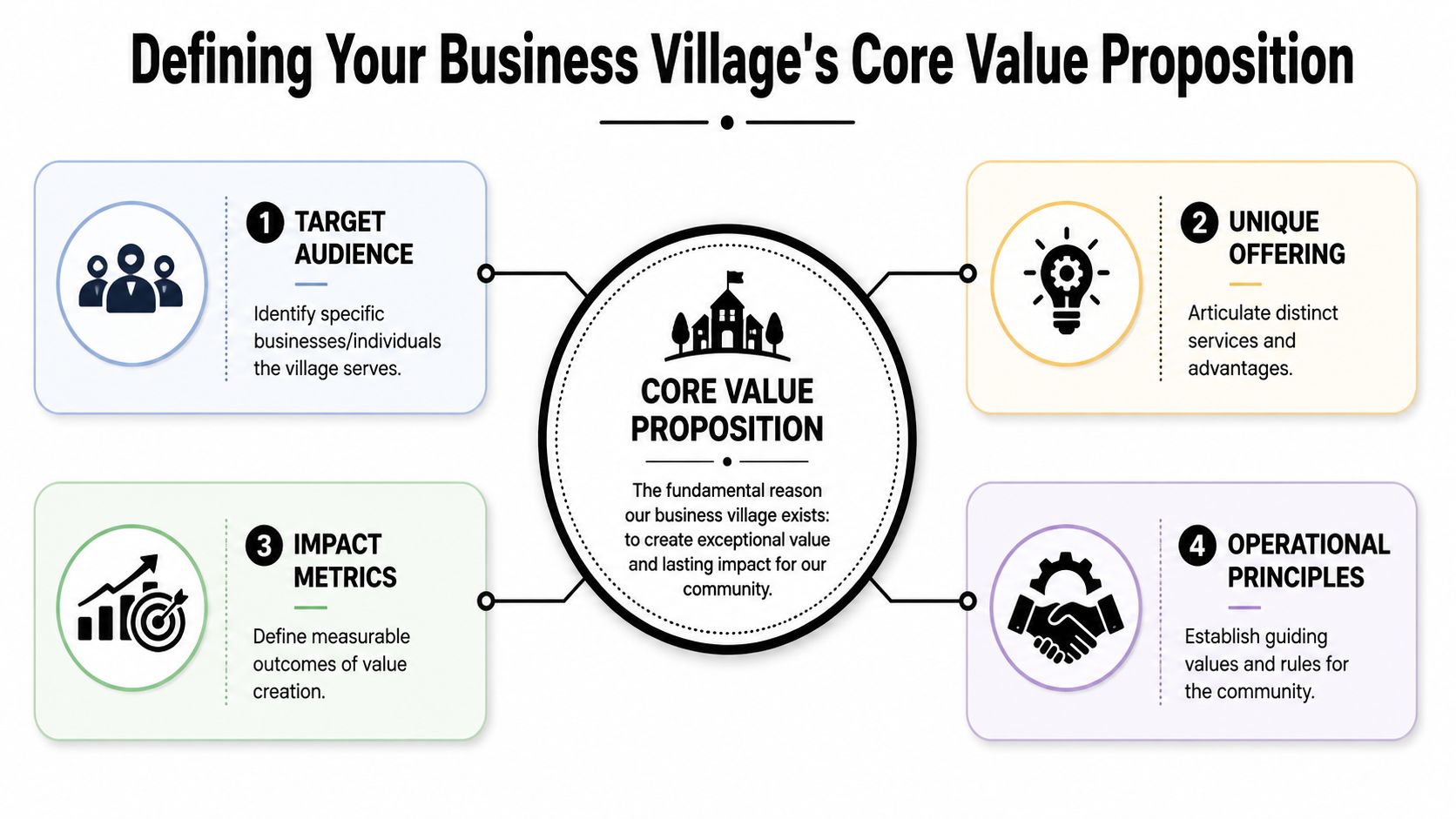
A useful value proposition answers three questions clearly:
| Decision area | Weak version | Strong version |
|---|---|---|
| Who is it for | Founders and entrepreneurs | Early-stage B2B founders selling into GCC enterprise buyers |
| What problem do you solve | Better networking | Trusted peer accountability and warm customer introductions |
| Why this model | Community and events | Curated small-group support with moderated sessions and operator-led matching |
Specificity creates operational clarity. It tells you what to say no to.
For example, a village for venture-backed fintech founders will need a different member profile, compliance conversation, partner set, and event rhythm than a village for consumer brand founders selling across the GCC. If you lump them together under one roof without a clear thesis, both groups get diluted value.
Use this when shaping your core offer.
Target founder
Define stage, sector, and immediate problem. “Pre-seed climate founders” is useful. “Innovators” is not.
Primary outcome
Pick one result your village is built to improve. Examples include better founder decision-making, stronger accountability, or faster access to relevant partners.
Signature experience
Decide what members repeatedly do inside the village. This might be moderated peer circles, curated expert sessions, or structured customer-introduction rounds.
Reason to believe
Explain why your setup can deliver the outcome. This often comes from curation, operator involvement, and a narrow focus.
A founder should be able to hear your proposition and know within a minute whether they belong there.
Ask your team these questions in one working session:
If you can't answer those with precision, don't move to site selection yet. Your physical build will only magnify a fuzzy strategy.
Once the thesis is clear, the physical environment becomes easier to design. You're no longer choosing furniture and rooms. You're engineering interaction patterns.
That starts with site selection. Location intelligence matters because successful business villages are built on data, not vague assumptions. Esri highlights how tools like ArcGIS can support site choice, and location frameworks can filter for zoning, transit access, and workforce demographics instead of relying on instinct alone in commercial real estate decisions, as described in Esri's piece on access to location data for commercial real estate success.

In UAE business village building, the wrong site creates friction every day. The right site removes it quietly.
Use a short operator checklist:
Access first
Check public transport proximity, parking reality, and travel friction for members coming from key business districts.
Regulatory fit
Confirm whether the building setup, licensing conditions, and local operating constraints fit the kind of founder activity you plan to host.
Ecosystem adjacency
Look for closeness to investors, service providers, corporate buyers, and talent pools. Founders don't need an isolated destination. They need a connected node.
Catchment quality
Focus on who can realistically use the space regularly, not who could theoretically visit.
Space elasticity
Make sure the layout can support both quiet work and programmed interaction without constant compromise.
If you're comparing established commercial centres, this overview of Forum Business Center is a useful example of the kind of location and workspace lens founders often apply when evaluating business environments in Dubai.
Many spaces are overbuilt for aesthetics and underbuilt for useful collisions. Founders don't need endless lounge area. They need places where the right conversation can happen at the right depth.
A practical layout usually needs three zones:
| Zone | What it should do | Common mistake |
|---|---|---|
| Focus zone | Give founders a place for deep work, calls, and sensitive conversations | Too open, too noisy |
| Connection zone | Encourage short, natural interactions before and after work blocks | Turning it into a general social area |
| Programming zone | Host peer groups, workshops, and curated sessions with control over acoustics and flow | Using the same room for everything |
Don't design for footfall. Design for repeated useful contact between the right members.
Amenities don't create trust on their own. Founders notice whether the room helps them work and connect with less friction.
Useful design choices often include:
For practical workspace ideas beyond founder hubs, Gibbsonn's guide to productive offices offers a solid reference for how layout choices shape behaviour.
The main trade-off is simple. The more your layout tries to please everyone, the less it supports your actual community thesis.
A business village without an operating system is just managed real estate. The community layer decides whether members get momentum or just proximity.
Many operators underinvest. They spend on fit-out, launch events, and brand identity, then leave the member experience to chance. In the UAE, that's costly because the ecosystem is already active. The Dubai Chamber of Digital Economy said it helped attract 270 digital startups to Dubai in 2023, which means the opportunity isn't about adding more founder volume. It's about improving curation, matching quality, and accountability inside the environment, as referenced in this summary citing the Dubai Chamber figure.

Signal quality starts before onboarding. If you admit everyone, you force your programming to carry too much weight later.
A practical member application should screen for:
Stage fit
Is this founder at the stage your village was designed for?
Problem relevance
Do they actually need the outcomes your community is structured to deliver?
Contribution potential
Can they add insight, introductions, or useful accountability for others?
Behavioural fit
Will they show up, respect confidentiality, and participate in good faith?
This doesn't require exclusivity theatre. It requires clarity.
Strong founder communities run on recurring formats, not random activity. Members should know what happens weekly, monthly, and quarterly.
A useful operating rhythm might look like this:
| Cadence | Format | Purpose |
|---|---|---|
| Weekly | Moderated small-group check-ins | Accountability and decision support |
| Monthly | Founder spotlight or working session | Visibility and practical learning |
| Ongoing | Warm 1:1 introductions | Targeted relationship building |
| Quarterly | Member review and feedback cycle | Quality control and renewal insight |
The format matters less than the consistency. Founders stay when the next useful interaction is already expected.
High-trust communities don't run on spontaneity alone. They run on repeatable rituals that make trust easier to build.
Governance sounds formal, but it shapes day-to-day value. Founders need to know what happens when someone oversells, breaks confidentiality, dominates discussions, or treats the space as a lead list.
Set explicit rules on:
Without that, your strongest members start self-filtering out.
For operators building this layer intentionally, this guide on building engaged startup communities is a helpful reference point for member engagement systems and community structure. One option in the UAE market is Founder Connects, which organises founders into curated small peer groups and supports ongoing introductions rather than relying on open networking formats.
Most operators think about onboarding as a welcome email and a tour. That's too shallow. The member journey should cover the first useful outcome.
Draft it in five moments:
If a new member reaches week four without a relevant conversation, a useful introduction, or a sense of who their people are, your operating system is leaking value.
The right next move is practical. Open a document and map that journey from first contact to first retained month. Don't leave any step to luck.
A business village that depends on rent alone usually drifts toward occupancy logic. That weakens the community because the operator starts optimising for filled seats instead of member fit.
A stronger model ties revenue to actual value creation. That doesn't mean monetising every interaction. It means choosing revenue streams that reward relevance, retention, and partner trust.
If your village is built around curated access and accountable peer support, your commercial model should reflect that.
Common revenue layers include:
Membership fees
Best when they map to clear access levels such as peer groups, curated introductions, programming, or workspace usage.
Partner packages
Useful when service providers, platforms, or ecosystem organisations want structured access to a vetted founder audience.
Programmatic revenue
This can come from specialised workshops, founder intensives, or operator-led facilitation for closed cohorts.
Space-linked revenue
Relevant if your physical environment includes meeting rooms, day access, or private offices. This should support the community thesis, not replace it.
The trade-off is straightforward. A broad, easy-to-sell membership can increase top-of-funnel interest but weaken average member fit. A more selective model usually makes growth slower, but member value stronger.
Partnerships can make a village more useful or much noisier. The difference comes down to whether partners solve real founder problems.
Good partners usually do one of three things well:
| Partner type | Useful role | Bad version |
|---|---|---|
| Service providers | Reduce friction around legal, hiring, finance, or go-to-market work | Hard-selling inside community sessions |
| Investors | Offer relevant feedback, network access, and selective exposure | Treating the village like a sourcing funnel |
| Institutions and ecosystem bodies | Open doors, provide context, support founder navigation | Showing up only for logos and stage time |
A practical screen is simple. Ask, “Would members still want this partner involved if there were no sponsorship revenue attached?”
If the answer is no, don't force the fit.
The easiest way to damage a founder hub is to oversell access. Founders can feel when a community exists mainly to package them for sponsors.
That's why partnership design needs boundaries:
If you're structuring a commercial model around ecosystem relationships, this guide to partnership ROI for startups is a practical lens for deciding whether a partner creates measurable value or just surface-level visibility.
A sustainable village is still a business. But it works best when revenue is the output of trust, not a substitute for it.
A full business village and a healthy business village are not the same thing.
Too many operators measure the easy things. Occupancy. Event attendance. Footfall. Social engagement. Those numbers can tell you whether people passed through. They don't tell you whether founders are getting useful outcomes.
Economic development work offers a better standard. Effective ecosystem hubs use dashboards that track more than occupancy, including business health, founder retention, and quantifiable indices such as a Business Independence Index, as discussed in this material on measuring Main Street-style district performance. That's the right mindset for business village building in the UAE. You need proof that the environment creates trust and commercial usefulness.
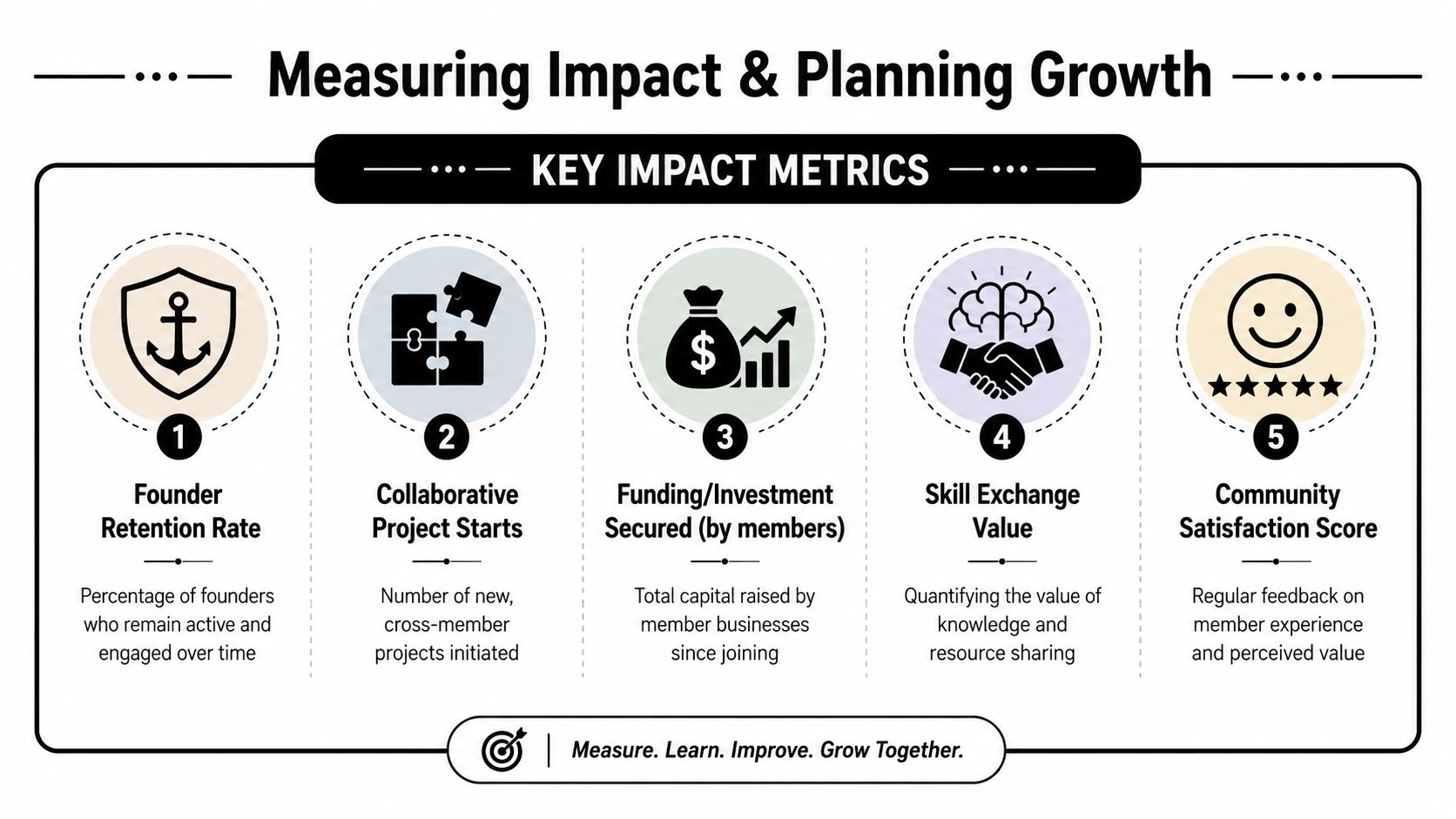
The strongest dashboards usually track behavioural and outcome signals, not just volume.
Start with measures like:
Founder retention
Are the right members staying active over time?
Warm introduction conversion
Are curated introductions turning into real follow-ups or collaborations?
Member-to-member support activity
Are founders helping each other with hiring, customers, advice, or problem-solving?
Programme usefulness
Which session types lead to repeat attendance and positive feedback?
Business health signals
Are members reporting clearer decisions, stronger execution, or better resilience?
This distinction helps when reviewing performance:
| Vanity metric | Useful metric |
|---|---|
| Event headcount | Repeat attendance by the right founder segment |
| Desk occupancy | Member retention and contribution quality |
| Social impressions | Qualified applications and accepted-member fit |
| Open networking activity | Warm introductions that lead to action |
If your dashboard makes the village look busy but can't explain why members stay, it isn't a management tool. It's a marketing report.
This is similar to how good marketing teams evaluate creator campaigns. They don't stop at reach. They look for outcomes tied to the original objective. That same discipline appears in frameworks for YouTube influencer measurement, where the important question is whether attention translated into action.
Pick one impact metric before launch and build your operations around capturing it cleanly.
Good starting choices include:
That single choice forces clarity. It shapes onboarding, programming, staff behaviour, and review cadence.
Business village building works when you design the community operating system first, then make space, revenue, and metrics support it. That order matters. In the UAE, where founder density already exists, the winning question isn't how to gather more people under one roof. It's how to build an environment that the right founders trust enough to keep using.
If you're building a founder hub or want to join a more curated founder environment in the UAE/MENA, Founder Connects offers a practical model built around peer groups, intentional introductions, and accountable support rather than generic networking.


