

Q&A: Cross-Border Investment Rules for UAE Startups

Building in MENA? You don't have to do it alone.
Join 300+ founders in the Founder Connects Residency. Monthly squad calls, warm intros, $3M+ in perks, and much more. All for less than your monthly coffee budget.

Cross-border investments are reshaping how UAE startups access funding and expand globally. Here's what you need to know:
- Foreign Ownership: UAE laws now allow 100% foreign ownership for most mainland companies, with some restrictions in sectors like defence, banking, and telecom. Free zones like DIFC and ADGM also offer 100% foreign ownership and tax benefits.
- Regulations: Startups must comply with UAE's regulatory frameworks, including the Commercial Companies Law, AML/KYC protocols, and specific approvals for strategic sectors.
- Taxation: A 9% corporate tax applies to income exceeding AED 375,000, but free zones can maintain a 0% rate under certain conditions. Double Taxation Agreements (DTAs) help avoid paying taxes in multiple jurisdictions.
- Funding Structures: Popular investment tools include SAFEs, convertible notes, and joint ventures. Governance agreements like Shareholders' Agreements ensure clear rights and responsibilities.
- International Expansion: UAE startups benefit from profit repatriation laws, DTAs, and streamlined processes for setting up foreign subsidiaries.
The UAE's legal and financial ecosystem makes it an attractive hub for startups seeking global growth, provided they adhere to the rules.
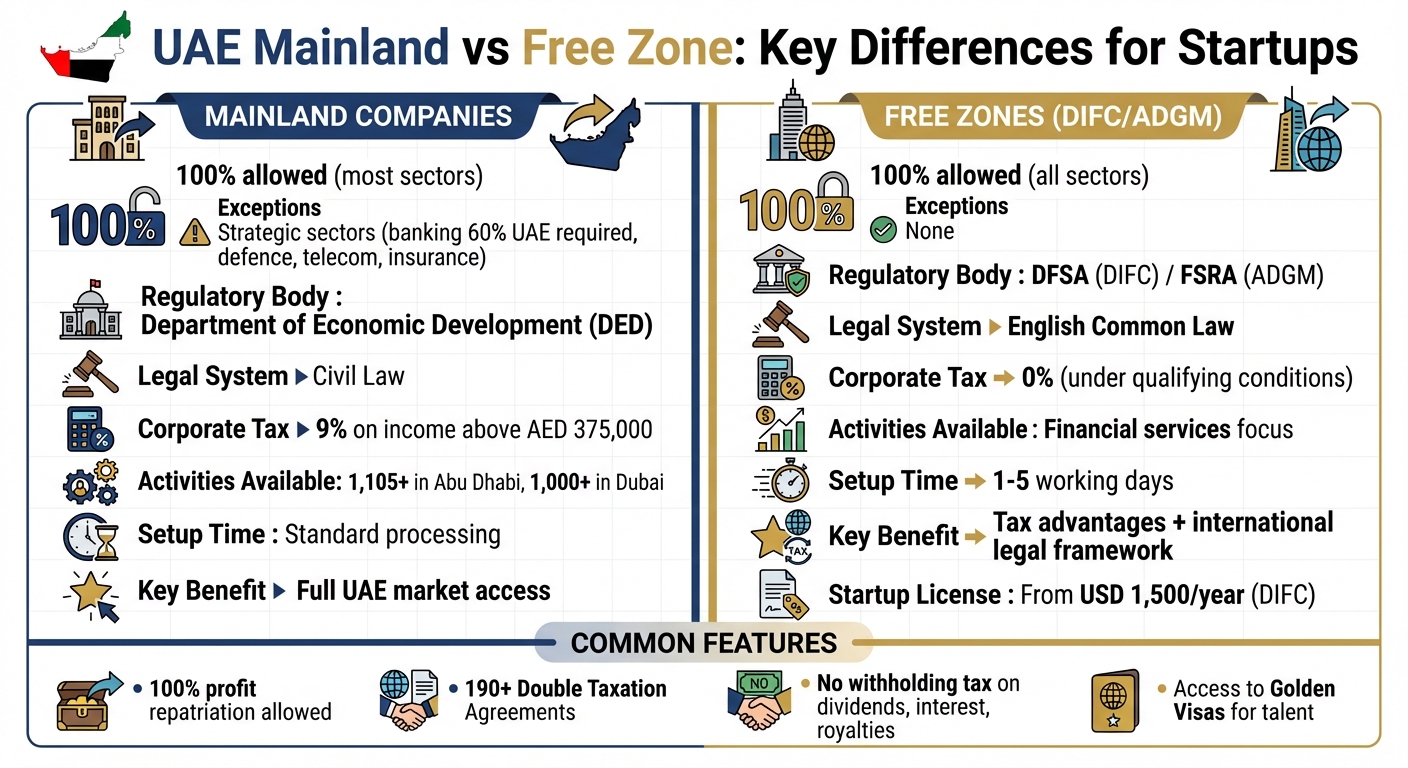
UAE Mainland vs Free Zone: Foreign Ownership Rules and Tax Benefits Comparison
Legal Framework for Cross-Border Investments in the UAE
Main Legal Requirements for Investors
The UAE has revamped its legal framework for cross-border investments with Federal Decree-Laws No. 26 of 2020 and No. 32 of 2021. These reforms now allow 100% foreign ownership of mainland companies in most sectors, eliminating the earlier requirement of having a UAE national shareholder or agent [4][3].
"The law annuls the requirement for commercial companies to have a major Emirati shareholder or agent; enabling full foreign ownership of onshore companies." - UAE Government Portal [3]
That said, some Strategic Impact Activities remain off-limits for full foreign ownership. These include sectors like security, defence, banking, insurance, telecommunications, fisheries, and exchange companies [4][7]. Entrepreneurs should carefully check if their business falls under the "Negative List", which includes industries like oil and gas, utilities, and transport that still have ownership restrictions [6][7].
Abu Dhabi has opened up 1,105 commercial and industrial activities for 100% foreign ownership, while Dubai offers similar opportunities for over 1,000 activities [3]. Additionally, foreign investors can repatriate 100% of their profits, returns, and proceeds from liquidation or sale [7]. However, compliance with the Commercial Companies Law (CCL) is crucial, as violations can lead to fines of up to AED 10,000,000 [8].
These legislative updates pave the way for understanding the roles of free zones and their respective authorities.
Free Zones and Their Regulatory Authorities
While the legal reforms primarily impact mainland companies, free zones in the UAE operate under their own regulatory frameworks. For instance, the Dubai International Financial Centre (DIFC) is governed by the Dubai Financial Services Authority (DFSA), and the Abu Dhabi Global Market (ADGM) is regulated by the Financial Services Regulatory Authority (FSRA) [5][9]. Both zones adopt independent common-law systems inspired by English law, offering a familiar legal environment for global investors [9][10].
Mainland businesses, on the other hand, fall under the jurisdiction of the Department of Economic Development (DED) in their respective emirates [5]. Federal investment policies are overseen by the Ministry of Economy, which also manages the "Register of Foreign Direct Investment" [7][4]. For sectors classified as Strategic Impact Activities, additional oversight is provided by specialised authorities, such as the Ministry of Defence for military-related businesses and the Telecommunications and Digital Government Regulatory Authority for telecom investments [4].
Registering a company in a free zone can be a quick process, often completed within 1 to 5 working days [5]. To encourage startups, the DIFC offers a startup licence starting at US$1,500 per year, particularly suited for entrepreneurs and tech firms [10]. Choosing between a mainland or free zone setup depends on factors like trade access, office space needs, and visa quotas.
Tax and Banking Rules
Since 1st June 2023, the UAE has introduced a 9% corporate tax on taxable income exceeding AED 375,000 [4]. However, free zone entities can still enjoy a 0% corporate tax rate if they qualify under the 2023 tax regime [5]. The UAE also boasts over 190 double taxation agreements, ensuring businesses aren't taxed in multiple jurisdictions [1].
The Federal Decree-Law No. 14 of 2025 (CB Law 2025) has unified the UAE's financial regulatory framework under the Central Bank of the UAE (CBUAE). This includes banking, insurance, and payment systems, while also recognising the Digital Dirham as legal tender, aimed at enhancing cross-border settlements [11].
"CB Law 2025 marks one of the most significant overhauls of the UAE's financial regulatory framework in over a decade." - Clint Dempsey, Partner, Ashurst [11]
The UAE Dirham (AED) remains pegged to the US Dollar at 3.6725, offering stability for international transactions [13]. Payments of principal or interest to domestic or foreign lenders are subject to a 0% withholding tax [13]. However, multinational enterprises with global revenues exceeding €750 million will face a 15% Domestic Minimum Top-up Tax starting 1st January 2025 [14].
New anti-money laundering (AML) regulations under Cabinet Decision No. 134 of 2025 now include Virtual Asset Service Providers (VASPs). Customer Due Diligence is triggered for transactions above AED 3,500, compared to AED 55,000 for traditional financial institutions [12]. Companies must also update their Ultimate Beneficial Ownership (UBO) details within 15 working days of any changes [12].
These updated tax and banking rules align with the UAE's evolving financial and regulatory landscape.
Receiving Foreign Investment: What UAE Startups Need to Know
How Foreign Investors Can Structure Their Investment
Foreign investors looking to invest in UAE startups have several structuring options, including LLCs, joint stock companies, limited partnerships, or holding companies within free zones such as DIFC and ADGM. These free zones allow for 100% foreign ownership, making them an attractive choice for international investors [2][15]. Direct equity investments are often the simplest route, especially after recent reforms that now permit 100% foreign ownership in most mainland sectors.
For instance, in April 2024, Microsoft invested USD 1.5 billion in Abu Dhabi-based G42 to drive advancements in AI across various industries [16].
For early-stage funding, Simple Agreements for Future Equity (SAFEs) are becoming increasingly popular in DIFC and ADGM. These agreements let investors convert their initial funding into equity during a future priced funding round [16]. Startups should also be aware that liquidation preferences in the UAE typically follow a one-time non-participating structure and often include anti-dilution protections [16]. These mechanisms simplify approvals and governance, which are further detailed below.
Required Approvals and Licences
To operate legally, startups must secure a commercial or industrial licence from the Department of Economic Development (DED) in their respective emirate. For businesses in strategic sectors - such as banking, insurance, telecommunications, or defence - additional regulatory approvals are necessary [3].
| Regulatory Authority | Sector Oversight | Approval Timeline |
|---|---|---|
| Central Bank of the UAE (CBUAE) | Banking, insurance, finance, and exchange companies | 14 business days from application [4] |
| Securities and Commodities Authority (SCA) | Public offerings, fund management, financial promotion | Varies by activity [9] |
| Dubai Financial Services Authority (DFSA) | Financial services within DIFC | Varies by licence type [9] |
| Financial Services Regulatory Authority (FSRA) | Financial services and VC funds within ADGM | Varies by licence type [16] |
| Telecommunications and Digital Government Regulatory Authority (TDRA) | Telecommunications activities | 14 business days from application [4] |
In December 2024, Quantix, a fintech subsidiary of UAE-based Astra Tech, secured a USD 500 million investment from Citi. This marked the largest funding round for a UAE fintech to date [16].
This major funding round required close coordination with the CBUAE due to the financial services nature of the business.
The UAE government has introduced initiatives like NextGenFDI to speed up licensing for high-tech companies [2]. Startups can also use platforms like Basher for online incorporation, which integrates various government services to simplify the process [4]. Before moving forward with any investment, it’s crucial to check your business activity against the "Positive List" maintained by your emirate's DED to confirm eligibility for 100% foreign ownership [3].
Foreign Ownership Rules and Governance
With the introduction of Federal Decree-Law No. 32 of 2021, foreign investors can now own 100% of mainland companies in most sectors [3][15].
"The law annuls the requirement for commercial companies to have a major Emirati shareholder or agent; thus, providing full foreign ownership to non-Emiratis with regard to onshore companies established by them." – WAM [3]
However, strategic impact sectors - such as security, defence, banking, insurance, telecommunications, and fisheries - remain exceptions [4][15]. For instance, mainland banks still require 60% UAE shareholding. Startups should review the "Negative List" to confirm whether these restrictions apply to their business [7][15].
Governance requirements have also been relaxed. For most companies, there’s no longer a need for the chairman or majority of board members to be Emirati nationals, except in strategic sectors [4]. When structuring investments, startups should include statutory safeguards such as pre-emptive rights (per Article 199 of the CCL) and the ability for 5–10% shareholders to call assemblies [15]. Additionally, foreign investors must register in the Register of Foreign Direct Investment at the Ministry of Economy. Startups are also required to appoint licensed auditors to ensure compliance [7].
In 2024, US-based vertical farming startup Plenty teamed up with Mawarid, a subsidiary of Alpha Dhabi Holding, to create a USD 680 million joint venture aimed at developing indoor farms across the Middle East [16].
Expanding UAE Startups into International Markets
Setting Up Entities in Foreign Markets
For UAE startups aiming to venture into global markets, the process begins with securing a Board resolution. This resolution authorises the establishment of a foreign branch or subsidiary and appoints a manager to oversee operations [4]. Following this, startups need to prepare and legalise their key incorporation documents [4].
Document attestation is a crucial step. It involves obtaining approval from the UAE Ministry of Foreign Affairs, followed by attestation at the embassy of the target country [4]. Startups operating within the DIFC or ADGM may find this process more streamlined. These jurisdictions have independent commercial legal systems based on English law, which are often more easily recognised by international regulators and investors [9].
An added advantage for UAE companies is the legal protection allowing businesses to repatriate profits and returns. This includes annual net profits, proceeds from liquidation, or funds from selling a project [7]. These provisions make it easier to navigate international agreements, which play a key role in global expansion.
Using International Agreements and Tax Treaties
The UAE has an extensive network of Double Taxation Agreements (DTAs) and Bilateral Investment Treaties (BITs). These agreements are designed to prevent dual taxation and reduce withholding taxes on dividends, royalties, and interest [18].
According to the Ministry of Finance, these agreements safeguard investments from non-commercial risks and ensure the free transfer of profits [18].
In addition, Comprehensive Economic Partnership Agreements (CEPAs) help reduce tariffs and simplify customs procedures [19]. The UAE's membership in the New York Convention further strengthens its position by enabling startups to enforce arbitration awards in 138 member states. This provides a dependable legal framework for resolving cross-border disputes [10]. Including arbitration clauses in international contracts is a smart move for founders looking to leverage this protection.
While these agreements offer tax benefits, effectively managing profit repatriation is equally essential for maintaining business growth.
Bringing Profits and Capital Back to the UAE
Once a foreign entity is established and benefits from DTAs, startups must focus on efficiently repatriating profits back to the UAE. Fortunately, this process is straightforward. There are no restrictions on exporting UAE Dirhams or foreign currencies, although amounts exceeding AED 40,000 require AML declarations [17].
To capitalise on treaty benefits and minimise foreign withholding taxes, startups should obtain a Tax Residency Certificate from the Federal Tax Authority (FTA) [20]. The UAE’s tax framework is highly advantageous - there are no withholding taxes on outbound dividends, interest, or royalties, making it an ideal jurisdiction for regional headquarters or holding companies [20].
For taxes paid abroad, the UAE allows foreign tax credits, ensuring that income is not taxed twice [20]. Many DTAs also allocate the right to tax capital gains on shares to the country of residence. Since the UAE does not generally impose capital gains tax, such returns can often be repatriated without additional tax burdens [20].
| Income Type | Treaty Treatment | UAE Domestic Tax Treatment |
|---|---|---|
| Business Profits | Taxable only if a Permanent Establishment (PE) exists abroad | Subject to 9% Corporate Tax above AED 375,000 [20][4] |
| Dividends | Withholding tax capped at 5%–15% | No outbound withholding tax [20] |
| Royalties | Withholding tax capped at 5%–10% | No outbound withholding tax [20] |
| Capital Gains | Taxable only in the country of residence (UAE) | Generally not taxed in the UAE [20] |
Cross-Border Rules for Regulated Industries
Fintech and Payment Startups: Cross-Border Requirements
The UAE's legal framework provides a strong foundation for regulated industries, but fintech and payment startups must navigate additional cross-border rules. These businesses face stricter regulatory reviews when it comes to foreign investment. For example, foreign ownership is capped under the "Activities with Strategic Impact", as outlined by the regulations [2][4]. The Central Bank of the UAE (CBUAE) must approve the exact percentage split between foreign and national ownership, as well as board representation requirements [4].
Applications for these approvals must be submitted to the CBUAE by licensing authorities within five business days, and decisions are typically issued within 14 business days [4]. This extra approval layer applies to banking, exchange companies, and financing activities [2][4].
When it comes to outsourced technology services, such as cloud infrastructure or API development, fintech startups must include provisions allowing UAE authorities access to outsourced service data [21]. To guide financial institutions adopting advanced technologies like APIs, cloud computing, AI, and blockchain, the CBUAE, along with the SCA, DFSA, and FSRA, has issued joint guidelines [21]. These guidelines emphasise the importance of clear liability terms and dispute resolution mechanisms in cross-border outsourcing agreements [21].
| Technology Category | Key Cross-Border Requirement |
|---|---|
| APIs | Governance documentation for API lifecycle; regulator access for outsourced services [21] |
| Cloud Computing | Exit strategies for critical outsourced services; regular business continuity tests [21] |
| AI & Big Data | Models must be transparent and explainable; accountability remains with UAE-licensed entities [21] |
| DLT/Blockchain | Users of permissionless DLT cannot operate anonymously or pseudonymously [21] |
Virtual Assets and Web3 Compliance
Dubai has taken a leading role in regulating virtual assets with the establishment of the Virtual Assets Regulatory Authority (VARA) under Dubai Law No. 4 of 2022. This makes VARA the first independent regulator worldwide dedicated to virtual assets [23][24]. VARA oversees all of Dubai, except for the DIFC, which is governed by the DFSA [24].
Startups planning to operate in this space must secure a VARA licence if they intend to run virtual asset platforms, facilitate exchanges between virtual assets and fiat, offer transfer services, or manage custody [24]. VARA's marketing rules also extend to foreign companies targeting UAE residents, regardless of whether they hold a VARA licence [23][24]. Penalties for non-compliance start at AED 20,000 and can escalate to AED 500,000 for repeat violations [24].
"VARA is now the ultimate gatekeeper into Dubai's digital asset economy - with this in mind, prudent operators wishing to target consumers in Dubai would be well-advised to comply with the Law." - Jones Day [24]
By 19th June 2025, virtual asset service providers must adhere to VARA Rulebook 2.0. This includes restricting margin trading to qualified and institutional investors [22]. Between July 2023 and June 2024, cryptocurrency transactions in the UAE hit $34 billion, marking a 42% year-over-year increase [22]. Institutional-sized crypto transfers also grew by 55% during the same period [22].
Startups working with sensitive data or AI technologies face their own unique compliance challenges.
Data Protection and AI Regulations
Operating under the UAE's dual legal systems - onshore civil law and free zone English common law - requires a customised approach to data protection and AI compliance [25]. Startups in sectors like telecommunications, which are considered strategic impact activities, must comply with oversight from the Telecommunications and Digital Government Regulatory Authority (TDRA) [4]. The TDRA is mandated to issue licensing decisions within 14 business days [4].
Handling sensitive data demands strict confidentiality, as unauthorised disclosures can lead to severe penalties, including fines of up to AED 10,000,000 or even imprisonment for one year [7].
For AI startups aiming to grow their teams, the UAE Council for Artificial Intelligence and Blockchain offers an added incentive. It can recommend exceptional digital technology talents for Golden Visas, a valuable tool for attracting foreign specialists to support cross-border operations [4].
sbb-itb-f597d8f
Documentation, Governance, and Community Resources
Required Investment Documents and Legal Agreements
When it comes to cross-border investments, having precise legal documentation is critical. These documents not only ensure compliance with regulations but also instill confidence in investors navigating the ever-changing rules of international business.
The Share Subscription Agreement (SSA) is a cornerstone document that outlines key investment terms, including pre-money valuation, warranties, and closing conditions. Meanwhile, the Shareholders' Agreement (SHA) governs the ongoing dynamics among shareholders, addressing crucial aspects like board composition, veto rights, transfer restrictions, and provisions such as drag-along or tag-along rights [16].
For startups in the UAE, particularly those operating in financial free zones like DIFC and ADGM, SAFE (Simple Agreement for Future Equity) instruments are a popular choice during early-stage funding. These agreements simplify the process by converting into equity during a qualifying financing event, avoiding complexities like interest or maturity dates. Similarly, convertible notes are often used in pre-seed and seed rounds when valuations are less certain [16].
Additionally, maintaining constitutional documents such as the MOA (Memorandum of Association) and AOA (Articles of Association) is essential. These documents define governance structures and share allocation. For foreign documents, notarisation, translation, and MOFA attestation are required, which typically takes 5–7 days [26].
| Document Type | Typical Use Case | Key Features |
|---|---|---|
| SSA | New Investment Rounds | Defines investment terms, including warranties and closing conditions [16] |
| SHA | Governance | Covers board composition, veto rights, and transfer restrictions [16] |
| SAFE | Pre-seed / Seed | Converts to equity during a qualifying event without added complexities [16] |
| MOA | Company Formation | Details company objectives, capital distribution, and legal structure [27][28] |
In April 2024, Abu Dhabi-based AI firm G42 secured a US$1.5 billion investment from Microsoft, highlighting the importance of investor-ready legal frameworks [16].
Managing Governance and Shareholder Rights
When foreign investors join your cap table, managing governance becomes a priority. The Shareholders' Agreement (SHA) is the go-to document for structuring this relationship. It defines critical elements such as board size, decision-making thresholds, and information rights. For instance, investors often secure veto rights over major decisions and outline board roles through the SHA [16].
Many UAE startups choose to incorporate in financial free zones like ADGM or DIFC. These jurisdictions operate under common-law systems and are overseen by independent regulators, such as FSRA and DFSA, which resonate well with international investors [16]. Additionally, Federal Decree Law No. 26 of 2020 introduced protections for minority shareholders, such as lowering the ownership threshold needed to call a general assembly or add agenda items [10].
When negotiating with investors, it’s worth considering one-time non-participating liquidation preferences, which are widely accepted in the region. Offering different types of board seats - ranging from voting positions to non-voting observer roles - can help balance governance. For strategic investors with specific requirements like co-investment opportunities or enhanced reporting, side letters can be negotiated without altering the main SHA [16].
"The DIFC and ADGM are the preferred jurisdictions for establishing VC funds in the UAE as they have common-law systems, are tax neutral, and have strong regulatory environments." – Trowers & Hamlins [16]
How the Startup Community Can Help
Beyond legal documentation and governance, the startup community in the UAE plays a vital role in helping founders navigate these complexities. The ecosystem offers extensive resources and support systems to help startups make the most of the regulatory advantages available.
Initiatives like Hub71, DIFC FinTech Hive, and Founder Connects provide founders with access to mentorship, networks, and tools to prepare for cross-border investments. For example, Founder Connects offers virtual masterminds, networking events, and curated investor lists. Through live talks and expert consultations, it equips founders with the knowledge needed to tackle documentation and governance challenges.
Another key resource is the Mohammed Bin Rashid Innovation Fund (MBRIF). With AED 2 billion in federal funding, this initiative supports innovative projects by offering an accelerator programme and government-backed guarantees to de-risk financing [29][30].
How To Secure Startup Funding in the UAE
Conclusion: What UAE Founders Should Remember
Cross-border investment in the UAE revolves around two key frameworks: onshore regulations governed by the Central Bank of the UAE (CBUAE) and the Securities and Commodities Authority (SCA), and offshore free zones like the DIFC and ADGM, which operate under English common law [32]. Choosing the right jurisdiction depends on your business model and the needs of your investors.
The introduction of Federal Decree-Law No. 26 of 2020 has opened the door to 100% foreign ownership for most mainland business activities. However, sectors such as banking, insurance, defence, and telecommunications still require specific approvals [3][4]. Before proceeding, verify whether your business activity is included on the "Positive List" to ensure compliance.
For cross-border deals, having strong legal documentation and clear governance structures is non-negotiable. Agreements like Share Subscription Agreements, Shareholders' Agreements, and constitutional documents such as Memorandums of Association (MOAs) must be precise and investor-ready. Engaging legal counsel early can help avoid delays, especially in rapidly evolving sectors like fintech, virtual assets, and AI [32].
The UAE offers a robust network of Bilateral Investment Treaties (BITs), Double Taxation Agreements (DTAs), and Comprehensive Economic Partnership Agreements (CEPAs), ensuring strong protections for international investors and facilitating profit repatriation [31]. With a corporate tax rate of 9% on taxable income exceeding AED 375,000 [4], effective tax planning and leveraging these agreements can significantly enhance profitability. Founders should also consider testing their business models in regulatory sandboxes offered by DIFC, ADGM, or the CBUAE before seeking full authorisation [32]. By aligning tax strategies with the UAE’s regulatory frameworks, startups can position themselves for global growth.
Beyond regulatory and legal considerations, tapping into the UAE's vibrant startup ecosystem can provide invaluable insights. Platforms like Founder Connects offer virtual masterminds, curated investor lists, and expert advice tailored to cross-border investments. For example, in July 2024, the Khalifa Fund's Abu Dhabi SME Champions Programme facilitated over 650 deals worth AED 672 million, underscoring the importance of community support [33]. With the UAE ranking 2nd globally for FDI inflows in 2023, attracting $30.688 billion [2], the opportunities are immense. However, success hinges on meticulous compliance, strategic planning, and making full use of available resources.
FAQs
What are the advantages of starting a UAE startup in a free zone compared to the mainland?
Setting up a startup in a UAE free zone comes with a host of appealing benefits, especially for international entrepreneurs. For starters, free zones offer 100% foreign ownership, meaning you won’t need a local partner. They also allow for full repatriation of profits and capital, making it easier to manage your earnings. On top of that, there are attractive tax advantages, such as a 0% corporate tax rate or a capped rate of 0–9%, with no withholding tax on dividends or royalties. Free zones often waive import duties and provide access to specialised infrastructure like office spaces, logistics hubs, and more. Operating under their own regulatory frameworks, these zones streamline licensing and dispute resolution processes, saving time and effort.
On the flip side, setting up on the mainland offers its own set of advantages. Mainland businesses have direct access to the UAE’s local market and can bid for government contracts, opportunities that free zone companies can only access through a local partner. Moreover, mainland companies can operate freely across the UAE without the geographic constraints that sometimes apply to free zone entities. Since 2021, 100% foreign ownership is also possible for mainland companies in most sectors, although they may face higher import duties and standard corporate tax obligations.
Deciding between a free zone or mainland setup ultimately comes down to your business goals. Free zones are a great fit for startups in sectors like tech, AI, fintech, or export-driven industries, thanks to their tax-friendly environment and simplified regulations. Meanwhile, mainland setups are ideal for businesses aiming to serve local customers, secure government projects, or operate without geographical restrictions across the UAE.
How can UAE’s Double Taxation Agreements help startups with international operations?
The UAE has built an extensive network of Double Taxation Agreements (DTAs), aimed at ensuring startups aren’t taxed twice on the same income across different countries. These agreements often reduce or completely remove withholding taxes on dividends, interest, and royalties, simplifying the financial operations of businesses with cross-border dealings.
For startups based in the UAE that operate internationally, DTAs offer key advantages like tax exemptions or credits. This allows them to repatriate profits without facing extra tax liabilities, creating a smoother path for growth and expansion while cutting down on financial complications.
What key legal documents are required for foreign investment in UAE startups?
For anyone looking to invest in UAE startups from abroad, having the right legal documents in place is non-negotiable. Here's what you'll need:
- Investment or term-sheet agreement: This outlines the terms of the investment deal.
- Shareholders' agreement: Defines the rights and obligations of all parties involved.
- Articles of Association and certificate of incorporation: These detail the startup's structure and legal standing.
- Foreign investment licence or preliminary approval: Issued by the Ministry of Economy to authorise foreign investments.
- Board resolutions and power of attorney: These documents formally approve and authorise the investment.
These papers aren't just bureaucratic hurdles - they ensure you're compliant with UAE laws and safeguard the interests of both the investor and the startup. To make the process smoother and address any unique legal requirements, it's wise to consult a lawyer who knows the ins and outs of the UAE's startup scene.
Related Blog Posts

Building in MENA? You don't have to do it alone.
Join 300+ founders in the Founder Connects Residency. Monthly squad calls, warm intros, $3M+ in perks, and much more. All for less than your monthly coffee budget.
Popular posts





Founder Connects is a premium MENA tech founder community. Meetups in Dubai and across MENA, Residency Squads of 8–10, and 400+ vetted WhatsApp founders (apply and screened).