

A Founder's Guide to Customer Experience Journey Mapping in the UAE & MENA
Building in MENA? You don't have to do it alone.
Join 300+ founders in the Founder Connects Residency. Monthly squad calls, warm intros, $3M+ in perks, and much more. All for less than your monthly coffee budget.

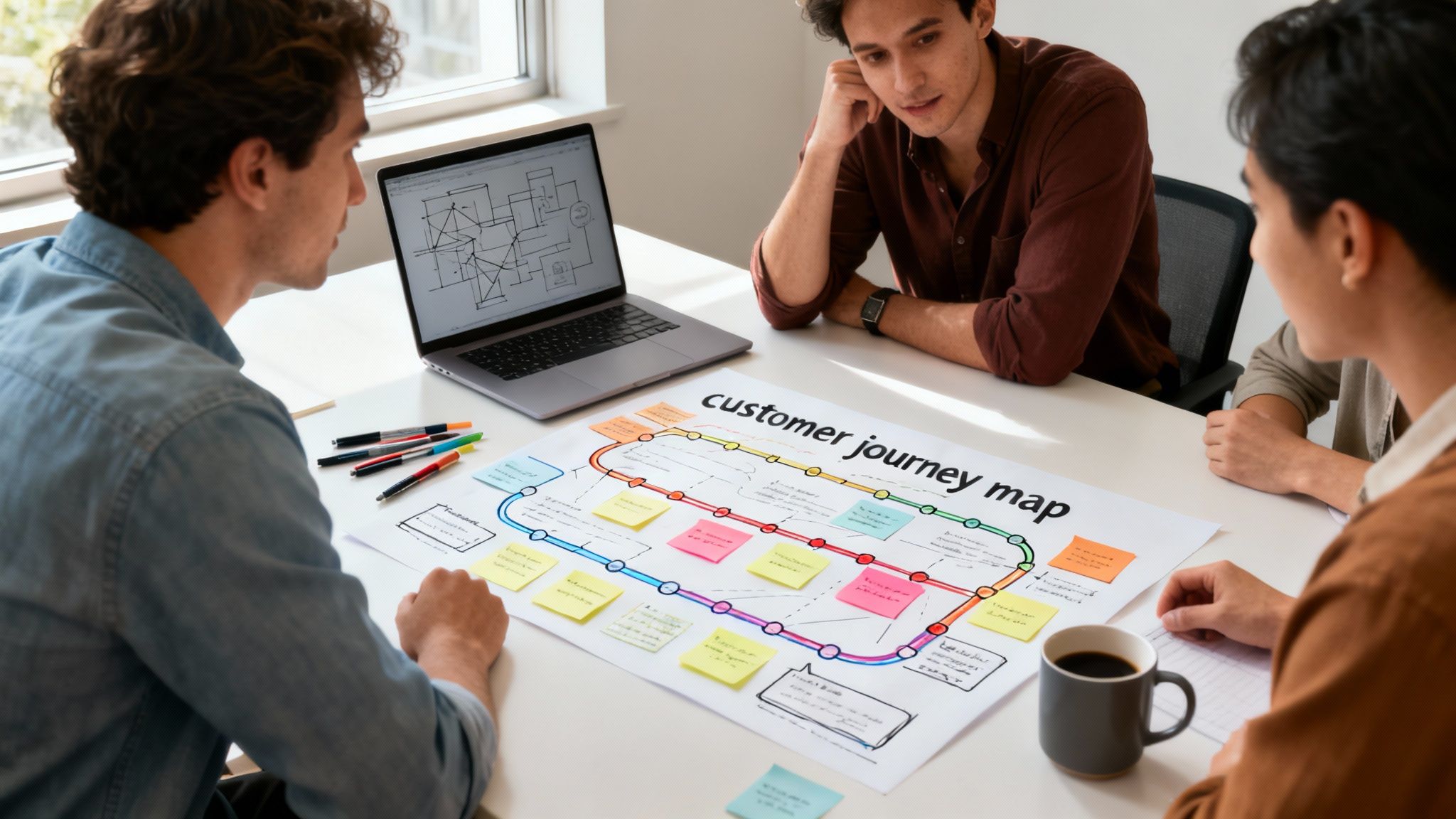
Think of customer experience journey mapping as creating a visual story of every interaction a person has with your business. For a busy founder, it's a powerful tool to understand why users drop off or churn. It helps you pinpoint the exact moments of frustration and, just as importantly, the moments of delight that create loyal customers.
This guide moves you from guesswork to making sharp, data-backed decisions that improve retention and grow your bottom line.
Why Journey Mapping is a Founder's Secret Weapon for Growth

As a founder in the UAE or MENA, your resources are precious. You can't afford to waste time and money on features that don't move the needle. Journey mapping turns vague user feedback into a clear, actionable roadmap for growth.
It's not about drawing a pretty diagram. It's about stepping into your customer's shoes to see your business as they do. By mapping their experience—from first hearing your name to becoming a loyal fan—you uncover the hidden friction that kills conversions and the 'wow' moments that create superfans.
Uncover the 'Why' Behind Your Numbers
Your analytics tell you what is happening. For instance, you see that 30% of users abandon their cart. A journey map helps you discover why.
Imagine you run a Dubai-based e-commerce app. A journey map might reveal a massive drop-off at the payment step. The map, combined with user feedback, shows the culprit: a lack of local payment options like Tabby or Tamara is forcing users to bail. That single insight points you to a high-impact fix.
"A journey map is a story about your customer's experience. It doesn't just show you the path they take; it reveals their feelings, motivations, and frustrations at every single step. This is where the real opportunities for growth are found."
This focus on the customer's real-world experience is now critical in the region. The Middle East and Africa Customer Journey Analytics market is projected to leap from USD 1.28 billion in 2022 to over USD 5.19 billion by 2030. This growth shows that loyalty is won on experience, not just price. You can explore the research on the MENA customer journey market to understand this shift.
Align Your Team and Spend Money Wisely
For a lean startup, having your whole team pulling in the same direction is vital. A customer journey map acts as a single source of truth, aligning your product, marketing, and support teams with a shared understanding of the customer.
When everyone sees the same pain points, arguments over priorities fade. Instead of debating based on opinions, you can focus your limited budget on fixing the problems that truly matter to customers. It ensures every dirham you spend is a direct investment in a better experience.
Step 1: Lay the Groundwork for a Winning Map
A great journey map starts before you pick up a sticky note. The quality of your prep work dictates the quality of your insights. For a busy founder, this means a few focused, practical steps to set your team up for a productive session. Jumping in without a clear goal is like driving from Dubai to Riyadh without a map—you'll waste time and resources.
This prep phase boils down to three things: a sharp goal, a realistic customer persona, and gathering raw customer feedback.
Set a Laser-Focused Goal
First, decide exactly what you’re trying to achieve. A vague goal like "improve the customer experience" leads to a vague, unusable map. You need a specific, measurable objective tied to a real business problem.
This transforms journey mapping from an academic exercise into a strategic tool for growth. A sharp goal aligns your team and provides a clear finish line.
Actionable Goal Examples for MENA Startups:
- SaaS: "Map our free trial onboarding to reduce user drop-off by 20% in Q3."
- E-commerce: "Understand the post-purchase journey to increase repeat customers by 15% in six months."
- Fintech: "Detail the KYC verification journey to decrease support tickets related to document rejection by 30%."
Founder's Next Action: Before scheduling a workshop, write one clear, measurable goal for your mapping session. Frame it as a problem you're solving and put it in the meeting invitation so everyone arrives aligned.
Create a Simple, Realistic Persona
You can't map a journey without knowing who's taking it. You don’t need a 10-page dossier. A simple proto-persona—a quick sketch of your target customer based on what you already know—is enough to start.
Crucially, ground your persona in local reality. An expat professional in Dubai has different expectations than a young creative in Riyadh. Getting this nuance right makes your map accurate and useful.
Build a Quick Proto-Persona:
- Who are they? (e.g., 'Amal, a 28-year-old marketing manager in Riyadh')
- What is their primary goal? (e.g., 'To find a reliable, locally sourced meal delivery service.')
- What are their biggest frustrations? (e.g., 'Delivery apps are often late, and food quality is inconsistent.')
- How do they discover new services? (e.g., 'Through Instagram influencers and WhatsApp recommendations.')
For more detail, our guide on the 5 steps to define your target customers in the UAE can help you build a relevant persona.
Gather Raw Materials (No Data Team Needed)
Now, bring the "voice of the customer" into the room. Even early-stage startups have more data than they realize. The goal is to collect real customer language and feedback. Forget complex analytics for a moment; focus on the qualitative comments that reveal emotion and context.
Pre-Workshop Checklist:
- Support Chats: Pull transcripts from WhatsApp or your website chat. Look for recurring questions and frustrations.
- Early Customer Emails: Reread the first emails you exchanged with initial users. What did they ask?
- Social Media Comments & DMs: What are people saying in your Instagram comments? This is often unfiltered, honest feedback.
- App Store Reviews: A goldmine of pain points and feature requests.
Collect these snippets in a shared document. This becomes the evidence your team will use, keeping the conversation grounded in real customer experiences, not internal assumptions.
Step 2: How To Build Your First Customer Journey Map
You've done the prep work. Now it's time to turn that thinking into a visual story. This is where you and your team get hands-on, stepping into your customer's shoes to trace their path, one interaction at a time.
Don't aim for a perfect document. The goal is to create a working tool that shows you where the quick wins are. It's about building empathy and discovering how people actually interact with your business.
Before we dive in, this visual frames the prep work you've just done.
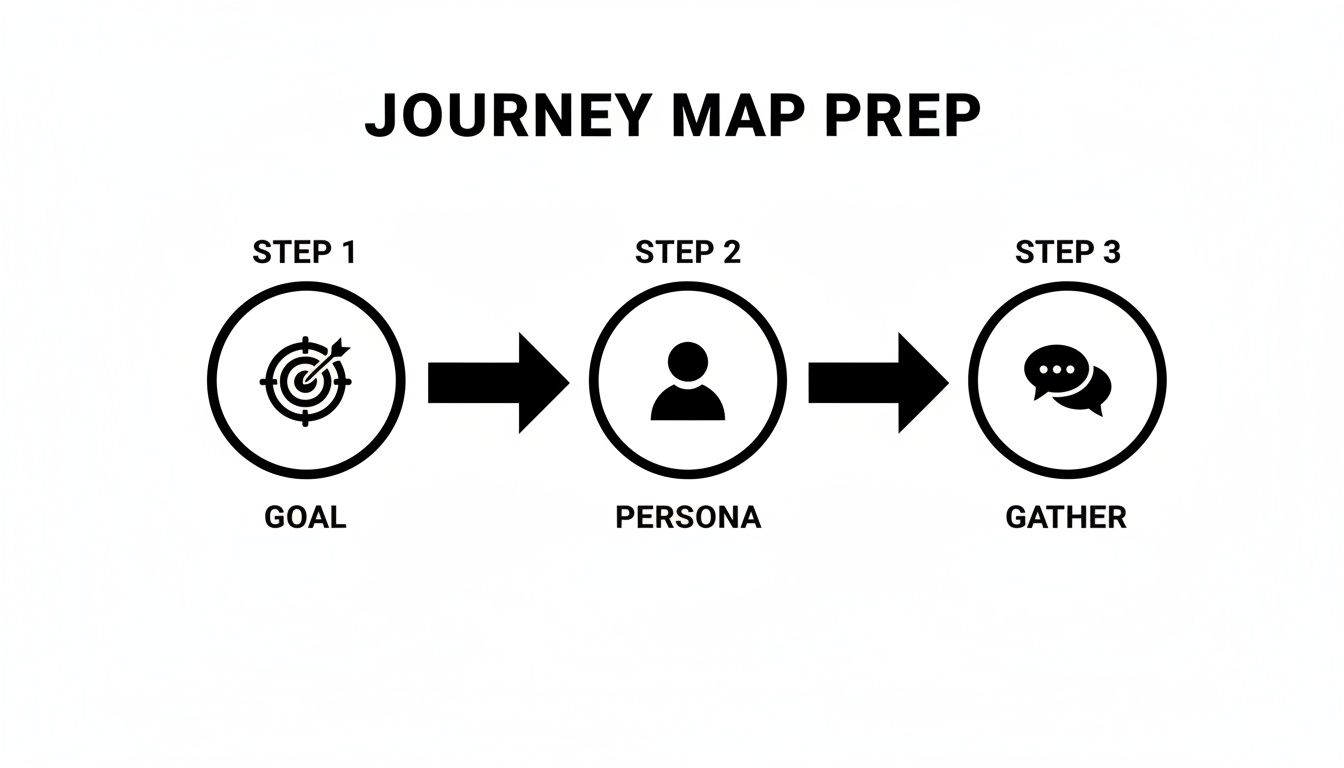
A solid journey map is built on a clear goal, a well-defined persona, and real data. Get those right, and the rest falls into place.
Defining the Key Stages of the Journey
First, outline the major phases your customer moves through. Think of these as the main chapters in their story. Keep it simple and aim for five to seven distinct stages.
A Classic Framework:
- Awareness: The "aha!" moment. A potential customer realizes they have a problem and finds your startup. How did they find you?
- Consideration: They're doing their homework, comparing you to others and reading reviews.
- Purchase/Conversion: The moment of truth. This could be checking out or signing up for a trial.
- Service/Onboarding: They've bought in. What happens next? This could be the unboxing experience or the setup flow for an app.
- Loyalty/Advocacy: What keeps them coming back? This covers repeat business, leaving reviews, and referrals.
Founder's Next Action: Gather your team around a whiteboard (digital or physical). Agree on the 5-7 core stages for your business. Write them horizontally across the top—this forms the skeleton of your map.
Identifying Every Customer Touchpoint
Next, add every point where a customer interacts with your brand. These touchpoints are the specific moments within each stage. Getting detailed here is how you find hidden roadblocks.
For a Dubai-based fashion startup, 'Consideration' stage touchpoints might include:
- Seeing a targeted Instagram ad.
- Clicking through to a product page.
- Using the online sizing guide.
- Scrolling through customer reviews.
- Asking a question on live chat.
- Checking delivery costs to different Emirates.
If you use third-party support teams, mapping external interactions is even more critical. There's helpful guidance on customer journey mapping for brands using outsourced CX partners to manage those relationships.
Charting Actions, Thoughts, and Emotions
This is where the map comes to life. For every touchpoint, fill in three crucial details:
- Actions: What is the customer physically doing? Be precise. Not "visits website," but "clicks Instagram ad, lands on product page, scrolls through images."
- Thoughts: What’s going through their head? Use your customer data. It could be, "Is this good quality?" or "Why do they need my phone number?"
- Emotions: How are they feeling? Use simple words: curious, excited, confused, frustrated. A simple line graph or emojis can make this clear at a glance.
This exercise forces you out of your own head and into the customer’s, highlighting the emotional journey that defines their perception of your brand.
Pinpointing Pain Points and Moments of Truth
Now for the most valuable part. As you fill in the map, two things will jump out:
- Pain Points: Moments of friction, frustration, and confusion. A slow-loading site or a difficult returns process are classic examples. Circle these in red. They form your immediate to-do list.
- Moments of Truth: Make-or-break interactions with a huge impact. A seamless checkout can create a fan for life. A negative one can send them to a competitor.
For a MENA fintech app, identity verification is a huge moment of truth. If it’s slow and buggy, you’ve lost trust. If it’s instant and seamless, you’ve won a customer.
Knowing where these moments are helps you put resources where they’ll have the biggest impact. It also guides your tech choices, as the right tools are critical. You can explore top martech platforms and marketing technology solutions that are built to smooth out these interactions.
Step 3: From Map to Action—Prioritizing What Matters
You’ve got your journey map. But a map that gathers dust is useless. The real value is in the action it sparks. This is where you shift from thinking to doing—turning observations into experiments that move the needle.
Staring at a wall of pain points can feel overwhelming. The secret is to resist fixing everything at once. It's all about ruthless prioritization.
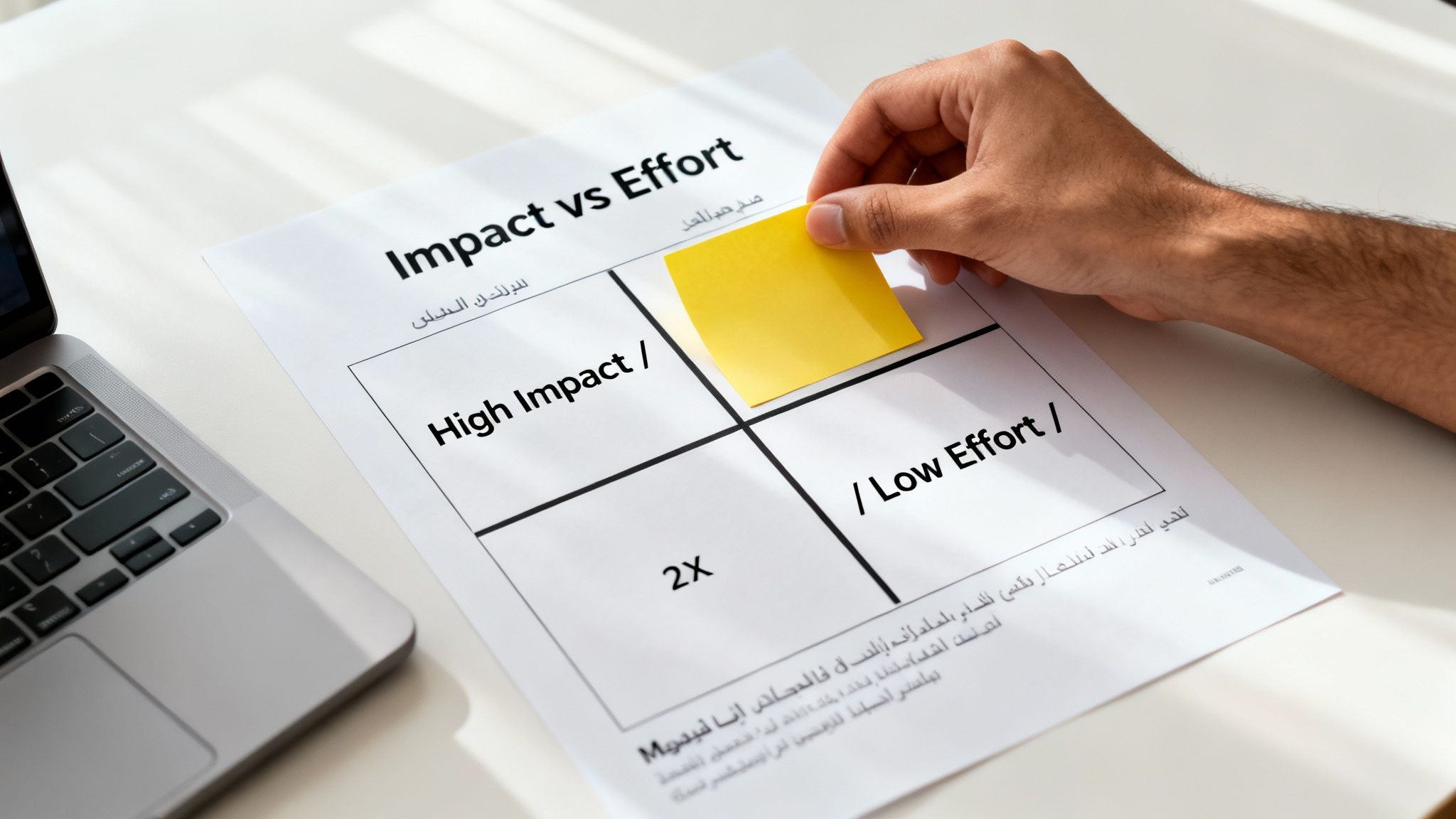
Prioritize With The Impact vs Effort Matrix
Use a simple but powerful tool: the Impact vs Effort matrix. This framework helps you sort ideas into four buckets, giving you a clear roadmap for what to tackle first. Plot every opportunity from your map based on how much impact it will have on the customer and how much effort it will take from your team.
This tool is a lifesaver for founders. It forces you to be honest about your resources and focus your energy where it counts.
The Impact vs Effort Prioritization Framework
This visual tool helps founders quickly categorize and prioritize actions from their journey map.
Priority QuadrantDescriptionExample Action for a UAE StartupHigh Impact, Low Effort (Quick Wins)These are goldmines. Simple, fast changes with noticeable improvement. Do these now.Add a direct WhatsApp support link to all order confirmation emails.High Impact, High Effort (Major Projects)Game-changing initiatives that need serious planning and resources. Think big strategic bets.Build a fully localized Arabic version of your app, including right-to-left UI.Low Impact, Low Effort (Fill-ins)Small tweaks to do when you have spare time. They won't move the needle significantly.Update the font on your 'About Us' page.Low Impact, High Effort (Time Sinks)The classic startup trap. These ideas eat up time and resources for almost no reward. Avoid them.Overhaul your internal reporting dashboard before validating if it's a real problem.
By categorizing each opportunity, you create a clear action plan. The 'Quick Wins' quadrant becomes your immediate to-do list, delivering immediate value to customers.
From Vague Insight to Testable Hypothesis
You have your priorities. But "Users are confused at checkout" is too vague. Sharpen it into a testable hypothesis using this format: "If we [implement a specific change], then [a specific outcome will occur], because [reasoning]."
Let's turn that checkout issue into an experiment for a UAE e-commerce store:
- Vague Insight: Users are confused at checkout.
- Testable Hypothesis: "If we add Tabby and Tamara as prominent payment options on our checkout page, we will increase our checkout conversion rate by 15% in 30 days, because it removes a major payment friction point for our target demographic."
Now you have a clear action, a specific metric, a timeframe, and a reason why it should work. This disciplined approach builds a real growth engine. For more frameworks, check out our guide on creating a startup growth strategy generator.
Founder’s Next Action: Take the top three 'Quick Wins' from your matrix. For each, write a clear, testable hypothesis using the "If... then... because..." format. Assign an owner and a deadline to each experiment.
Leveraging Technology to Execute Your Plays
Once your hypotheses are ready, technology helps bring them to life. The market for customer journey mapping software is expected to grow from USD 16.8 billion in 2025 to USD 76.2 billion by 2035. This growth makes powerful tools more accessible than ever.
If your map revealed a support bottleneck, an automated chat tool could be a high-impact, low-effort solution. To see how these tools solve specific problems, you can Review illumichat's customer experience use cases. This is how your map becomes a dynamic playbook for growth.
Step 4: Keeping Your Journey Map Relevant and Effective
You've built your map. The real work starts now. The biggest mistake is treating it as a one-off project. A great journey map is a living tool wired into your startup's operating system. To make that happen, you must connect its insights directly to the hard numbers that define your business's health.
The goal is to draw a straight line from a customer’s frustration on your map to a real number on your dashboard.
Connect Your Map to Core Business Metrics
Your journey map becomes a strategic weapon when its insights influence your Key Performance Indicators (KPIs). It provides the why behind the numbers.
Link Your Map to Metrics Founders Obsess Over:
- Customer Acquisition Cost (CAC): Does your map show confusion during the 'Consideration' stage? That friction is likely increasing your ad spend. Fix the confusion—clarify your pricing or value prop—and you should see your CAC drop.
- Lifetime Value (LTV): A clunky onboarding process or poor post-purchase support kills LTV. Improving these touchpoints in the 'Loyalty' stage is the most direct way to increase it.
- Churn Rate: High churn is a symptom of unresolved pain points. By tagging support tickets to issues on your map, you can measure the impact of your fixes on retention. A smoother experience means fewer reasons to leave.
Your journey mapping efforts must create a direct feedback loop. You take an action based on the map and see a measurable change in a core metric. If not, you've either fixed the wrong problem or are measuring the wrong thing.
The customer experience management market in the Middle East and Africa was valued at USD 639.7 million in 2023 and is on track to hit USD 1,823.0 million by 2030. Standing still means falling behind. You can discover more insights about the MENA customer experience market to understand the competitive pressure.
Establish a Regular Review Cadence
To keep your map from becoming obsolete, it needs a regular health check. A simple quarterly review cycle works best. It’s frequent enough to keep the map current without creating administrative drag.
A quarterly review is a focused refresh, not a complete redo. Ask your team these questions:
- What have we learned? Dive into the last 90 days of data. What are the new trends in support tickets or user feedback? Update the map with new pain points or moments of delight.
- What has changed in our business? Did you launch a new feature or expand into a new market like KSA? Your map must reflect how these changes alter the customer's journey.
- Are our assumptions still correct? Revisit your persona. Is 'Amal from Riyadh' still your core customer, or has a new segment emerged?
This process ensures your journey map remains a reliable, strategic tool that fuels real growth.
Common Journey Mapping Questions From MENA Founders
Here are practical answers to common queries we hear from founders across the UAE, KSA, and the wider region.
How often should an early-stage startup update its journey map?
At least quarterly, or after any major product or market change. A map is a living document. If you expand your service from the UAE into Saudi Arabia, you must map that new customer's journey, as their payment preferences, delivery expectations, and cultural nuances will be different.
What if I don’t have enough data for a journey map?
You don't need "big data." Your first 10-20 customer conversations are gold. Start with what you have:
- Support Emails: What are the recurring questions or complaints?
- WhatsApp Chats: Where do customers get stuck in real-time?
- Direct Feedback: What did your first users tell you during initial demos?
Your first map will be a mix of real insights and educated guesses. That's fine. An 80% complete map today is better than waiting for perfect data that may never come.
What’s the biggest mistake founders make when journey mapping?
Mapping the journey from an internal, company-first perspective instead of the customer's. Founders often map the ideal path they want customers to take, not the messy, real-world route they actually follow.
To avoid this trap, constantly pull in direct customer quotes, reference specific support tickets, and challenge every assumption with one question: "Are we guessing, or do we have evidence for this?"
This habit keeps the exercise grounded in reality and ensures your insights lead to meaningful changes.
Can I create a journey map as a solo founder?
Absolutely. The trick is to consciously step outside your own head. Before you start, immerse yourself in your customer's world by reading every support email and online review. Use a digital whiteboard like Miro or FigJam to visualize your thoughts.
Critically, get an outside perspective. Show your draft map to a peer group, mentor, or trusted advisor for a sanity check. This external feedback will shine a light on blind spots.
At Founder Connects, we believe that founders build stronger businesses together. Our private community is designed around curated peer groups and intentional introductions, providing the practical support and accountability you need to turn insights like these into real progress. Join the waitlist to connect with your trusted circle.

Building in MENA? You don't have to do it alone.
Join 300+ founders in the Founder Connects Residency. Monthly squad calls, warm intros, $3M+ in perks, and much more. All for less than your monthly coffee budget.
Popular posts





Founder Connects is a premium MENA tech founder community. Meetups in Dubai and across MENA, Residency Squads of 8–10, and 400+ vetted WhatsApp founders (apply and screened).