

Your Dubai Business Network: 7 Top Founder Groups for 2026

Building in MENA? You don't have to do it alone.
Join 300+ founders in the Founder Connects Residency. Monthly squad calls, warm intros, $3M+ in perks, and much more. All for less than your monthly coffee budget.

Which Dubai business network will help this quarter, and which one will just fill your calendar?
Dubai has plenty of access. The primary filter is fit. Founders usually join a network for one of three reasons: peer accountability, investor or corporate access, or steady B2B referrals. If you do not know which of those you need right now, almost any room will feel productive for an hour and disappointing a week later.
That signal versus noise gap is wider in Dubai because the city attracts everyone from first-time founders to corporate dealmakers to service providers hunting leads. Large open-access communities can be useful if your goal is volume and visibility. Curated, high-trust groups are better when you need honest feedback, warm introductions, or a smaller circle that keeps showing up.
I have found that the fastest way to judge a network is to treat it like a channel decision. Ask what job it does, how members are filtered, and what happens after the event. A founder dinner with the right twelve people can outperform a ballroom breakfast if you need candid advice or investor context. If you want to leverage your second-degree connections, smaller rooms usually create better follow-through than broad mixers.
This matters even more if you are building a local business presence in Dubai. The city rewards speed, but it also punishes vague networking. Time spent in the wrong community does not just waste evenings. It delays hires, slows partnerships, and sends founders toward low-value conversations that look active on paper.
If you want a practical starting point, this guide to building a strong startup network in Dubai lays out the basics well. The rest of this list focuses on a narrower question: which networks are built for trust, which are built for reach, and which are worth a founder's time.
1. Founder Connects
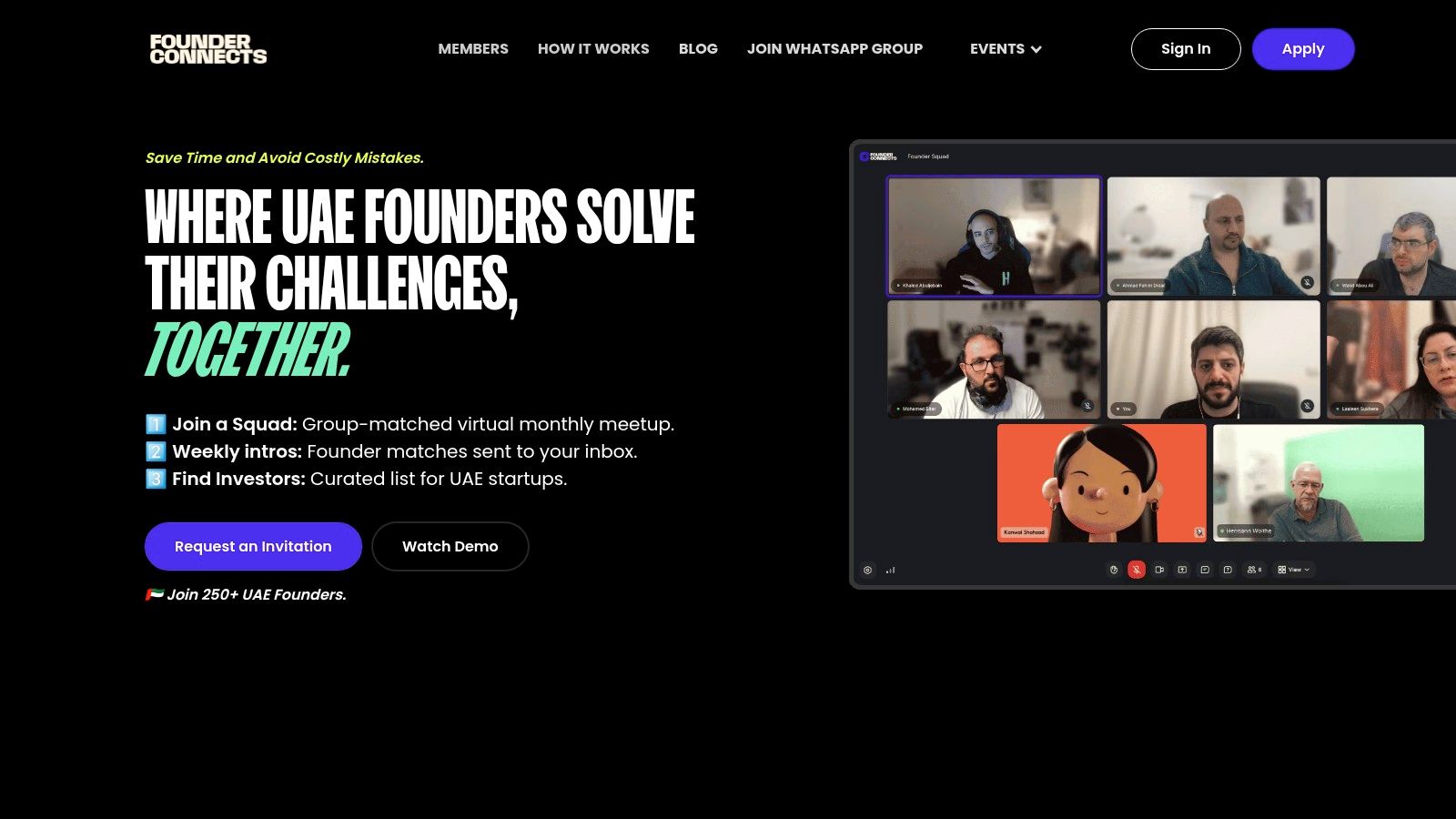
Need sharper conversations, or just a bigger room?
Founder Connects suits founders who already know broad access is not the problem. The problem is relevance. In Dubai, plenty of communities can fill a calendar. Far fewer can put you in recurring contact with people who can challenge your thinking, make a useful introduction, or stay involved after the event ends.
That is the primary filter here. If your goal is peer accountability, this network has a clear edge over open-access groups built around turnout.
Why it stands out
Founder Connects runs on smaller, moderated groups and curated one-to-one introductions. That changes the quality of interaction. Instead of spending an evening sorting through loose conversations, founders enter a structure designed for follow-through.
I rate networks on three questions. Who gets in. What kind of conversation the format creates. What happens after the first meeting. Founder Connects scores well on all three because it screens for founder relevance, keeps groups small enough for honest discussion, and extends the relationship through warm intros and ongoing touchpoints.
That matters if you are working through decisions that do not benefit from public posturing. Pricing. Co-founder friction. A stalled enterprise sale. A raise that needs context, not just exposure.
Where it fits best
This is a better fit for founders who want fewer conversations with higher expected value.
- Peer accountability: The squad model works well for founders who need regular pressure-testing and operator feedback, not occasional inspiration.
- Targeted introductions: Curated intros are more useful than general mixers when you are trying to reach specific partners, customers, or investors.
- Local operating context: The conversations tend to be more useful when your questions are tied to UAE and MENA realities, such as hiring, GTM, regulation, or fundraising norms.
Founders who get the most from it usually show up with a defined ask. "I need five random contacts" is weak. "I need intros to two B2B founders selling into regulated sectors" gives the network something practical to work with.
If you want a more tactical starting point, their guide on how to build a strong startup network in Dubai is useful for setting expectations before you join anything.
A second smart move is to leverage your second-degree connections. Founder Connects follows that same logic. It favors trusted paths over cold, high-volume networking.
Trade-offs to know
This network asks for participation. Founders who attend once, stay passive, and wait for value to arrive will get less from it than they expect. The upside comes from consistency and specificity.
There is also some friction in the process. Pricing is not fully transparent on the public side, and you may need to apply or request an invitation before you can judge fit. I do not see that as a flaw by default. In founder communities, a little gatekeeping often improves the room.
If your priority is broad market access across industries, trade groups, and established commercial players, a Dubai Chamber of Commerce directory breakdown is the better next reference point. If your priority is trust, candor, and introductions that continue past one event, Founder Connects is the stronger option.
2. Dubai Chambers Business Groups and Business Councils
Dubai Chambers is the institutional option. If Founder Connects is where you go for trusted founder-level signal, Dubai Chambers is where you go when you need broad commercial reach, policy context, and a seat near established industry players.
This network works best when your business depends on sectors, trade flows, procurement relationships, or government-adjacent visibility. It’s less intimate, but often more useful for mainstream B2B.
Where it works well
Dubai Chambers operates through sector-specific Business Groups and country-focused Business Councils. That structure gives you a practical route into existing industries rather than just the startup scene.
If your company sells into logistics, construction, retail, professional services, manufacturing, or cross-border trade, that matters. You’re not just meeting founders. You’re meeting operators, decision-makers, and representatives who already sit inside active commercial networks.
A smart starting point is this breakdown of the Dubai Chamber of Commerce directory, which helps you identify the right group before you start attending events blindly.
What founders often get wrong
Founders sometimes join chambers expecting founder intimacy. That’s not what this is. The value is in credibility, continuity, and access to industry-specific forums that can open doors to B2B conversations at scale.
Use Dubai Chambers if you need:
- Industry access: Better for established sectors than startup-only circles.
- Policy signal: Useful when regulations or sector dynamics affect your sales process.
- Credibility: Helpful when you’re building trust with larger companies or cross-border partners.
The weakness is activity quality can vary by group. Some councils are active and commercially useful. Others feel more ceremonial. You have to choose carefully.
Join the group where your buyers already spend time, not the group with the best brand name.
For a founder deciding between a curated dubai business network and a larger institutional one, the test is simple. If you need honest peer support, this won’t replace a founder circle. If you need business-facing legitimacy and broader market access, it’s often one of the better doors to walk through.
3. DIFC Innovation Hub
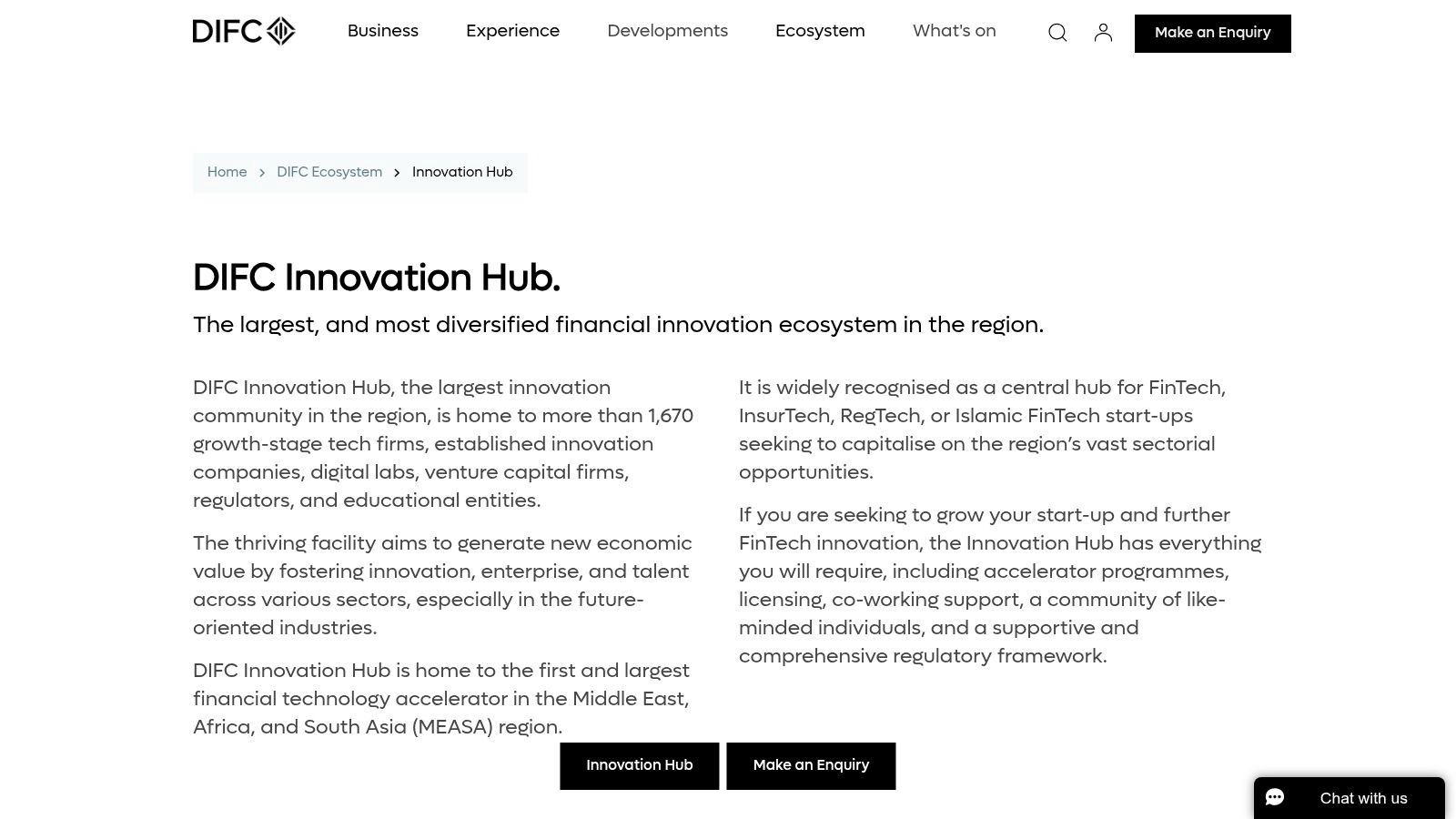
Need investor proximity, regulated-market context, or direct access to enterprise buyers in financial services?
DIFC Innovation Hub is one of the few places in Dubai where the network value comes less from event volume and more from who is already operating inside the ecosystem. For the right company, that cuts a lot of noise. You spend less time sorting through broad startup communities and more time getting into rooms with banks, funds, compliance stakeholders, and corporate innovation teams that are relevant to your sales cycle.
That only matters if your business fits the environment. Fintech, regtech, insurtech, cybersecurity, and enterprise software companies selling into regulated institutions usually have a clearer reason to be here than generalist startups.
Key advantage
DIFC works best when trust needs to be established before the commercial conversation even starts. In regulated sectors, buyers often screen for context as much as product. They want to know whether you understand procurement, compliance, licensing, data handling, and the pace of institutional decision-making.
That is why I would not treat DIFC as a general dubai business network. It is a high-trust, sector-specific environment. Founders who join for signal tend to do well. Founders who join for generic exposure often overpay in time, cost, and complexity.
A simple filter helps. Use DIFC if you need one or more of these:
- Investor relevance: Better suited to founders looking for finance-linked investors, strategic capital, or introductions tied to regulated sectors.
- Enterprise access: Useful if your target customers are banks, insurers, wealth platforms, or large institutions with formal buying processes.
- Regulatory context: Strong fit when product adoption depends on close contact with legal, compliance, or market-structure stakeholders.
If you are weighing platform fit at the pre-seed stage, this comparison of Hub71 vs DIFC vs AREA 2071 for pre-seed founders gives a more practical breakdown.
Trade-offs founders should price in
DIFC is not built for founder intimacy. It is built for strategic proximity. That is a different proposition.
The upside is sharper commercial relevance. The downside is more friction. You may face longer setup cycles, more formal processes, and a network experience that feels institutional rather than communal. For some founders, that is exactly the point. For others, especially consumer brands, lifestyle businesses, and non-specialist SMEs, the return is often weak.
I usually frame it this way. If your next milestone depends on trust, compliance fluency, and enterprise-grade relationships, DIFC can save months. If your next milestone depends on candid peer support, early experimentation, or broad local visibility, a more curated founder community will likely produce better signal.
4. TiE Dubai

TiE Dubai sits in a useful middle ground. It’s more founder-oriented than a chamber, more mentor-led than a peer accountability circle, and more structured than most open meetup communities.
That makes it a solid choice for founders who need guidance and visibility at the same time.
What TiE does well
The biggest strength is the mentor bench. TiE’s charter network, educational programming, and investor-facing activities make it practical for first-time founders who need calibration, not just contacts.
A lot of founders in Dubai join communities too late in the learning curve. They start networking aggressively before they’ve tightened the story, sharpened the ask, or validated the right market narrative. TiE is useful because the format often gives you access to people who can help correct that before you burn too many introductions.
Its global footprint also helps if your company is using Dubai as a regional base rather than the end market. Cross-border spillover is one of TiE’s better, and often underrated, advantages.
Where it fits best
TiE Dubai tends to work for these profiles:
- First-time founders: Good if you need mentor-led feedback on positioning, fundraising, or growth decisions.
- Cross-border builders: Useful when your path includes India, wider MENA, or other TiE chapter markets.
- Founder-operators who learn in public settings: Workshops, talks, and pitch-style formats can create useful exposure.
The downside is the quality of any given event depends heavily on the topic, room, and speaker mix. Some sessions are highly practical. Others are more inspirational than operational.
A mentor network is only valuable if you show up with a concrete problem. “Would love to connect” is not a use case.
Membership structure can also take a bit of sorting. Founders should get clear on what they want before joining. If you want recurring peer accountability, a mentor-led organisation won’t automatically give you that. If you want access to experienced operators and a broader entrepreneurial brand, TiE is a credible option.
5. Startup Grind Dubai
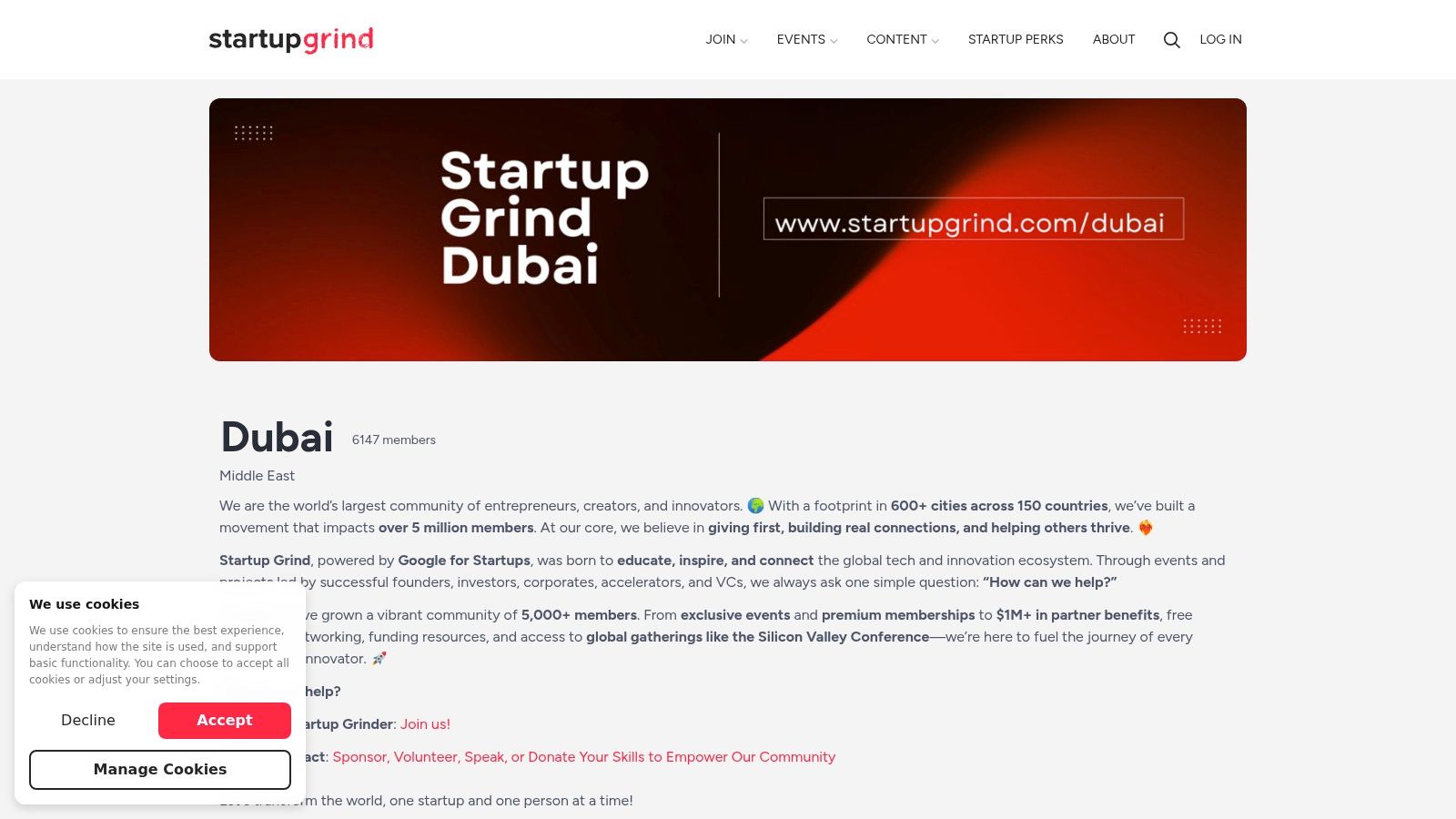
Startup Grind Dubai is the easiest entry point on this list. If you’re new to the city, new to startup ecosystems, or still figuring out where you fit, it’s one of the lowest-friction ways to start building a network.
That accessibility is both the advantage and the limitation.
Why founders join
Startup Grind works because it gives you a broad surface area. You get founder talks, investor appearances, meetups, workshops, and access to a global brand that many people already recognise.
For founders who’ve just landed in Dubai, that can be enough. You don’t always need the highest-signal room on day one. Sometimes you need a fast way to understand who’s active, which operators are worth following, and where the local startup conversation lives.
What to expect
This is a better fit for exploration than for precision.
- Good for breadth: You’ll meet founders across stages and sectors.
- Good for learning: The event format can help you absorb ecosystem context quickly.
- Good for global overlap: Useful if your plans include other Startup Grind markets.
It’s less effective if your need is highly specific. Open events naturally produce more noise. You’ll often have to do more filtering yourself.
That doesn’t make Startup Grind weak. It just means you should use it correctly. Treat it as an on-ramp, not as your only dubai business network.
Trade-offs in plain terms
If you’re disciplined, Startup Grind can be a useful discovery engine. Go in with a narrow target. Meet three relevant people. Leave. Don’t drift into passive attendance.
If you’re looking for a trusted small-group forum, this isn’t the default model. If you need warm investor prep, recurring accountability, or highly curated intros, you’ll likely need a second network layered on top.
The founders who get value here usually don’t try to “network with everyone”. They use one event to identify five people worth deeper follow-up.
6. BNI UAE Dubai chapters

BNI UAE is the most structured referral engine on this list. If your company sells a clear B2B service and you can explain your offer in one sentence, BNI can work well. If your sales cycle is long, technical, or exploratory, it often won’t.
That’s the trade-off. BNI isn’t trying to be a founder community. It’s trying to be a disciplined referral machine.
Where BNI performs
The one-seat-per-profession model reduces direct internal competition inside a chapter. That makes it easier for members to refer business without worrying they’re feeding a rival in the same room.
The weekly meeting structure also creates something many founders say they want but rarely commit to. Consistency. If you attend, do your one-to-ones, and make referrals, the system keeps relationships moving.
BNI is strongest for:
- Service businesses: Agencies, consultants, legal, finance, HR, operations, and other clear B2B offers.
- Founders who like process: The format rewards people who follow a repeatable routine.
- Referral-led growth: Good if word-of-mouth is already one of your strongest channels.
Where founders misread it
BNI isn’t ideal for every startup. Deep tech founders, venture-backed product companies, and startups selling into long enterprise procurement cycles can find the cadence awkward. Weekly attendance plus relationship maintenance is a serious commitment.
There’s also a chapter-quality issue. Some chapters are commercially sharp. Others are less aligned with your market. You should always visit first and observe how specific the referrals are.
If the room can’t describe your buyer clearly, it probably can’t refer you well.
For the right business, BNI can outperform looser communities because it forces discipline. For the wrong business, it becomes calendar debt. That’s why it belongs on a practical list of dubai business network options, but only with a clear warning label about fit.
7. Dubai Business Women Council DBWC
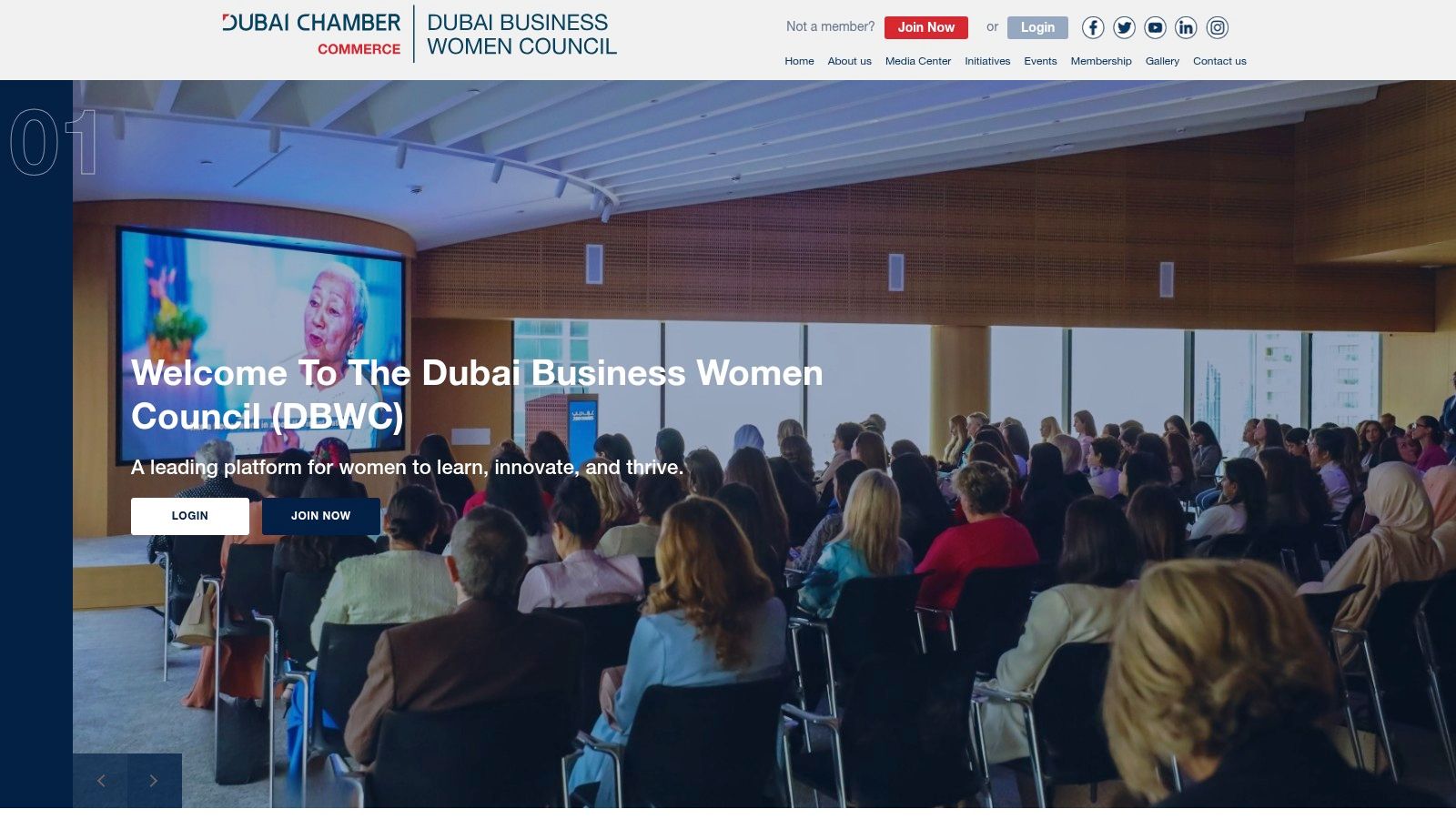
Dubai Business Women Council is one of the more credible long-running platforms for women founders and business leaders in Dubai. It combines official backing, business programming, and a cross-industry network that can be more useful than generic startup events.
For women founders in particular, that combination matters because not every founder problem is solved in a mixed, open-access networking room.
Why it earns a place here
DBWC has the institutional credibility many newer communities lack, but it’s still practical enough to matter for operators. Workshops, training sessions, mentorship, and partner-led programming create more than just visibility. They create repeated points of contact.
That’s often the difference between a network you remember and one that is effective. Repetition builds trust. Trust creates follow-up. Follow-up turns into intros, partnerships, hiring leads, and collaboration.
Best fit
DBWC makes sense for:
- Women founders and executives: Especially those who want both business development and leadership-oriented programming.
- Cross-industry operators: Useful if your customer or partner set spans beyond the startup world.
- Founders who value official ecosystem links: The Chamber alignment can help with credibility and broader business context.
The limitation is obvious. It’s purpose-built around women in business. That focus is the strength, but it also means mixed-gender founding teams may find some programming less directly aligned with their immediate operating needs.
Still, if your goal is a higher-trust environment with practical business relevance, DBWC is one of the more sensible choices in Dubai. It avoids some of the shallowness that creeps into broad networking culture and gives founders another route besides the usual startup circuit.
7 Dubai Business Networks Compared
| Network | 🔄 Implementation complexity | ⚡ Resource requirements | 📊 Expected outcomes | 💡 Ideal use cases | ⭐ Key advantages |
|---|---|---|---|---|---|
| Founder Connects | Moderate, invite/application + recurring moderated sessions | Time‑intensive: monthly 90‑min squads + weekly engagement; invite-only access | High, curated intros, collaborations, fundraising visibility (reported community outcomes) | UAE/MENA founders needing accountability, warm investor access and peer problem‑solving | Region‑first curation, small moderated groups, proven community metrics |
| Dubai Chambers – Business Groups & Councils | Low–Moderate, join sector or country groups; institutional processes | Organizational engagement and event attendance; group membership varies | Medium, policy influence, broad B2B matchmaking and credibility | Companies seeking advocacy, policy channels and mainstream industry connections | Official credibility, direct access to authorities and wide industry reach |
| DIFC Innovation Hub | Moderate–High, application, licensing and onboarding steps | Significant: licensing, on‑site presence and engagement with corporates/regulators | High for FinTech, investor access, corporate pilots and scale‑up support | FinTech/finance‑adjacent startups pursuing pilots, investors and regulatory proximity | Dense investor/corporate/regulator ecosystem and accelerator support |
| TiE Dubai | Low, chapter membership and event participation | Moderate, selecting membership tier and engaging mentors | Medium, structured mentorship, pitch exposure and cross‑border introductions | Founders seeking mentor‑driven support and global network access | Strong mentor bench and global TiE network for cross‑border spillover |
| Startup Grind Dubai | Low, open speaker events and meetups | Low, free access available; optional premium/global benefits | Medium, broad connections, learning and market soft‑landing support | Early‑to‑growth founders seeking networking, learning and exposure | Large global community, regular curated speaker events and partnerships |
| BNI UAE (Dubai chapters) | High, structured weekly meetings with formal referral process | High time commitment: weekly meetings, 1:1s and active referral work | High for B2B, predictable pipeline and repeatable lead generation | Founders with clear B2B/service offers who can commit to steady referrals | Repeatable referral system and strong accountability culture |
| Dubai Business Women Council (DBWC) | Low–Moderate, membership and program participation | Moderate, workshops, mentorship and event attendance | Medium, targeted support, skills development and cross‑industry connections | Women founders/leaders seeking mentorship, training and partner collaborations | Credible, women‑focused programming with strong partner perks |
Your Next Step A Simple Framework for Choosing
What do you need from a Dubai business network in the next 90 days?
That question matters more than the brand name on the invite. I have seen founders join several groups at once, attend a string of events, and still come away with no meaningful progress. The usual problem is not effort. It is weak fit between the room and the bottleneck.
Start with the job you need the network to do. If the goal is better decisions, look for high-trust rooms where people know your business well enough to challenge you. If the goal is pipeline, choose a format built for repetition, referrals, and follow-up. If the goal is investor access or enterprise relationships, spend time where those stakeholders already show up.
The signal versus noise test is simple. Smaller curated communities usually produce better context, stronger accountability, and more candid feedback. Larger open-access networks produce more volume, more surface-level conversations, and a wider top of funnel. Neither model is universally better. The right choice depends on what you need now.
Use this filter:
- Choose Founder Connects if you want a curated founder room with accountability, relevant introductions, and direct peer feedback.
- Choose BNI if you have a clear B2B offer and can commit to weekly meetings, 1:1s, and a disciplined referral process.
- Choose DIFC Innovation Hub if your company benefits from investor density, corporate access, or a finance-heavy ecosystem.
- Choose TiE Dubai if mentorship, founder education, and cross-border operator access matter most.
- Choose Dubai Chambers if your growth depends on industry relationships, trade access, or institutional credibility.
- Choose Startup Grind Dubai if you want a broad entry point and need to meet people across the ecosystem before committing deeper.
- Choose DBWC if women-focused programming, mentorship, and commercially useful connections are the priority.
Then make one clear move.
Apply to one group. Attend one event with one defined outcome. Ask the organizer a blunt question: who gets real value here, and who usually does not? That answer will tell you more than the event page.
A good Dubai business network should reduce noise, not add to it. The right room gives you either better decisions, better access, or better pipeline. If it does none of the three, it is probably just calendar filler.
If a curated founder community is the fit, Founder Connects is one of the more focused options for UAE and MENA founders who want accountability, trust, and relevant introductions rather than generic mixers.

Building in MENA? You don't have to do it alone.
Join 300+ founders in the Founder Connects Residency. Monthly squad calls, warm intros, $3M+ in perks, and much more. All for less than your monthly coffee budget.
Popular posts





Founder Connects is a premium MENA tech founder community. Meetups in Dubai and across MENA, Residency Squads of 8–10, and 400+ vetted WhatsApp founders (apply and screened).