

A Founder's Guide for an Entrepreneur in UAE

Building in MENA? You don't have to do it alone.
Join 300+ founders in the Founder Connects Residency. Monthly squad calls, warm intros, $3M+ in perks, and much more. All for less than your monthly coffee budget.

So, you’re thinking about setting up a business in the UAE. Good call. You’re looking at a place that’s buzzing with innovation, backed by smart regulations, and has a serious amount of capital and talent floating around.
But let's be honest, the hype can be overwhelming. This guide cuts through the noise. It’s a practical, no-fluff blueprint for founders in the UAE who need clear answers and actionable next steps.
Your Essential Blueprint for Launching in the UAE
Forget the generic advice. Setting up in the UAE is its own unique game, and knowing the local rules is your biggest advantage. This guide is your roadmap, built to answer the questions every founder has when they start out.
We're digging into the how. Think of this as your step-by-step manual, covering everything from the big legal decisions you’ll make on day one to how you’ll eventually pitch for your first round of funding.
What You Will Gain from This Guide
Your time is your most valuable asset. This guide is lean and scannable, focusing on the actionable insights you need right now.
Here’s a quick look at what we'll cover:
- Strategic Setup: A simple framework to help you choose between a mainland or free zone company. Getting this right from the start saves a world of headaches later.
- Operational Clarity: A straightforward walkthrough of getting your license, sorting out visas, and opening a corporate bank account without the usual runaround.
- Funding Roadmap: An inside look at the funding scene here—from local VCs and angel networks to government grants you might not know about.
- Market Opportunities: A breakdown of the sectors getting the most traction right now, so you can see where your idea fits into the UAE’s bigger picture.
Your next action: After reading this guide, create a personalized checklist based on our final section. This ensures you translate knowledge into immediate, tangible progress for your venture.
Choosing Your Foundation: Mainland vs Free Zone
Your first big decision as an entrepreneur in the UAE is where to legally plant your flag. This isn't just paperwork; it's a strategic choice that dictates who you can sell to, your ownership structure, and your company's growth potential. Let's break it down into a clear, actionable framework.
A Mainland company is your all-access pass to the entire UAE economy. It gives you the freedom to trade directly with any customer or business anywhere in the country, from Dubai to Abu Dhabi. If your primary customers are here in the UAE, this is likely your path.
A Free Zone company is a specialised global export hub. These designated economic areas offer key perks like 100% foreign ownership and tax exemptions, making them ideal for businesses serving international clients or those who don't need direct access to the local UAE market.
Where Will Your Customers Be?
The critical question is simple: where is your revenue coming from for the next 18-24 months? Your answer points directly to the right setup.
- Choose Mainland if: You are building a B2C app for local residents, launching a service-based business for UAE clients, opening a retail shop, or want to bid on lucrative government contracts. A mainland license is non-negotiable for these activities.
- Choose Free Zone if: You are a SaaS founder with customers in Europe, a media company with a global audience, or an e-commerce store shipping worldwide. It provides a strategic, cost-effective base for international operations.
Founder's Reality Check: Don't pick a Free Zone just because it seems cheaper or faster upfront. If your business model pivots to serve the local UAE market, you could hit a wall with operational restrictions or face the expensive headache of restructuring your entire company.
Matching Your Structure to Your Business Model
Your day-to-day operations also dictate the right choice. A Mainland setup sometimes requires a local service agent for specific regulated industries, though recent reforms have opened up 100% foreign ownership for most business activities. This structure fully integrates you into the local economy.
Free Zones are self-contained ecosystems. There are over 40 in the UAE, many specializing in specific industries—like tech, media, or finance. For example, Dubai Media City is a hub for creative agencies, while the Dubai International Financial Centre (DIFC) is a powerhouse for FinTech. This specialization gives you direct access to a dense network of peers, partners, and talent. For a deeper dive, check out our guide on the best UAE free zones for early-stage startups.
To help clarify this choice, here’s a quick comparison.
Mainland vs Free Zone at a Glance
FeatureMainland CompanyFree Zone CompanyMarket AccessUnrestricted access to the entire UAE marketRestricted to operating within the free zone and internationallyOwnershipUp to 100% foreign ownership for most activities100% foreign ownership is standardOffice SpacePhysical office space is often requiredFlexible options, including virtual offices and co-working spacesGovernment ContractsEligible to bid on government tendersGenerally not eligible to bid directly on government tendersVisasVisa eligibility is typically tied to office sizeVisa packages are usually included with the company setupCustoms DutyStandard import duties apply0% customs duty on goods imported into the free zoneBest ForB2C services, retail, trading within the UAE, government workGlobal B2B, SaaS, e-commerce, consulting, international trade
Ultimately, the right structure aligns with your business goals from day one. This decision tree can help you visualize the choice.
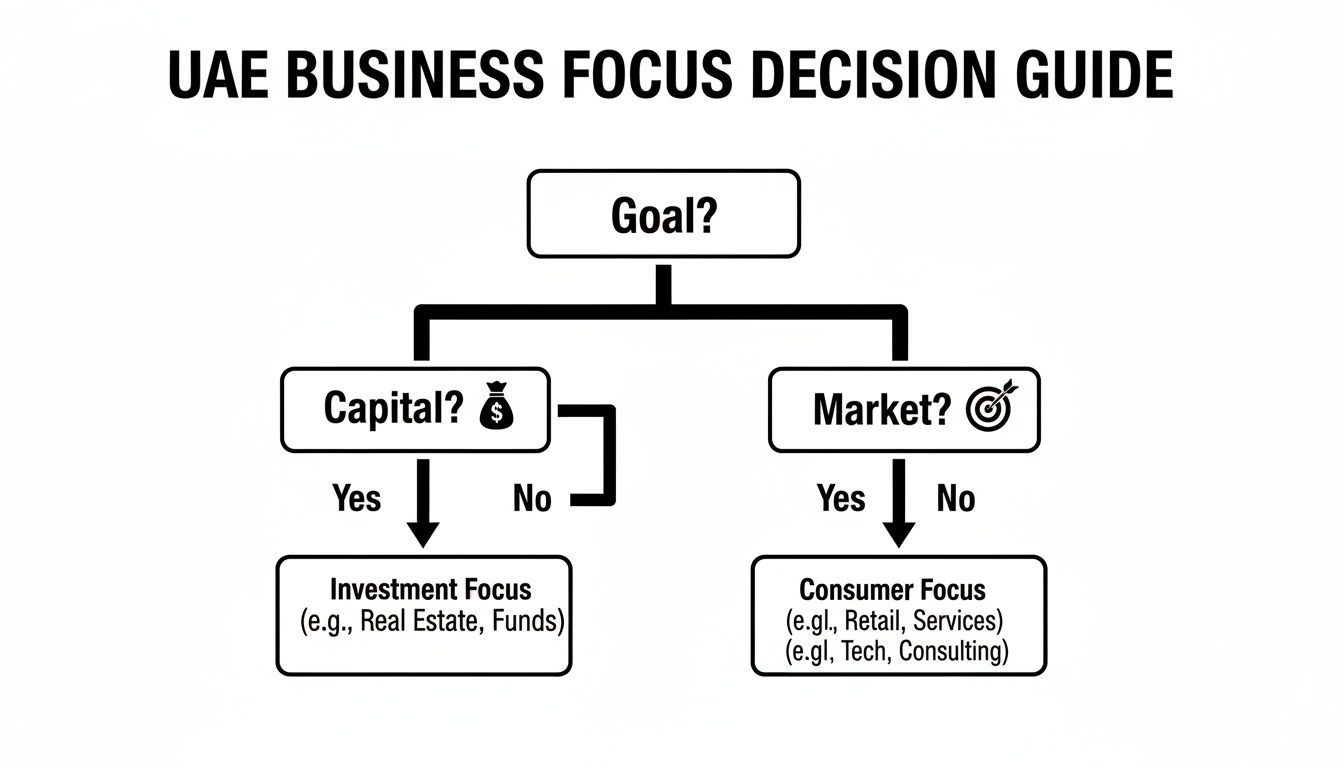
As the flowchart shows, the path you take is fundamentally tied to your core objective—whether that's deep market penetration within the UAE or using the nation as a springboard for international scale.
Your Next Action: A Simple Decision Framework
To make a confident decision, sit down with your co-founder this week and answer these three questions with complete clarity.
- Who is our primary customer for the next 18 months? (Be specific: individuals in the UAE, businesses across the MENA region, or global users?)
- What is our core business activity? (e.g., selling physical goods, providing digital services, consulting, trading.)
- Do we plan to seek government contracts or work with mainland-based distributors? (A simple 'yes' or 'no' here can make the decision for you.)
Answering these questions honestly provides a clear, logical reason for your choice, preventing costly pivots later and ensuring your legal structure supports, rather than hinders, your growth.
Navigating Licences, Visas, and Banking
You’ve chosen your path: mainland or free zone. Now it’s time to make it real. This stage boils down to three core administrative hurdles: securing your trade licence, arranging residency visas, and opening a corporate bank account. It might sound complex, but it's a clear, step-by-step process.
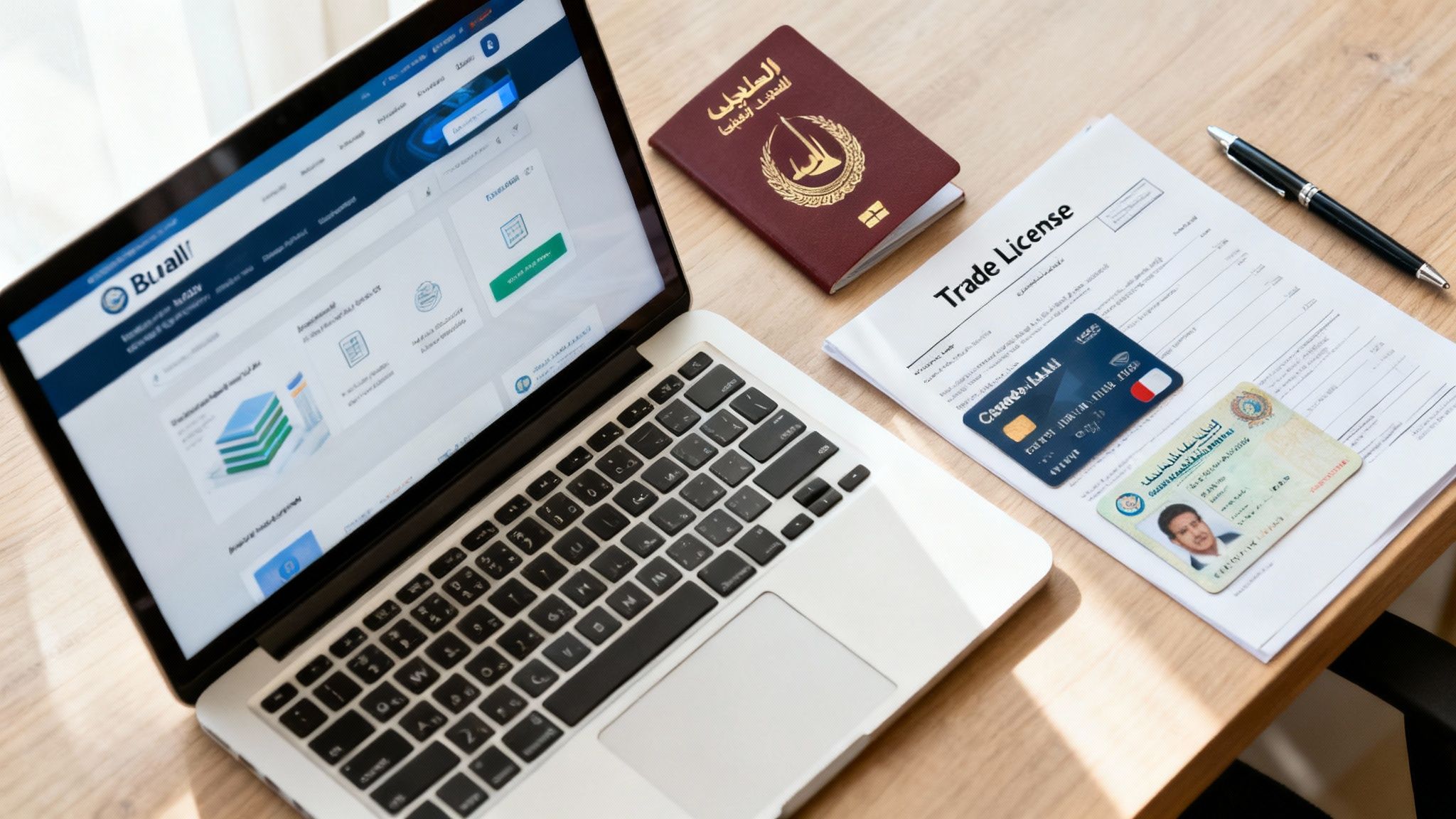
Success here isn’t about being a legal expert; it's about being organized and understanding the local process. Nail these steps, and you’ll have a solid operational foundation.
Securing Your Trade Licence
Your trade licence is your official permission to operate. For a mainland company, you'll work with the Department of Economy and Tourism (DET) in your chosen emirate. For a free zone company, you'll deal directly with that zone's authority.
The process typically involves three key steps:
- Initial Approval: The government gives a preliminary nod to your business name and activity.
- Document Submission: You'll provide shareholder passport copies, the application form, and a business plan.
- Final Issuance: After paying the fees, you receive the official licence, making your business a legal entity.
Actionable Tip: Ensure your business activities perfectly match what's on your licence. Operating outside this scope can lead to significant fines.
The Visa and Residency Process
With your company legally formed, the next step is securing residency for yourself and key team members. In the UAE, your company acts as the visa sponsor.
The process is straightforward: an application, a medical test, biometrics for the Emirates ID, and the visa stamp in your passport. Missing paperwork is the number one cause of delays, so be meticulous. Founders should also explore options beyond the standard employment visa. Get the full picture in our detailed UAE startup visa guide for pre-seed founders.
Crucial Tip for Founders: Your company’s visa allocation is often tied to the size of your office space. Before signing any lease, confirm it provides enough visa eligibility for your immediate and near-future hiring needs.
Opening Your Corporate Bank Account
This is often the most challenging step for a new entrepreneur in the UAE. Banks are extremely thorough with their Know Your Customer (KYC) checks. Expect the process to take several weeks, not days.
Get ahead by preparing these documents:
- Company Documents: Your trade licence, memorandum of association, and share certificates.
- Founder Documents: Passport, visa, and Emirates ID copies for all shareholders.
- Business Proof: A detailed business plan, information on potential customers or suppliers, and your professional background.
Banks want to see a legitimate, well-planned business. Be ready to answer detailed questions about your revenue model and operations. To understand your financial obligations from day one, read this comprehensive guide to VAT in UAE.
Your Next Action: If you hire a consultant for setup, vet them carefully. Ask them these three questions to gauge their expertise:
- Which bank do you have the strongest relationship with for startups in my industry?
- What is the most common reason you see for bank account application delays?
- Can you provide a complete, itemised breakdown of all government and service fees upfront?
Fueling Your Growth in the UAE Funding Landscape
Capital is the fuel for your startup. For an entrepreneur in the UAE, the funding scene is more accessible than ever, but it has its own unwritten rules. A successful fundraise requires more than a great pitch deck; it requires understanding the local ecosystem and building genuine relationships.
The momentum is undeniable. MENA-wide startup funding hit $6.6 billion year-to-date by Q3 2025. In September 2025 alone, 26 UAE startups raised a collective $704.3 million, demonstrating strong investor appetite in Dubai and Abu Dhabi. This is fueled by government-backed funds actively supporting innovation. You can read the full research about these funding trends to get a deeper sense of the market.
This section provides a practical guide to the capital sources available, from your first pre-seed check to growth-stage venture funds.
Understanding the Local Investor Mindset
Fundraising in the MENA region is heavily relationship-driven. A cold email to a VC partner has a near-zero chance of success. Investors here operate on trust, which is built through warm introductions from their network.
This means your first goal isn't asking for money; it's building credibility. Attend key ecosystem events, get introduced by other founders, and offer value before you ask for it.
Your Funding Spectrum From Early Cheques to Growth Capital
As your startup grows, your funding needs will evolve. Here’s a breakdown of the main sources of capital for a founder in the UAE.
- Angel Investors and Networks: Often the first to write checks at the pre-seed or seed stage. Networks like Dubai Angel Investors and WOMENA are great starting points, but many active angels operate privately.
- Accelerator Programmes: Programmes from players like Hub71 or Flat6Labs provide initial funding, mentorship, and a structured path to growth in exchange for equity. They are an excellent way to validate your idea and plug into the local scene.
- Venture Capital (VC) Funds: The UAE has a strong base of local and international VCs. Funds like BECO Capital, Shorooq Partners, and MEVP are active from seed to Series A and beyond, often with specific sector focuses like FinTech or SaaS.
- Government-Backed Funds: Do not overlook government initiatives. Entities like the Abu Dhabi Investment Office (ADIO) offer grants and non-dilutive funding to startups that align with the UAE’s strategic economic goals.
Key Insight: Local VCs want to see a clear plan for regional expansion. When you pitch, don't just talk about the UAE market. Show them how you'll use the country as a launchpad to scale across the entire MENA region.
Preparing for Your Fundraising Journey
Getting "investor-ready" means having your house in order and a targeted approach.
- Build a Target List: Research investors whose focus matches your industry, stage, and geography. Don't pitch a FinTech fund if you're building a D2C brand. Our guide on the top 5 funding sources for UAE tech startups in 2025 is a great starting point.
- Get Your Financials in Order: Have a clean cap table, realistic financial projections, and a deep understanding of your key metrics.
- Map Your Introduction Pathways: For every investor on your list, identify who in your network can make a warm introduction. This is the most critical step.
Investors will also scrutinize your sales process. To get that locked down, check out this localized guide to the best CRM software options in Dubai.
Your Next Action: Spend the next week creating a "dream list" of 10-15 ideal investors. For each one, identify at least one person you know who could make an introduction. This single exercise will transform your fundraising from a random effort into a focused, strategic campaign.
Tapping Into High Growth Market Opportunities

Getting your business set up is the start. The real question for an entrepreneur in the UAE is: where do you focus your energy? The country's economy is being intentionally shaped, with clear signals pointing towards several high-growth sectors.
Aligning your business with these national priorities gives you a powerful tailwind. This section moves from the how of setting up to the where of winning, focusing on industries with real market demand, strong government backing, and clear gaps waiting for smart founders.
The AI Gold Rush and Tech Innovation
Artificial intelligence has explosive potential in the UAE. UAE-based AI startups raised over $2.1 billion in the first half of 2025 alone—a 134% year-on-year increase. Abu Dhabi is becoming the region's AI hub, now home to 673 AI companies, with 150 new ones launching in the first six months of 2025.
This growth is driven by top-down government support. Abu Dhabi has pledged AED 13 billion ($3.5 billion) through its Digital Strategy 2025-2027, with the goal of becoming the world's first AI-native government by 2027. Initiatives like the UAE National AI Strategy 2031 make the ground fertile for startups. The biggest opportunities lie in applying AI to solve specific problems in logistics, healthcare, and finance. You can get a deeper sense of the MENA AI landscape over at Hub71.
FinTech and the Digital Economy
The UAE is rapidly moving towards a cashless society, creating massive opportunities for FinTech innovation. While payments are competitive, there is still ample room for founders to build in niche areas.
Consider these market gaps:
- WealthTech: Accessible platforms for asset management and investing, tailored to the region's growing affluent class.
- InsurTech: Smart, flexible insurance products that disrupt traditional, rigid offerings.
- RegTech: Solutions that help financial firms navigate complex compliance and regulation efficiently.
Homegrown successes like Tabby (Buy Now, Pay Later) and Sarwa (WealthTech) prove there is a huge appetite for tools that simplify finance. Your mission is to find a point of friction in someone's financial life and build the solution.
HealthTech and EdTech Modernising Core Services
The UAE is heavily investing in technology to modernize healthcare and education. The pandemic accelerated the adoption of digital solutions, creating lasting new consumer habits.
In HealthTech, the focus is on patient-centric care. This includes telehealth platforms, AI-powered diagnostic tools, and preventative wellness apps. The government's push for a world-class healthcare system provides a powerful tailwind for startups.
In EdTech, the opportunity has moved beyond basic online courses to personalized learning platforms, corporate upskilling solutions, and effective vocational training tools. Local success stories like Lamsa have demonstrated the power of creating culturally relevant, Arabic-first educational content.
Key Insight for Founders: Don't just build a generic tech product. The startups that win here deeply understand local needs. That could mean navigating Islamic finance principles in a FinTech app or creating Arabic-first content for an EdTech platform.
Your Next Action: An idea is just an idea until you validate it. Spend the next few days digging into ecosystem reports from platforms like Hub71 and Wamda. Cross-reference their findings on your target sector with your own vision. This research is invaluable for refining your business plan and investor conversations.
Building Your Team and Finding Your People
A startup is just an idea without the right people and the right network. For an entrepreneur in the UAE, success depends on building a killer team and plugging into an ecosystem that accelerates your growth. Founder isolation is real, but you don’t have to build in a vacuum here.
Finding great talent and finding your community are two sides of the same coin. Both require understanding the local landscape, from visa rules to the unwritten etiquette of networking.
Attracting and Keeping Top Talent
The UAE’s global talent pool is a massive advantage. It allows you to build a world-class team, but it also means you must be competitive in your hiring.
- Offer a Globally Competitive Package: Your compensation must stack up internationally. This includes a competitive salary, quality health insurance, and the mandatory end-of-service gratuity required by UAE Labour Law.
- Manage Visas Professionally: As the employer, you sponsor your team's residency visas. A smooth, efficient process creates an excellent first impression.
- Embrace Cultural Diversity: Your team will likely be a mix of nationalities. Fostering an inclusive culture is a powerful tool for innovation and retention.
Founder’s Tip: When hiring, look for adaptability and a global mindset. These are the individuals who will thrive in the fast-paced, multicultural environment of a UAE startup.
Finding Your Community in a Booming Ecosystem
Being a founder can be lonely, but it doesn't have to be. The UAE's startup scene is exploding, with over 5,600 new startups registered by Q2 2024 and 32% ecosystem growth by 2025. This means a massive, vibrant network is waiting for you. You can get a deeper look at the growth of Dubai's startup ecosystem on synergylabs.co.
The key is to find the right communities—the ones that offer real value, not just networking.
High-Signal Networks and Accelerators
To move the needle, connect with peers and mentors in "high-signal" environments built on trust and shared learning.
Here’s what to look for:
- Accelerators and Hubs: Powerhouses like Hub71 in Abu Dhabi and in5 in Dubai are structured ecosystems offering mentorship, investor access, and a curated community of serious founders.
- Curated Founder Groups: Look for communities that create small, private peer groups. Organisations like Founder Connects are designed to fight founder isolation by matching you with a trusted circle for honest feedback and accountability.
- Industry-Specific Meetups: Niche events focused on your sector are where real connections and partnerships are born. These are the rooms where you connect with people who truly understand your work.
Your Next Action: This month, shift from observing to participating. Find one accelerator, one curated peer group, or one industry event that aligns with your goals. Apply or register. Getting involved is the fastest way to accelerate your learning and build the support system you need to succeed.
Your Questions, Answered: A Founder's UAE FAQ
Starting a business in the UAE brings up many questions. Here are clear, practical answers to the most common queries from founders on the ground.
What's a Realistic Living Cost for a Founder in Dubai?
While Dubai can be expensive, a founder can live well on a budget of AED 12,000 to AED 18,000 per month.
Here's a sample breakdown:
- Rent: A studio or one-bedroom apartment in a well-connected area like JVC or Dubai Silicon Oasis will cost AED 5,000 - AED 8,000 per month.
- Utilities: Budget AED 1,000 - AED 1,500 for DEWA (water/electricity), internet, and your mobile plan.
- Transport: Using the Dubai Metro mixed with occasional ride-hailing can keep costs under AED 1,000.
- Food & Social: A mix of groceries and dining out will likely be AED 3,000 - AED 5,000.
This is a baseline. Living in prime locations like Downtown or Dubai Marina will require a significantly higher budget.
How Do I Actually Get an Entrepreneur Golden Visa?
The Golden Visa provides long-term stability. To qualify as an entrepreneur, you typically need to meet one of these criteria:
- You have founded and sold a startup for at least AED 7 million (approx. $1.9 million).
- You have a startup idea approved by an accredited UAE business incubator.
- You are the founder of an SME with annual revenues of at least AED 1 million.
The application is a formal process requiring a detailed business plan and proof of your entrepreneurial track record.
What’s the Biggest Mistake Foreign Founders Make?
The most common mistake is underestimating the importance of relationships. Many founders arrive with a great product but assume the playbook from their home market will work here. It won’t. Cold outreach is ineffective.
Business in the MENA region is built on trust and personal connections. You cannot simply parachute in and expect doors to open. Real success comes from investing time to build a genuine network, understanding cultural nuances, and finding trusted local advisors who can make the right introductions.
Your Next Action: Review your business plan today. Identify one major assumption you've made about the UAE market that isn't backed by a real conversation with a local customer or expert. Your mission this week is to validate it.
At Founder Connects, we believe no founder should build in isolation. We run curated peer groups and high-signal events to help you build meaningful connections, get honest feedback, and find the support you need to succeed in the UAE. Join a community built for real progress at https://www.founderconnects.com.

Building in MENA? You don't have to do it alone.
Join 300+ founders in the Founder Connects Residency. Monthly squad calls, warm intros, $3M+ in perks, and much more. All for less than your monthly coffee budget.
Popular posts





Founder Connects is a premium MENA tech founder community. Meetups in Dubai and across MENA, Residency Squads of 8–10, and 400+ vetted WhatsApp founders (apply and screened).