

Entrepreneurship in Dubai: A Founder's Guide to Building and Scaling

Building in MENA? You don't have to do it alone.
Join 300+ founders in the Founder Connects Residency. Monthly squad calls, warm intros, $3M+ in perks, and much more. All for less than your monthly coffee budget.

Dubai is no longer just a hub for trade and tourism; it's a launchpad for founders with global ambitions. For entrepreneurs in the UAE and MENA region, this translates into practical advantages: access to capital, supportive government policies, and an ecosystem ready to help you build and scale, fast.
This guide provides clear, practical answers to help you make better decisions and take the next step in your founder journey.
Why Dubai Is a Global Hub for Founders

Dubai's rise as a premier startup destination isn't an accident. It's a calculated strategy built on founder-friendly pillars that give you a tangible edge. This deliberate engineering of the ecosystem means you can focus on building, not bureaucracy.
The momentum is undeniable. The UAE was ranked 1st globally in the Global Entrepreneurship Monitor (GEM) 2024–2025 report for the fourth consecutive year. This top ranking is driven by real-world factors like access to finance and strong government support. You can review the specifics on the UAE's top global ranking.
A Deliberate Bet on Startups
The government's commitment is more than talk—it’s baked into the national economic vision, providing real-world benefits for your startup.
Here’s what this means for you, practically:
- Access to Capital: The UAE government has earmarked around USD 8.7 billion under its "Projects of the 50" initiative to bolster the startup and SME sector. This is serious funding designed to fuel growth.
- Supportive National Goals: With a clear vision to nurture one million SMEs by 2031, the country's policies and infrastructure are aligned to help small businesses succeed.
- Simplified Business Setup: Initiatives have systematically removed red tape, making it faster and easier to get your business off the ground compared to other regions.
A Cultural Shift Towards Entrepreneurship
Beyond policy, there's a tangible cultural shift. Entrepreneurship is now a respected career path, creating a dense, supportive network for founders. You're not an outlier; you're part of a movement.
This shift is reflected in public attitude: roughly 70% of adults in the UAE see good opportunities to start a business. This creates a powerful flywheel of inspiration and peer support that you can tap into.
This mix of deliberate government strategy, significant funding, and a pro-business culture creates an environment where you can focus on what matters—building a great product and team.
Next Action: Your first move is to decide how to position your venture within this ecosystem. Start with the most foundational choice: your legal structure.
Choosing Your Foundation: Mainland vs. Free Zone
Your first critical decision is where to legally set up your company. This choice defines who you can sell to, your ownership structure, and the rules you operate under. For founders in Dubai, the choice boils down to two paths: Mainland or a Free Zone.
Think of it this way:
- A Mainland company is like a shop on a major high street with unrestricted access to the entire local UAE market.
- A Free Zone company is like a high-tech retail space in a specialized mall with its own rules, designed for specific industries like tech or media.
This decision impacts everything from bidding on government contracts to taxes and whether you can retain 100% ownership.
Understanding the Mainland Advantage
A Mainland company, registered with Dubai's Department of Economy and Tourism (DET), gives you complete market access. You can trade directly with any customer or business anywhere in the UAE. This is essential if your primary market is local consumers or you plan to bid on government tenders.
While recent reforms allow 100% foreign ownership for most commercial activities, some strategic sectors still require a local partner.
Key benefits of a Mainland setup:
- Unrestricted Market Access: Sell directly to anyone in the UAE, including government bodies.
- Location Flexibility: Set up your office anywhere in Dubai.
- Government Contracts: Only Mainland companies can take on lucrative government contracts.
The Power of Free Zones
Dubai has over 40 specialized Free Zones, each an independent economic hub with its own regulator. These zones are engineered to attract foreign investment with simplified processes and powerful incentives. For most international tech founders, this is the default starting point.
The biggest draw is the guarantee of 100% foreign ownership, regardless of business activity. You don't need a local partner, giving you complete control. You also benefit from exemptions on import/export duties.
The main trade-off? A Free Zone company is generally restricted to doing business within its zone or internationally. To sell directly into the UAE Mainland market, you typically need a local distributor.
For most early-stage tech startups, a Free Zone offers the ideal blend of autonomy, cost-efficiency, and simplicity. It lets you focus on building for a regional or global audience without Mainland complexities.
To go deeper, check out this detailed comparison of Mainland vs Freezone Dubai.
Mainland vs. Free Zone: A Quick Framework
Use this simple table to align your business model with the right legal structure.
FeatureMainland CompanyFree Zone CompanyOwnershipOften 100% foreign ownership, but some activities require a local partner.100% foreign ownership guaranteed for all activities.Market AccessUnrestricted access to the entire UAE market, including government contracts.Can trade within the Free Zone and internationally. Requires a local distributor for Mainland sales.Office LocationCan be located anywhere on the Dubai mainland.Must have a physical or virtual office within the specific Free Zone.Regulatory BodyGoverned by the Department of Economy and Tourism (DET) and federal laws.Governed by the authority of the specific Free Zone.Best ForBusinesses targeting the local UAE market, retail, and government clients.Startups focused on international trade, tech, consulting, and specific industries.
Next Action: Map your business model against this table. Ask your team: "Who is our primary customer in the next 24 months?" If the answer is "consumers and businesses inside the UAE," investigate a Mainland setup. If it's "regional or global clients," a Free Zone is likely the faster, more efficient path. For specific recommendations, review our guide on the best UAE Free zones for early-stage startups.
Navigating Visas and Legalities for Your Team
Once you’ve chosen your company's home, the next step is getting you and your key people legally established in Dubai. Nailing the visa process is a core part of the journey and signals to investors and talent that you're a serious operator.
Your company structure—Mainland or Free Zone—is the starting point for your visa strategy.
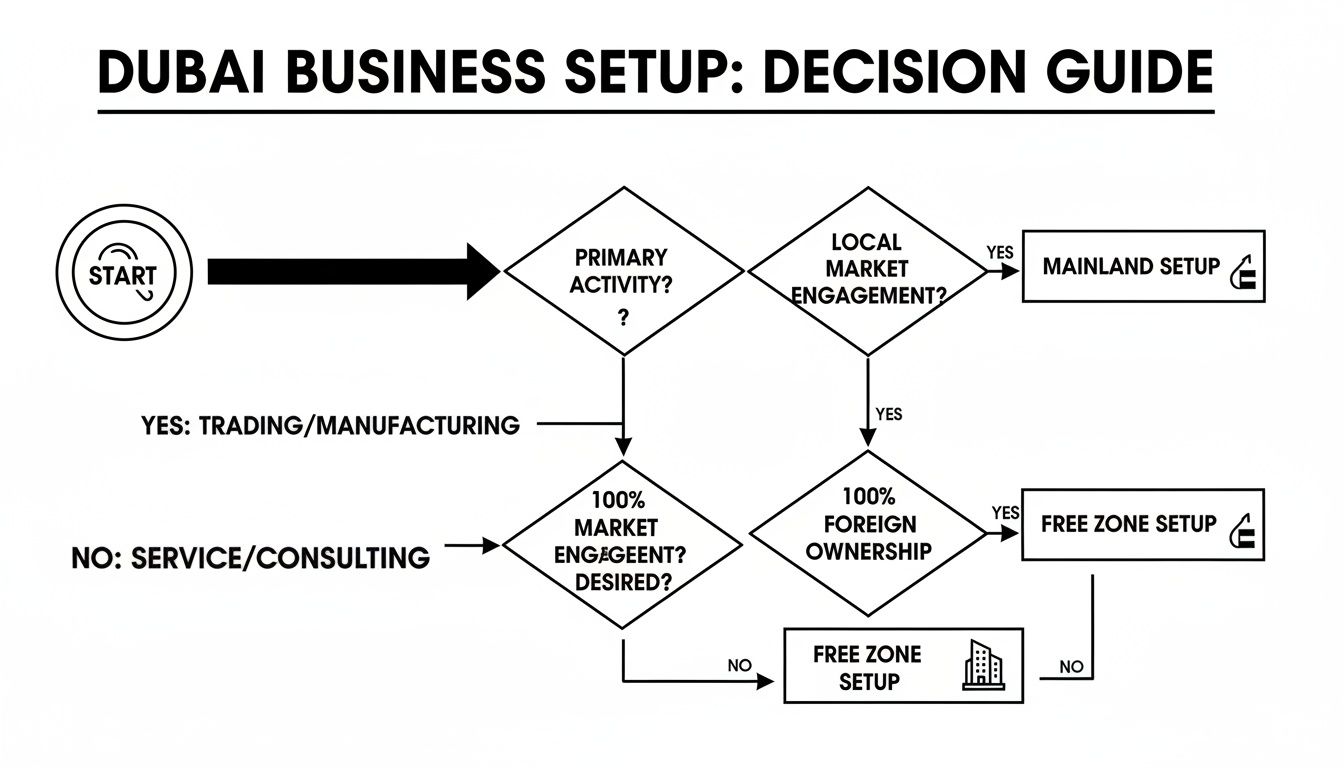
This choice unlocks specific visa paths for you and your founding team.
Key Visa Options for Founders and Their Teams
Think of visas as different tools for building your team. As a founder, you'll mainly use three types. Knowing which one to use when is crucial for hiring without bureaucratic delays.
Here are the most common options:
- Investor Visa (Partner Visa): The go-to for founders who own shares in their company. It ties your residency to your business ownership, typically valid for two years.
- Employee Visa: Once your company is formed, you can sponsor visas for your employees. This is the standard route, linking an individual's residency to their job.
- Golden Visa: A premium, long-term residency visa (up to 10 years) for top-tier investors, entrepreneurs, and exceptional talent. The requirements are higher, but it provides incredible stability.
The Corporate Bank Account Hurdle
Actionable Insight: Opening a corporate bank account is a major friction point. UAE banks have strict Know Your Customer (KYC) rules, making the process slow. Your business cannot operate without it.
Start the bank account application the moment you have your trade license. Prepare all shareholder documents, a clear business plan, and proof of address. Persistence is essential.
Adhering to UAE Labour Law
Once you hire your first employee, you must comply with UAE Labour Law. This governs employment contracts, working hours, and end-of-service benefits. Non-compliance leads to heavy fines.
Get these right from day one:
- Official Employment Contracts: Every employee needs a formal contract registered with the Ministry of Human Resources and Emiratisation (MOHRE).
- Wages Protection System (WPS): You are legally required to pay salaries through the WPS to ensure timely payment.
- End-of-Service Gratuity: This is a mandatory payout for departing employees, calculated based on their final salary and tenure.
For a deeper dive, our UAE startup visa guide for pre-seed founders breaks down the steps.
Next Action: Create a "Visa and Legal Checklist" for your first three planned hires. Map out the likely visa type, list the required documents (passports, photos, degree certificates), and estimate the timeline. This turns a vague legal task into a manageable project.
The Dubai Funding Landscape From Angels to VCs
Raising capital in Dubai has its own rhythm. It's not Silicon Valley. Investors here place a heavy premium on disciplined execution and a clear path to profitability—often much earlier than in other ecosystems.
Understanding the funding ladder—from smaller, personal checks to larger, institutional rounds—is key. It’s about knowing who to talk to, when, and what they need to see.
The On-the-Ground Reality for Founders
The current market is a mixed bag. While optimism around demand is high, founders face a serious profit squeeze due to rising costs and competition.
According to the Dubai Business Survey for Q1 2025, the SME Business Confidence Index is a healthy 114.3. However, the net balance on profits plummeted to -11% in Q1 2025 from +37% the previous quarter. You can explore the data by reading the full business survey report.
What this means for you: Investors are laser-focused on your unit economics and operational efficiency. Demonstrating disciplined growth is non-negotiable.
Mapping the Funding Stages
Navigating the funding ecosystem means knowing who to approach at each stage. Each brings different players with different expectations.
- Pre-Seed/Seed Stage: Your first capital will likely come from angel investors, government grants, or early-stage micro-VCs. They bet on you, your market, and a compelling MVP. Warm intros are essential.
- Series A: Once you have product-market fit and a repeatable revenue model, you're ready for local and regional Venture Capital (VC) firms. They want to see real traction, solid unit economics, and a smart plan for MENA expansion.
- Growth Stages (Series B+): By now, you're on the radar of larger regional VCs and international funds. The expectation is a well-oiled machine ready for massive expansion, with strong financials.
Common Mistake: Pitching a seed-stage business to Series A investors. Know where you stand and target investors who play at your stage to avoid wasting time.
For a deeper dive, see our guide on the top 5 funding sources for UAE tech startups in 2025.
The Power of High-Signal Connections
In Dubai's tight-knit ecosystem, how you connect with an investor is as important as what you're building. Cold emails rarely work. The system runs on trust and warm introductions.
This is where a curated founder community becomes a strategic advantage. Peer groups like those at Founder Connects provide a direct line to founders who have already raised capital. They offer unfiltered advice, share decks, and make critical warm introductions to trusted angels and VCs.
Next Action: Before writing an investor email, create a target list of 5-10 investors who focus exclusively on your stage (e.g., pre-seed). Then, work your network to find a warm intro to your top three. This focused approach beats a generic email blast every time.
Building Your Team in a Competitive Market

Your company is only as good as its people. In Dubai's competitive talent market, this is both an opportunity and a challenge. The city attracts skilled professionals globally, giving you access to a deep, diverse talent pool.
However, competition is fierce, and salary expectations are high. To win, you need more than a big paycheck. A strategic approach to culture, equity, and the employee experience is crucial for building a world-class team.
The local talent pool is also increasingly sophisticated. Mastercard research shows that in the UAE, 49% of women and 47% of men see themselves as entrepreneurs, nearly closing the gender gap. Moreover, 75% of women founders here use AI regularly, highlighting a tech-savvy and competitive talent landscape.
Strategies to Attract Top Performers
Early-stage startups must play a different game than large corporations. You can't always win on cash compensation. Your advantage lies in creating a compelling story and an environment top talent can't find elsewhere.
- Build a Magnetic Company Culture: Be crystal clear on your mission, vision, and values. A strong culture built on autonomy, impact, and learning is a powerful recruiting tool.
- Offer Meaningful Equity: For early hires taking a risk on your vision, equity is non-negotiable. It aligns their success with the company’s long-term goals. Frame it as a partnership.
- Provide Seamless Visa Support: Handling the visa process efficiently and professionally removes a major friction point and shows candidates you are organized and care about their well-being.
High-Demand Skills and Where to Find Them
The tech-first startup scene has created intense demand for specific skill sets. Founders are constantly hunting for people who can build, market, and scale digital products.
For insights on attracting technical talent, review a complete founder's guide to hiring a developer for a startup.
The most in-demand roles include:
- Artificial Intelligence and Machine Learning: Professionals who can leverage AI for efficiency or product innovation are highly sought after.
- Digital Marketing and Growth: Experts in performance marketing, SEO, and content strategy are essential for customer acquisition.
- Product Management: A great product manager who can translate vision into a practical roadmap is invaluable.
Next Action: Draft a one-page Employee Value Proposition (EVP). Answer this question: "Why should a top-tier engineer or marketer leave their stable job to join our unproven startup?" Your answer must go beyond salary. Focus on mission, impact, learning opportunities, and culture. This document will become your recruitment north star.
Finding Your Community (The Real Kind)
The founder journey can be incredibly lonely. After tackling legal structures, visas, and fundraising, it's easy to overlook one of the most critical elements of success in Dubai: building a real support network.
This isn't about collecting business cards at crowded networking events. It’s about finding a trusted circle of peers. Your sanity and long-term success often depend on the quality of your relationships. The real value comes from small, curated groups where you can be honest about struggles and get unfiltered feedback from people who understand.
Cutting Through the Noise
Dubai is full of events. The trick is to distinguish high-signal gatherings from low-signal time sinks. A generic "networking night" with hundreds of people is low-signal. A curated roundtable with ten vetted founders is high-signal, where one conversation can change your entire perspective.
- Noise: Huge, unfocused mixers and broad industry conferences.
- Signal: Small, moderated peer groups, accountability circles, and invite-only roundtables.
The connections that truly matter are built slowly in environments of mutual trust, where founders feel safe enough to be vulnerable about their biggest challenges.
This is why curated peer groups are non-negotiable. They are the antidote to founder isolation and the fastest way to learn from the mistakes and successes of others.
How to Spot a Good Founder Community
Not all communities are equal. Before committing your time, use this simple checklist.
A high-quality founder community delivers on three things:
- Curated Membership: The group vets its members to ensure everyone is at a similar stage or shares a similar drive.
- Active Moderation: A facilitator guides discussions, keeps them on track, and maintains a supportive, no-fluff culture.
- Clear Alignment with Your Goals: The group’s mission aligns with what you need right now, whether it's fundraising intel, tactical scaling advice, or mental well-being.
Next Action: This month, identify one high-signal community or peer group in Dubai that aligns with your current challenges. Reach out to the organizer or a member to learn about their format and culture. Don't just join another newsletter—find a place where you can actively connect and contribute.
Got Questions About Setting Up in Dubai?
Here are quick, practical answers to the most common questions we hear from founders setting up in the UAE.
What’s the Real Cost to Start a Business in Dubai?
The cost depends on your setup (Mainland vs. Free Zone), business activity, and visa needs. Here’s a simple framework:
- Free Zone: For most tech startups, expect initial setup costs between AED 15,000 to AED 25,000. This typically covers your trade license, registration, and a basic virtual office package for one year.
- Mainland: Costs are generally higher, starting from AED 30,000 and increasing based on office space and approvals.
- Budget Extra for Visas: Plan for an additional AED 5,000 to AED 8,000 per person for visas.
Do I Actually Need a Local Partner?
For most tech and professional service founders, the answer is no.
- Free Zone Companies: You get 100% foreign ownership. No local partner required.
- Mainland Companies: Recent legal reforms allow 100% foreign ownership for over a thousand commercial and industrial activities. Only a few strategic sectors still require an Emirati partner.
Next Action: Don't assume you need a partner. Check the official list of approved activities from the Department of Economy and Tourism (DET). For most tech, e-commerce, and consulting businesses, full ownership is now the standard.
How Long Does the Whole Setup Process Take?
With organized paperwork, the process is surprisingly fast. A Free Zone setup is quickest, with a trade license issued in a few days to two weeks.
However, the residency visa and corporate bank account opening can cause delays. Realistically, budget one to two months for the entire end-to-end process—from license to having an Emirates ID and a functional bank account. Delays usually come from incomplete documents or slow bank processing, so preparation is key.
At Founder Connects, our mission is to ensure no founder builds in isolation. We create curated peer groups and high-signal events that foster genuine connection and accountability. If you’re ready to make real progress alongside a trusted circle of fellow entrepreneurs, learn more about joining our community.

Building in MENA? You don't have to do it alone.
Join 300+ founders in the Founder Connects Residency. Monthly squad calls, warm intros, $3M+ in perks, and much more. All for less than your monthly coffee budget.
Popular posts





Founder Connects is a premium MENA tech founder community. Meetups in Dubai and across MENA, Residency Squads of 8–10, and 400+ vetted WhatsApp founders (apply and screened).