

You’re probably in one of three places right now. You’ve built something real and need seed capital. You’ve got early traction but need sharper structure around product, sales, and investor readiness. Or you’re trying to decide whether an accelerator will help, or just consume equity and time.
That’s the right lens for evaluating flat6labs abu dhabi. Not as a logo to add to your deck, but as a strategic decision about speed, network, and execution. In Abu Dhabi, the strongest programmes matter because they can compress months of trial and error into a tighter operating cycle, especially if you need investor access, market credibility, and a reason to build locally.
For founders in the UAE, momentum can be deceptive. The ecosystem is active, events are full, and capital is visible. But a founder still has to solve the hard parts alone. Who helps tighten the pitch, challenge weak assumptions, open the right doors, and keep the team accountable when things wobble?
That’s where flat6labs abu dhabi becomes worth serious consideration. It sits in the category of programmes that can change a company’s trajectory if the startup is at the right stage and the founders know how to use it. If you’re still sorting out Abu Dhabi’s wider startup environment, this overview of startups in Abu Dhabi is a useful place to map the ecosystem around you.
There’s also a practical layer many founders underestimate. If acceptance into a UAE accelerator means relocating team members or hiring internationally, immigration admin quickly becomes a bottleneck. This guide to Dubai Work Visa Requirements helps founders understand the paperwork and timing issues that often show up right after momentum starts.
Flat6Labs only works well when you treat it as an operating system for a sprint, not as a rescue plan for a weak business.
A founder with early traction in Abu Dhabi usually hits the same question fast. Is it better to keep building independently, or join a programme that can compress six to nine months of fundraising prep, market feedback, and local relationship-building into one cycle?
flat6labs abu dhabi sits in that decision point. It is a seed-stage platform launched in March 2021 with DisruptAD, ADQ’s venture platform, to back early startups through the Flat6Labs Ignite Program. In practical terms, it brings funding, structured support, workspace, and access to a network that would take many founders far longer to build alone.
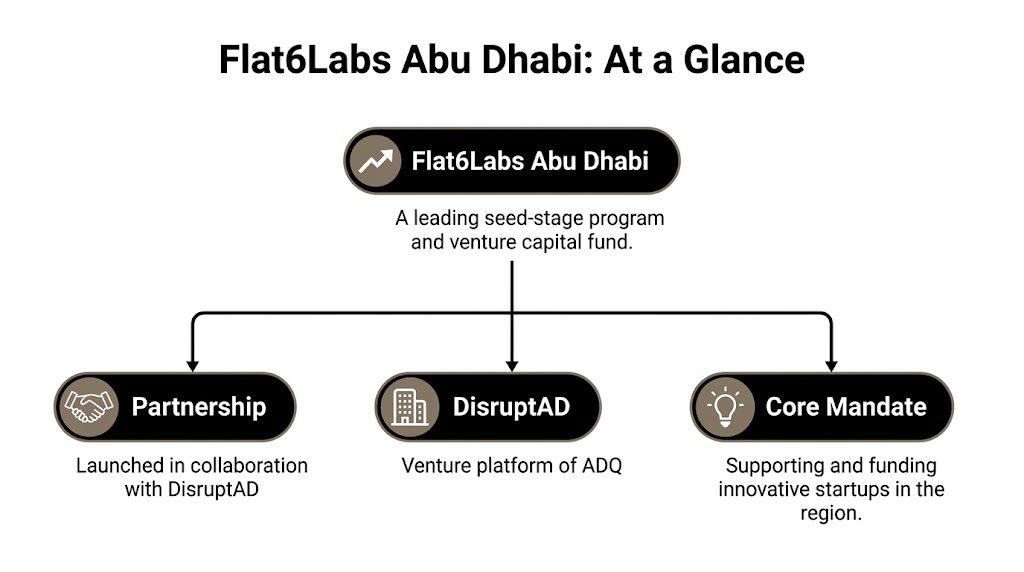
Flat6Labs matters because it is tied to a clear economic goal inside Abu Dhabi. The programme is not only trying to fund startups. It is also helping the emirate increase the number of venture-backed companies that are built, staffed, and based locally.
That distinction matters.
A lot of founders treat accelerators as short-term funding channels. In Abu Dhabi, the stronger question is whether a programme helps you become part of the local company-building system. Flat6Labs has done enough across multiple cohorts to show repeatability, and the UAE-heavy founder base makes it more relevant for teams planning to operate in the country rather than just pass through for a cheque.
The programme also runs on a repeat cycle, which is important for founders assessing signal quality. Repeated cohorts usually produce better mentor pattern recognition, tighter selection standards, and a more useful alumni network than one-off startup initiatives.
The headline value is not only capital. It is how Flat6Labs fits into the Abu Dhabi build path.
If your company needs a base in the UAE, investor exposure, and pressure-tested execution support, the programme can shorten the path to credibility. If your startup is already well connected, already fundraising confidently, or needs highly specialised sector support that sits outside the programme’s strengths, the benefit may be smaller.
Founders should assess Flat6Labs across four practical areas:
| What founders should notice | Why it matters |
|---|---|
| Partnership with DisruptAD | Gives the programme stronger institutional reach than an independent accelerator |
| Repeated cohorts | Builds alumni density, better operating patterns, and more relevant founder-to-founder advice |
| UAE-heavy company base | Makes the programme more useful for startups planning to build and hire locally |
| Structured support around company building | Helps founders handle setup, investor readiness, and early execution discipline at the same time |
Flat6Labs is one piece of the Abu Dhabi startup field, not the whole answer. Good founders compare it against other routes. That could mean building independently, joining another accelerator, or combining a programme with founder communities that provide longer-term peer support after the formal cycle ends.
Operations matter here more than many first-time founders expect. If you are weighing programme support against setting up on your own, this guide to setting up a business in a Free Zone Abu Dhabi is useful for understanding how company formation choices can affect hiring, visas, and investor readiness.
It also helps to compare programmes directly rather than judging Flat6Labs in isolation. This detailed UAE accelerator comparison guide with program differences and a comparison chart gives a clearer view of where it sits relative to other options available to founders in the market.
A founder in Abu Dhabi usually hits the same decision point fast. Keep building alone and figure out fundraising, hiring, and market access one problem at a time, or join a programme that adds structure, deadlines, and outside scrutiny.
That is the main frame for Ignite.
The Flat6Labs Ignite Program is useful when a startup needs more than capital. It gives founders a compressed operating cycle. You get investment, workspace at Etihad Airways Center Floor 7 in Al Muneera, Abu Dhabi, and access to the Flat6Labs regional network. Flat6Labs also states that Ignite participants have recorded average customer base growth of 20 to 30% during the programme and that graduates have achieved a fundraising success rate above 70%, based on its published programme material.
The numbers matter less than the mechanism behind them. Good accelerators improve pace. Weekly check-ins, mentor sessions, and investor-facing milestones force teams to answer questions they might otherwise delay for months. I have seen that pressure work well for founders who already have a product in market and badly for teams still debating basic assumptions.
The strongest value in Ignite is operating discipline.
A serious programme pushes founders to tighten four areas at once:
Customer clarity
The team has to define who the buyer is, what pain is urgent, and what proof already exists.
Commercial focus
Sales conversations get examined quickly. Weak pricing, vague positioning, and soft pilot language are hard to hide for long.
Fundraising readiness
Investors respond better when the company can explain use of funds, current traction, and the next milestone with precision.
Decision speed
Bad experiments get cut earlier. Good ones get more attention.
That sounds obvious, but it is where many founder teams stall. They stay busy without getting sharper.
“Mentorship” gets oversold across the region. What matters is whether the advice changes execution.
In a useful Ignite cycle, mentors and programme managers should be pushing on a few specific points. Is the problem urgent enough to support budget? Is the target segment narrow enough to win? Can the startup grow outside founder-led selling? Are the founders listening carefully without changing direction every week?
That last point matters a lot. Coachable founders usually do better. Reactive founders waste the programme.
For a practical filter before committing to any accelerator, review these questions to ask before joining UAE incubators. It helps founders separate real programme value from polished marketing.
Some founders treat Demo Day as the headline benefit. That is too narrow.
The bigger upside usually shows up earlier in the cycle. Product assumptions get tested harder. The pitch becomes more commercially credible. The company starts speaking in milestones instead of ambition alone. By the time Demo Day arrives, the useful work should already be visible in pipeline quality, customer learning, and a cleaner investor story.
There is also a trade-off. Ignite adds structure, but structure can feel heavy if the startup is still at raw idea stage or if the founding team is not aligned. In those cases, the programme can expose gaps faster than the team can fix them.
For startups with an MVP, some early traction, and a clear reason to build in Abu Dhabi, that pressure is often the point.
A lot of founders ask whether they’re eligible. The better question is whether they’re competitive.

Flat6Labs Abu Dhabi isn’t built for every business type. It’s more likely to back a startup that can scale, use capital well, and operate credibly in Abu Dhabi than a business that mainly needs time, generic advice, or freelance-style revenue.
Use this self-check before you apply:
Your product is already tangible
You don’t need a perfect product. You do need something a customer can use, test, or pay for.
The founding team is balanced
Complementary skills matter. If one founder handles product and another handles commercial execution, your application reads stronger.
You can explain why Abu Dhabi matters
A vague “UAE expansion” line won’t carry much weight. You need a real reason to build or anchor here.
Your business has venture characteristics
Flat6Labs is not for small service firms that grow through owner effort alone. It suits startups that can scale beyond a founder’s direct bandwidth.
Programmes say they value ambition, but operators usually screen for execution quality. They’ll notice whether your team makes decisions quickly, whether your materials are coherent, and whether you understand your market beyond headline trends.
A weak sign is when founders describe a large market but can’t explain their wedge. Another weak sign is when they say they want mentorship, but can’t name the exact problem they need help solving.
This resource on questions to ask before joining UAE incubators is worth reading before you commit, because the wrong programme can cost more in distraction than it gives back in support.
| Strong fit | Weak fit |
|---|---|
| MVP or early traction exists | Only an idea and a concept deck |
| Coachable, responsive team | Defensive founders who don’t absorb feedback |
| Tech-enabled, scalable model | Small local service business |
| Clear Abu Dhabi rationale | No local logic beyond “the market is good” |
| Fundraising intent is real | No near-term need for investor readiness |
Founders often lose applications before the first interview because they submit generic answers. A strong programme can usually tell within minutes whether the team understands its own business.

This is not admin. It’s your first diligence test.
The best applications are concise and specific. They explain the problem clearly, identify the target customer precisely, and show why this team is qualified to solve it. Bad applications hide behind buzzwords like AI, platform, ecosystem, or disruption without showing how the business works.
A practical approach is to answer each form field as if an investor will only read that field. Don’t rely on your deck to save weak written responses.
If you’re shortlisted, expect the conversation to move quickly from surface-level explanation to judgement calls. The team will want to know how you think, how you respond under pressure, and whether your assumptions hold up.
Prepare for questions such as:
Don’t memorise polished lines. Know your business deeply enough that you can answer from first principles.
By the later stages, the programme isn’t only evaluating the startup. It’s evaluating the founders’ operating behaviour.
That usually includes:
Responsiveness
Do you send materials on time, adapt quickly, and communicate clearly?
Coachability
Can you absorb challenge without becoming defensive or shapeless?
Commercial judgement
Are your priorities tied to revenue, customer value, and clear milestones?
Team dynamic
If co-founders attend together, do they show trust and role clarity?
| What helps | What hurts |
|---|---|
| Sharp problem definition | Broad claims about “transforming” an industry |
| Evidence of customer learning | Assumptions presented as facts |
| Clear use of funds | Raising because “it’s time” |
| Direct answers | Overdesigned storytelling with little substance |
| Founder-market fit | A capable team with no obvious right to win |
Your next action is simple. Open your current deck and rewrite only three slides: problem, traction, and why now. If those three become stronger, the whole application usually improves.
A founder deciding whether to apply should read alumni outcomes the same way an investor reads a pipeline. Look for pattern fit, execution quality, and what happened after the programme ended.

Flat6Labs Abu Dhabi has backed startups across categories including EdTech, HealthTech, FoodTech, AdTech, and Web3. That matters because it shows the programme is not tied to one narrow thesis. It also suggests the bar is less about sector fashion and more about whether the team can execute, sell, and use the programme well.
That distinction matters.
A broad sector mix does not mean every business has an equal shot. In practice, accelerators still build internal pattern recognition. They tend to respond well to companies with a clear commercial use case, a credible founding team, and enough traction or customer evidence to benefit from structured support.
Raised funding is the headline founders remember. It is rarely the only useful signal.
A better read on alumni quality comes from questions like these:
This is the strategic lens founders should use. If the alumni base is full of startups that look nothing like yours in customer type, sales cycle, regulation, or go-to-market motion, pay attention. Flat6Labs may still be open to your category, but that does not automatically mean it is the best environment for your stage.
A closer look at founder voices and programme context can help. This interview footage gives a more grounded feel for the environment and expectations inside the ecosystem.
For strong founders, the longer-term value often comes from the alumni network rather than the programme calendar itself.
Former cohort members can become warm introducers, pilot partners, early hiring references, and operators who have already handled the same Abu Dhabi questions around licensing, enterprise sales, procurement, and regional expansion. That kind of access is useful because the UAE still runs heavily on trust, context, and timing.
There is a trade-off, though. Alumni value is uneven. Founders who stay visible, ask good questions, and build real peer relationships usually get far more from the network than founders who treat graduation as the finish line.
So read the success stories with some discipline. Do not ask only whether past startups did well. Ask whether their path tells you Flat6Labs is built for the kind of company you are trying to build.
Most founders feel a strange drop after an accelerator ends. During the programme, there’s cadence. Weekly check-ins. External pressure. Deadlines. Investor conversations. A reason to keep the team tight.
Then the structure disappears.
Flat6Labs can help a startup become more investable and more organised, but it can’t run your company after the cohort ends. The founders still have to build the sales process, manage the team, survive fundraising delays, and make hard calls without the comfort of a programme calendar.
That’s usually where one of two things happens:
A good accelerator gives you momentum. It doesn’t replace founder habits.
Founders leaving a programme usually need three things:
Peer accountability
Not broad networking. A small circle that will challenge drift and weak decisions.
Targeted introductions
Helpful intros are specific. A founder, operator, customer, or investor who matches the immediate problem.
A place for honest operating conversations
Not pitch theatre. Real discussion about churn, hiring mistakes, founder conflict, pricing, and burn.
One option in the UAE is Founder Connects, which runs curated peer groups, moderated founder sessions, and targeted introductions for founders who want ongoing support beyond event-based networking.
Treat Flat6Labs as one phase of a longer build path.
A sensible founder sequence often looks like this:
| Stage | Best support type |
|---|---|
| Early validation | Customer discovery, tight founder feedback, small peer circle |
| Seed acceleration | Structured programme like Flat6Labs if the startup is ready |
| Post-programme execution | Ongoing founder accountability and strategic introductions |
| Fundraising and scale | Investor process discipline, hiring support, market expansion help |
The mistake is expecting one institution to do all of it. It won’t.
No. The money matters, but the practical value is usually the mix of structured pressure, mentorship, office support, and investor exposure. Founders who only care about the cheque often underuse the programme.
You need a credible reason to build with Abu Dhabi in the picture and the ability to engage properly with the programme. If your company has no serious local commitment, your application will be harder to justify.
Possibly, but solo founders usually face a harder test. Programmes tend to trust balanced teams more because execution risk is lower. If you’re solo, show very clearly how you cover product, sales, and execution gaps.
You should be beyond the idea stage. A product, MVP, pilot activity, or clear customer evidence gives the programme something real to evaluate. If you only have slides, you’ll likely struggle.
No. The programme has supported companies across several sectors, but not every business model benefits equally from an accelerator format. Startups with scalable, tech-enabled models tend to fit better than conventional services businesses.
Very competitive. The application volume and repeated cohorts suggest that founders shouldn’t treat admission as likely by default. Apply when your business is coherent enough to survive scrutiny.
Keep it simple and strong:
Apply now if your startup already has momentum and the programme can accelerate something that’s working. Wait if you still need to validate the core problem, sort out founder commitment, or build a credible MVP.
The wrong timing is expensive. A premature application can waste a good shot.
If you’re weighing Flat6Labs Abu Dhabi and want steady support before or after an accelerator, Founder Connects offers a practical next layer through curated founder groups, accountability sessions, and targeted introductions across the UAE and wider MENA ecosystem.


