

How to Startup a Company: A Founder's Guide for the UAE & MENA

Building in MENA? You don't have to do it alone.
Join 300+ founders in the Founder Connects Residency. Monthly squad calls, warm intros, $3M+ in perks, and much more. All for less than your monthly coffee budget.

Starting a company isn't about one big "aha!" moment. It's a process of testing ideas, building relationships, and executing with an almost obsessive focus. For founders in the UAE and MENA, the journey has unique challenges and opportunities. You're validating ideas in a high-speed market, navigating a distinct legal landscape, and tapping into a dense, relationship-first ecosystem. This guide is your playbook for that specific journey.
The Modern Founder's Starting Point in the UAE
Learning how to start up a company in the UAE today is completely different than it was five years ago. This is a high-velocity environment where speed, capital, and competition have all hit the accelerator. Generic advice from Silicon Valley often misses the local nuances of building here.
Success now demands a different mindset. Move past the romanticised "solo founder" hustle; your most valuable asset is your network of peers. Founders who build in a vacuum are at a massive disadvantage. The ones who win are those who systematically seek out feedback, share their struggles, and build genuine, give-and-take relationships within the ecosystem.

What to Expect From This Guide
This playbook provides clear, actionable steps that work in the MENA region. We'll break down the founder journey into five core pillars, each framed with local context and practical actions you can take right now.
- Idea Validation: How to stress-test your assumptions quickly and cheaply, before you write a single line of code.
- Legal & Registration: Demystifying the UAE's free zone landscape so you can make a smart, cost-effective choice.
- Building an MVP: A no-nonsense guide to launching a lean product that gets you real-world learning.
- Fundraising Preparation: How to get your house in order months before you even think about asking for investment.
- Launch & Operations: Nailing your go-to-market strategy and making those critical first hires.
The Guiding Philosophy: Progress over perfection. Your goal isn't to have all the answers on day one. It's to build a system for finding them fast, with the help of others on the same path.
The Opportunity and the Noise
Starting a company in the UAE and wider MENA region is a mainstream economic engine backed by serious capital. In a recent quarter, MENA startups raised $4.5 billion across 180 deals. The UAE continues to lead, with its startups raising a staggering $704.3 million in a single recent month, showing high investor confidence.
But this activity creates a ton of noise, making it difficult for new founders to get noticed. It's a classic signal vs. noise problem. To understand the local scene better, you can learn more about the Dubai and MENA startup ecosystem on Synergy Labs.
Your First 100 Days: A Practical Checklist for UAE Founders
To cut through the noise, you need a roadmap. Those first three months are a frantic sprint. This checklist focuses your energy on actions that create real momentum.
PhaseKey ObjectiveCritical ActionCommon PitfallDays 1-30Validate the ProblemGet out of the building. Conduct 20-30 customer discovery interviews with your target audience in the UAE.Building a solution for a problem that doesn't exist or isn't painful enough for this market.Days 31-60Build Your FoundationFinalise your legal structure (Free Zone) and open a corporate bank account. This takes time in the UAE, so start early.Getting stuck in "analysis paralysis" over the perfect legal setup. Pick a suitable option and move.Days 61-90Launch a Minimum Viable Product (MVP)Ship a bare-bones version of your product to a small group of early adopters in your target city (e.g., Dubai, Riyadh).Polishing the MVP for too long. Your goal is learning, not a perfect product.Days 91-100Get First Feedback & IterateSystematically collect feedback from your first users and create an iteration plan based on their needs.Ignoring negative feedback. Local user criticism is pure gold for product-market fit.
This roadmap forces you to confront the hardest parts of building a business head-on.
Validate Your Idea Before You Build Anything
The single biggest reason startups fail is tragically simple: they build something nobody wants to pay for. In a fast-moving market like the UAE, this mistake isn't just common—it's expensive.
The point of validation isn’t to confirm you’re right; it’s to find out if you’re right, as cheaply and quickly as possible. Before writing a line of code, your only job is to gather evidence. This means talking to actual potential customers in your target market.
Run Low-Cost Validation Experiments
You don’t need a big budget to figure out if you're onto something. Here are a few practical experiments you can run this week for less than AED 400.
- The Landing Page Test: Use a tool like Carrd or Webflow to create a simple one-page website. Clearly explain the value you offer. Your call-to-action should be a clear "Join the Waitlist."
- The Micro-Ad Campaign: Spend AED 200 on LinkedIn targeting professionals in DIFC with a specific job title. Spend another AED 200 on Instagram targeting families in Arabian Ranches. The goal is to measure the click-through rate (CTR) and conversion rate.
- The "Concierge" Test: Deliver the service manually to a handful of early users. If you’re building a platform to connect homeowners with maintenance companies, do it yourself first with a WhatsApp group. This proves whether people will actually pay for the outcome.
Key takeaway: Your first experiments are for learning, not scale. The data from 50 visitors or 5 manual customers is infinitely more valuable than a hundred positive survey responses.
Master the Problem Interview
A "problem interview" is a structured conversation to uncover struggles, not to sell your solution. Your mission is to get the other person talking about their frustrations. For a deeper dive, check this guide on how to validate product ideas fast.
Here’s a simple framework:
- Set the Stage: Clarify you're doing research, not selling anything.
- Ask Open-Ended Questions: Instead of "Is managing invoices a problem?", try, "Walk me through your process for managing invoices."
- Dig for Past Behaviour: Ask "Tell me about the last time you faced that problem. What did you do to solve it?" This uncovers real pain points.
- Listen More, Talk Less: Aim for an 80/20 split. Let them do most of the talking.
For a detailed plan for moving from idea to your first customer in the UAE, this resource helps structure your next steps.
Next Action: Identify 10 people in your target market (you can find them on LinkedIn). Send them a message asking for 15 minutes of their time for research. Your goal is to conduct 5 problem interviews by the end of next week.
Navigating the Legal Maze of UAE Free Zones
You have evidence you’re solving a real problem. Now, where should your company officially live? For most tech founders in the UAE, the answer is a free zone. This is a strategic decision that impacts your burn rate, scalability, and investor appeal.
The goal isn't to find the "perfect" free zone, but the one that’s the best fit for your startup right now, while giving you room to grow.
What Really Matters When Choosing a Free Zone
Zero in on the factors that truly matter for an early-stage tech company:
- Cost-Effectiveness: How much will you burn on setup fees, annual licence renewals, and visas? Every dirham counts. Look for transparent, startup-friendly packages.
- Investor-Friendliness: Will VCs be comfortable with your legal structure? Investors prefer clear, internationally recognised frameworks.
- Scalability and Flexibility: How painful will it be to add visas for new hires? Your free zone should enable growth, not block it.
- Ecosystem and Credibility: Does the free zone have a strong tech reputation? Being associated with a well-regarded authority adds credibility.
Actionable Insight: The best free zone gets you operational quickly and affordably, without creating legal hurdles that slow you down later.
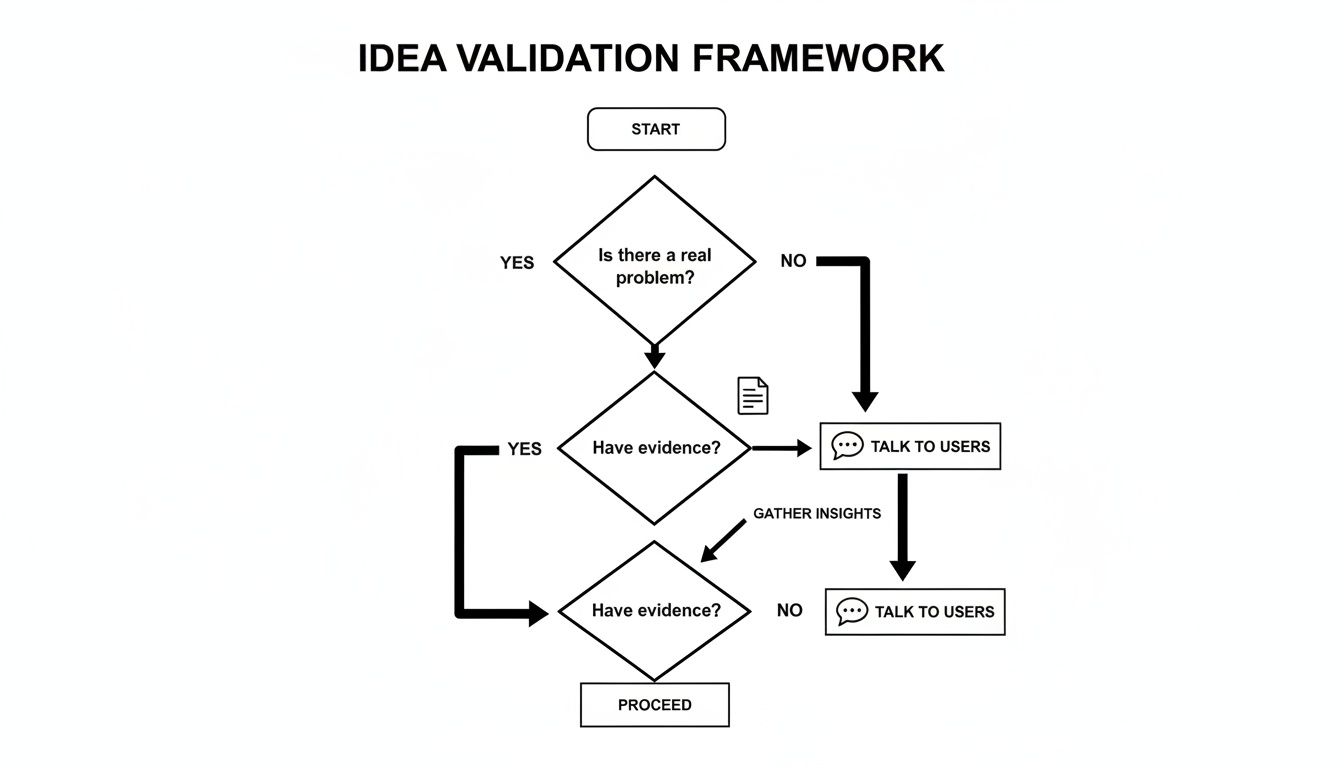
This flowchart hammers home the point: gather evidence first. Only then should you commit to financial and legal steps.
Comparing Top Contenders for Tech Startups
While there are dozens of free zones, a few are go-to options for tech founders.
Free ZoneBest ForAnnual Cost (Approx.)Key AdvantageDMCCGeneral Tech, SaaS, E-commerceAED 40,000 - 60,000Highly reputable, flexible, with a massive business community.DIFC FinTech HiveFinTech, RegTech, InsurTechSubsidised packages availableDirect access to financial regulators, banks, and a dedicated FinTech ecosystem.ADGMFinTech, Asset Management, VCsAED 30,000 - 50,000+Operates under English Common Law, making it extremely attractive to international investors.
If you're building a FinTech, DIFC or ADGM might be non-negotiable. For a SaaS or e-commerce platform, DMCC could be the smarter play. For a deeper dive, check this guide to the best UAE free zones for early-stage startups.
Beyond the Licence: Founder Agreements and IP
Setting up your legal entity is just one piece of the puzzle. Two other documents are critical from day one:
- The Founder Agreement: This non-negotiable document between co-founders outlines equity splits, roles, vesting schedules, and what happens if a founder leaves. Not having one is a common and destructive mistake.
- Intellectual Property (IP) Assignment: All code, branding, and content created must be legally owned by the company, not the individuals. Ensure every founder signs an IP assignment agreement.
Getting these legal pieces sorted shows your team and future investors that you’re professional and ready for serious growth.
Build Your MVP Without Breaking the Bank
Your Minimum Viable Product (MVP) isn't a cheaper version of your final product. It’s your fastest path to learning what customers actually want. Its goal is to test your biggest assumption with the least amount of time, effort, and cash. Many founders in the UAE burn through capital over-engineering a product nobody asked for.

Embrace the No-Code Revolution
You don’t need a technical co-founder or expensive developers to launch. Powerful no-code platforms let you build a functional app in weeks, not months. This is a game-changer for early-stage founders in MENA who need to move fast.
- For web applications: Bubble lets you create complex platforms with drag-and-drop functionality.
- For websites: Webflow gives you professional-grade design control for beautiful, responsive sites.
- For mobile apps: Adalo or Glide can turn a simple spreadsheet into a working mobile app.
A Dubai founder used Bubble to build a real estate management prototype in under a month, getting early feedback long before committing to custom code.
Focus on Solving One Problem Perfectly
Your first product needs to be ruthlessly focused. It should do one job—the most critical job for your target user—and do it exceptionally well. Use the MoSCoW method to categorize features and avoid "feature creep."
Break down every feature idea into one of four buckets:
- Must-Have: Non-negotiable. The product is useless without them.
- Should-Have: Important, but can wait for the next iteration.
- Could-Have: "Nice-to-have" features, first on the chopping block.
- Won't-Have (This Time): Explicitly out of scope for this version.
Your MVP should only contain your Must-Have features. That’s it.
Actionable Insight: An MVP is a process, not a product. Your goal is to get to the first feedback loop as quickly as possible. Launch, learn, and then build what users actually ask for.
Turn Feedback into a Learning Engine
Launching your MVP is the starting line. The entire point is to collect feedback from real users. Build a system to actively chase it down.
- Collect Qualitative Feedback: Get on the phone with your first ten users. Use tools like Hotjar to watch screen recordings and see where people get stuck.
- Track Quantitative Data: Set up basic analytics. How many are signing up? How many complete the core action?
- Organise and Prioritise: Dump all feedback into a Trello board. Look for patterns. If five users complain about the same button, that’s your next priority.
Next Action: Sit down with your team (or just yourself) and draft a one-page MVP spec using the MoSCoW framework. Define the single core problem you're solving and list only the absolute Must-Have features needed to solve it. This document will be your north star as you build a lean, effective MVP.
Prepare for Fundraising Before You Need It
The golden rule of fundraising in the UAE and MENA: start before you desperately need the money. Investors here back founders they know, trust, and have seen execute. Think of fundraising as the final step in a long relationship-building process that should start months before you ask for a cheque. Waiting until your bank balance is low creates a desperation investors can smell a mile away.
Build Your Investor Target List
Don't "spray and pray." Your approach must be focused. Build a targeted list of investors who are a good fit. Track this in a simple spreadsheet.
- Fund or Angel Group: Who are they? (e.g., BECO Capital, Shorooq Partners).
- Investment Thesis: What’s their focus? (Pre-seed, seed, FinTech, SaaS).
- Relevant Portfolio Companies: Have they backed companies in your space? This is a huge signal.
- Key Partner/Contact: Who is the right person at the fund to talk to?
- Connection Path: How can you get a warm introduction?
This ensures you only spend energy on conversations that could go somewhere.
Actionable Insight: Fundraising in this ecosystem is a game of warm introductions. A referral from a trusted founder in an investor’s portfolio is worth a hundred cold emails.
Get Your Data Room in Order
A clean, well-organised data room tells an investor you're professional. Use Google Drive or DocSend to hold the documents an investor needs for due diligence. For an early-stage startup, it needs just the essentials:
- Your Pitch Deck: A sharp, compelling story in 10-15 slides.
- A Simple Financial Model: A spreadsheet showing key assumptions and projections for the next 18-24 months.
- Team Bios: Short biographies for the founding team.
- Corporate Documents: Your certificate of incorporation and founder agreements.
Having this ready means you can move instantly when an investor shows interest. For more, check this guide on how to prepare your startup to meet UAE investors.
Craft Your Narrative and Track Your Progress
Your pitch is a story. It needs a compelling narrative that explains the problem, your solution, and the opportunity. Get brutally honest feedback on this narrative from other founders. They'll spot the holes in your logic better than anyone.
At the same time, become obsessed with your key metrics (user growth, revenue, engagement). This momentum is the hard evidence that backs up your story. This data is the heartbeat of your investor updates. The UAE's startup scene grew by 32% and is home to over 1,129 startups, ranking #21 globally according to StartupBlink's data. This density means a strong network of mentors is available to help you build.
Making Your First Hires and Finding a Rhythm
Hiring your first employee transitions you from a founder to a leader. In a competitive market like the UAE, attracting top talent requires a compelling story and purpose. Your first hires are taking a massive risk on you. Your job description must be a sales document for your vision. Sell the problem you're solving and the impact they’ll have.
Attracting the Right People
Early-stage hiring isn't about a perfect CV; it's about mindset. You need builders and problem-solvers who are energised by ambiguity.
When interviewing, ask questions that reveal character:
- "Tell me about a time you had to solve a problem with almost no resources."
- "What kind of team environment brings out your best work?"
- "How did you handle disagreeing with a team's direction?"
These questions get to what matters in a small team: resilience, adaptability, and cultural fit. For more, check out these best practices for recruitment.
Actionable Insight: The most important quality in an early hire isn’t what they know; it’s how fast they can learn. Look for raw intellectual curiosity and a bias for action.
Establishing Your Operating Rhythm
Once you have a team, you need a system to keep everyone aligned. This is your operating rhythm: a simple, repeatable cadence of meetings. A lean startup doesn't need a heavy corporate structure. A simple weekly check-in is all you need.
Next Action: Put this 30-minute weekly check-in on the calendar.
- Wins (5 mins): What did we accomplish last week?
- Priorities (10 mins): What are the 1-3 most important things for each of us this week?
- Roadblocks (10 mins): What's standing in our way?
- Pulse Check (5 mins): How's everyone feeling?
This simple framework builds accountability and keeps your team laser-focused. It’s the bedrock of a high-performing culture.
Your Top UAE Startup Questions Answered
Starting a company in the UAE throws up common questions. Here are practical answers for things we hear most often.
How Much Does It Really Cost to Set Up in a UAE Free Zone?
Budget between AED 25,000 to AED 60,000 for your first year in a tech-focused free zone like DMCC or Dubai Internet City. This range typically covers setup fees and the annual trade licence. The final cost depends on the number of visas and your office choice (physical vs. flexi-desk). Many free zones now offer startup-specific packages, so ask about them.
Do I Need a Local Partner to Start a Company in the UAE?
For almost any tech startup, the answer is a firm no. If you set up in a UAE free zone, you are entitled to 100% foreign ownership. The requirement for a local Emirati sponsor generally applies only to mainland companies operating directly in the domestic UAE market, outside a free zone.
What Is the Best Way to Find Early-Stage Investors in the MENA Region?
Forget cold emails; they rarely work here. The only strategy that consistently gets results is a warm introduction from someone the investor already trusts.
Actionable Insight: Investors in the MENA region back founders they know or who are recommended by someone in their network. Your first job is building genuine relationships in the ecosystem long before you need the money.
Get active in the community. Attend high-signal founder events and join curated communities. Building solid connections with other founders who've already raised capital is often the most direct path to an introduction with the right VCs and angel investors.

Building in MENA? You don't have to do it alone.
Join 300+ founders in the Founder Connects Residency. Monthly squad calls, warm intros, $3M+ in perks, and much more. All for less than your monthly coffee budget.
Popular posts





Founder Connects is a premium MENA tech founder community. Meetups in Dubai and across MENA, Residency Squads of 8–10, and 400+ vetted WhatsApp founders (apply and screened).