

You've got traction in the UAE. Customers are paying. The team finally has a rhythm. Then the next question lands on your desk: where do we grow next?
That's usually when founders start searching for an international business group.
Not because they want another badge, breakfast panel, or WhatsApp group. They want a working answer to a harder problem. Who can open the right door in a new market? Which introductions are worth taking? How do you test another country without burning six months on polite conversations that never turn into revenue?
In the UAE, that tension shows up early. A founder can build real momentum locally, then hit a wall the moment expansion becomes cross-border instead of aspirational. You're not just choosing a country. You're choosing distributors, hiring models, payment rails, legal structure, and local trust.
If your expansion path includes hiring before setting up locally, it helps to understand the operational side early. A practical guide to PEO and EOR for businesses can help founders compare ways to enter a market without rushing into entity formation. For a UAE-specific growth lens, this roundup of global expansion tips for UAE startups is also useful because it frames expansion as a sequence of tests, not a single leap.
A common UAE founder scenario looks like this. You've built demand in Dubai or Abu Dhabi, maybe across the Emirates, and inbound interest starts coming from Saudi, Egypt, India, or the UK. A potential partner says, “Let's explore this.” An investor asks about regional expansion. A customer wants delivery outside your current footprint.
That sounds like momentum. Sometimes it is.
Sometimes it's noise dressed up as opportunity.
Most founders don't struggle to find people. They struggle to find the right people in the right order. They take meetings with country managers, consultants, event contacts, and service providers, then realise none of those conversations answer the central question: can this market produce repeatable revenue for us soon enough to justify focus?
Practical rule: If an introduction doesn't help you validate demand, distribution, hiring, or compliance, it probably belongs later.
The founders who handle expansion well usually stop treating it like a networking exercise. They treat it like a controlled operating decision. They define the first commercial milestone, then look for support around that milestone.
When someone says they need an international business group, they often mean one of these:
That's an important distinction. The essential need isn't membership. It's a support system that reduces expansion risk.
An international business group can mean different things depending on who's using the phrase. For a founder, the simplest way to think about it is this: it's usually a structure designed to help people operate across borders, but it isn't always designed to help startups move quickly.
A useful analogy is a library. There's information inside. There are people around. There may even be useful introductions. But you still have to know what you're looking for, who to ask, and what to do with the answer.

The UAE's role as a global business hub shapes how these groups developed. Its economy is heavily trade-oriented, with total trade often exceeding 100% of GDP, reflecting a system built around re-export, logistics, and cross-border services rather than only local demand, as outlined in this UN trade context reference.
That history matters because many traditional international business groups were built for a different job. They were built to support trade facilitation, corporate relationships, and regional business presence. A startup usually needs something narrower and faster: validated market entry, credible counterparties, and founder-level decision support.
In practice, an international business group may offer:
That sounds useful, and sometimes it is. But there's a catch. Most of the value is potential energy, not immediate traction.
A directory isn't a deal pipeline. An event invitation isn't a market-entry plan.
If you want the more formal chamber-style version of this world, it helps to understand how those organisations operate and whom they serve. This overview of international chamber of commerce members is a good reference point because it shows how broad these networks can be.
It isn't automatically:
That gap explains why many founders join broad business groups, stay busy for a quarter, and still feel commercially stuck.
The phrase international business group covers several very different models. Founders waste time when they assume all of them do the same job.
Some are broad and institutional. Some are transactional. Some are mostly social. One type can be useful in one stage and a distraction in another.
| Group Type | Best For | Primary Value | Typical Cost | Founder Fit |
|---|---|---|---|---|
| Bilateral chambers and formal business councils | Companies needing visibility, institutional access, or cross-border credibility | Access to business communities, official programmes, broad networking | Varies by membership and participation level | Better for established firms than early-stage startups |
| Industry trade associations | Founders in regulated or specialised sectors | Sector-specific context, policy visibility, industry relationships | Usually membership-based and time-based | Good when your market depends on sector access |
| Informal networking clubs and open meetups | Very early discovery and casual relationship building | Serendipitous connections and general ecosystem exposure | Low financial cost, high attention cost | Useful in moderation, weak for focused execution |
| Boutique market-entry consultancies | Companies actively entering a specific market | Hands-on business development, partner search, market-entry execution | Project-based spend | Strong fit when you already know the target corridor |
Some firms using the label international business group aren't communities at all. They're boutique consultancies.
One example is the Arizona-based International Business Group, which is positioned around international business development and market-entry support. Its profile shows headquarters in Scottsdale, Arizona, with revenue listed below $5 million, and its value is closer to outsourced execution than networking community, based on this ZoomInfo company profile.
For the right founder, that can be rational. Instead of hiring a full in-house international BD lead too early, you convert that burden into variable project spend. That's useful when you already know what corridor you want to test and need someone to move fast on partner discovery, supply-chain questions, or market navigation.
Broad groups can help if your immediate need is legitimacy, ecosystem mapping, or access to a formal business circle.
They usually don't help when you need:
The mistake isn't joining the wrong group. It's expecting a broad network to behave like an execution engine.
A practical way to choose is to ask one blunt question: do I need access, expert service, or peer judgement? Those are different products.
Traditional international business groups do have value. The problem is that founders often buy into the value they imagine, not the value they'll use.
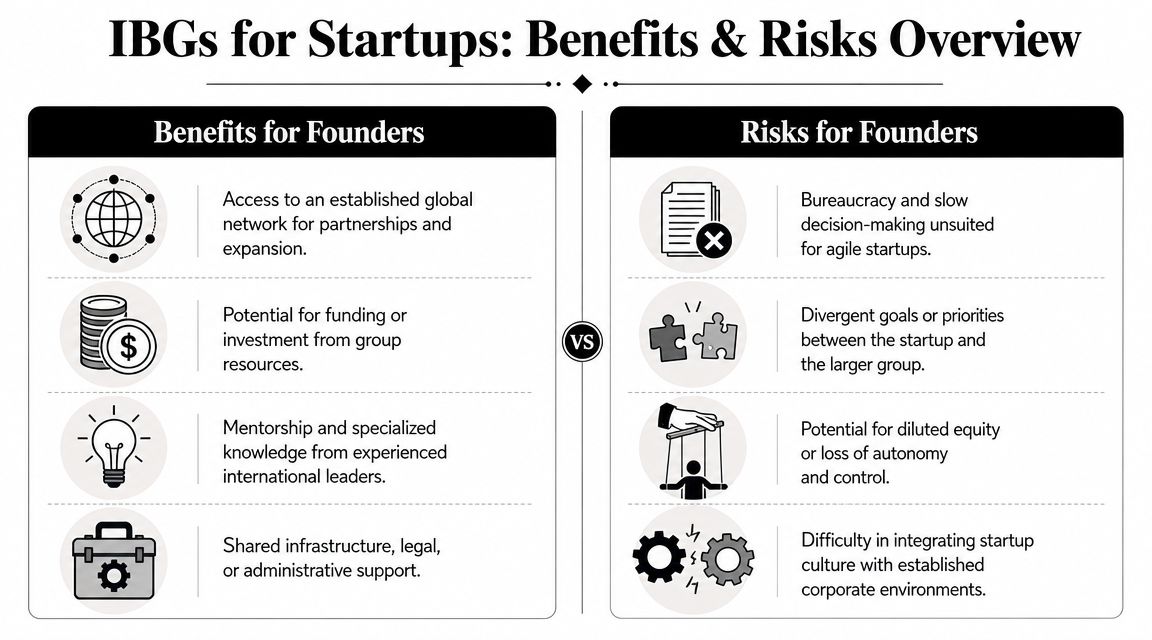
For a startup, the upside usually sits in three areas:
The risks are less obvious because they show up as activity.
You attend events. You meet smart people. You have follow-up coffees. The calendar fills up. But your pipeline doesn't get clearer, and your expansion thesis doesn't improve.
The most common failure modes are:
A founder planning international hiring or relocation can run into the same issue outside the Gulf as well. For example, if Canada is on your map, this explainer on Go Hires on Canadian immigration is useful because it shows how quickly expansion decisions become operational, not just strategic.
If your support system gives you more contacts but less clarity, it's not helping.
The trade-off isn't community versus no community. It's breadth versus relevance.
Broad groups give range. Startups usually need precision.
The strongest alternative to the traditional international business group isn't another bigger network. It's a curated peer group built around progress.

A traditional group works like a library. A curated peer group works more like an operating system. It doesn't just store access. It helps the founder process decisions, surface the right relationships, and stay accountable between moments of inspiration.
A curated founder model fixes several things broad networks don't.
First, the room gets better. You're speaking with founders and operators whose stage, pressure, and decision patterns are closer to yours.
Second, the conversation gets sharper. In a moderated small group, people don't perform the way they do on a panel or at an open mixer. They bring actual problems.
Third, introductions improve. Instead of being handed a directory, you get matched around a live need. Hiring in Saudi. Testing demand in Qatar. Finding a logistics partner. Pressure-testing pricing before market entry.
This matters even more for founders who are under-networked. The value of curation is especially clear for women-led, migrant-led, or solo-founder ventures, because underserved groups often face visibility and access gaps in open networks. BImpact's definition of underserved includes people with limited access, which fits many founders who get lost in large, unstructured ecosystems, as explained in this BImpact guidance on underserved populations.
The UAE is highly international in how business happens. Cross-border movement, regional headquarters, free zone logic, and multinational teams all shape founder decisions. At the same time, startup execution still depends heavily on trust, warm access, and local context.
That's why a smaller, more organised support model often outperforms a larger one.
A peer community can do what broad groups often can't:
One example of this model is how founders benefit from peer groups. In the UAE context, Founder Connects runs around curated peer interaction, moderated small groups, and intentional one-to-one introductions rather than open-ended networking.
A quick look at the model helps:
A better question: Don't ask whether a group is prestigious. Ask whether it improves the quality of your next decision.
For early-stage founders, curated groups are useful when they create honest feedback and momentum.
For scaling founders, they matter when they tighten the loop between problem, introduction, and action.
That's the difference between networking and a support operating system.
Most founders don't need more options. They need a way to evaluate options quickly.

Ask these six questions.
Does it solve a live problem
If your issue is expansion execution, a generic networking club won't fix it. Match the support model to the bottleneck you have now, not the identity you like.
Are the people relevant
Not just senior. Relevant. Same stage, similar market complexity, or direct corridor experience.
Is there structure beyond events
One-off sessions create energy. Repeatable structure creates progress. Look for regular cadence, moderation, follow-up, and a mechanism for accountability.
How are introductions made
Random access is overrated. Ask whether introductions are curated around a clear ask or left to chance after a crowded event.
Will you get honesty or politeness
Founders need spaces where they can discuss weak margins, failed hires, distributor issues, and expansion mistakes without performance theatre.
What is the actual return on your time
The cost of joining any international business group isn't just the fee. It's the hours, attention, and decision bandwidth it consumes.
If you're comparing two groups, write down one business outcome you want in the next quarter.
Then ask:
If you can't answer those questions clearly, don't join yet.
Good founder support doesn't add activity. It removes wasted motion.
The best choice for a UAE startup is rarely the broadest network in the room. It's the support structure that matches your stage, your corridor, and your next real constraint. Treat that choice like strategy, because it is.
If you want a founder support system built around curated peer groups, moderated accountability, and intentional introductions in the UAE and wider MENA ecosystem, take a look at Founder Connects. It's designed for founders who want practical conversations and relevant connections, not just another networking calendar.


