

You’re probably in a familiar spot. Kuwait is on the shortlist for expansion, a distribution deal, a commercial partnership, or a possible acquisition target. You’ve heard the usual advice: find a local partner, speak to counsel, attend a few events, sort your paperwork.
That advice isn’t wrong. It’s just incomplete.
For most UAE and wider MENA founders, the main question isn’t “What is the Kuwait chamber of commerce?” It’s “Can this institution help me enter Kuwait faster, with less noise, and with better commercial signal?” The answer is yes, sometimes. But only if you use it as a tool, not as a logo to put on your company profile.
The Kuwait Chamber of Commerce and Industry, usually shortened to KCCI, matters because it sits close to business activity, business representation, and parts of the operating machinery that foreign and regional founders often only notice when something slows down. If you treat it like a ceremonial body, you’ll get very little. If you treat it like an access point for documentation, market validation, and practical credibility, it becomes far more useful.
A founder in Dubai decides Kuwait is the next market. The logic is sensible. The customer base looks attractive, the regional proximity helps, and a Kuwaiti partnership could open a wider GCC path. Then the essential work starts.
Who can make the right introduction? Which documents need attestation? Which conversations are worth taking seriously? Which ones are just polite meetings with no commercial follow-through?
That’s where many founders lose time. They bounce between legal advisers, WhatsApp introductions, generic networking events, and fragmented government guidance. The process starts to feel heavier than the opportunity.

The kuwait chamber of commerce deserves a place on your radar because it can reduce some of that friction. Not all of it. But enough to matter.
Most first-time entrants make one of two mistakes:
Neither approach is strong.
Practical rule: Use KCCI for structure, legitimacy, and access to formal business processes. Don’t expect it to behave like a startup operator community.
For a busy founder, that distinction is everything. The chamber can help you get closer to the commercial centre of gravity in Kuwait. It can also help you understand how business is organised locally. What it won’t do, at least not by default, is replace the need for tight execution, local judgement, and a curated founder support system.
Think of KCCI as one layer in your Kuwait entry stack:
That makes it useful. It doesn’t make it sufficient on its own.
The cleanest way to understand KCCI is this: it’s part private sector representative body, part business services hub. If you only see one side, you miss why it matters.
KCCI didn’t appear recently as a modern startup platform. It has deep roots in Kuwait’s commercial life. Its origins go back to 1920 with the formation of a commercial committee, and it was formally established by legislative enactment in 1959. It later expanded to include industry, becoming the Kuwait Chamber of Commerce and Industry. Today, it operates as a self-financed, non-profit institution with over 79,000 members, who elect a 24-member board of directors every four years, and it runs through nine branches across Kuwait, according to the KCCI institutional history and structure summary.
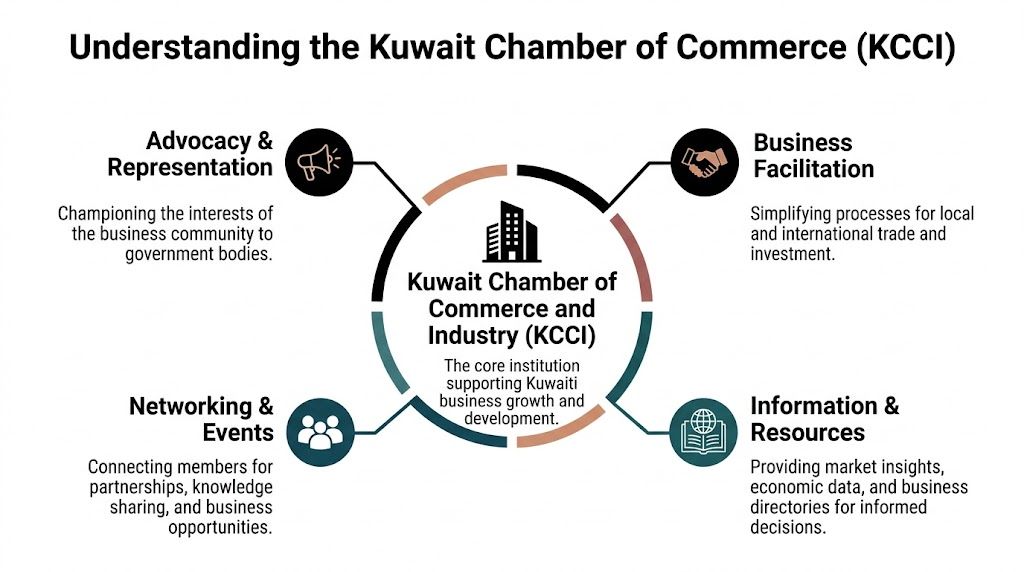
A self-financed, non-profit chamber behaves differently from a pure government department. It still operates in a formal institutional setting, but its reason for existing is tied to the business community it represents.
That matters in practice for three reasons:
For founders, that usually means KCCI is more valuable when your need is concrete. Examples include document authentication, market presence, sector visibility, or understanding how commercial interests are represented in Kuwait. It’s less useful when your need is highly founder-specific, such as investor warm-ups, brutally honest product feedback, or peer accountability.
That sounds obvious, but it’s the source of most mismatched expectations.
A founder often approaches chambers hoping for startup velocity. KCCI was designed for continuity, representation, and commercial order. It supports the wider business ecosystem. It wasn’t built as a founder-first community.
KCCI is strong where business processes need legitimacy. It’s weaker where startups need curation.
Here’s the practical framing.
| Function | What it means for a founder |
|---|---|
| Representation | The chamber stands as a recognised voice for the private sector in Kuwait. |
| Facilitation | It supports business processes that affect trade, paperwork, and market operations. |
| Convening | It brings businesses into the same orbit through branches, events, and institutional touchpoints. |
| Commercial signalling | Association with the chamber can help a company look more serious to partners, suppliers, and counterparties. |
The fact that KCCI has nine branches isn’t just administrative detail. It suggests the chamber is not operating as a single distant headquarters. It has a local operating footprint, which matters when your issue is practical rather than strategic.
If your team needs a document handled, a query clarified, or a branch-level contact to point you in the right direction, that distributed structure can make the chamber feel more usable than founders expect from a formal institution.
Don’t think of KCCI as a “nice to have” credential. Think of it as a market access instrument with limits.
If your expansion plan into Kuwait includes any of the following, you should at least understand how KCCI fits into the puzzle:
That’s the right frame. It keeps you realistic, and it stops you from treating the chamber either as irrelevant bureaucracy or as a magic shortcut.
Founders don’t need a ceremonial summary. They need to know what KCCI helps with when there’s money, time, or execution risk involved.
The useful lens is simple: which chamber functions remove friction from doing business in Kuwait?
| Service | Who It's For | Primary Benefit |
|---|---|---|
| Document attestation and authentication | Exporters, importers, regional businesses entering Kuwait | Helps make business documents usable and credible in formal processes |
| Commercial information and market support | Founders assessing sectors, partners, or market entry routes | Gives a more structured starting point than informal introductions alone |
| Networking and business events | Companies seeking visibility and broad relationship-building | Opens access to established business circles |
| Commercial dispute support and arbitration context | Firms entering contracts with local counterparties | Adds a recognised business framework around disputes and enforcement discussions |
| Trade facilitation touchpoints | Businesses moving goods or formalising cross-border trade | Helps reduce confusion around what documents and approvals matter |
For many founders, document work feels like back-office drag. In Kuwait, that’s a mistake.
Attestation and authentication can shape whether your paperwork is accepted smoothly, delayed, or challenged. If you’re exporting goods, opening formal business relationships, or submitting documents that need local recognition, chamber-linked validation can move from “minor task” to “critical path”.
That’s especially true for teams used to the UAE, where they may already know the value of chamber-issued or chamber-authenticated commercial documents. If your launch checklist is still loose, it’s worth tightening the commercial side before market entry. A practical read on sequencing offers from product to launch is this foundational guide for launching a product, because market entry work tends to break when ops and go-to-market are planned separately.
Founders often ask chambers broad questions and get broad answers. That’s not a chamber problem. It’s a question quality problem.
Don’t ask, “Can you help us understand Kuwait?” Ask narrower questions:
The more specific your ask, the more likely the chamber can help.
A useful comparison point is how other GCC chambers present business directories and commercial pathways. If you want a reference for how chamber directories can be used in practice, this look at the Dubai Chamber of Commerce directory gives a good benchmark mindset.
KCCI events can be valuable. But only if you go in with a shortlist.
Don’t attend with the goal of “meeting people”. Attend with one of these goals:
A chamber event is productive when it gives you one next meeting with commercial relevance. Anything beyond that is upside.
Before you approach the chamber, prepare:
The chamber can support momentum. It won’t create clarity for an unprepared team.
Membership questions usually come too early or too late. Too early, when the founder hasn’t decided what they need from Kuwait. Too late, when a transaction or market entry task already depends on chamber-linked access or documentation.
Don’t begin with “How do we join?” Begin with “What are we trying to achieve?”
That usually falls into one of these buckets:
If none of those are true yet, rushing into membership may not be the best first move.
The exact requirements can vary based on your business structure and Kuwait setup, so founders should confirm directly with the chamber and local counsel. But the working process is straightforward.
Confirm your Kuwait operating setup
Before applying, make sure your company structure in Kuwait is clear enough to support the membership request.
Prepare company documents
Keep your registration materials, authorised signatory details, and any required supporting paperwork organised before submission.
Check attestation expectations early
Cross-border founders often lose time here. If you’re already dealing with chamber-linked certificates elsewhere in the GCC, this explainer on the chamber of commerce certificate process in Dubai is a useful benchmark for the type of document discipline to expect.
Submit through the appropriate chamber channel
Don’t assume the main branch is always the best route. Sometimes branch-level clarity makes the process easier.
Ask what membership gives you operationally
Not just the formal benefits. Ask which services, access points, and processes become easier once membership is active.
Public-facing founder guidance on membership tiers is limited, which is part of the broader issue with chamber access for startups. In practice, founders should treat the “tier” question as a decision about use case, not prestige.
Use these filters:
| If your goal is | Your decision filter |
|---|---|
| Basic market presence | Choose the entry point that gives access without overcommitting |
| Trade operations | Prioritise service usability over symbolic status |
| Longer-term market build | Consider whether repeated chamber interaction justifies deeper engagement |
Membership can help if you’re already moving. It won’t rescue a weak market thesis.
If you haven’t identified your Kuwait objective, your best next step isn’t membership. It’s tighter market definition.
A founder with a clear partner profile, product angle, and document plan gets more from the chamber than a founder who joins first and hopes clarity follows.
Passive chamber membership is a waste. That’s true in Kuwait, Dubai, Muscat, and almost everywhere else in the region.
KCCI becomes useful when you use it with intent. Founders who treat it as an active operating asset usually pull more value from it than those who merely register and wait.

This is one of the most practical uses.
If you’re entering Kuwait through distribution, supply, enterprise sales, or a joint commercial arrangement, the chamber can help you move beyond surface-level introductions. The point isn’t that KCCI will do your diligence for you. It won’t. The point is that it can help you operate closer to recognised business channels.
Use chamber touchpoints to test:
That won’t replace legal diligence, but it improves your early filtering.
Generic networking is low yield. Chamber settings work better when you already know what signal you want.
Go in with a market map, not a vague goal. Split the room into categories:
Then use short conversations to answer one hard question: “What would stop a company like ours from scaling in Kuwait?”
That question usually gets better answers than a polished pitch.
A chamber relationship can help when you need to look less like an unknown entrant and more like a serious regional operator. That’s useful in outreach, partnership conversations, and business development material.
It won’t make a weak offer stronger. But it can improve how your firm is perceived, especially by counterparties who care about institutional seriousness.
This is also where communications matter. If you’re entering a new market and need to shape how partners, media, or stakeholders interpret your move, it helps to understand the importance and benefits of Public Relations before you start announcing partnerships or launches without a clear narrative.
KCCI plays a role in regional trade and relationship-building, but there is limited guidance for startup founders on using it for cross-border peer collaboration and warm introductions. Recent KCCI activity points to bilateral economic partnerships, yet there isn’t clear founder-focused guidance for early-stage teams from places like the UAE that want curated access to high-signal relationships, as reflected on the official KCCI website.
That gap is real.
Chambers are built to support business communities broadly. Founders often need a narrower kind of help: trusted peers, accountability, and intros that are relevant on day one.
What works
What doesn’t
If you use KCCI for precision, it can be very useful. If you use it like a startup community, you’ll probably be disappointed.
The most overlooked reason to pay attention to KCCI is not events, directories, or business visibility. It’s influence.
When founders think about chambers, they usually think front-of-house. Membership, certificates, introductions. But for scaling companies, especially those considering acquisitions, joint ventures, or strategic deals, the more important question is whether the chamber shapes the rules of the market.
In Kuwait, it does.
KCCI advises on commercial regulation, and one concrete example is merger control. Under Kuwait’s Competition Protection Agency regime, pre-merger filing can be triggered by relatively low thresholds. One threshold cited is KWD 500,000 in annual sales for one party, and that contributes to higher scrutiny for non-oil sector M&A than many UAE founders expect. The same analysis notes that pre-filing consultations via KCCI can reduce rejection risks and shorten approval time from 120+ days to 60-90 days, according to the Kuwait merger control trends analysis.
That changes behaviour.
If you’re used to operating in markets where only bigger deals trigger serious review, Kuwait may catch your transaction earlier than expected. A founder rolling up smaller businesses, buying into a local operator, or forming a structured JV can end up in a more regulated process than the deal size initially suggests.
If Kuwait is part of your expansion thesis, add these questions to your deal checklist:
This isn’t just legal housekeeping. It affects transaction design, timing, and bargaining power in negotiations.
KCCI is not only useful when you need a document stamped or a meeting attended. It can matter before a strategic move is even announced.
The founders who handle Kuwait best usually stop treating regulation as a late-stage legal issue. They bring it into commercial planning early.
For a UAE founder, that’s a true upgrade in mindset. Kuwait may be geographically close, but the operating assumptions can still be different enough to affect execution.
The practical verdict is straightforward. The kuwait chamber of commerce is useful, credible, and worth understanding if Kuwait is commercially relevant to your company. It is not a complete founder support system.
That distinction matters most in emerging areas, where institutional interest exists but founder-level guidance is still thin. One example is sustainability. A 2025 report by KCCI and the ILO assessed private sector readiness for a low-carbon economy aligned with Kuwait’s national goals, but there is still a lack of founder-centric guidance showing MENA startups how to engage with those opportunities in practical terms, as covered in the KCCI and ILO low-carbon economy report summary.
That tells you something important. KCCI can be close to the right conversations, but not always close to the founder workflow.
If Kuwait is now on your active roadmap, use this sequence.
Define the use case
Decide whether you’re entering for sales, trade, partnership, hiring, or a strategic transaction.
Assign one internal owner
Don’t spread Kuwait across three people with part-time attention. Give one person responsibility for chamber contact, document tracking, and follow-up.
Build a Kuwait brief
Keep it short. Include your offer, target sector, partner type, and what you need from the market.
Contact the chamber with narrow asks
Ask about relevant services, business pathways, or the right office to speak with. Broad requests waste time.
Review your document readiness
Your legal and operations teams should confirm what will need authentication, attestation, or local acceptance.
Map your support gaps
Identify what the chamber can help with, and what it can’t. Peer accountability, investor warm-ups, and brutally honest founder feedback usually sit outside the chamber model.
You should supplement chamber engagement when you need:
| Need | Better fit |
|---|---|
| Curated founder peers | Founder communities and smaller private groups |
| Fast feedback on strategy | Operators who’ve already entered Kuwait or adjacent GCC markets |
| Warm intros based on relevance | Trusted ecosystem connectors rather than broad institutional events |
| Execution accountability | Regular founder check-ins, not occasional formal meetings |
If you’re comparing chamber ecosystems across the region, this look at the chamber of commerce landscape in Oman is a useful cross-GCC reference point.
The smart move isn’t choosing between KCCI and more agile founder support. It’s knowing what each is good for, then using both accordingly.
Founders shouldn’t assume that chamber membership works the same way in every GCC market. Whether membership is necessary for your situation depends on your company structure, your activity in Kuwait, and the specific process you’re trying to complete. Confirm this directly with Kuwait counsel and the chamber instead of relying on regional assumptions.
Yes, foreign and GCC founders can still find KCCI relevant, especially when they are setting up, trading, partnering, or formalising a local presence. The key issue isn’t nationality. It’s whether your business has the right legal and operational footing in Kuwait to use chamber services or pursue membership.
There’s overlap, but don’t treat them as interchangeable. Both sit close to business activity and formal commercial processes, but the operating culture, service flow, and founder experience can feel different. A UAE founder should expect less startup-style guidance in Kuwait and more reliance on direct, process-driven engagement.
Not in the way most founders mean it. KCCI can create institutional proximity and broad business exposure, but it isn’t designed like a curated founder network. If you need relevant peer support, accountability, and carefully matched introductions, you’ll need to build that layer separately.
Digital access can help with convenience, but it won’t replace judgement. Founders still need local clarity on documents, counterparties, and next-step sequencing. Use digital services as a convenience layer, not as your full Kuwait strategy.
If you want support that complements formal institutions like KCCI, Founder Connects is built for founders who need sharper peer conversations, curated introductions, and accountability that moves decisions forward across the UAE and wider MENA ecosystem.


