

Local vs Global: Adapting Strategies in UAE
Building in MENA? You don't have to do it alone.
Join 300+ founders in the Founder Connects Residency. Monthly squad calls, warm intros, $3M+ in perks, and much more. All for less than your monthly coffee budget.

The UAE’s business environment is unique. With 90% of its population being expatriates, businesses must balance global ambitions with local trust-building to succeed. Key challenges include navigating diverse cultural expectations, regulatory frameworks, and relationship-driven markets. Here's what you need to know: (and stay updated with the latest UAE startup news and trends)
- Local-first strategies focus on trust through personal connections, Arabic language support, and alignment with local norms (e.g., Sharia compliance). These work well for B2C businesses but may limit scalability.
- Global-first strategies prioritize standardization and scalability but often fail due to mismatched cultural expectations, regulatory hurdles, and lack of local engagement.
- Hybrid strategies combine local trust-building with global scalability, offering a balanced approach. This includes bilingual branding, phased market entry, and partnerships with local entities.
Key Takeaways
- The UAE’s market demands a tailored approach - global strategies often falter without local adaptation.
- Trust is critical; face-to-face interactions and visible local presence are essential.
- Regulatory alignment (e.g., DIFC, ADGM, VARA) and cultural sensitivity can make or break market entry.
- Hybrid models, blending global strengths with local insights, are often the most effective.
The bottom line: Success in the UAE requires balancing global efficiency with local trust. Companies must align their strategies with the region’s unique dynamics to thrive.
Local-First Strategies in the UAE
Cultural and Language Alignment
In the UAE, Arabic is the official language, making full localisation a must for B2C products. This means more than just translating content - it involves adapting right-to-left (RTL) UI layouts and providing Arabic-language customer support. However, localisation should also account for the UAE's diverse population, which includes people from more than 200 nationalities. Messaging that resonates with non-native speakers, rather than relying solely on standard global English, is key.
For businesses aiming to scale locally, adhering to Sharia-compliance is often essential. This means avoiding themes related to alcohol, gambling, sexuality, or LGBTQ+ topics. Branding also plays a big role in connecting with local audiences. Incorporating elements like desert-inspired colours, Islamic art influences, and sleek urban aesthetics can make a difference. For example, green often symbolises Islam, while red may carry negative connotations depending on the context.
Getting these cultural and linguistic nuances right sets the stage for building trust, which is pivotal in UAE business practices.
Relationship-Driven Business Practices
In the UAE, trust is built through personal connections and a visible presence. Business relationships often depend on understanding a founder's background and community ties. Decisions made remotely, without a local presence, may lack the personal touch needed to succeed in this market.
"Trust isn't a nice-to-have - it's the operating currency." - Sergei Andriiashkin, Founder and Strategy Partner, Vinden.one [7]
Face-to-face interactions, such as meetings, conferences, and exhibitions, are seen as markers of credibility. Without these personal connections, digital strategies often struggle to gain traction. Demonstrating a commitment to the local market - whether through local leadership or even family ties like having children in UAE schools - can significantly boost a company's reputation and trustworthiness.
While trust is built on relationships, the UAE government also provides structured support to strengthen local-first strategies.
Government Support and Local Advantages
The UAE government actively supports businesses through initiatives that complement cultural and relational practices. For instance, Hub71 in Abu Dhabi offers startups subsidised office space, housing, and healthcare for up to three years, along with connections to investors and corporate partners [6]. The Khalifa Fund, through its SME Champions Programme, has facilitated over AED 672 million in procurement deals for small and medium-sized enterprises in 2024 [8].
Another initiative, the Future 100 Initiative, focuses on identifying 100 SMEs in emerging sectors like Fintech, AI, and Healthtech. These businesses receive a specialised label and faster access to regulators and investors [6]. Similarly, the In-Country Value (ICV) Programme encourages localisation of supply chains, making ICV certification crucial for startups seeking government contracts [8].
Startups also benefit from the UAE's flexible regulatory frameworks. Depending on their needs, they can choose between jurisdictions like DIFC for common law frameworks, ADGM for sovereign wealth connections, or VARA for Web3 and crypto-focused models [1].
"The UAE doesn't just create favourable conditions for tech businesses – it actively invests in them." - Andrii Lazorenko, CEO and Co-Founder, Ideasoft [4]
sbb-itb-f597d8f
How to EXPAND Your BUSINESS in the UAE: Key Strategies & Tax Tips
Global-First Strategies and Their Limitations in the UAE
Global-first models may promise quick scalability, but in the UAE, their lack of local alignment can jeopardise both trust and financial stability. This underscores the importance of adopting local or hybrid approaches to thrive in this unique market.
Scalability vs Cultural Customisation
Global-first strategies often rely on standardised products to expand quickly. However, in the UAE, this approach faces a major hurdle: consumers here benchmark products against the best in the world. With the UAE serving as a hub for talent and capital from global cities like London, Singapore, and New York, local buyers expect offerings that match international standards [7].
The issue becomes more pronounced when startups attempt to scale without addressing local preferences. For instance, the "minimum viable product" (MVP) model that works in Western markets can be seen as subpar in the UAE, where customers value premium or standout products in any category [4][7]. A global MVP, without local enhancements, often fails to make an impact.
Adding to the complexity are regulatory challenges. Unlike tariffs, which primarily affect profit margins, non-tariff barriers such as data sovereignty laws can entirely block a product from entering the market. Industries like finance, healthcare, and edtech frequently require local data hosting, which clashes with the centralised cloud systems typical of global-first models [2]. These rules create significant financial and operational obstacles, sometimes preventing market entry altogether.
These cultural and regulatory factors also pose difficulties for businesses relying on digital-first, standardised strategies.
Standardisation in a Relationship-Focused Market
Digital-first strategies that depend solely on performance marketing often hit a wall in the UAE. With expatriates making up around 90% of the population and representing over 200 nationalities, trust becomes the cornerstone of business success [7]. Transactional, standardised approaches often fail because they lack the personal touch and physical presence that local stakeholders expect.
"If your market entry plan is purely digital and transactional, you'll hit a ceiling fast." - Sergei Andriiashkin, Founder and Strategy Partner, Vinden.one [7]
In-person interactions - whether through meetings, conferences, or exhibitions - act as trust signals that digital campaigns struggle to replicate. Prospective partners often look for signs that founders are genuinely invested in the UAE, such as having children in local schools or maintaining long-term residence. Without these markers of commitment, even well-funded global companies face challenges in gaining traction [7].
The communication gap goes beyond language barriers. Standardised designs, often created for native Western English speakers, can alienate large segments of this diverse market. Additionally, the lack of Right-to-Left (RTL) support for Arabic users further highlights the pitfalls of a one-size-fits-all digital approach [7][4].
Without local grounding, digital standardisation can lead to costly financial missteps.
Financial Risks of Insufficient Adaptation
Failing to adapt global strategies to the UAE's specific needs doesn't just result in missed opportunities - it can lead to significant financial setbacks. The "alignment trap" occurs when marketing efforts outpace the readiness of local products or sales teams, eroding trust and making recovery difficult in the UAE market [7].
Operational delays also play a role. For example, corporate banking processes in the UAE, slowed by Anti-Money Laundering (AML) and Know Your Customer (KYC) requirements, can take 1–3 months, disrupting cash flow [4]. Startups unprepared for these delays risk operational breakdowns. Similarly, neglecting to address Sharia compliance or local content restrictions can trigger regulatory issues, potentially halting revenue streams entirely [4].
In the UAE, financial efficiency takes a backseat to product excellence and local engagement. Global startups must allocate resources to build a local brand presence, establish physical operations, and nurture relationships - expenses that purely digital models often overlook [4][7]. Without aligning product readiness, marketing efforts, and sales capacity, startups risk wasting resources while damaging their reputation in a market where trust, once lost, is almost impossible to regain.
Hybrid Approach: Combining Local and Global Elements
A hybrid strategy brings together the strengths of both local and global approaches. By blending global scalability with local trust, this "glocal" method has enabled regional success stories to address local challenges using technology that scales globally [6].
The key is to align global ambitions with local execution. Instead of choosing between a purely local or global strategy, successful startups develop systems that can expand internationally while respecting the UAE market's distinct cultural, regulatory, and relationship-driven dynamics. Achieving this balance takes thoughtful planning across areas like branding, market entry, and partnerships.
Bilingual Branding and Cultural Sensitivity
Your brand needs to resonate both locally and globally. In the UAE, effective branding must work seamlessly in both Arabic and English - this goes beyond simple translation. Arabic-English parity has become a critical requirement, particularly with the rise of AI and digital services [9]. To connect with the local audience, incorporate elements like desert-inspired tones, Islamic art influences, and culturally meaningful visuals [9][3]. The goal isn’t to discard your global identity but to adapt it in ways that feel authentic rather than generic. For example, ensure your design supports right-to-left (RTL) text and that your messaging aligns with local values while staying consistent with your international brand.
Cultural fluency within your team is essential. Hire individuals who combine deep local knowledge (Arabic language skills and an understanding of religious and cultural norms) with the ability to execute at global standards [3]. This dual expertise ensures your brand communicates effectively in both markets without compromising on quality or efficiency.
Phased Market Entry Strategy
Jumping into full-scale operations too quickly can lead to costly errors. A phased approach allows you to test and refine your product-market fit before making significant investments. Start with in-depth, on-the-ground customer research and market analysis before deciding on your legal structure or jurisdiction [3].
A hybrid entry model can be particularly effective. For example, consider taking a minority stake in a local entity while simultaneously pursuing your own independent licence [10]. This approach offers immediate access to local insights and networks while preserving your long-term autonomy. Local partnerships can provide credibility and faster initial traction, but pursuing an independent path ensures you’re not entirely reliant on partner timelines.
"The most effective strategies are rarely limited to one path. Some firms combine approaches, for example, taking a minority stake in a local entity while pursuing their own licence." - Hasnae Taleb, Managing Partner, Mintiply Capital [10]
Don’t depend solely on partnerships for your first year’s revenue. The UAE’s hierarchical decision-making and emphasis on relationship-building often mean partnerships take longer to deliver results than they might elsewhere [3]. Ensure you have a direct-to-market strategy that can operate independently, so your growth isn’t hindered by delays. Once you’ve validated your market entry, strengthen your presence through strategic local partnerships. For ongoing support, consider joining a startup community to access expert advice and investor networks.
Partnerships with Local Entities
Collaborating with established local organisations can give your business instant credibility and access to networks that would otherwise take years to develop. Platforms like Hub71 in Abu Dhabi or Dubai Future District offer more than just office space - they provide grants, non-dilutive funding, and direct connections to enterprise clients in both public and corporate sectors [6].
Select partners that align with your business model and leverage jurisdictional advantages [10].
Take Careem as an example. Between 2012 and 2020, the company combined its global aspirations with a deep understanding of regional nuances that global competitors initially overlooked. This approach resulted in its AED 11.4 billion acquisition by Uber and its transformation into a regional super-app [6]. Similarly, Tabby identified the local demand for flexible, interest-free credit and partnered with over 40,000 brands. By 2025, Tabby achieved a valuation of AED 12.1 billion, attracting investments from J.P. Morgan and Mubadala [6].
Empowering local leadership is another critical factor. In the UAE, personal connections and physical presence play a vital role in building trust. Local leaders who understand the region’s relationship-driven business practices are key to forming successful partnerships [10].
Team Building and Hiring Considerations
Hiring in the UAE requires a careful approach, blending an understanding of local customs with the ability to meet global standards. This dual focus often requires additional time and resources, reflecting the complexity of the UAE’s unique business environment.
Arabic Language Skills
Having Arabic-speaking team members is crucial for accessing key segments of the UAE market, especially in government sectors and more traditional industries. For B2C startups, offering full Arabic localisation - including customer support and automated chat services - is highly advisable. While English is widely understood, Arabic remains the official language and plays a significant role in effective communication.
A case in point: In February 2026, a Vinden.one research manager tested website prototypes with a local trader, only to see the effort fail due to language and cultural mismatches. This highlighted how non-localised messaging can alienate key customer groups. Similarly, strategy partner Sergei Andriiashkin accompanied a sales representative to a small laundry business in Dubai. By engaging directly with the owner in their environment, they gained insights that shaped more effective, locally resonant sales strategies.
"Without Arabic speakers, for instance, you're cut off from a meaningful portion of the business landscape." - Sergei Andriiashkin, Founder and Strategy Partner, Vinden.one
Cultural Knowledge and Market Understanding
Language fluency is just one piece of the puzzle; cultural understanding is equally, if not more, important. Building trust is essential for success in the UAE, where relationships often hold more weight than transactional agreements. Hiring individuals who understand local religious and cultural norms can help foster these connections, demonstrating to clients that your business is genuinely embedded in the local context. This could even extend to visible indicators like having families or children involved in local schools.
Cultural awareness can also help avoid costly missteps. For example, aggressive sales tactics that might succeed in other markets can backfire in the UAE’s relationship-oriented business culture. Even details like colour symbolism - knowing that green is linked to Islam and that red should be used cautiously - can make a difference. This creates a hiring challenge: while local hires bring deep cultural insight, they may have a different approach to deadlines. On the other hand, global hires might excel in execution but lack the local knowledge needed to navigate the market effectively.
"The real skill - and it takes time to develop - is finding people who sit at the intersection: culturally fluent, linguistically capable, AND aligned with your pace, ambition, and standards." - Sergei Andriiashkin, Founder and Strategy Partner, Vinden.one
Talent Acquisition Costs and Timelines
Startups should prepare for higher talent acquisition costs compared to their home markets, especially when seeking professionals who combine local expertise with global execution skills. Specialised roles often command premium salaries - AI and machine learning specialists, for instance, earn between AED 240,000 and AED 720,000 annually, while cybersecurity experts earn between AED 180,000 and AED 600,000 [11]. Additional costs include visa fees (AED 5,000–7,000 for two years) [12], recruitment agency fees, onboarding expenses, and tools or software licences.
The UAE is experiencing strong employment growth, with a +48% net employment outlook for 2025. However, 45% of employers report ongoing skills shortages in specialised tech roles [11]. While contract-based hiring can offer quick onboarding with higher monthly costs but less long-term commitment, full-time hiring provides stability at a higher overall expense.
Synchronising your hiring strategy with local practices is vital to avoid delays or missteps. Aligning hiring timelines with your product readiness, marketing efforts, and sales objectives is equally important. Any misalignment risks not only missed opportunities but also a loss of trust - something that can be particularly challenging to rebuild in the UAE’s relationship-driven market.
Comparison Table: Local vs Global vs Hybrid Strategies
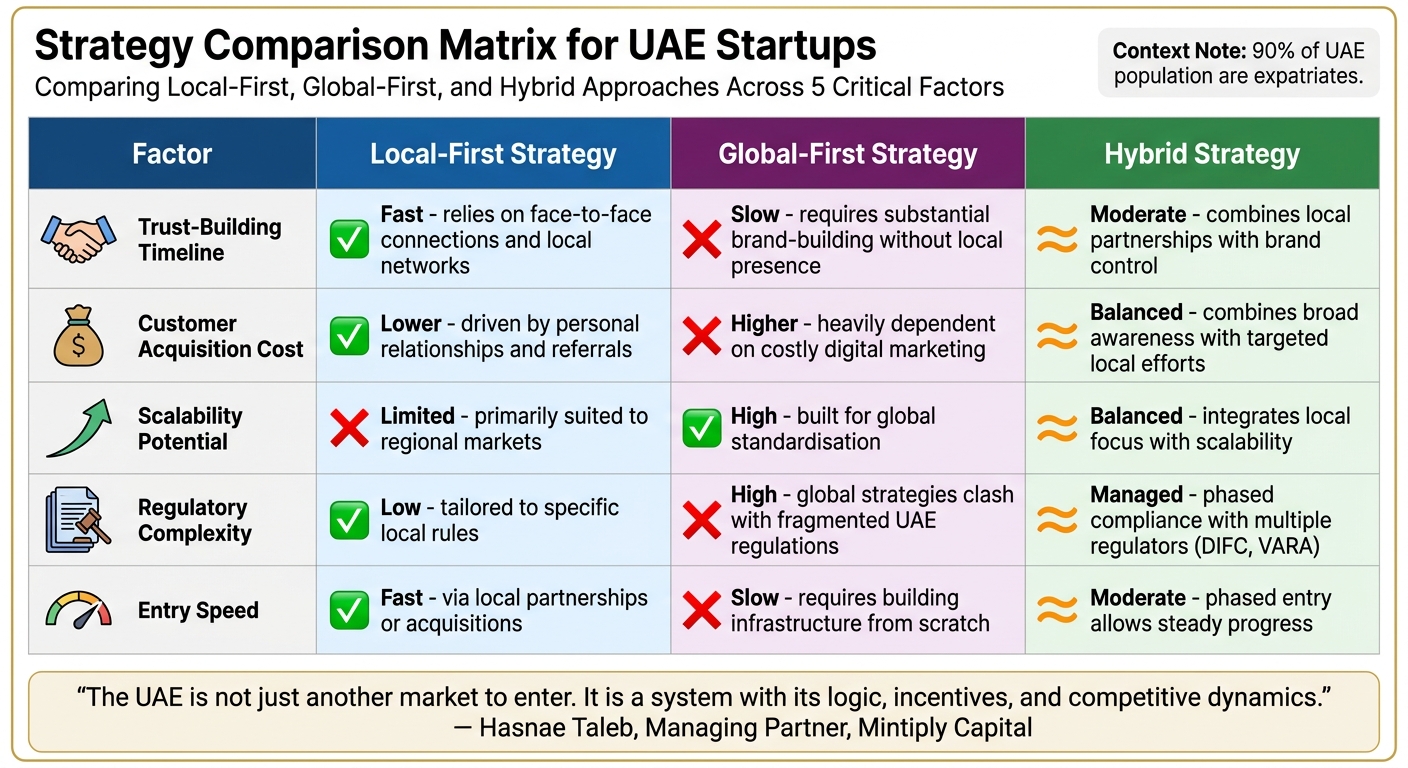
Local vs Global vs Hybrid Business Strategies in UAE: Comparison Matrix
Strategy Comparison Matrix
In the UAE, where 90% of the population are expatriates, startups face a unique set of challenges. With no inherited trust networks, choosing the right strategy - local-first, global-first, or hybrid - can significantly impact revenue timelines, costs, and the ability to build trust [3].
Here’s how these strategies compare across five critical factors in the UAE:
| Factor | Local-First Strategy | Global-First Strategy | Hybrid Strategy |
|---|---|---|---|
| Trust-Building Timeline | Fast; relies on face-to-face connections and local networks [4][10] | Slow; requires substantial brand-building efforts without direct local presence [4] | Moderate; combines local partnerships with brand control for quicker results [10] |
| Customer Acquisition Cost | Lower; driven by personal relationships and referrals [4] | Higher; heavily dependent on costly digital marketing | Balanced; combines broad brand awareness with targeted local efforts |
| Scalability Potential | Limited; primarily suited to regional markets [14] | High; built for global standardisation | Balanced; integrates local focus with scalability [13][6] |
| Regulatory Complexity | Low; tailored to specific local rules [10] | High; global strategies often clash with fragmented UAE regulations [10] | Managed; phased compliance with multiple regulators (e.g., DIFC, VARA) [10] |
| Entry Speed | Fast (via local partnerships or acquisitions) [10] | Slow; requires building infrastructure from scratch [10] | Moderate; phased entry allows steady progress [10] |
Local-first strategies shine in building trust and entering the market quickly but tend to limit growth beyond the region. Global-first strategies, while scalable, face higher initial challenges due to cost and regulatory hurdles. The hybrid approach offers a middle ground, blending local expertise with global scalability, though it requires careful management.
"The UAE is not just another market to enter. It is a system with its logic, incentives, and competitive dynamics." - Hasnae Taleb, Managing Partner of Mintiply Capital [10]
Consumer services in the UAE often lean towards local-first strategies, given the importance of trust and personal connections. On the other hand, business services benefit from global-first approaches, leveraging standardisation and scale. However, strategy choices can evolve over time.
For example, Astra Tech adopted a hybrid model, securing AED 1.84 billion in funding from G42. This allowed them to consolidate local players like Rizek, PayBy, and Botim into an all-encompassing ultra-app [6]. Similarly, Tabby combined local execution with global backing from J.P. Morgan and Mubadala, reaching a valuation of AED 12.1 billion [6].
Next, we’ll explore a framework to help UAE startups determine the most effective strategy for their business goals.
Decision-Making Framework for UAE Startups
Testing Product-Market Fit
Before deciding on a local, global, or hybrid strategy, it’s essential to test your assumptions in the real world. Desk research might give you a starting point, but it won’t fully capture how UAE customers behave. Instead, immerse yourself in the local environment: visit traditional souks, accompany sales reps on client meetings, and observe how businesses operate on the ground. Pay close attention to what customers use rather than what they say they want - there’s often a noticeable gap between the two [7].
"The first question is whether the market actually exists for your product, how large it is, who the customers are, and what the competitive landscape looks like." - Sergei Andriiashkin, Founder and Strategy Partner, New Markets [7]
To get a clear picture, conduct at least 20 detailed interviews with individuals from the UAE’s diverse population of over 200 nationalities. Tailor your messaging to resonate with different English accents - whether it’s Indian, Arabic-accented, or British English. Additionally, track digital demand through WhatsApp inquiries, social media messages, and online comments. This helps you capture the raw, unfiltered language your customers use [7].
Once you’ve confirmed product-market fit, it’s time to evaluate the competitive landscape and market demand.
Analysing Competition and Market Demand
In the UAE, competition isn’t just local - it’s global. Consumers here compare products and services against international standards, whether they’re physical goods or SaaS offerings. The country’s world-class logistics and low import barriers make this comparison inevitable [7].
To refine your strategy, break down the market by emirate, industry, and revenue tier. Ask yourself: does your product align with the UAE’s image of being the "biggest and best"? Solutions that enhance the nation’s appeal to investors or contribute to tourism often gain more traction. In this market, prestige can sometimes matter more than traditional profitability metrics [4].
With a clear understanding of market dynamics, focus on aligning your internal resources.
Matching Resources to Strategy
Before launching, ensure your product readiness, marketing efforts, and sales capacity are all in sync. Overpromising while your product is still evolving can damage your reputation in a market where trust is everything [7]. Keep in mind that opening a UAE corporate bank account can take 1–3 months, so regulatory timelines should be part of your planning process [4].
Set aside a budget for "bridge talent" - professionals who combine cultural understanding with the ability to execute quickly. This is a rare but essential skill set for thriving in the UAE. Lastly, aim for direct-to-market revenue within the first year, as relying solely on partnerships could delay results [7].
"The license structure follows the strategy. Not the other way around." - Sergei Andriiashkin, Founder and Strategy Partner, Vinden.one [7]
Networking and Relationship Building for Strategy Success
Face-to-Face Connections in the UAE
Personal connections play a central role in the UAE, where trust isn't automatically extended but must be earned through meaningful interactions. In-person meetings are often the key to validating credibility and opening doors to opportunities that remain inaccessible to those relying solely on digital outreach [3]. Local partners in the UAE value visible commitment, prioritising face-to-face engagement over remote management. While digital marketing can spark initial interest, it rarely achieves its full potential without the reinforcement of strong offline relationships.
"Often, what truly matters is not what's written in the documents, but who you know and who knows you" - Andrii Lazorenko, CEO and Co-Founder, Ideasoft [4]
Investing in events, conferences, and in-person meetings is essential. Sales tactics that might work in Western markets often fall flat in the UAE, where building relationships requires patience and respect. This cultural emphasis on personal interaction creates a natural pathway for innovative networking platforms to thrive.
Using Founder Connects for Network Growth
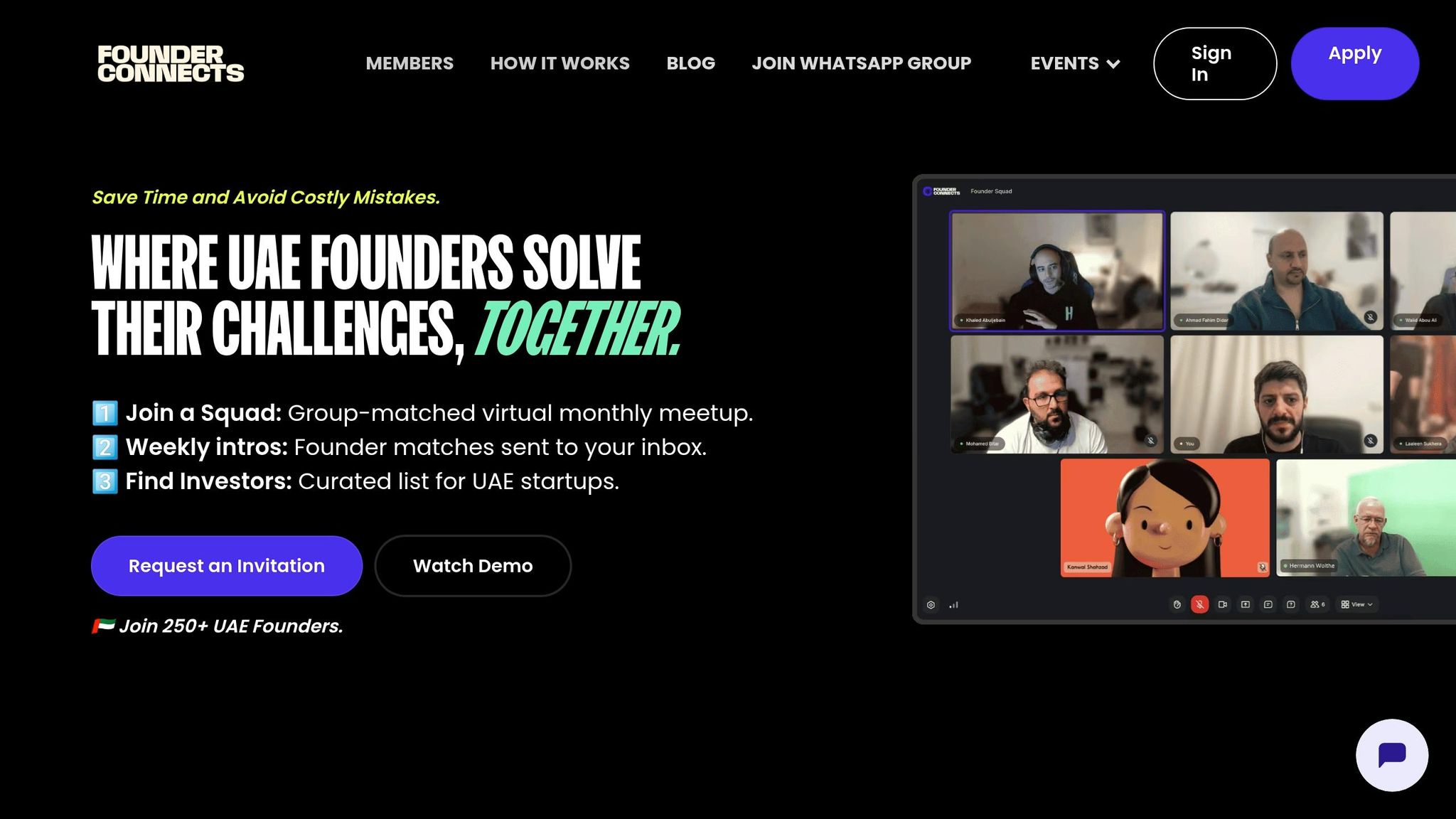
For startups in the UAE's tech, fintech, and AI sectors, Founder Connects provides a structured way to engage with the local startup ecosystem. The platform offers group-matched virtual masterminds, curated networking opportunities, and access to culturally knowledgeable peers with deep insights into regional markets.
Through live talks, expert consultations, and investor introductions, Founder Connects bridges global strategies with local execution. Founders gain collective knowledge about navigating regulatory frameworks in areas like the DIFC, ADGM, and the mainland. This shared intelligence not only simplifies the complexities of the UAE's startup landscape but also speeds up the trust-building process - an essential ingredient for long-term success in this region.
Conclusion: Choosing the Right Strategy for UAE Success
Success in the UAE isn’t a one-size-fits-all formula. Strategies tailored to local markets help build trust in this relationship-driven environment but can sometimes limit broader scalability. On the other hand, global-first approaches can scale quickly but often miss crucial regulatory details and the importance of personal connections. A hybrid approach - combining local validation with global standards - offers a middle ground but demands careful coordination between local teams and headquarters.
The hardest part? Aligning strategy with execution. As Hasnae Taleb, Managing Partner at Mintiply Capital, puts it:
"The issue is rarely capital or ambition. It's strategy." [10]
Founders need to align their resources, timelines, and market insights with their chosen approach. Different sectors require different strategies; for instance, a fintech startup operating in DIFC will have vastly different needs compared to a Web3 company under VARA. This diversity in strategy must be backed by solid execution.
The UAE’s startup ecosystem thrives on the seamless integration of product, team, and market entry. Earlier discussions on adapting to local norms and market-specific challenges underscore this need. Empowering local leadership with decision-making authority often outshines remote management. The UAE's impressive 380% year-on-year startup growth in 2024 [5] showcases how adaptability, not just ambition, drives success. Whether you're in tech, fintech, or AI, finding the right balance between global reach and local trust is the key to thriving in this dynamic market.
FAQs
How do I choose local-first, global-first, or hybrid in the UAE?
Deciding on the right strategy for your startup in the UAE hinges on your goals, target audience, and how the market operates. Here's a quick breakdown of the options:
- Local-first: This approach focuses on aligning your products or services with the preferences and traditions unique to the UAE. It’s a way to build trust and create a strong connection with the local audience.
- Global-first: This strategy prioritises scalability by offering products or services with minimal localisation. However, it’s crucial to ensure compliance with UAE regulations to avoid any roadblocks.
- Hybrid: A middle ground that blends global branding with tailored adjustments for the UAE market. This approach allows you to cater to local needs while still maintaining a broader growth strategy.
Each path offers its own set of advantages, so the choice depends on how you plan to position your startup in the region.
What local changes matter most for UAE customers?
For businesses targeting the UAE, aligning with the country’s focus on advanced technology, digital infrastructure, and innovation-driven industries is essential. Key areas like renewable energy and education technology stand out as priorities.
Understanding local regulations and market strategies is equally important. Companies must ensure compliance with the UAE’s frameworks while tailoring their approach to resonate with the market. Offering high-quality and forward-thinking products or services is a must, but it’s just as critical to respect the local language, traditions, and cultural values.
Building trust is another cornerstone of success. This can be achieved through community engagement and forming meaningful partnerships within the region. Ultimately, navigating the UAE’s strategic sectors while respecting its cultural and regulatory landscape will determine a business’s ability to thrive.
Which UAE regulator or zone should my startup start in?
Choosing the right regulator or zone in the UAE hinges on your business objectives and operational needs. Mainland companies are the way to go if your focus is on the local market, securing government contracts, or obtaining local licensing. On the other hand, Free Zones come with perks like 100% foreign ownership and tax exemptions, making them a great choice for export-driven ventures or tech startups.
To make the right decision, assess your business requirements carefully. For instance, tech startups might find Dubai Silicon Oasis appealing, while industrial businesses could benefit from Abu Dhabi’s Khalifa Industrial Zone. Consulting with experts can provide clarity and help you pick the zone that aligns with your goals.
Related Blog Posts

Building in MENA? You don't have to do it alone.
Join 300+ founders in the Founder Connects Residency. Monthly squad calls, warm intros, $3M+ in perks, and much more. All for less than your monthly coffee budget.
Popular posts





The premier community for tech founders, investors, and builders. Connect, collaborate, and grow together.