

Most founders don’t have a networking problem. They have a signal problem.
You can attend events every week in Dubai, collect a stack of LinkedIn connections, and still make no real progress. You’ll hear broad advice, meet people outside your stage, and spend hours on conversations that don’t lead to customers, mentors, hires, or investor relationships. That’s why many UAE and MENA founders eventually look beyond generic platforms and start evaluating market networking companies instead.
A strong market network sits somewhere between a community, a marketplace, and an operating system. It doesn’t just help you meet people. It helps you meet the right people, in the right format, around a concrete outcome. For a solo founder, that might mean regular peer accountability. For a scaling startup, it might mean investor access or market-entry support. For a founder in fintech, it might mean direct proximity to regulators and enterprise buyers.
That distinction matters in this region. A 2022 Dubai Future Foundation study found that 62% of UAE-based startups said access to the right network significantly accelerates growth, yet only 34% systematically track outcomes from networking activities. Founders know network quality matters. Many still don’t choose networks with a clear ROI lens.
If you’re also building your external presence while choosing where to network, this guide on LinkedIn personal branding pairs well with what follows.
Below is a practical comparison of 10 market networking companies and founder ecosystems relevant to UAE founders in 2026. The angle is simple. Pick based on stage and goal, not hype. Some platforms are best for early validation. Some are strongest for scale. Some work if you need a founder circle. Others are really investor access vehicles with community attached.
What does a useful founder network look like when your problem is execution, not exposure?
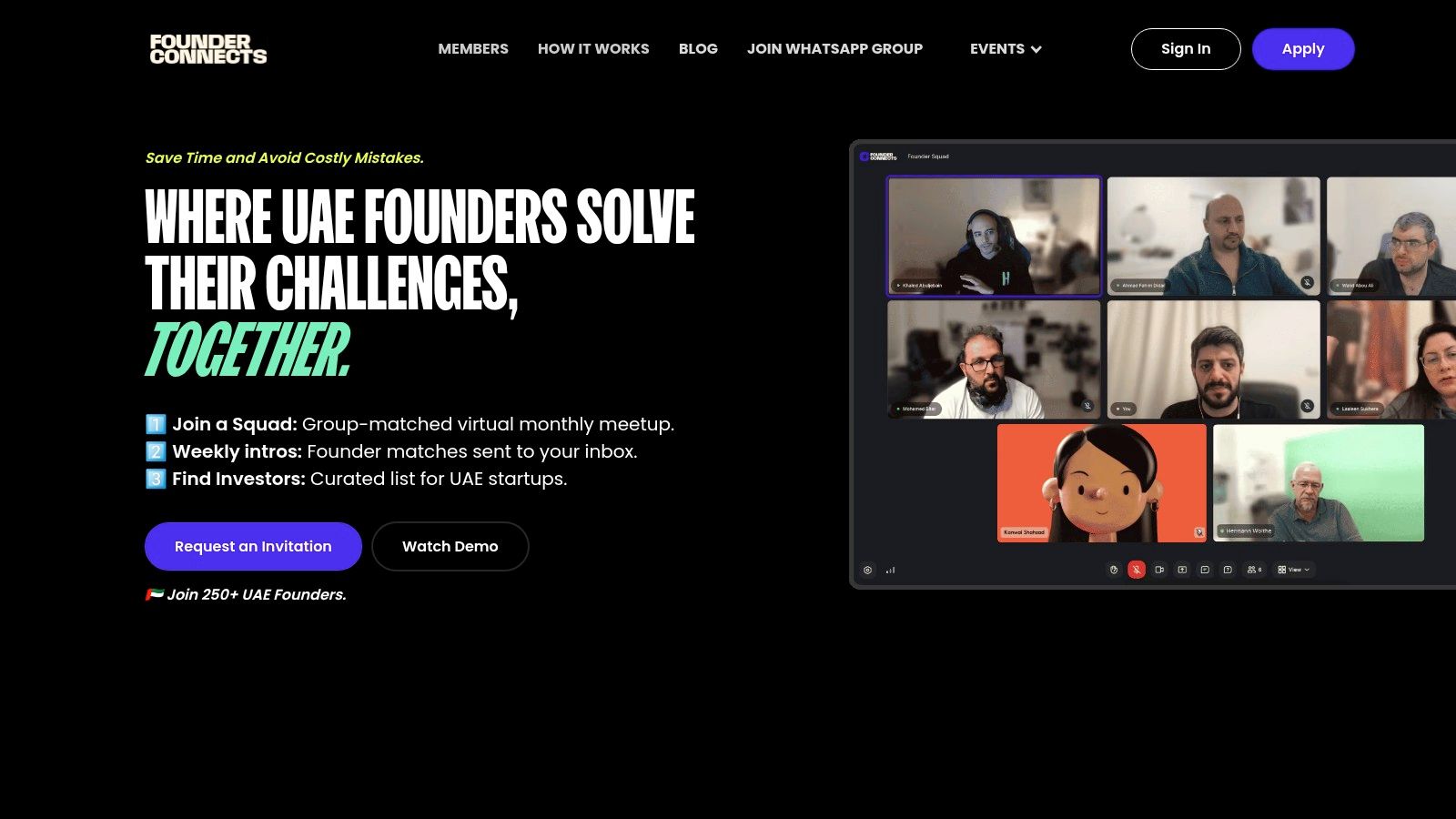
Founder Connects fits founders who want a smaller, more structured environment that turns introductions into actual progress. For UAE and MENA founders, that matters. Broad communities can be useful for visibility, but they often leave too much to chance if your immediate goal is feedback, accountability, or targeted relationships.
The model is simple. Founder Connects is built around curated peer groups, weekly introductions, and moderated sessions. That structure changes the quality of interaction. Founders get fewer random conversations and more context-rich discussions about issues that affect the business now.
This network works best if you can clearly name the outcome you want.
It is less about collecting contacts and more about building a working circle.
That distinction matters in this region. Founders in the UAE and wider MENA market often need practical guidance on setup choices, fundraising norms, pilot timelines, and expansion across Gulf markets. A curated regional network can help faster than a large global community that lacks local context.
Founder Connects combines a few formats that are often split across separate communities and tools.
The platform also shares concrete community outcomes, including founder participation, collaborations, cost savings, and funds raised across the network. That is more useful than generic claims about community value because it gives founders a clearer sense of what the network is trying to produce.
If you want to assess whether this style of network fits your current stage, this guide on how to build a strong startup network in Dubai is a useful companion.
Founder Connects is not the right choice for every founder.
That focus is also part of the value. In practice, curated communities work better when the main goal is better decisions and stronger relationships, not maximum reach.
One feature that stands out is the option to participate anonymously in certain situations. That can help when a founder wants honest input on a sensitive issue without attaching it to their public brand.
Choose Founder Connects if you are a founder who already knows what kind of help you need and wants a network built around that outcome. It is a strong fit for peer accountability, relevant introductions, and practical founder support with a clear UAE and MENA lens.

Endeavor UAE is not a casual networking community. It’s a selective scale-up network for founders building companies with serious growth ambitions. If you’re still validating the core problem or trying to get your first paying customers, this is probably too early. If you’re already scaling and need sharper mentorship, stronger investor credibility, and access to experienced operators, it becomes much more relevant.
The value here comes from selection quality. Once a founder clears that gate, they enter a network built for high-growth questions such as expansion, governance, hiring senior leadership, and preparing for institutional capital.
Endeavor works best when your company has moved past founder therapy mode and into scale architecture mode. That’s a different networking need.
For founders trying to build a better relationship map before applying, this piece on how to build a strong startup network in Dubai is a useful primer.
Endeavor is best treated as a force multiplier, not a starting point.
The obvious downside is access. Selection is competitive, and that’s part of the model. Another limitation is stage fit. A talented founder with a very early company may still get more immediate value from a curated peer group or operator community than from a prestige-heavy network aimed at later-stage growth.
This is one of the most credible market networking companies for founders who already have traction and now need significant amplification. It’s less useful if you’re still figuring out what to build, who to sell to, or how to stay accountable week to week.
TiE Dubai is often the easiest entry point for first-time founders who want to plug into an active entrepreneurial scene without waiting for a selective admissions process. It offers mentor-led sessions, networking events, pitch opportunities, and thematic programmes that can help founders widen their circle quickly.
That breadth is the upside. It’s also the downside.
If you’re new to the ecosystem, TiE can help you build foundational exposure.
For founders who still don’t know which kind of support they need, a broad platform like this can help clarify whether their primary challenge lies in fundraising, mentorship, partnerships, or peer support.
TiE is more open and less tightly curated than founder-only private communities. That means quality varies. Some events produce useful conversations. Others feel closer to traditional networking where everyone is collecting contacts and few are following through.
Membership and pricing details also aren’t especially transparent online, which means you’ll likely need to engage directly before understanding what level of access makes sense.
A practical way to use TiE is to treat it as a discovery layer. Attend, meet people, and identify who repeatedly shows up with depth. Then move the best relationships into smaller, more consistent settings. For early-stage founders, that approach works far better than assuming event attendance alone will solve the network problem.
Hub71 is less a pure networking company and more a full ecosystem platform. That distinction matters. If you’re choosing between market networking companies, Hub71 fits founders who want network plus setup support, programme structure, incentives, and investor access inside a well-known Abu Dhabi tech environment.
It’s especially relevant for teams relocating to the UAE or formalising a serious regional base.
Hub71’s strongest advantage is practical depth. Founders don’t just join a community. They step into a programme environment tied to partners, investors, and company-building support.
Hub71 works best if you’re willing to operate on programme terms. That means timelines, selection criteria, eligibility requirements, and often physical presence expectations. Some founders thrive in that structure. Others find it restrictive, especially if they want a lighter-touch network without institutional overhead.
It’s also more compelling for venture-scale technology startups than for service businesses, bootstrapped operators, or solo founders who mainly need peer accountability and introductions.
If your networking goal is tied to relocation, institutional credibility, or strategic partnerships in Abu Dhabi, Hub71 deserves a short list spot.
Founders often overestimate the value of “being in a strong ecosystem” and underestimate the friction of programme fit. Before applying, be honest about whether you want a community, a launchpad, or both. Hub71 is closer to the second.

DIFC Innovation Hub is one of the most useful environments in Dubai if your startup sits close to financial services, regulated tech, or enterprise infrastructure. For fintech founders, proximity matters. Random networking doesn’t replace being inside the district where financial institutions, investors, regulators, and enterprise decision-makers already operate.
That’s why DIFC Innovation Hub works better as a strategic base than as a simple event network.
This platform is strongest for founders who need institutional adjacency.
The hub promotes community, programming, startup support, and a clear setup path through the DIFC Innovation License. That combination makes it more practical than many networking brands that stop at introductions.
The main limitation is relevance. If your startup has little connection to finance, regulation, or enterprise relationships in that environment, the hub can feel narrower than its branding suggests. You may still benefit from the events and community, but the highest-value use cases are concentrated in specific categories.
Another practical point is that the setup value is tied to operating inside the DIFC environment. That can be attractive for the right company and unnecessary for the wrong one.
DIFC Innovation Hub is worth prioritising when your networking goal is not “meet founders.” It’s “get into the flow of institutions that can shape distribution, partnerships, compliance, or strategic credibility.”

AstroLabs is a practical choice for founders who want regional access without joining a tightly gated private network. It combines coworking, market-entry support, setup help, and a large founder and operator community across Dubai and Riyadh.
That makes it especially useful for founders who are moving between the UAE and Saudi Arabia or planning Gulf expansion with operational support attached.
AstroLabs is good at reducing friction. Founders can use it as workspace, as an expansion partner, and as an ecosystem node.
This isn’t a founders-only high-curation circle. It’s a broader tech and business community. That means you can absolutely build strong relationships there, but the platform won’t do all the filtering for you. You still need to show up, join the right events, and follow up intentionally.
That’s the common trap with broad communities. Founders assume proximity equals progress. It doesn’t. AstroLabs delivers best value when you use the ecosystem as infrastructure, not entertainment.
Another upside is transparency around access compared with some communities that hide the practical details until late in the process. For busy founders, that alone can make AstroLabs easier to evaluate quickly.

in5 is one of the better options for founders who need infrastructure as much as introductions. It sits inside the broader TECOM environment and supports startups across tech, media, design, and science, with facilities, advisory support, and ecosystem access spread across multiple Dubai sites.
For product builders, creative founders, and teams that benefit from studios, labs, or specialist space, this is a more useful environment than a pure networking club.
Founders often talk about “community” when what they really need is somewhere to build and people to unblock them. in5 can offer both.
The community is broad and relatively open, so quality control will never feel as tight as invite-only founder groups. That doesn’t make it weak. It just means the founder has to be more active in shaping the value.
Broad ecosystems reward deliberate founders. Passive founders attend workshops, meet many people, and leave with little.
Pricing and perks also aren’t always immediately clear from public pages, so some evaluation work still sits with the founder. If your priority is highly curated peer accountability, in5 won’t replace that. If your priority is infrastructure, ecosystem access, and practical startup support in Dubai, it becomes much more attractive.
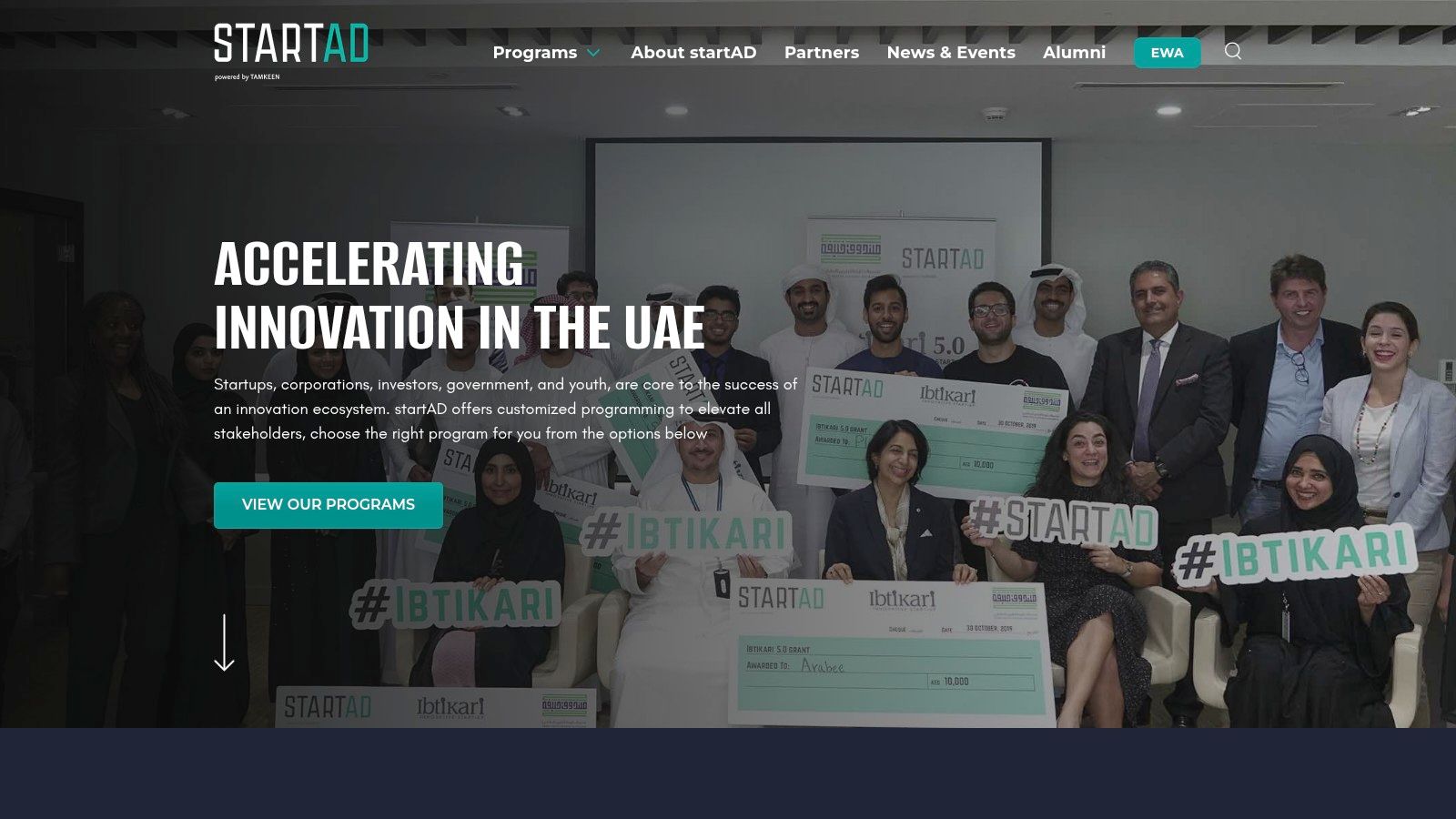
startAD sits in a different category from most of the names on this list. It’s not built around always-on networking. It’s built around structured programmes, coaching, university anchoring, and corporate collaboration. That makes it a better fit for founders who like clear learning environments and milestone-based support.
If you want a steady membership community with regular peer accountability, other options will feel more natural. If you want founder development inside structured cohorts, startAD becomes more compelling.
This is particularly useful for founders who value organised skill-building and thoughtful programme design.
The academic context can be an advantage. It tends to attract serious participants and create more substance than purely social event formats.
The main limitation is continuity. Programme-based ecosystems can feel episodic. You get strong support during a cohort and less of an always-on founder community outside it. Some founders are fine with that. Others need regular peer contact across the entire year.
You should also check track relevance. Some programmes may lean student-facing, research-adjacent, or sector-specific depending on timing.
For founders who want networking to happen through doing, not mingling, startAD is a credible option. It works best when the programme itself is the product.

Sheraa is one of the strongest options outside the usual Dubai and Abu Dhabi centre of gravity. That matters because access in the region still skews toward major urban hubs. A 2023 report discussed in an underserved market analysis noted that 45% of regional funding goes to companies based in the UAE or Saudi Arabia, while curated networks often skew toward urban hubs and male-led teams. For founders in Sharjah or founders looking for more grounded ecosystem support, Sheraa offers a useful counterweight.
Its model is more hands-on than many event-led communities. The support tends to be programme-based, operator-involved, and tied to sector priorities.
Sheraa is a good option when you want active support, not just a badge.
This is not a drop-in founder club. Cohort timing matters. Sector alignment matters. Presence in Sharjah can matter. That makes Sheraa a poor fit if you want an always-available network with flexible engagement.
It’s a strong fit if your startup matches the ecosystem’s priorities and you want structured support with public-sector and regional visibility attached. It’s a weaker fit if you mainly want broad founder social capital without programme commitment.
Emirates Angels Investors Association is the most investor-centric entry on this list. It isn’t a founder peer community, and founders shouldn’t approach it as one. Its value lies in access to the UAE angel investing ecosystem, education, and warm pathways into investor conversations.
That makes it relevant for one narrow but important job. Fundraising readiness.
If your main networking objective this quarter is early-stage capital access, this becomes highly relevant.
For a more deliberate fundraising relationship strategy, this guide on building relationships with angel investors over 12 months is worth reading before you start outreach.
Many founders join investor-facing environments too early. They pitch before they’re ready, treat every event like a funding shortcut, and burn warm intros with weak material. Emirates Angels is most useful when you already have a coherent story, clear use of funds, and enough traction or conviction to justify the conversation.
Investor networks don’t replace founder networks. They solve a different problem.
If you need accountability, tactical founder advice, or emotional resilience support, look elsewhere. If you need informed access to angel capital in the UAE, this is one of the more relevant organisations to know.
| Offering | Core Features ✨ | Quality & Impact ★ | Target Audience 👥 | Pricing / Value 💰 |
|---|---|---|---|---|
| 🏆 Founder Connects | Curated Founder Squads, weekly 1:1 intros, moderated virtual & in‑person spotlight events, partner perks | ★★★★☆, 250+ founders, 98 collaborations, AED189M raised | UAE/MENA founders (idea → scale); founders wanting accountability | Invite / application; pricing private, high ROI via curated intros 💰 |
| Endeavor UAE | Selection‑based 1:1 mentorship, global mentor & investor network, post‑selection growth services | ★★★★★, top mentor bench, strong VC credibility | High‑growth, scale‑up founders seeking fundraising & market access | Competitive selection; services tailored post‑acceptance 💰 |
| TiE Dubai | Regular mentor‑led sessions, pitch events, thematic tracks (TiE Women, TiE U) | ★★★★, broad active community; event quality varies | First‑time founders, students, women founders seeking exposure | Membership/program fees vary; not always transparent 💰 |
| Hub71 | Cohort programs, cash‑for‑equity & in‑kind incentives, relocation & ADGM setup support | ★★★★, high‑signal corporate & investor access | Startups relocating to UAE or scaling with corporate/investor focus | Program‑based terms; incentives may include equity/requirements 💰 |
| DIFC Innovation Hub | Fintech/regulatory focus, 1,200+ firms, Innovation License & on‑hub coworking | ★★★★, strong fintech/regulatory proximity & licensing | Fintech and regulated tech founders needing regulator access | On‑prem lease often required for license; hub benefits tied to presence 💰 |
| AstroLabs | Coworking (24/7), market‑entry & expansion programs, events and 10k+ network | ★★★☆, transparent membership; practical expansion support | Solo founders & small teams expanding across UAE/KSA | Flexible membership tiers; transparent pricing options 💰 |
| in5 Innovation Centers | Subsidized business setup, sector labs/studios, advisory hours & investor intros | ★★★★, strong prototyping infra and TECOM ecosystem links | Hardware, media, design, science founders needing labs | Subsidized programs; membership/perks vary by site 💰 |
| startAD (NYUAD) | Cohort incubators, founder coaching, corporate/startup collaboration tracks | ★★★★, academic anchor; high‑signal partners | Founders seeking structured, skills‑focused programming & corp partners | Cohort‑based; timelines and eligibility vary 💰 |
| Sheraa (Sharjah) | Studio‑style support with EIRs, sector focus, perks & festival visibility | ★★★★, hands‑on program depth and public‑sector access | Sector‑focused founders (EdTech, Sustainability, Creative) with Sharjah presence | Program timelines; participation expectations apply 💰 |
| Emirates Angels Investors Assoc. | Platform linking startups to UAE angel groups, investor education & mentoring | ★★★, centralized angel access; investor‑centric | Pitch‑ready startups seeking early‑stage funding & warm intros | Selective founder access; membership/events may carry fees 💰 |
Most founders don’t need more networking. They need fewer, better bets.
That’s the main lesson across these market networking companies. The right network depends less on brand recognition and more on what problem you’re trying to solve right now. If you’re validating an idea, broad prestige won’t help much. You need honest peer feedback and people who’ll challenge weak assumptions. If you’re scaling, founder therapy groups won’t be enough. You need operator access, distribution relationships, and investor credibility. If you’re a solo founder, the problem might not be access at all. It might be isolation and lack of accountability.
A simple decision framework works better than chasing the biggest name.
Start with stage.
Then filter by immediate goal.
One more practical point. Don’t judge a network by how polished the event photos look. Judge it by what happens after the first interaction. Do people follow up? Do introductions feel relevant? Does the format create trust? Can you point to one actual decision, pilot, hire, investor meeting, or avoided mistake that came from the network?
That matters because founders in the UAE already know networks are important. The gap is execution. Many still don’t measure outcomes from networking in a structured way, even when they feel the value. A better habit is to define one quarterly goal and choose networks against that goal, not against reputation alone.
Your next action is simple. Pick one objective for this quarter. It could be “find a fintech mentor,” “get investor-ready feedback,” or “meet three founders solving similar distribution problems.” Then choose the two platforms from this list that best match that goal. Spend 15 minutes on each website. Request a demo, join a session, apply to a programme, or ask for an intro call.
If you need help turning outreach into actual conversations, this B2B networking email guide for sales is a useful companion.
The founders who get value from networks aren’t the ones who join the most communities. They’re the ones who join the right one, show up with a clear ask, and follow through fast.
If you want a founder network built for practical progress rather than surface-level visibility, Founder Connects is a strong place to start. It’s designed for UAE and MENA founders who want curated peer groups, relevant introductions, and honest support that helps them make decisions and move faster.


