

The UAE is shifting its focus toward quantum computing, aiming to become a global research hub. This move is supported by initiatives like Abu Dhabi's Technology Innovation Institute (TII) and the Quantum Computing Hub at ADGM. Here's what you need to know:
Challenges remain, such as scaling hardware and addressing talent shortages, but the UAE's investments in infrastructure and education are paving the way for startups in sectors like healthcare, finance, and aerospace.
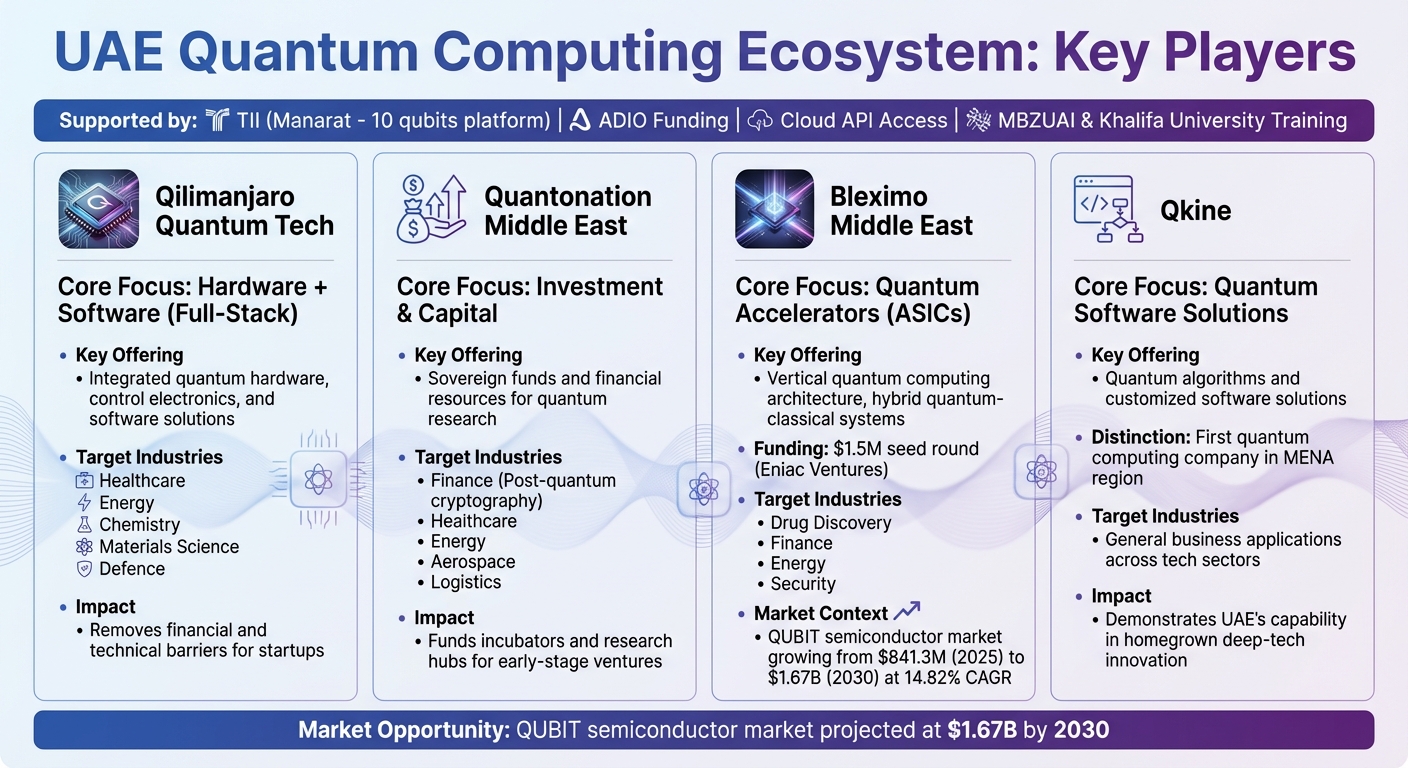
UAE Quantum Computing Startups: Key Players and Focus Areas Comparison
Qilimanjaro Quantum Tech highlights the UAE's dedication to advancing full-stack quantum computing platforms. Their approach integrates in-house hardware, control electronics, and software solutions into a seamless system. By combining quantum hardware with control systems, Qilimanjaro follows in the footsteps of groundbreaking efforts like those of TII, delivering cost-efficient and high-performance quantum solutions. This is a game-changer for UAE startups venturing into quantum applications, offering tailored solutions for a range of emerging industries.
The UAE's quantum initiatives focus on key sectors such as healthcare, energy, chemistry, materials science, and defence. Practical applications include chemical energy estimation, superconducting simulation, and encoding image data. These advancements align with the UAE's broader ambitions to diversify its economy and transition to a knowledge-driven model. By addressing industry-specific needs, Qilimanjaro strengthens its role in supporting the UAE's innovation ecosystem.
Qilimanjaro's integrated quantum infrastructure removes the financial and technical barriers often associated with quantum computing. This allows tech, AI, and fintech startups in the UAE to experiment with quantum-inspired algorithms and develop cutting-edge solutions. These efforts not only empower early-stage ventures but also enhance the overall startup ecosystem. Initiatives like Qilimanjaro complement platforms such as Founder Connects (https://founderconnects.com), which help entrepreneurs network and access vital resources. Ultimately, Qilimanjaro supports the UAE's goals of technological advancement and economic diversification.
Quantonation Middle East takes a different path compared to Qilimanjaro's technical approach. Instead of building hardware or software, it focuses on capital investments to fuel quantum advancements. By directing sovereign funds and other financial resources into cutting-edge technologies, the UAE is fostering a quantum-powered ecosystem. This model allows for direct funding of quantum research projects, giving local tech and AI startups the financial support they need to create quantum applications without the usual budgetary hurdles [3].
The funding strategy zeroes in on industries where quantum computing can make a real difference. Key sectors include finance, healthcare, energy, aerospace, and logistics [2][3]. Within these areas, the focus is on:
This targeted approach ensures that investments are channelled into projects with tangible benefits.
By prioritising investments in quantum-tech startups, particularly in fields like cybersecurity, logistics, and data science, Quantonation Middle East is reshaping the UAE's entrepreneurial landscape [3]. The initiative funds incubators and research hubs, providing early-stage ventures with the capital they need to innovate. This not only supports the growth of in-house quantum expertise but also aligns with the UAE's ambition to achieve strategic independence, reducing reliance on international tech providers.
The UAE's quantum ecosystem thrives on collaborative efforts. Partnerships between Abu Dhabi's Technology Innovation Institute (TII) and VentureOne, ATRC's venture-building unit, play a central role. These alliances give startups access to both technical know-how and venture capital, ensuring that research efforts lead to real-world applications. By bridging investment with expertise, these collaborations create a thriving environment where startups can share ideas and fast-track their development. This integrated approach strengthens the UAE's position as a hub for quantum innovation.
Bleximo takes a distinctive approach by embedding quantum routines directly into existing workflows, offering a hybrid model that's both practical and efficient.
Bleximo specialises in creating quantum accelerators - customised ASICs designed to tackle complex problems alongside traditional systems. Instead of pursuing general-purpose quantum computers, the company focuses on a vertical quantum computing architecture. This method integrates quantum processes seamlessly into current computational workflows, making quantum technology more accessible for industries that rely on high-performance computing.
The company secured US$1.5 million in a seed funding round led by Eniac Ventures to further its application-specific quantum co-processors[13]. This architecture simplifies the integration of quantum solutions, providing a practical pathway for UAE startups to adopt quantum technologies.
"Bleximo's approach of building vertical quantum computing architecture will bring this emerging technology mainstream." – Vic Singh, Founding General Partner, Eniac Ventures[13]
Bleximo's quantum processors, capable of handling anywhere from tens to hundreds of qubits, are tailored for industries requiring substantial computational power. These include:
By complementing conventional high-performance computing systems, these processors allow quantum routines to operate seamlessly within existing workflows[13].
As one of the leading companies in the Middle East's quantum computing market by 2026, Bleximo is well-positioned to benefit from the UAE's growing reputation as a hub for quantum technology innovation[11][12]. The QUBIT semiconductor market, projected to grow from US$841.3 million in 2025 to US$1.67 billion by 2030 (14.82% CAGR), reflects the increasing demand for quantum solutions[12].
This growth presents exciting opportunities for UAE-based tech and AI startups to integrate quantum capabilities without the need to build infrastructure from scratch. Bleximo collaborates with UAE startup incubators like ADGM to facilitate quantum trials. Additionally, platforms such as Founder Connects (https://founderconnects.com) help connect startups with investors and resources, further empowering the local ecosystem. This synergy strengthens the UAE's position as a leader in quantum technology adoption and innovation.
Qkine stands out as the first quantum computing company in the MENA region, focusing on quantum software solutions rather than hardware. The company specialises in creating quantum algorithms and customised solutions that bring global quantum advancements to local businesses. This aligns well with the UAE's ongoing efforts in quantum research and its support for startups.
As a trailblazer in the UAE's tech landscape, Qkine marks a key achievement for the region. Its progress demonstrates that UAE-based startups can thrive in cutting-edge fields, encouraging other ventures in AI, fintech, and beyond to consider the possibilities of quantum technology. Additionally, Qkine serves as a prime example for UAE startup incubators, showcasing what homegrown deep-tech innovation can achieve.
The quantum computing sector in the UAE offers a mix of opportunities and hurdles for startups aiming to tap into this cutting-edge field. Knowing these trade-offs is key for founders when deciding on partnerships, investments, and resource management.
The Technology Innovation Institute (TII) has played a pivotal role in advancing the region's quantum capabilities. Startups in the UAE benefit from access to a variety of quantum platforms, such as Quantinuum's Helios system, IonQ's trapped-ion processors, and devices available through AWS Braket [1][6]. However, the ecosystem is still in its early stages. Much of the hardware remains in prototype form, and the region depends heavily on international partners for advanced chip technology [9]. These developments highlight both the progress made and the challenges that remain.
One of the biggest obstacles is scaling hardware initiatives. A major issue is the shortage of skilled talent - the pool of quantum educators and researchers is limited, and global competition for this expertise is fierce [9]. As Professor Andrew Lütken, Executive Director of the QRC's Quantum Computing group, explains:
"More than the number of qubits, it is the quality of qubits and how well they work together that really matters" [9].
This underscores the UAE's focus on building strong foundational capabilities before attempting to scale - a strategy that prioritises quality over sheer quantity.
Other barriers include high costs, unclear standards, and gaps in infrastructure. Startups often rely on cloud-based access to international quantum hardware since many local facilities are still under construction or in testing phases [8][9]. For UAE-based ventures, these challenges make it crucial to carefully navigate decisions around investment, hiring, and infrastructure.
Despite these limitations, the UAE's strategic focus on sovereign hardware development and its "Quantum as a Utility" model points to exciting long-term potential. This approach offers significant opportunities for startups in industries like tech, AI, and fintech [7].
The UAE's quantum computing landscape is quickly shifting from theoretical groundwork to real-world commercial solutions. With quantum computing offering immense economic potential [4], startups in the region are already making strides in industries like pharmaceuticals, finance, and logistics [3]. For instance, the launch of QuantumConnect in March 2026 highlights how UAE-based tech companies are transforming cutting-edge research into practical systems that tackle challenges like cybersecurity and secure communications [14][15].
Access to infrastructure has also become more streamlined. Instead of investing in building their own quantum processors, UAE founders can now use resources such as TII's Cloud API and cloud platforms like AWS Braket to experiment with quantum algorithms and tap into Quantum Processing Units [1][3]. Additionally, the Manarat control electronics platform, developed locally, is lowering the barriers for startups aiming to create sovereign quantum technologies [5].
The talent pool in the UAE is expanding, thanks to collaborations between universities like MBZUAI, Khalifa University, and the University of Sharjah. These institutions are embedding quantum mechanics and algorithm studies into their programmes, ensuring that engineers and entrepreneurs are equipped with the specialised expertise needed to excel in quantum-driven fields like AI and fintech [3]. With this blend of skilled talent and accessible resources, the ecosystem continues to gain momentum. For founders exploring this rapidly evolving sector, connecting with the UAE startup community is crucial. Platforms like Founder Connects offer tools such as group-matched masterminds, networking events, and curated investor lists to help startups thrive in quantum computing. Events like the Quantum Innovation Summit 2026, scheduled for 7–9 April 2026, also provide opportunities to collaborate with global leaders and potential partners [6].
From funding initiatives to integrated hardware solutions, these efforts reflect the UAE's dedication to advancing quantum technologies. With sovereign hardware, accessible cloud platforms, and a robust support network, UAE startups are well-positioned to harness quantum computing's transformative possibilities.
Startups in the UAE now have the opportunity to tap into quantum computing through cloud-based platforms offered by research institutions and tech companies. A notable example is the Technology Innovation Institute (TII), which provides remote access to its superconducting quantum processors. This setup allows startups to experiment with and refine quantum applications without the hefty investment in hardware. By removing these financial barriers, such initiatives are driving forward innovation and aligning with the UAE's vision to lead in quantum technology advancements.
Quantum computing is poised to revolutionise several industries in the UAE, with finance, healthcare, and AI standing to gain the most.
In finance, quantum computing offers the potential to transform processes like data analysis, risk management, and strategic decision-making. By handling massive datasets at unprecedented speeds, financial institutions can uncover patterns and insights that were previously out of reach.
The healthcare sector is set for breakthroughs in areas like drug discovery and medical research. Quantum's ability to simulate complex molecular interactions could accelerate the development of new treatments, bringing hope for tackling diseases more effectively.
Meanwhile, AI and data-driven industries will benefit from quantum's capacity to refine and optimise algorithms. This aligns perfectly with the UAE’s goal of becoming a global leader in technology, while also boosting the growth of its vibrant startup ecosystem. By integrating quantum advancements, the nation is paving the way for a future defined by innovation and progress.
Founders in the UAE aiming to establish a quantum-ready team need a balance of technical expertise and strategic acumen. On the technical side, a solid grasp of quantum physics, foundational principles like superposition and entanglement, and familiarity with quantum algorithms are crucial. Additionally, proficiency in quantum programming languages can set the foundation for success in this cutting-edge field.
Strategically, understanding the dynamics of the UAE's startup ecosystem is vital. This includes navigating funding opportunities and fostering a culture of innovation. Leadership traits such as adaptability and the ability to promote collaboration play a key role in shaping a forward-thinking team that thrives in the rapidly evolving quantum technology landscape.


