

Checklist for Securing EdTech Funding in UAE

Building in MENA? You don't have to do it alone.
Join 300+ founders in the Founder Connects Residency. Monthly squad calls, warm intros, $3M+ in perks, and much more. All for less than your monthly coffee budget.

Securing EdTech funding in the UAE requires more than just a great idea. Investors here focus on execution, measurable progress, and compliance with local regulations. Here's a quick breakdown to help you navigate the process:
- Market Fit: Tailor your solution to UAE's educational needs, such as bilingual platforms (Arabic and English) and alignment with local curricula (IB, British, American, or Arabic).
- Regulatory Compliance: Choose between Mainland or Free Zone licensing, and ensure adherence to local education laws.
- Investor-Ready Documentation: Prepare a pitch deck with financial projections in AED, a clean cap table, and a Virtual Data Room with all key documents.
- Traction Metrics: Show measurable learning outcomes, user growth, and revenue figures to validate your market impact.
- Relationship Building: Build trust by engaging with local investors and participating in UAE startup events well before pitching.
Investors in the UAE value trust, preparation, and clear market strategies. Use this checklist to position your EdTech startup for success, even in a competitive funding environment.
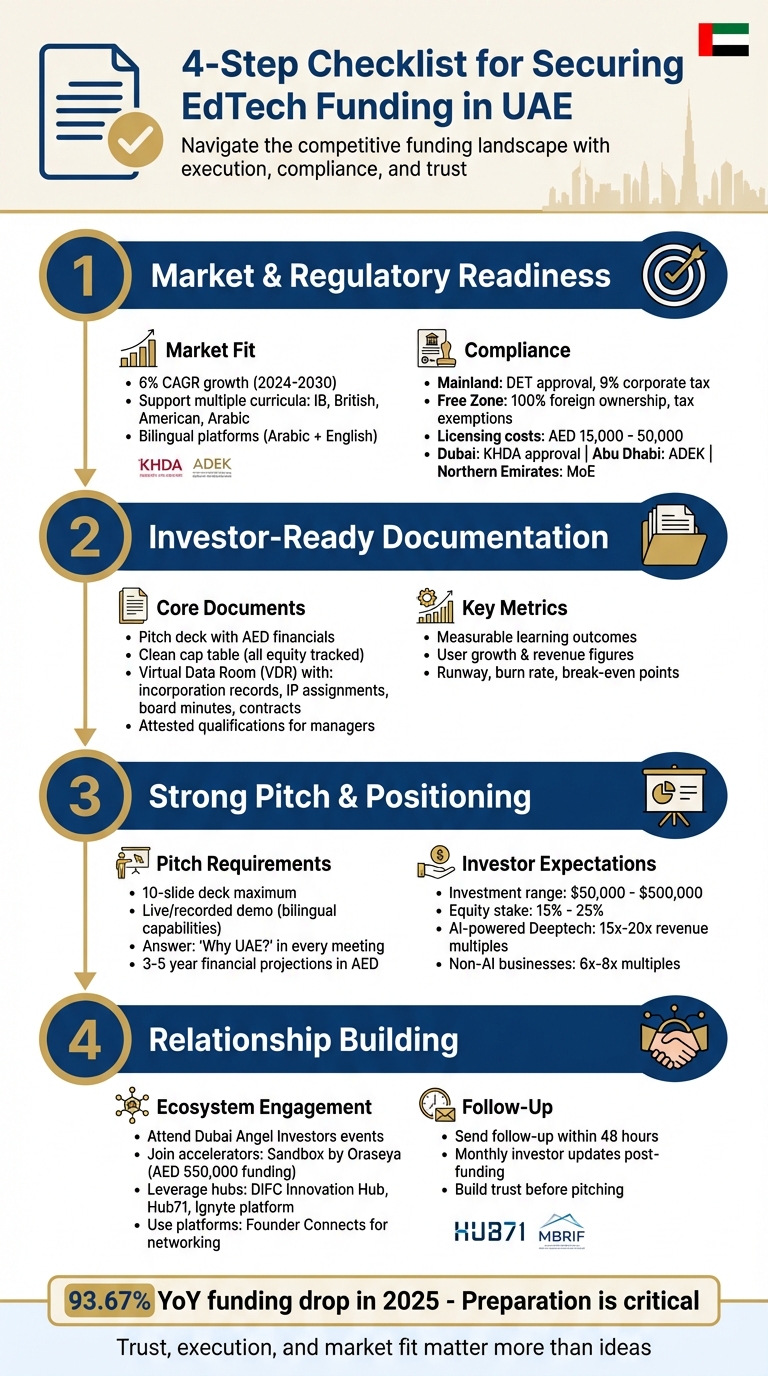
4-Step Checklist for Securing EdTech Funding in UAE
Market and Regulatory Readiness
UAE EdTech Demand and Trends
The EdTech market in the UAE is expanding steadily, with a projected growth rate of 6% CAGR from 2024 to 2030 [1]. To stand out, it’s essential to demonstrate how your solution addresses specific gaps in the market. A key area to focus on is curriculum diversification - there’s a strong demand for digital solutions catering to British, American, IB, Indian, and Arabic curricula, as well as corporate upskilling [1][9].
Certain sectors remain underserved, presenting opportunities for growth. For instance, early childhood education (Pre-K) and vocational training are areas with significant potential [7]. The Ministry of Economy anticipates that technologies like AR/VR and Artificial Intelligence will play a central role in education delivery by 2025 [7]. A notable example of the UAE’s growing EdTech landscape is Ostaz (previously Synkers), a local startup that partnered with Aldar Education in January 2023 to deliver tutoring services to around 30,000 students in Abu Dhabi. Part of the Hub71 ecosystem, Ostaz has already provided over 90,000 hours of tutoring to more than 60,000 students across the MENA region [8]. CEO Audrey Nakad highlighted their mission:
Our goal is to be a one-stop-shop for education, and to make sure every learner has the opportunity to succeed [8].
To gain traction in this competitive market, ensure your regulatory compliance aligns with local requirements and expectations.
Compliance and Licensing Requirements
The regulatory path your company takes largely depends on its setup. Mainland companies benefit from direct access to the UAE market, subject to DET approval and a 9% corporate tax [4]. On the other hand, Free Zones offer advantages like 100% foreign ownership and tax exemptions, though market access is limited to the free zone or international markets [4][9].
If operating in Dubai, you’ll need approval from the KHDA before moving forward with other licensing steps [9]. In Abu Dhabi, the Department of Education and Knowledge (ADEK) oversees licensing, while the Northern Emirates fall under the Ministry of Education (MoE) [9][10]. Licensing costs typically range from AED 15,000 to AED 50,000, depending on the scope of your operations [9]. Additionally, Federal Decree Law No. 18 of 2020 on Private Education mandates that all private education entities adhere to Islamic and Arab principles. Any changes to fees or curricula require prior approval [10].
A thorough understanding of these regulatory frameworks is crucial to operating successfully in the UAE.
Localisation for UAE Learners
To effectively serve learners in the UAE, your platform must be bilingual, offering content in both Arabic and English [1][9]. All educational materials should be culturally appropriate and align with the UAE’s values to avoid regulatory issues [10].
Pricing should be in AED and structured in line with local school fee benchmarks [1][9]. Platforms like Madrasa, which provide free Arabic e-learning resources for students from kindergarten to grade 12, highlight the importance of offering accessible, localised content [9]. Additionally, consider establishing your business in tech-driven hubs like Hub71, which provide opportunities for corporate partnerships and regional expansion [4][8].
sbb-itb-f597d8f
Investor-Ready Documentation
Core Fundraising Documents
Angel investors in the UAE expect a well-prepared pitch deck that covers the essentials: ownership structure, jurisdictions, financials, customer segments, team profiles, and investment history [5][3]. With startup funding in the UAE dropping by a staggering 93.67% year-on-year in 2025, investors are now laser-focused on companies that demonstrate proven market traction and a solid product-market fit [3].
Your financial model should be presented in AED, with detailed projections that include runway, burn rate, and break-even points. Don’t forget to account for licensing fees and the costs of hiring local talent [3][4]. The UAE offers significant funding opportunities, such as the AED 2 billion Mohammed bin Rashid Innovation Fund (MBRIF) for technology-focused ventures and the Abu Dhabi Investment Office (ADIO), which manages over $500 million in incentives for R&D and tech pilot projects [3][2].
To streamline the due diligence process, set up a Virtual Data Room (VDR) with all critical documents. Include incorporation records, employee agreements, IP assignments, board meeting minutes, and commercial contracts, all organised for efficient access [5]. For UAE-based funding, additional documentation is required, such as clear copies of passports, UAE visas, Emirates IDs, and attested degree qualifications for key managers [11]. Since attestation can take time, it’s wise to start this process well before approaching investors.
This level of preparation ensures you're ready to make a strong impression during your pitch.
Traction and Validation Metrics
After securing your documentation, the next step is presenting metrics that validate your market impact. Investors and educational institutions in the UAE look for outcome-focused dashboards, particularly those aligned with official inspection cycles from KHDA in Dubai or ADEK in Abu Dhabi [12]. Go beyond user engagement stats and show measurable learning outcomes tied to local curricula, such as IB, British, American, Indian, or MOE Arabic [12].
A great example of this is Alef Education, which reported AED 750 million in annual revenue in 2023. This impressive performance led to an oversubscribed IPO on the Abu Dhabi Securities Exchange in 2024, solidifying EdTech as a promising sector for regional institutional investors [12]. To meet localisation standards, ensure your metrics cover performance in both Arabic and English [12].
If your solution incorporates AI, make it a focal point. AI-powered Deeptech companies in the UAE currently enjoy revenue multiples of 15x to 20x, far outpacing the 6x to 8x multiples for non-AI businesses [13]. Additionally, to qualify for entrepreneurial incentives like the Golden Visa, your pilot project should ideally generate annual revenues of at least AED 1 million [14].
Team and Governance Overview
Once your metrics are in place, a well-defined governance structure can further enhance investor confidence. Keep an up-to-date capitalisation table that tracks all equity issuances, including shares, options, and SAFEs, along with the necessary corporate approvals [5]. Formalising these arrangements is essential to avoid any hidden liabilities [5].
"The clearer your capital structure is, the smoother the path to closing." – REVERA [5]
Highlight your team’s experience relevant to the UAE market and clearly outline their roles. If you have an advisory board or mentors who bring industry expertise and connections, make sure to showcase their contributions, as UAE angel investors place a high value on these relationships [13][15]. Employment and contractor agreements should include explicit clauses for IP assignment and confidentiality to protect your business [5].
Be prepared for equity dilution, as UAE angel investors typically take a 15% to 25% stake in early funding rounds [13]. Ensure that your licensing and trade permissions align with your business model [3]. Finally, review commercial contracts for any "change-of-control" clauses that may require partner consent during investment deals, as these can lead to unexpected legal complications [5].
Pitch and Meeting Preparation
Story and Positioning
When crafting your pitch, make it clear: why does this matter in the UAE? Start with a sharp, one-line statement that defines the problem and highlights the specific gap in the local market [3]. If you're a foreign founder, explain how your model is tailored to the UAE's unique needs [3].
Investors today prioritise traction, market fit, and financial discipline over lofty ambitions [3]. Position your EdTech solution within the framework of the UAE's educational landscape. For example, reference KHDA inspection cycles in Dubai, ADEK standards in Abu Dhabi, or how your product aligns with curricula like IB, British, American, Indian, or MOE Arabic. Show how your solution directly addresses the pressing challenges faced by schools, parents, or learners in the UAE today.
Product Demo and Business Model
Prepare a demo - live or recorded - that demonstrates your product's bilingual capabilities (Arabic and English). Highlight how your dashboard tracks learning outcomes and include pricing tiers clearly presented in AED.
Lay out a concrete path to profitability with three-to-five-year financial projections. Include details on operating costs and margins. Keep your pitch deck to 10 concise slides that are visually engaging, easy to follow, and impactful [16][3].
Once your demo and business model are solid, align your pitch with the expectations of UAE investors.
UAE Angel Investor Expectations
Be ready to answer, "Why the UAE?" in every investor meeting. Build on your documentation and market readiness to explain why the UAE is the cornerstone of your growth strategy. Highlight how you plan to scale across the GCC region, which offers access to a market of over two billion consumers across MENA and South Asia [16][4]. Partnerships with local schools, educational institutions, or government bodies can significantly enhance your credibility.
"In the UAE, trust precedes term sheets. Start early." – CE Interim [3]
Angel investors in the UAE typically invest between $50,000 and $500,000 in early-stage funding rounds [16]. Before engaging in discussions, ensure you have a valid UAE trade licence, a business bank account, and a minimum viable product [16][3]. Building trust is crucial in this market, and participating in local startup events and platforms like Founder Connects can help you establish the relationships needed to secure investment [16][3].
Relationship Building and Follow-Up
Engaging with the UAE Startup Ecosystem
In the UAE, building genuine relationships takes precedence over quick transactions. The startup ecosystem thrives on trust and long-term connections rather than one-off pitches [3]. To immerse yourself in this environment, attend events like those hosted by Dubai Angel Investors. These gatherings not only provide funding opportunities but also offer valuable market insights and strategic introductions [3]. Platforms such as Founder Connects can also help, offering group-matched masterminds, networking opportunities, and access to investors.
For startups seeking structured support, consider joining accelerator programmes like Sandbox by Oraseya Capital. In October 2024, this programme selected 19 startups from a pool of 1,100 applicants and provided Phase 2 participants with funding of approximately AED 550,000 [6]. Additionally, hubs like the DIFC Innovation Hub in Dubai and Hub71 in Abu Dhabi offer tailored growth incentives and direct access to angel networks [4][6]. Another noteworthy initiative is Dubai’s Ignyte platform, launched in October 2024, which aims to connect 100,000 startups with global mentors and investors. Each startup also receives over AED 3,670 in perks through this platform [6].
Once you’ve established these connections, ensure you follow up promptly and effectively to solidify the relationships.
Follow-Up and Data Room Management
After engaging with investors or partners, it’s crucial to maintain momentum. Send a concise follow-up email within 48 hours to address feedback, confirm next steps, and keep the conversation moving forward [3]. This demonstrates professionalism and commitment.
Equally important is preparing a well-organised virtual data room (VDR). This should include all essential documents, such as incorporation records, a clean and transparent cap table, employee agreements with IP assignment clauses, commercial contracts, and relevant licences [5]. A clear cap table, with all equity issuances - shares, options, and SAFEs - properly documented, is particularly critical for building investor confidence [5].
Efficient management of your data room sets the stage for sustained investor engagement.
Post-Investment Collaboration
Securing funding is just the beginning. To maintain strong relationships with investors, establish a system for regular monthly updates. These updates should cover key metrics, milestones, and any challenges where you might need support. UAE-based angel investors often offer more than just capital - they can provide local insights, regulatory guidance, and strategic introductions to schools, government bodies, or other potential partners [3].
Clearly define how your investors can contribute beyond funding. For example, they might facilitate partnerships with educational institutions, connect you with officials from KHDA or ADEK, or introduce you to potential enterprise clients. Early alignment on strategies for future funding rounds is also essential. Discuss how your investors can assist with bridge rounds or preparation for Series A funding.
In a market where funding activity has seen a sharp decline of 93.67% year-on-year [3], maintaining strong investor relationships is key to securing the capital needed to scale your EdTech venture across the GCC. By fostering collaboration and staying proactive, you can position your startup for long-term success.
VC React Podcast (E27): Good vs. Great, EdTech Wave In MENA, Revenue Based Financing, Cars, & Cake!
Conclusion: Securing UAE EdTech Funding
Getting funding from UAE angel investors requires more than just a good idea - it demands strong execution. Investors in the region prioritise businesses that demonstrate measurable progress and a solid foundation over flashy presentations or empty promises [3]. To help you prepare, this checklist focuses on four key areas: market relevance, rigorous documentation, a concise pitch strategy, and relationship building. These elements are essential for creating an investor-ready EdTech venture in the UAE.
Start by establishing your relevance in the local market. Tailor your EdTech solution to align with UAE educational frameworks, such as British, American, IB, or Arabic curricula. Make sure your offering adheres to regulatory standards and incorporates emerging technologies like AI to tap into the region’s projected 6% market growth through 2030 [1]. Additionally, ensure your legal structure is in order - secure the appropriate licensing (Mainland or Free Zone) and verify that managerial qualifications are properly attested [3][11].
When it comes to your documentation and pitch, focus on hard data. Highlight measurable achievements like user growth, revenue figures, burn rate, and a clear strategy for profitability. Avoid relying on vanity metrics that lack substance. As CE Interim explains:
In 2025, raising capital in the UAE is a strategic, high-stakes process... They respond to clarity, structure, preparation, and a business model that holds up under scrutiny [3].
Building trust is equally important. In the UAE startup ecosystem, relationships are the cornerstone of successful deals [3]. Start engaging with investors and the business community well before you actually need funding. Attend local networking events, participate in accelerator programmes, or connect with other founders through platforms like Founder Connects. These efforts can help you access curated investor lists and establish meaningful connections. Remember, consistent engagement over time is far more effective than a single aggressive pitch.
With a growing number of local funding initiatives aimed at supporting well-prepared founders, your success depends on systematically addressing every aspect of this checklist.
FAQs
What are the essential regulatory requirements for launching an EdTech startup in the UAE?
To set up an EdTech startup in the UAE, you’ll need to navigate a few essential regulatory steps to ensure everything is above board:
- Educational Licence: If your platform provides educational services, you’ll need approval from the relevant authority. For example, in Dubai, this would mean obtaining a licence from the Knowledge and Human Development Authority (KHDA).
- Compliance with Private Education Laws: Federal Law No. 18 of 2020 sets the rules for licensing, curriculum standards, safety protocols, and reporting requirements. This includes hiring qualified professionals with the necessary licences and keeping proper records for audits.
- Commercial Registration: Register your business either onshore or in a free zone. Make sure your commercial licence specifies your activity, such as "e-learning services."
- Data Protection Compliance: Adhere to the UAE’s Personal Data Protection Law (PDPL). This means implementing clear privacy policies and strong data security measures to protect user information.
By fulfilling these requirements, your EdTech platform can operate legally while meeting the UAE’s rigorous standards for quality and transparency.
How can I customise my EdTech solution to align with the UAE's educational needs?
To tailor your EdTech solution to the UAE's educational landscape, it's crucial to understand the region's unique market dynamics. The UAE places a strong emphasis on curriculum-based education, STEM learning, and corporate training, with most content delivered in English, Arabic, or a mix of both. This makes it essential for your platform to support bilingual functionality and align with the national curricula.
Here are some ways to make your solution more relevant:
- Customise the user experience: Ensure your platform includes a fully Arabic interface, precise translations, and uses metric units like kilograms and centimetres.
- Integrate UAE-specific examples: Highlight local achievements, such as the UAE's space exploration projects or AI advancements, which align with the country’s Vision 2030 goals.
- Localise pricing and formats: Display pricing in AED and use date formats like dd/mm/yyyy (e.g., 28/12/2025) to ensure clarity and familiarity.
To further strengthen your presence in the UAE, consider tapping into local resources like Sheraa, a prominent startup incubator. These platforms provide access to mentorship, networking opportunities, and potential investors. By adapting to the UAE's educational and cultural context, your EdTech solution will resonate more deeply with users and stakeholders alike.
What key documents do I need to secure funding from UAE investors?
To draw in UAE investors, you'll need to have a solid collection of essential documents ready. Start with personal identification, including your passport, UAE visa, and Emirates ID. If applicable, include attested copies of your degree and birth certificates. Don't forget to provide CVs for all shareholders and managers to highlight their credentials.
On the business front, investors will expect key documents such as your incorporation certificate, a shareholders agreement or cap table, and proof of any intellectual property (IP) ownership. Additionally, include any relevant commercial contracts that showcase your business activities. To top it off, prepare a polished, deal-oriented pitch deck that clearly outlines your vision and strategy - it’s your chance to make a strong impression.
Related Blog Posts

Building in MENA? You don't have to do it alone.
Join 300+ founders in the Founder Connects Residency. Monthly squad calls, warm intros, $3M+ in perks, and much more. All for less than your monthly coffee budget.
Popular posts





Founder Connects is a premium MENA tech founder community. Meetups in Dubai and across MENA, Residency Squads of 8–10, and 400+ vetted WhatsApp founders (apply and screened).