

Silicon Valley in Dubai: A Founder's Guide to Winning in the UAE

Building in MENA? You don't have to do it alone.
Join 300+ founders in the Founder Connects Residency. Monthly squad calls, warm intros, $3M+ in perks, and much more. All for less than your monthly coffee budget.

The term "Silicon Valley in Dubai" isn't just hype—it’s a signal of a massive, strategic ambition to build a world-class tech hub. For founders in the UAE and MENA, it points to a unique ecosystem that blends government-backed incentives, serious capital inflows, and a prime geographic location.
This guide isn't about comparing Dubai to California. It's about giving you a practical framework to leverage Dubai's distinct advantages, navigate its hurdles, and build a successful startup.
What Silicon Valley in Dubai Means for Founders
"Silicon Valley in Dubai" doesn't mean a carbon copy of the San Francisco Bay Area. It points to Dubai's rapid emergence as a global tech hub built on a completely different foundation.
Silicon Valley grew organically over decades, fueled by venture capital and academia. Dubai's rise is a top-down, deliberate push driven by visionary government policies.
For a founder, this distinction is critical. You're operating in an ecosystem with a unique mix of advantages and hurdles. The government actively rolls out the red carpet with friendly regulations and tax breaks. But the culture and funding landscape have specific nuances you must understand to succeed.
This chart gives you a quick visual on how the two hubs stack up.
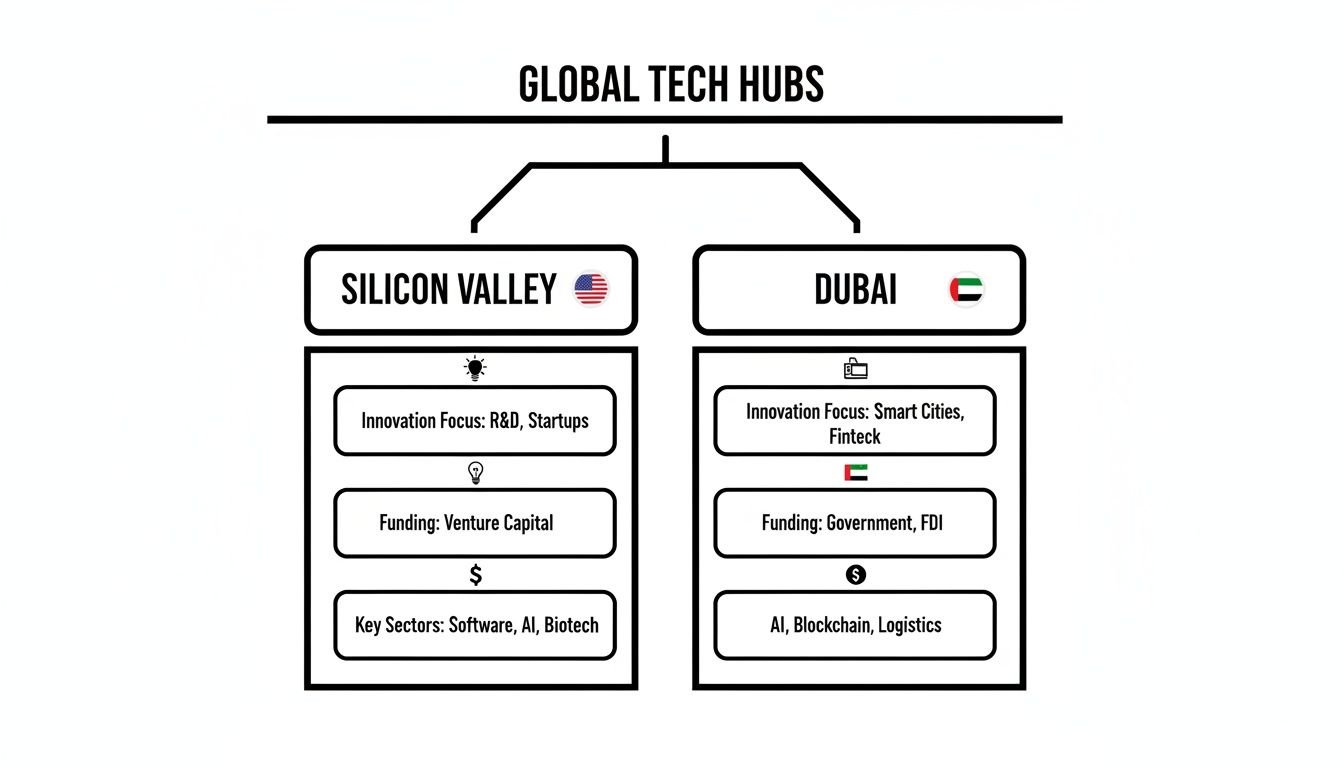
While Silicon Valley has a deep history of venture capital, Dubai is a powerhouse in government support and strategic market access.
To help you get a clearer picture, here’s a breakdown of how the two ecosystems compare.
Dubai vs Silicon Valley at a Glance
This table offers a snapshot of the core differences that founders need to understand.
CharacteristicSilicon Valley (USA)Dubai (UAE)Origin StoryOrganic, bottom-up growth from academia and VCTop-down, government-led strategic initiativeFunding CultureHigh-risk, 'fail-fast' VC-drivenMore conservative, relationship-based, growing VC sceneGovernment RoleRegulatory, less direct interventionProactive support, incentives, direct investmentKey StrengthsDeep talent pool, massive VC network, innovation legacyStrategic location, tax benefits, rapid infrastructureTalent PoolHighly specialized, competitive, and expensiveDiverse, international, but specialized roles can be a challengePrimary FocusDeep tech, software, disruptive innovationFintech, logistics, e-commerce, Web3, trade
Silicon Valley is the established champion of tech, but Dubai is the ambitious challenger building a different kind of arena.
A Hub Built on Intentional Design
Unlike the grassroots culture of the Bay Area, Dubai’s tech scene is a product of purposeful construction. Key advantages for founders include:
- Strategic Government Initiatives: Policies like the Golden Visa, 100% foreign ownership, and zero personal income tax are calculated moves to attract global talent and investment.
- Geographic Advantage: Dubai is a natural bridge between Western markets and the high-growth economies of Asia and Africa, offering founders a launchpad to scale across continents.
- Rapid Infrastructure Development: World-class digital and physical infrastructure, from high-speed internet to modern business parks, reduces operational friction.
"Dubai isn’t trying to be another Silicon Valley; it's creating a new playbook for a global tech hub. It's leaning into its strengths—strategic location, government agility, and a multicultural talent pool—to offer something genuinely different for founders."
Understanding the Local Nuances
It's crucial to understand the on-the-ground differences. The funding culture can be more conservative, with less appetite for the 'fail fast, fail often' mantra. Finding highly specialized tech talent can also be a challenge, requiring a global hiring strategy from day one. To learn more, explore our deep dive into the local ecosystem and what it takes to launch here.
This guide provides a clear, balanced perspective to help you build a solid strategy and navigate this dynamic landscape.
The Pillars of Dubai's Tech Ecosystem

Dubai's ambition to be a global tech hub is built on strategic pillars designed to give founders a real advantage. Understanding these foundations is the first step toward scaling your startup effectively. Think of these as tangible assets you can use to cut red tape, lower costs, and hit your growth milestones faster.
Strategic Geographic Positioning
Dubai’s location is its superpower. It sits at the crossroads of Europe, Asia, and Africa, giving startups immediate access to diverse, high-growth markets. When you launch here, you’re setting up a springboard to over two billion consumers just a few hours away by plane. This enables a lean operation while tapping into massive potential.
Next Action: When drafting your go-to-market strategy, map out your first three expansion markets. Analyze how Dubai’s logistics network and time zone give you a practical edge over competitors based elsewhere.
World-Class Infrastructure
Dubai has invested billions in creating a frictionless business environment. For a founder, this means reliable digital connectivity, efficient transport logistics, and state-of-the-art business parks. You can focus on building your product and winning customers, knowing the infrastructure has your back.
- Digital Backbone: High-speed internet is a given, which is non-negotiable for SaaS companies and remote teams.
- Physical Connectivity: Modern ports, airports, and road networks make moving goods and people seamless, a huge plus for e-commerce and logistics startups.
Favorable Government Policies
This is where Dubai pulls ahead. The government acts as a strategic partner, rolling out policies designed to attract talent, capital, and innovation. These are major financial and operational game-changers.
- 100% Foreign Ownership: In many free zones and mainland businesses, this gives you complete control over your company without needing a local partner.
- Zero Personal Income Tax: A powerful recruiting magnet that makes it easier to attract skilled professionals from around the world.
- The Golden Visa Program: This long-term residency visa for entrepreneurs provides stability and removes the stress of visa renewals for your core team.
The economic results are clear. Dubai saw a 102% increase in its millionaire population between 2014 and 2024, hitting 81,200 individuals. This influx of capital is increasingly funding the local startup scene. For context, that growth rate outpaces the Bay Area's 98% during the same period, creating fertile ground for fundraising.
Navigating the Hurdles for Founders in the UAE

While the buzz around Dubai's tech scene is real, founders need a clear-eyed view of the hurdles. Knowing them ahead of time turns potential deal-breakers into manageable challenges. This is about smart preparation to help you build a tougher strategy and allocate resources effectively.
The Funding Landscape Nuances
Raising capital in Dubai feels different. While plenty of capital exists, early-stage funding can be tough to secure. Many local investors are more risk-averse than their Silicon Valley counterparts. This means you need a heavy focus on traction, revenue, and a clear path to profitability, even at the seed stage. The conversation is often more conservative and valuation-sensitive.
Next Action: Before your next investor meeting, ask your team: "How can we frame our pitch to highlight near-term revenue potential and de-risk the investment, rather than focusing solely on a massive, long-term vision?"
You have to have your unit economics and go-to-market strategy dialed in. It’s not just about selling a big idea; it’s about proving you have a sustainable business model.
The Specialized Talent Hunt
Finding highly specialized tech talent is another hurdle. While Dubai attracts a diverse, international workforce, tracking down senior engineers or data scientists with deep, niche experience can be tough. The local talent pool is still maturing, and you're competing against multinationals and heavily funded scale-ups.
Understanding current strategies for startups to win the AI talent battle is critical. Smart founders use a global recruitment strategy from day one.
Here’s a practical approach:
- Build a Global Remote Team: Access talent pools in Eastern Europe or Southeast Asia for an edge in both skill and cost.
- Leverage the Golden Visa: Use this long-term visa as a huge selling point to attract senior talent seeking stability.
- Invest in Junior Talent: Partner with local universities and coding bootcamps to build a pipeline of developers you can train in-house.
Cultural Appetite for Risk
The MENA region generally doesn’t share the "fail fast" mantra celebrated in Silicon Valley. Culturally, there’s a lower appetite for public failure, which can create pressure to project success at all times. This can make it hard to have honest conversations about struggles and pivots.
For founders, a strong, trusted support network is essential. Finding a peer group, like the one in communities such as Founder Connects, gives you a safe space to share challenges and get candid feedback. This support system is a lifeline for staying resilient and making clear-headed decisions.
Mapping Dubai's Tech Scene: Hubs, Players, and Events
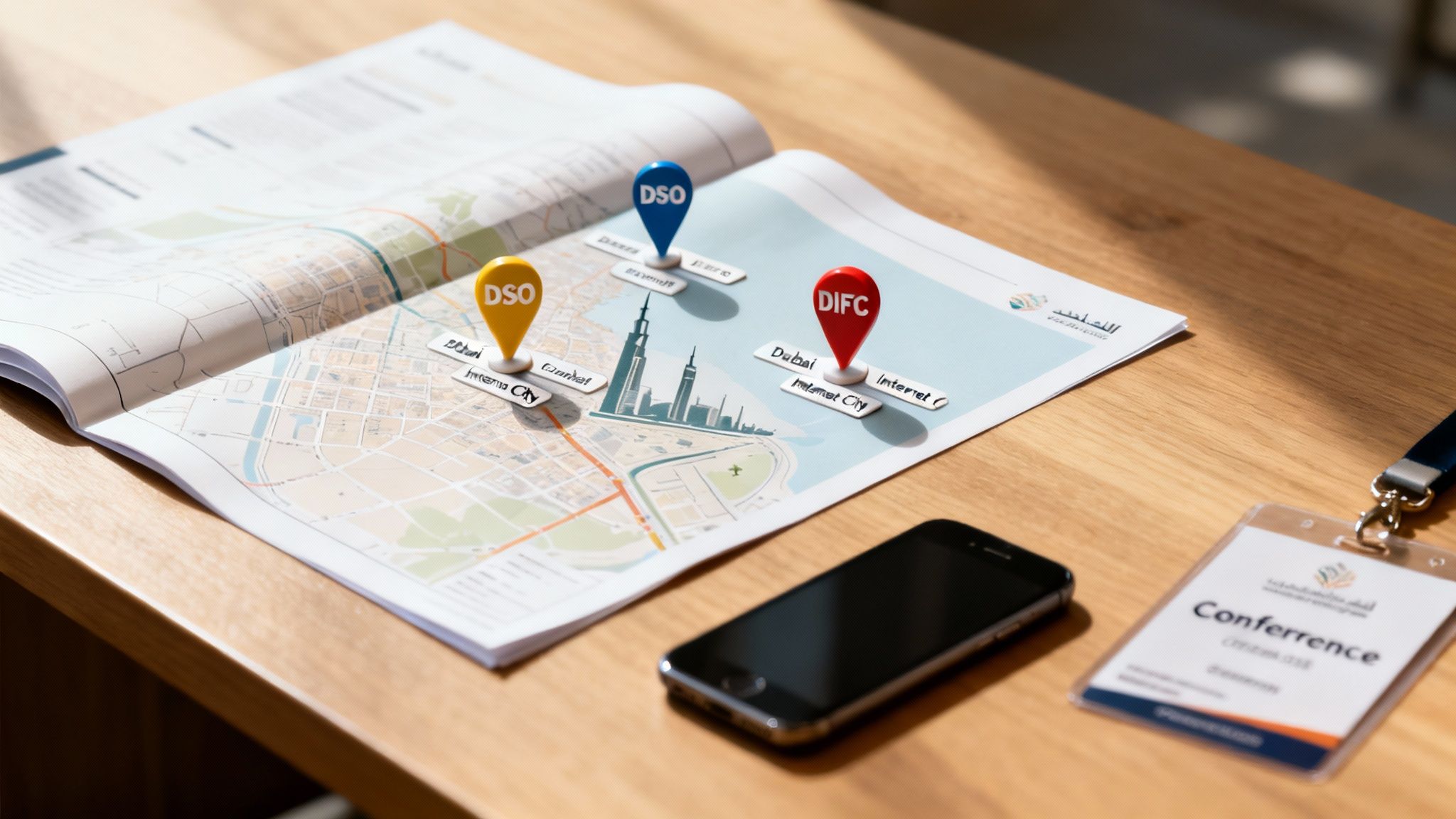
To make progress in Dubai, you need a map of the ecosystem’s key hubs, players, and events. Wasting time in the wrong places is a classic mistake. Knowing where to focus your energy is a massive strategic advantage. This is your practical guide to navigating the landscape effectively.
Key Tech Hubs and Free Zones
Dubai's tech scene is a network of specialized hubs. Picking the right one is critical for your license, network, and community.
- Dubai Internet City (DIC): Home to giants like Google and Microsoft. If you need to partner with or sell to large enterprises, this is your base.
- Dubai International Financial Centre (DIFC): The heart of FinTech in the region, with a world-class regulatory framework and the FinTech Hive accelerator.
- Dubai Silicon Oasis (DSO): A purpose-built tech park for the entire tech supply chain. Established in 2003, this 7.2 square kilometer free zone is a major reason why 66% of AI companies now choose Dubai as their global HQ.
For a practical breakdown for pre-seed startups, see our in-depth guide comparing Hub71, DIFC, and Area 2071.
Influential Players to Know
The ecosystem runs on people. Building relationships with these key players can open doors to funding, partnerships, and crucial advice.
Next Action: Pinpoint three people from the list below who are most relevant to your startup. Follow them on LinkedIn, engage thoughtfully with their content, and then find a path to a warm introduction through a mutual connection.
Here are the key players:
- Government Bodies: Organizations like the Dubai Future Foundation are active ecosystem builders, running accelerators and initiatives that provide grants and pilot projects.
- Venture Capital Firms: Get familiar with active funds like BECO Capital, Middle East Venture Partners (MEVP), and Wamda Capital. Research their portfolios to understand their investment thesis.
- Major Tech Corporations: Companies in DIC often have corporate venture arms or partnership programs that can provide distribution and resources.
Must-Attend Events and Conferences
The right event can change your startup's trajectory. Focus on quality connections, not quantity.
- GITEX Global: The region's biggest tech conference. Its startup-focused event, Expand North Star, is where thousands of startups connect with hundreds of VCs.
- Step Conference: A great event for early-stage founders to network with peers and learn about the latest trends in tech and digital media.
- Specialized Meetups: Smaller, industry-specific gatherings hosted by communities like Founder Connects are designed for high-signal connections away from the noise of big conferences.
Your Founder's Playbook for Success in Dubai
Navigating the "Silicon Valley in Dubai" requires a solid playbook focused on three pillars: capital, talent, and community. Getting these right from the start will help you move faster and build a resilient foundation for growth.
Securing Capital The Right Way
Raising money in the UAE is about understanding the local investor mindset. Forget "growth-at-all-costs." Most investors here want to see a clear path to profitability. Your pitch must speak their language. De-risk the investment by showing early traction, solid unit economics, and a grounded financial model.
Next Action: Rework your investor deck to lead with your revenue model and early customer wins. Frame your ask around the specific, capital-efficient steps you'll take to hit your next milestone.
This approach builds credibility and shows you understand the local capital scene.
Building Your A-Team
The war for talent is fierce in Dubai for specialized tech roles. Attracting and keeping an A-team requires a strategy that plays to the UAE's unique strengths. Think globally from day one with a remote or hybrid model to access wider talent pools. Use the Golden Visa as your secret weapon in recruiting senior talent.
Here’s a simple framework:
- Go Global for Remote Talent: Actively recruit key engineering and product roles from established tech hubs.
- Tap into Local Universities: Build relationships with institutions like the American University of Sharjah or Khalifa University for ambitious junior talent.
- Sell the Dubai Dream: Highlight the tax-free salary, safety, and lifestyle. This is your edge against competing offers.
Finding Your Tribe Beyond Networking
In an ecosystem that can feel transactional, a genuine community is your greatest asset. Generic networking events rarely lead to real connections. Your mission is to find your "tribe"—a trusted circle of fellow founders for accountability and honest feedback.
This is where curated communities like Founder Connects are a game-changer. These groups create a safe space to discuss real challenges without the pressure to project constant success.
This need for authentic connection is critical as the region undergoes a massive technological shift. The UAE's AI revolution is turning Dubai into the 'Silicon Valley of Sovereign AI,' with AI predicted to add $96 billion to the country's GDP by 2030. To keep up, consider incorporating essential SaaS marketing automation tools for growth to scale your operations.
By focusing on smart capital, global team-building, and authentic community, you create a powerful engine for growth.
The Verdict: Stop Chasing Silicon Valley, Build in Dubai
The "Silicon Valley of Dubai" conversation misses the point. Dubai isn't a copy of the Bay Area—and that’s a massive advantage. What’s emerging is a powerful, globally connected tech hub built on its own terms.
Coming here is a strategic choice. The ecosystem is a potent mix of government ambition, a geographic sweet spot unlocking high-growth markets, and a deepening capital pool. It’s built for founders who value execution speed, global reach, and operational efficiency.
From Imitation to Innovation
Silicon Valley grew organically. Dubai’s tech scene is a product of deliberate design. This means you can plug into purpose-built infrastructure and policies engineered to accelerate growth. Dubai’s strength lies in creating a stable platform for scaling businesses across international markets. It’s less about "fail fast" and more about building sustainable, global companies from day one.
The real opportunity isn't to find a new Silicon Valley in Dubai. It's to leverage what makes Dubai unique—its unmatched government backing, tax advantages, and role as a global crossroads—to build a company that simply couldn't exist anywhere else.
Your Next Moves
Success here is about leaning into these unique strengths. Write a new playbook tailored to this landscape.
Here’s your action plan:
- Find Your Tribe: Join high-signal communities like Founder Connects to build a trusted network for honest feedback and support.
- Master the Incentives: Use the Golden Visa, 100% foreign ownership, and zero-tax environment as critical tools to attract talent and make your capital go further.
- Go Global from Day One: Use Dubai’s location as your launchpad into the MENA region, South Asia, and Africa. Build your strategy for cross-border expansion from the start.
By focusing on these pillars, you can build a formidable business on a foundation that is uniquely, and powerfully, Dubai's.
Founder FAQs
Here are quick, practical answers to common questions about setting up your startup in Dubai.
What Are the Best Free Zones for Tech Startups?
Choosing the right free zone is a critical first step. These three stand out for tech companies:
- Dubai Silicon Oasis (DSO): A purpose-built tech park and all-in-one ecosystem for hardware, software, and semiconductor businesses.
- Dubai Internet City (DIC): The original tech hub, ideal if your startup needs to partner with or sell to major enterprises like Google or Microsoft.
- Dubai Multi Commodities Centre (DMCC): A magnet for tech and Web3 companies due to its efficient setup process, flexibility, and wide range of approved business activities.
How Can Foreign Founders Get a Long-Term Visa?
The UAE government has made it straightforward for entrepreneurs to get long-term residency. The top choice is the Golden Visa for Entrepreneurs.
To qualify, your startup generally needs to be tech-focused or innovative. You'll need an approval letter from an accredited UAE business incubator or proof of hitting certain funding milestones. If approved, you can get a 10-year residency without needing a local sponsor.
Always check the latest rules on official UAE government portals or consult a registered business setup expert.
Is Raising Seed Funding Difficult in Dubai?
Yes, it can be tougher here than in mature ecosystems. Dubai's early-stage funding scene is still developing, and many local investors are more risk-averse, wanting to see traction like revenue and paying customers first.
However, difficult doesn't mean impossible. A smart strategy is key:
- Angel Investor Networks: Connect with groups like Dubai Angel Investors that actively seek early-stage companies.
- Early-Stage VCs: Get on the radar of firms like BECO Capital and MEVP with funds for seed and Series A rounds.
- Government Grants: Watch for programs from organizations like the Dubai Future Foundation, which often provide non-dilutive funding.
At Founder Connects, we understand these challenges. We build curated peer groups that provide the accountability, warm intros, and unfiltered feedback you need to succeed in Dubai. Learn more and join our community.

Building in MENA? You don't have to do it alone.
Join 300+ founders in the Founder Connects Residency. Monthly squad calls, warm intros, $3M+ in perks, and much more. All for less than your monthly coffee budget.
Popular posts





Founder Connects is a premium MENA tech founder community. Meetups in Dubai and across MENA, Residency Squads of 8–10, and 400+ vetted WhatsApp founders (apply and screened).