

If you were a founder in 2019, you probably remember the mantra: growth-at-all-costs. Venture capital was flowing freely, and for anyone building a start up, 2019 felt like a gold rush. It was a year of peak optimism globally, but for us in the UAE and the broader MENA region, it was the moment a massive wave of investment hit our shores, carving out the ecosystem we live in today.
Looking back, 2019 feels like a completely different world for founders. The global playbook was straightforward: raise massive rounds, spend like crazy on user acquisition, and grab as much market share as you possibly could, as fast as you could. This was the "blitzscaling" era.
This approach put top-line growth metrics on a pedestal while pushing profitability off to some distant, hazy future. It was a problem for the next funding round.
Here in the UAE and the rest of the MENA region, this global trend had its own unique flavor. Our ecosystem was finally coming of age, attracting serious international and local investors. This wasn't just about the money; it was about proving that the region—and particularly the UAE—was a legitimate hub for high-growth tech companies.
And the capital certainly flowed. In 2019, startups across MENA pulled in a landmark $704 million in VC funding across 564 deals. But here’s the most important number for local founders: the UAE snagged a massive 60% of that total investment. This cemented the Emirates as the undisputed center for capital and innovation in the region. You can read more about the 2019 funding surge on Laffaz.
This chart really puts the UAE's dominance into perspective.
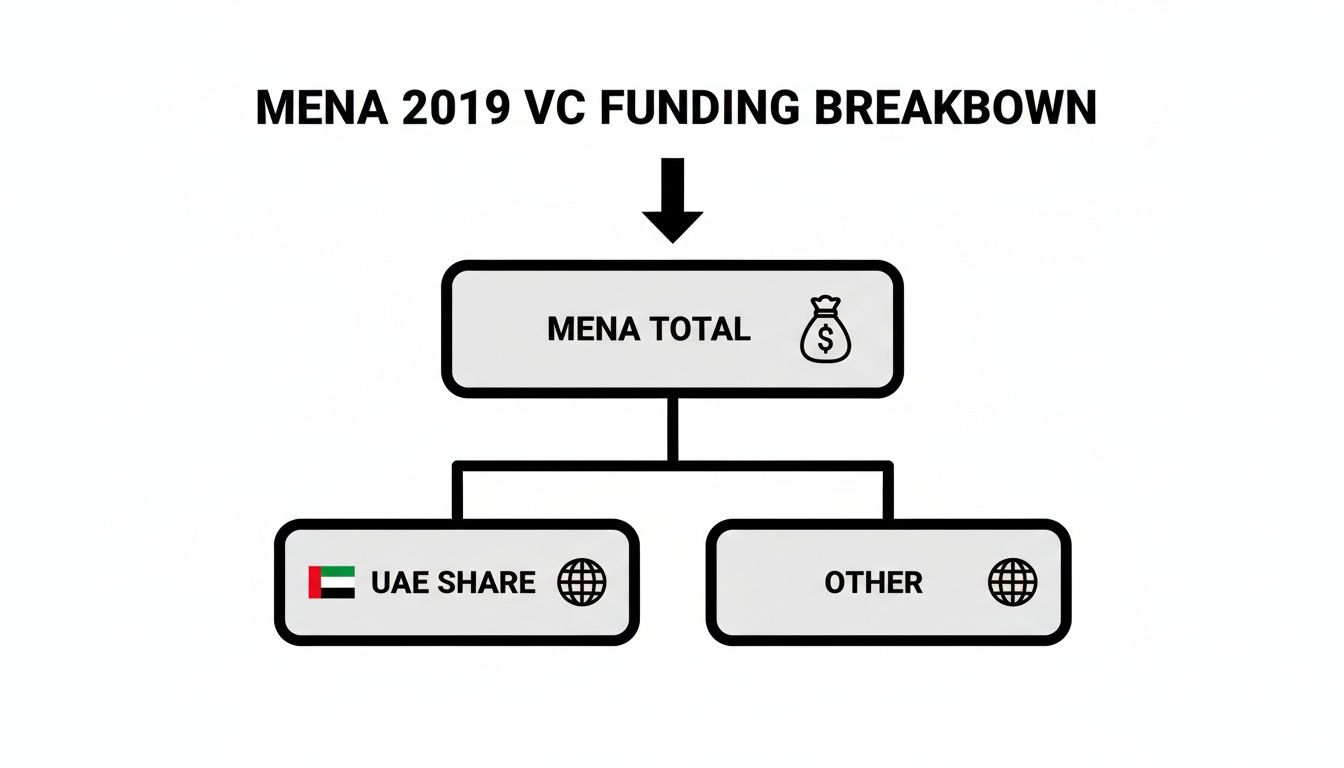
This heavy concentration of capital gave founders in the UAE a real leg up. We had better access to funding and a more mature network of support than our peers in neighboring countries.
The lessons from the start up 2019 era are absolutely essential for anyone building a company today. The ground has completely shifted beneath our feet. To give you a clearer picture, here’s a quick snapshot comparing the playbook from back then to what works now.
As you can see, the game has changed. The strategies that worked in a bull market are the very ones that can sink a company in today's more cautious climate.
The core question has evolved from "How fast can we grow?" to "How efficiently can we grow?" This shift is the most important step to building a resilient company right now.
This isn't just a history lesson. It's about giving you a practical map to avoid the traps of the past and build a business that can actually last. By understanding what happened in 2019, you can make smarter calls on your funding, your team, and your entire growth strategy.
If you were fundraising in 2019, you remember the playbook. It was a mad dash for growth, a strategy we all came to know as blitzscaling. Investors, fueled by massive funds like SoftBank’s Vision Fund, were writing huge checks for hyper-growth, often prioritizing ambitious expansion over a solid financial footing.
The goal wasn't just to grow—it was to dominate the market completely, bankrolled by one enormous venture round after another. This "growth-at-all-costs" mindset shaped how founders pitched. You had to tell a story of explosive scale, even if your path to profitability was hazy. For any start up in 2019, a sky-high valuation often felt more critical than proving the business model could actually last. That global trend poured rocket fuel on the MENA funding scene, but it also left some crucial lessons in its wake.

The biggest lesson for any founder in the UAE today? Balance. Ambition and a big vision are still non-negotiable, but investors now pore over your numbers with a new level of scrutiny. They've seen what happens when growth gets detached from reality.
Today, the magic lies in weaving a compelling growth story with a disciplined financial plan.
Your pitch today must answer a crucial question: What is your clear path to profitability, not just your path to the next funding round?
This shift means you have to be much sharper in your fundraising approach. A chart that just goes "up and to the right" isn't enough anymore. You need to show you have a deep, practical understanding of your unit economics, customer acquisition costs, and long-term retention. To get a better sense of how investors think and what they look for, it's worth digging into the mechanics of how to get venture capital funding.
Before you walk into your next investor meeting, grab your team and hammer out the answers to these questions. This isn't just about crafting a better pitch; it's about building a more resilient business that can weather any storm.
Thinking through these points moves you far beyond the 2019 playbook. For a deeper dive on building out your financial story, our guide on fundraising for startups is a great resource. The lesson from 2019 is crystal clear: the best way to attract smart money is to build a durable company from day one.
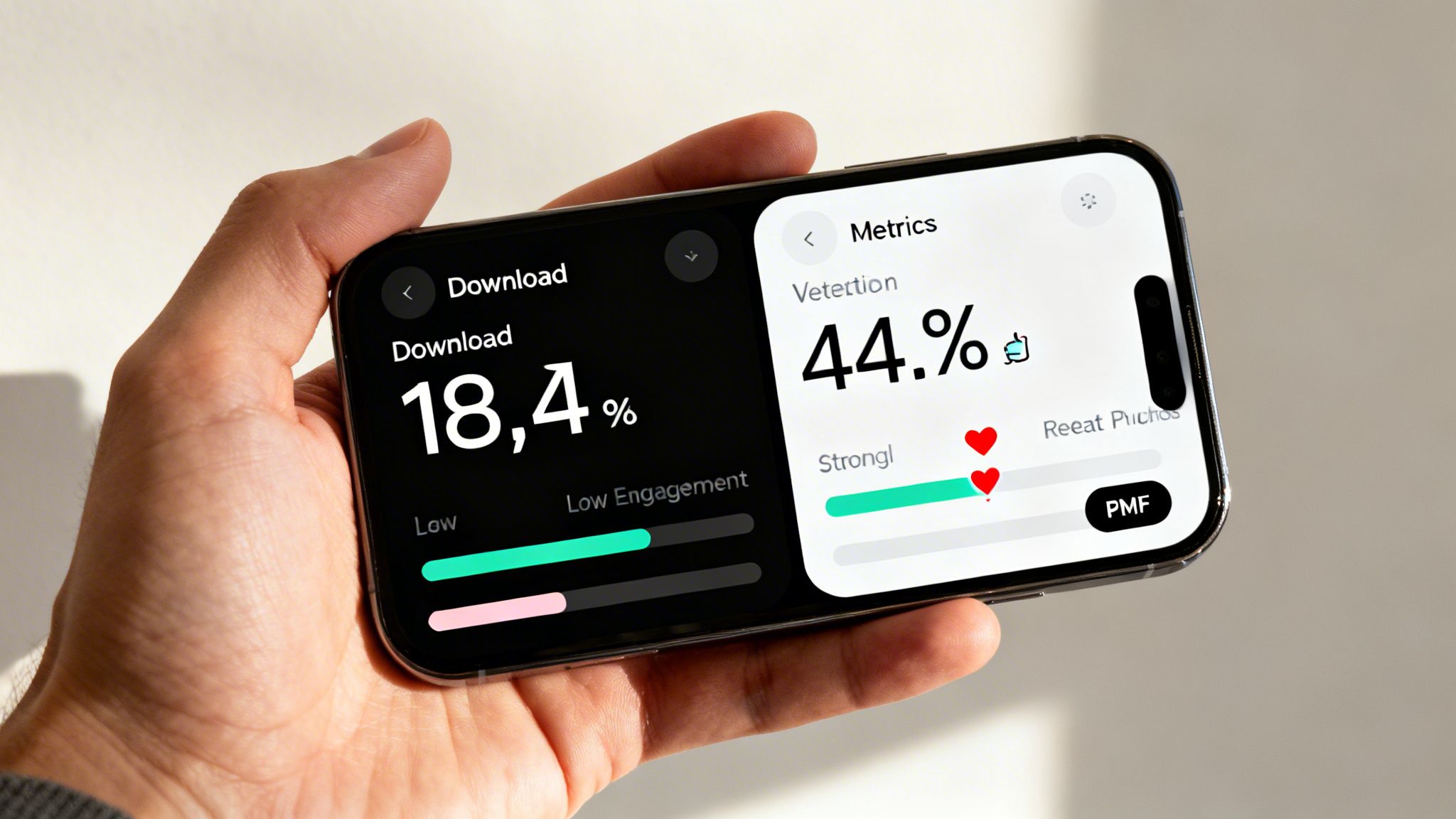
The “growth-at-all-costs” mindset of 2019 created a dangerous illusion around product-market fit (PMF). Founders and investors got swept up in vanity metrics—soaring user sign-ups, impressive app downloads, and splashy press mentions. It was an intoxicating time, and many companies raised huge rounds based on this top-line traction, only to discover their foundations were built on sand.
The hard truth was that rapid, subsidized growth was often mistaken for genuine customer demand. When a company with millions of users collapses because it can't keep them or convince them to pay once the discounts dry up, you learn a harsh lesson: huge user numbers are not the same as having a product people truly need.
Real product-market fit feels completely different. It’s less about the noise you can buy and more about the organic signals you earn. Think of it as pull from the market, not a push from your marketing budget. For founders in the UAE and MENA, learning to spot these real signals is what separates a durable business from a temporary growth story.
Instead of chasing flashy numbers, you have to zero in on the metrics that prove customer love and dependency. These are the signs that show you’ve built something people would genuinely miss if it were gone.
Product-market fit isn't when you hit a certain number of users. It's the moment your product's value becomes so undeniable that it starts to grow on its own, driven by customers who become your best salespeople.
To avoid the traps that snared so many founders back then, here’s a simple way to identify the real signals of PMF.
Get your team focused on these core indicators. They’ll give you a much clearer picture of your business's health than any vanity metric ever could. For more on this from local builders, you might want to check out these lessons from UAE founders on product-market fit.
Strong, Organic Word-of-Mouth: Are new users finding you because existing customers are telling their friends, unprompted? This is the gold standard, especially in the close-knit communities of the MENA region where reputation is everything.
High Retention Rates: What percentage of your customers are still active after one month? Three months? Six months? Loyal, repeat users are the absolute bedrock of a sustainable business. Everything else is secondary.
Willingness to Pay: This is the ultimate test. Are people actually willing to open their wallets for your solution? If your entire user base would leave the moment you turn on paid subscriptions, you have an expensive hobby, not a business.
The "How Would You Feel?" Test: Simply ask your users, "How would you feel if you could no longer use our product?" If a significant chunk (the benchmark is over 40%) answers "very disappointed," you're onto something special.
Your Next Action: Run a simple one-question survey with your most active users asking the "How would you feel?" question. The results will give you a brutally honest, fast, and actionable signal of how close you are to true product-market fit.
Back in 2019, the go-to-market (GTM) playbook for a startup often felt like an arms race. With venture capital flowing freely, the dominant strategy was brute force: pour staggering amounts of cash into paid acquisition. The goal was to outspend everyone else on Google and Facebook, buying traffic to chase those top-line growth numbers.
This was the peak of the "blitzscaling" era, and it created a dangerous addiction. Customer acquisition cost (CAC) became an afterthought as long as growth targets were met. But when the capital markets started to cool, that model shattered. Its fatal flaw became obvious—it was a great way to rent traffic, but a terrible way to build a loyal user base.
While the hyper-aggressive ad spend trend has faded, a few core growth strategies from that time have proven to be timeless. These methods aren't about quick wins; they’re about building real relationships and creating a durable, cost-effective growth engine.
Community-Led Growth: This is about creating a home for your users—a place where they can connect, learn from each other, and feel like they belong. Smart MENA startups figured out that building strong local networks created a powerful defensive moat that competitors couldn't just buy with a bigger ad budget.
Content That Builds Trust: Instead of just pushing ads, the sharpest founders invested in creating content that actually helped their audience solve problems. This move positions your brand as a trusted expert, not just another company trying to sell something.
The most resilient growth doesn't come from a bigger ad budget; it comes from building a brand that people want to be associated with. It's the difference between renting an audience and earning one.
For founders in the UAE today, the lesson is crystal clear: diversify your growth channels and build on a foundation of sustainable, organic methods. Your GTM strategy can’t be a house of cards resting on a single channel like paid ads.
A huge part of this is getting direct feedback to ensure you're actually building something people want. You can learn more about framing your questions effectively with these 10 essential survey questions about a product.
Next Action: Use this quick checklist to audit your own GTM strategy. Sit down with your team and ask these tough questions. You’re not just looking for traffic spikes; you’re looking to build a real, loyal user base.
While headlines across MENA in 2019 screamed about record-breaking deal volume, a quieter, more strategic game was being played in Abu Dhabi. While other hubs chased immediate funding announcements, the emirate was patiently laying the groundwork for long-term, sustainable value.
This was a different way of thinking about ecosystem building, one that any startup in 2019 can learn from. It focused less on winning the short-term funding race and more on creating what we now recognize as a ‘high-signal environment’ for founders.
The bet was simple: real support—not just cash—is what ultimately attracts and retains top-tier talent and innovation.
At the heart of this strategy were government-backed initiatives like Hub71, which really hit its stride in 2019. Hub71 was designed to be much more than a co-working space; it was an integrated ecosystem offering access to a global network, strategic partners, and a community of peers.
This approach was powerful because it addressed the core needs of a startup beyond its balance sheet. Instead of just offering money, Abu Dhabi focused on providing:
The core lesson from Abu Dhabi's 2019 strategy is that the best ecosystems provide not just capital, but the complete support structure that allows a startup to focus on building. It’s about reducing friction so founders can execute.
This deliberate, foundational work laid the groundwork for the emirate's future success. The numbers tell the story: this early focus helped Abu Dhabi become the fastest-growing emerging startup hub in MENA, with total VC funding hitting $1.06 billion from 2019-2023. This strategic patience paid off, as its Ecosystem Value soared to $4.2 billion from 2021-2023. You can learn more about Abu Dhabi's ecosystem growth to get the full picture.
For founders today, this offers a clear action plan when choosing a home base. Look beyond the flashy funding headlines. Ask yourself: does this city or ecosystem provide the practical support, peer network, and resources I need to actually build my business for the long haul?
Getting this choice right can be more valuable than any single funding round. For an in-depth look, check out our guide on the benefits for startups in Abu Dhabi.

The start up 2019 era wasn't just a moment in time; it was an expensive education. For founders across the UAE and MENA, its stories are a blueprint of what to do and, more critically, what not to do. This history is the key to building a business that’s not just fundable, but fundamentally sound.
We’ve distilled the lessons from that period into a straightforward playbook. This is how you build a resilient company today, using the hard-won wisdom of the past.
Think of these as the new ground rules for building a high-growth startup in our region. Each one is designed to help you make smarter moves and avoid the traps that took down so many companies in the "growth-at-all-costs" frenzy.
DO:
DON'T:
The most important mental shift is from asking, "How do we get funded?" to "How do we build a business that will last?" A company with strong fundamentals will always find money. A company built only to attract funding rarely survives.
The core lesson from the start up 2019 boom-and-bust cycle is simple: durable companies are built, not blitzscaled. Your job now is to put this playbook into practice.
Get your leadership team in a room this week. Put one thing on the agenda: "Are we building a 2019 startup or a 2026 startup?" Go through the Do's and Don'ts above as a checklist and be honest with yourselves.
Find the one area where you’re still stuck in the old playbook, and make a concrete plan to change it. That one conversation could be what sets your company on a completely different—and far more successful—path.
So, what does all this history from the startup 2019 era mean for you today? Here are some straight answers to the questions we hear most from founders in the UAE and MENA trying to connect the dots.
The short answer? Ditch the "growth at all costs" story. Today, it’s all about efficient, sustainable growth. Back in 2019, you could get away with a pitch focused on grabbing market share, no matter the burn. Now, investors in Dubai and Riyadh want to see a clear, believable path to profitability.
You absolutely must have a bulletproof grasp of your unit economics from day one. Be prepared to show exactly how every dirham of investment builds a durable business, not just funds another 18 months of expenses.
The most convincing story you can tell an investor today is one of financial discipline. Show them you’re building a business that can thrive with or without their capital, making their investment an accelerant, not a lifeline.
The single biggest takeaway is to hire for sustainability, not for scale. The 2019 playbook was all about growing headcount fast to signal momentum. That strategy left a lot of startups with bloated teams and sky-high burn rates when the music stopped.
Your priority today should be a lean, high-impact team. Recent data shows a big drop in new graduate hiring at startups, with a clear preference for experienced talent who can hit the ground running. Focus on critical roles that directly drive revenue or product milestones. A smaller, more senior team is infinitely more resilient.
Your Next Action: Before you approve another hire, ask your team: "Is this role absolutely critical for hitting our next major milestone, or is it a 'nice to have'?" That one question is a powerful filter for enforcing hiring discipline.
You scale through efficiency and retention, not just by throwing money at customer acquisition. In 2019, "scaling" was a synonym for pouring cash into paid ads. Today, that’s the fastest way to incinerate your runway.
Instead, your focus should be on building a powerful organic growth engine. That means:
This approach builds a loyal customer base and a much more defensible market position, helping you grow without being completely dependent on the next VC check.
Building a business is tough, but you don't have to do it alone. Founder Connects is a private community for UAE/MENA founders designed for real progress, peer accountability, and meaningful connections. Join us to find your trusted circle and grow your business with the support of founders who get it. Learn more at https://www.founderconnects.com.


