

A Founder's Guide to Building a Start Up Business in the UAE

Building in MENA? You don't have to do it alone.
Join 300+ founders in the Founder Connects Residency. Monthly squad calls, warm intros, $3M+ in perks, and much more. All for less than your monthly coffee budget.

Launching a startup in the UAE and MENA is an incredible opportunity, but a great idea is only the beginning. Before you spend a single dirham, your most critical task is to validate that idea in the local market. This guide gives you a fast, actionable framework to find hard proof that people in the UAE/MENA region will actually pay for what you’re building.
Validate Your Idea First: A Practical Framework for UAE Founders
Every founder starts with assumptions. The most dangerous one? Believing you already know exactly what your customers want. In the unique consumer landscape of the UAE and MENA, that assumption can kill your start ups business before it even begins.
Your goal is not to build your grand vision from day one. It's to run small, cheap experiments designed to learn as much as possible, as fast as possible.
It all starts with a specific, painful problem. Great businesses solve real needs. Look for the frustrations, slow processes, or unmet desires currently overlooked in the region. Is there a gap for a hyper-local delivery service that understands neighborhood nuances? Is an entire industry still using outdated, clunky software?
Once you have a problem, pinpoint who feels that pain most intensely. This is your initial target customer.
- Don't be vague: "Young professionals in Dubai" is too broad.
- Get laser-focused: "Expat marketing managers aged 28-35 in Dubai Media City who struggle to find reliable freelance designers for urgent projects." This is an actionable starting point. It makes it infinitely easier to find and talk to real potential users.
The good news is the UAE's impressive ecosystem growth provides a strong tailwind for founders. But government support doesn't guarantee product-market fit. That's on you.
An Actionable Framework for Fast Idea Validation
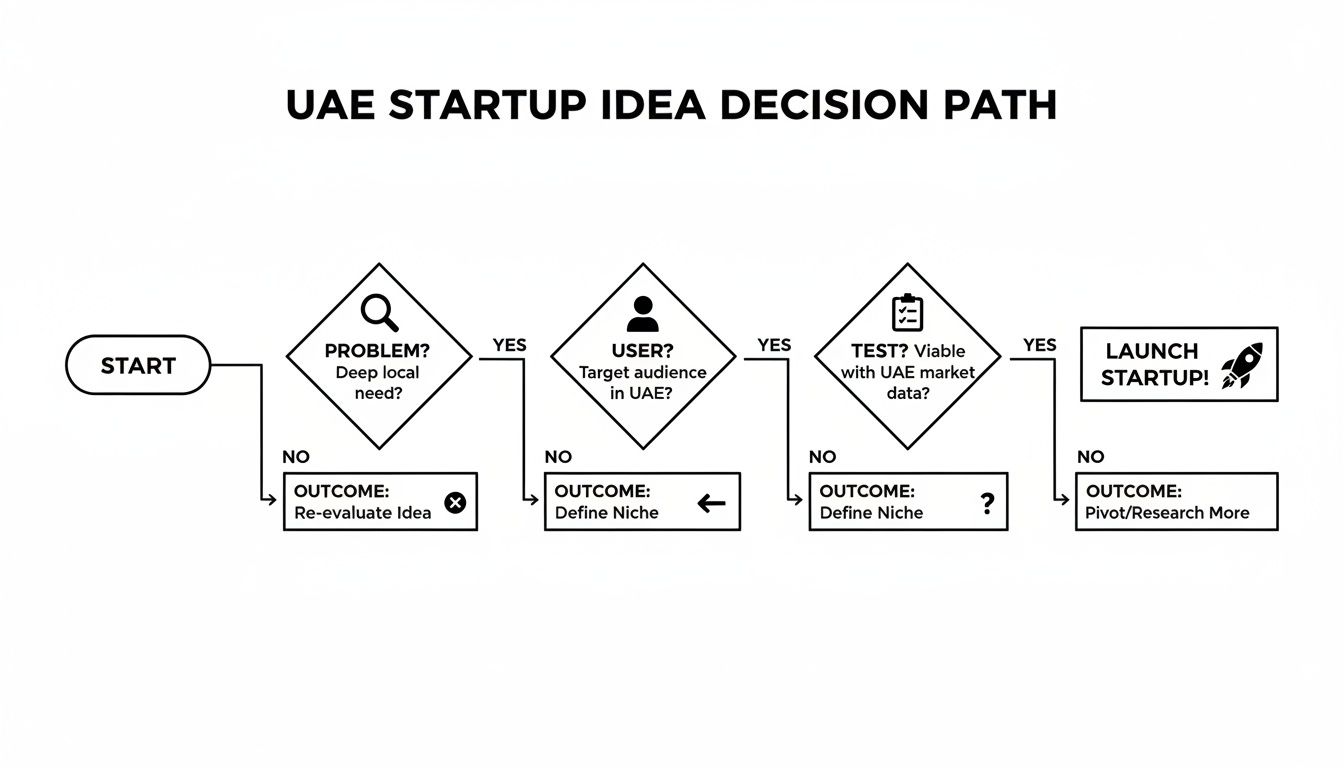
Before writing a single line of code or registering a trade license, your only job is to gather evidence. Move from "I think" to "I know" using this simple framework. It forces you to get honest about your assumptions and base your next steps on real feedback, not just gut feelings.
Validation StepKey Question to AnswerActionable Next StepProblem InterviewDo people recognize this as a problem? How are they solving it now?Interview 15-20 people in your target profile. Just listen. Don't sell.Solution InterviewDoes my proposed solution actually sound appealing to them?Go back to those people with a low-fidelity mock-up (a sketch, a slide deck). Do they "get it"?Willingness-to-Pay TestWill someone actually commit money to this solution?Ask for a small pre-order, a deposit, or a signed letter of intent. This is the ultimate validation.Channel TestWhere can I reliably and affordably find these people online?Run a tiny AED 200 ad campaign on one channel (e.g., LinkedIn) to see if you can get clicks to a landing page.
Think of it this way: if your idea is a meal-prep service for busy families in Abu Dhabi, your first move isn't building a commercial kitchen. It's interviewing 20 parents in your target neighborhood. Ask them about their weekly meal planning, what drives them crazy, and what hacks they’ve tried. Their answers are worth more than any business plan.
Actionable Insight: Your primary goal at this stage is not to sell, but to learn. Every conversation with a potential user is a chance to refine your problem statement, your solution, and your understanding of the market.
Next Action: Launch a Low-Cost Validation Experiment
With a clear hypothesis, it’s time to run a quick, low-cost experiment to see if people will take a meaningful action.
- Build a Simple Landing Page: Use a tool like Carrd or Webflow to create a one-page site in an afternoon. Clearly state the problem and your solution. Add a sign-up form to "Get early access." The number of emails is a direct signal of interest.
- Run a Small Ad Campaign: Put AED 200 behind an Instagram or LinkedIn ad targeting your specific user profile. Send traffic to your landing page. This tests both your messaging and underlying demand in the real world.
- Offer a 'Concierge' MVP: For your first few users, deliver the service manually. If you’re building a software tool, do the work for them using spreadsheets and WhatsApp. This gives you deep insights into what users actually need and what they’ll pay for—all without a product.
If you get a strong positive signal, you have the confidence to move forward. If you hear crickets? That’s not a failure. It’s a gift—an opportunity to pivot based on data, saving you from building something nobody wants.
Navigating the UAE Legal Maze: Free Zone vs. Mainland
You've validated your idea and have early signs of interest. Now it's time to make your start ups business official. In the UAE, your first major decision is choosing your legal structure: mainland or free zone. This choice impacts everything from raising capital to your daily operations.
This decision comes after you've done the groundwork to validate your idea, as the right legal structure depends heavily on the business you're actually building.
Free Zone vs. Mainland: The Simple Breakdown for Founders
- A free zone is a special economic area with its own rules, often tailored to specific industries (like tech or media). Think of it as a business island with its own regulations.
- A mainland company is registered directly with the Department ofEconomic Development (DED) in an emirate like Dubai or Abu Dhabi, allowing you to trade anywhere in the UAE without restriction.
Here’s a simple way to decide:
- Choose a Free Zone if: Your business is digital (SaaS, e-commerce), you serve international clients, or you don't need a physical shopfront in the UAE. The key benefit is 100% foreign ownership, a massive advantage for expat founders.
- Choose Mainland if: You need to sell directly to customers or other businesses within the UAE domestic market (e.g., a retail store, a local service provider, a restaurant).
The UAE's pull as a startup hub is undeniable. A massive 70% of the digital startups that launched or expanded in Dubai in early 2026 were foreign-owned, drawn in by founder-friendly visa reforms and world-class infrastructure.
Which Free Zone is Right for Your Tech Startup?
Deciding on a free zone is just the first step. There are dozens, each with its own focus. For tech start ups business, these are the ones that matter most:
- ADGM (Abu Dhabi Global Market): A top-tier financial free zone operating under English Common Law. It's a magnet for FinTech, VCs, and serious tech companies. Its Tech Licence program is designed specifically for early-stage founders.
- DIFC (Dubai International Financial Centre): Another heavyweight financial hub with its own courts. Ideal for regulated FinTechs looking for a premium jurisdiction.
- DMCC (Dubai Multi Commodities Centre): One of Dubai's largest and most diverse free zones with a massive, vibrant tech community. A solid all-around choice.
- Hub71 (within ADGM): More than a free zone, it's an ecosystem. Hub71 offers incentives, corporate partnerships, and market access specifically for tech startups.
Actionable Insight: The best jurisdiction isn’t the cheapest one. It’s the ecosystem that provides the right regulations, network, and support to fuel your growth. Getting a handle on the trade license cost in Dubai is crucial, but it's only one part of the equation.
Your Next Action: Prepare for Your Legal Consultation
Don't DIY your legal setup. The risks of making a mistake are too high. Your next step is to book a consultation with a qualified corporate services provider or lawyer who specializes in UAE startups.
To make that meeting productive, go in prepared. Ask these questions to get clear, strategic answers:
- Based on my business model (e.g., SaaS, D2C, FinTech), which three free zones do you recommend and why?
- What are the total estimated setup and renewal costs for each option over three years, including all hidden fees?
- If we start in a free zone, what are the exact limitations and steps if we later want to sell directly to UAE customers?
- How does our choice of jurisdiction affect our ability to raise venture capital from local and international VCs?
- What are the precise visa allocation rules, and how will that impact sponsoring our first employees?
Getting solid answers to these questions will give you the clarity to make one of the most important early decisions for your startup.
Building Your Minimum Viable Product (MVP) the Smart Way
Let's be clear: a Minimum Viable Product (MVP) isn't a cheaper version of your final product. It's a scientific tool for learning. For founders in the UAE, the MVP is your first real conversation with the market. The entire point is to get the most valuable insights with the least amount of effort and cash.

The biggest trap is feature creep. Be ruthless. Pinpoint the single most critical problem your product solves and build only the core function needed to test that solution. Everything else is noise.
What Kind of MVP Should You Build?
The best MVP is the one that delivers maximum learning for minimum effort. Before writing code, consider these lean, fast alternatives perfect for the MENA market:
- Landing Page MVP: The fastest path to gauging interest. A simple one-page site explaining your value proposition with a "Request Early Access" button. A Dubai B2B SaaS could use this to see how many local SMEs sign up for a waitlist.
- Concierge MVP: You deliver the service entirely by hand. Planning an automated gifting service? You personally buy, wrap, and deliver the gifts for your first clients. The insights you get are unmatched.
- No-Code App: Tools like Bubble or Adalo are game-changers. They let you build functional web and mobile apps that feel real, without code. This is perfect for testing user flows with a clickable prototype in weeks, not months.
Actionable Insight: The purpose of an MVP is to start a conversation. It's an invitation for your target users to tell you what they truly value, what's missing, and most importantly, what they are willing to pay for. Check out this founder's guide to MVP development for a deeper dive.
Next Action: Use This Checklist to Scope Your MVP
To avoid a bloated, unfocused MVP, use this checklist to stay laser-focused on what matters.
MVP Scoping Checklist
- Core Problem: What is the #1 pain point this MVP must solve for our target user?
- User Journey: What is the single, critical path a user must take to get value? (e.g., Sign up -> Create project -> Invite team member).
- "Must-Have" Features: List the absolute bare-minimum features for that journey. Now, cut the list in half. Seriously.
- Success Metric: What is the one key metric that proves/disproves our core hypothesis? (e.g., % of users who complete the core action, # of pre-orders).
Once your MVP is live, track what users do.
- Activation Rate: What percentage of sign-ups complete the core action?
- Qualitative Feedback: Get on the phone with your first users. Ask, "What part was confusing?" and "What did you wish it could do?"
Your next move is to analyze this feedback and decide: pivot, persevere, or kill the idea. This validated learning is the real return on your MVP investment, and our guide on getting from idea to your first customer in theUAE can help.
Finding Your First 100 Customers in the MENA Region
Your MVP is live. Congratulations. Now the real work begins: getting your first 100 customers.
This isn't about flashy ad campaigns. It's about doing things that don't scale. Think focused, high-touch, manual outreach. Your goal isn’t mass-market appeal; it's to find a small, passionate group of early adopters who truly feel the pain you're solving.

Every sign-up, every conversation, is a chance to get priceless feedback.
Go Where Your Customers Already Are
Your first users are already talking about their problems in communities, online and off. Your job is to find these places and join the conversation authentically.
- Online Communities: Dive into professional LinkedIn and Facebook groups relevant to the UAE, KSA, and Egypt. Find niche subreddits or industry WhatsApp groups. Offer genuine value—answer questions and share insights to become a trusted voice.
- Ecosystem Events: Skip huge, anonymous conferences. Focus on smaller, curated meetups at places like Hub71 in Abu Dhabi or in5 in Dubai. These are goldmines for meaningful conversations.
- Hyper-Local Focus: If you have a B2C app for gym-goers, go to the actual gyms. Talk to people. If you aren't sure who or where these people are, use our guide to define your target customers in the UAE.
The Power of Personalised Outreach
Mass emails are a waste of time at this stage. Your first 100 users come from effort that doesn't scale.
Craft a short, direct message on LinkedIn or email. Make it personal. Reference a post they shared or a common connection. Show you’ve done your homework. This isn't a sales pitch; it's an exclusive invitation to help shape a product built for them.
Actionable Insight: "Your early adopters are signing up for the vision and the personal connection to you, the founder, as much as they are for the product itself. Don’t hide behind a corporate logo; put yourself front and centre."
Next Action: Run a 30-Day Growth Experiment
Execution is what matters. Use this tangible checklist to land your first customers, starting today.
Your 30-Day Experiment Plan:
- Week 1 (Research & Outreach):
- Pinpoint 5 online communities where your ideal customers are active.
- Draft a personalized outreach template (and customize it for every single person).
- Send 10 thoughtful, personalized messages a day on LinkedIn.
- Week 2 (Engagement & Feedback):
- Attend at least one relevant local meetup or virtual event.
- Schedule 1-on-1 onboarding calls with your first 5-10 users. Watch how they use your product.
- Week 3 (Iteration):
- From your calls, identify the top 3 user complaints or feature requests.
- Ship one small, high-impact fix to your MVP. Show users you're listening.
- Week 4 (Amplify & Repeat):
- Ask your happiest users for a testimonial or an intro to 1-2 other people.
- Analyze your data. Which channel brought the most engaged users? Double down on what works.
- Honest Feedback on Demand: Get unbiased takes on your MVP or pitch deck from people who've been there.
- Accountability That Forces Action: Regular check-ins create powerful deadlines, pushing you to hit milestones.
- Warm Introductions that Matter: A warm intro from a trusted peer to an investor or key client is worth a hundred cold emails.
- A Shortcut to the Best Resources: Find out who the best legal advisors are or which sales tools actually work, saving you time and money.
- Curated Membership: Members are properly vetted.
- Structured Meetings: Sessions are moderated and focused on solving specific member challenges.
- A High-Trust Environment: Confidentiality is paramount.
- A Bias for Action: The purpose is to help you make tangible progress.
- Lean Setup: For a tech startup, a license in a cost-effective free zone typically costs AED 15,000 to AED 25,000 for the first year.
- Premium Setup: A mainland license or a premium free zone like ADGM or DIFC will be significantly more.
- Visas: Budget roughly AED 5,000 - AED 7,000 per resident visa.
- Office: Co-working spaces start from a few thousand dirhams a month.
- Buffer: Factor in costs for opening a corporate bank account, mandatory health insurance, and legal/accounting fees.
- Local Market Validation: Show undeniable traction with customers in this region. A Silicon Valley playbook is a red flag.
- Clear Path to Monetization: How, exactly, will you make money? Have a well-thought-out revenue model.
- A Formidable Team: Investors are backing you. Show them you have the right experience, grit, and an obsession with execution. Show them your early traction metrics (MRR, CAC, engagement).
This action-focused plan shifts you from thinking to doing, setting the foundation for growth.
Why Your Founder Circle Is Your Biggest Asset
Building a start ups business is isolating. Friends and family mean well, but they don't get the pressure of wrestling with brutal user feedback. This isolation isn't just a personal struggle; it's a business risk. Making critical decisions in a vacuum is flying blind.
This is where a curated founder community becomes one of your most powerful tools.
This Isn’t a Networking Mixer
Forget collecting business cards at crowded mixers. A curated peer community, like the groups facilitated by Founder Connects, is built on trust and structure. It brings together vetted founders wrestling with similar challenges at the same stage. The goal isn't small talk; it's brutally honest conversations about what’s actually going on in your business.
Actionable Insight: The magic of a peer group isn't just what you learn. It's the accountability it creates. Knowing you have to report your progress to a small group of peers is a powerful motivator to stay focused.
Struggling to price your new SaaS product for the local market? In your peer group, one founder can share how they tackled this six months ago. Another might offer hard data on what their customers pay. A third could connect you to a pricing expert. That’s shared intelligence in action.
The Real-World Returns of a Trusted Circle
A structured peer group delivers measurable progress.
What to Look for in a Founder Community
Not all communities are equal. Look for these key signs of quality over quantity:
Next Action: Take a hard look at your support system. Do you have a small circle of trusted peers for unfiltered advice? If not, it's time to actively find one. Turning founder isolation into a competitive advantage is one of the smartest investments you’ll make.
Your Top UAE Startup Questions, Answered Fast
Here are straight-talking answers to the most common questions we hear from founders in the UAE.
How Much Does It Really Cost to Set Up a Startup in Dubai?
There's no single number, but here’s a realistic budget framework. Your cost is mainly driven by your choice of free zone vs. mainland.
Don't forget these other costs:
Actionable Insight: A safe starting budget for a lean tech startup (license, founder visa, 6 months basic runway) is typically AED 60,000 to AED 100,000.
What Are MENA Investors Looking for Right Now?
VCs in the MENA region are getting more selective. They are looking past hype for solid fundamentals, especially in sectors like AI, FinTech, and HealthTech.
To get a 'yes' from a regional investor, you need to nail three things:
Can I Start a Business in the UAE While Still Employed?
Yes, many founders start this way. You just have to do it by the book.
You will need a No Objection Certificate (NOC) from your current employer. This is a formal letter confirming they are okay with you setting up your own business. Without it, you could breach your employment contract.
With an NOC, you can get a Freelance Permit or set up a Free Zone Company. It’s crucial to keep clear boundaries: do not use your employer's resources, time, or IP, and avoid any direct conflicts of interest.
Tired of going it alone? The startup journey is tough, but you don't have to navigate it in isolation. Founder Connects provides curated peer groups, high-signal introductions, and the practical support system you need to make real progress. Join a community built for founders, by founders.

Building in MENA? You don't have to do it alone.
Join 300+ founders in the Founder Connects Residency. Monthly squad calls, warm intros, $3M+ in perks, and much more. All for less than your monthly coffee budget.
Popular posts





The premier community for tech founders, investors, and builders. Connect, collaborate, and grow together.