

A Founder's Guide to Startup Company Valuation in the UAE & MENA

Building in MENA? You don't have to do it alone.
Join 300+ founders in the Founder Connects Residency. Monthly squad calls, warm intros, $3M+ in perks, and much more. All for less than your monthly coffee budget.

Startup valuation is the process of figuring out what your company is worth. For early-stage founders in the UAE and MENA, it’s less about a precise formula and more about telling a compelling story backed by believable assumptions. Your goal is to land on a value that justifies an investor's capital for a certain slice of equity, setting you up for a successful fundraising round.
Why Startup Valuation Is More Art Than Science
Figuring out what your startup is worth, especially before you’ve made a single dirham, can feel like guesswork. You don’t have historical cash flows to analyze or hard assets to appraise. Instead, a startup valuation is a negotiation—a blend of art and science built on a powerful vision for the future.
Your objective isn't to find a single, "correct" number. It's to establish a defensible range that both you and a potential investor can agree on. This is especially true in a fast-moving ecosystem like the MENA region.
The Story Behind the Numbers
For a new venture, the story you tell is often more powerful than any spreadsheet. Investors are betting on your potential. The core pieces of this narrative include:
- The Team: A rock-solid founding team with relevant experience can seriously boost a valuation. Can your team execute this vision?
- The Market Opportunity: A huge and growing Total Addressable Market (TAM) signals massive upside. How big can this company really get? Get specific with MENA-focused numbers.
- Traction and Progress: This doesn't have to be revenue. It can be user sign-ups, a working prototype (MVP), key partnerships, or letters of intent from potential customers.
- Competitive Landscape: What makes you special? Your unique selling proposition (USP) and any defensible moats—like proprietary tech or a killer business model—are what set you apart.
The UAE & MENA Context: A High-Growth Ecosystem
The power of a strong narrative is even more important in booming markets like the UAE and Saudi Arabia. In fact, Dubai's ecosystem alone was valued at over $23 billion by the end of 2023. This massive valuation highlights the region's magnetic pull for entrepreneurs, fueled by business-friendly policies and innovation hubs like Hub71 in Abu Dhabi. You can discover more about the UAE's top-ranking startup hub and what it means for founders like you.
For a founder in Dubai or Riyadh, valuation isn’t just about your idea. It’s about positioning it within one of the fastest-growing tech hubs in the world. Your ability to connect your startup's potential to the region's growth story is a massive valuation driver.
The sections that follow will give you the practical methods and frameworks to translate your vision into a number that can power your entire fundraising journey.
Picking the Right Valuation Method for Your Startup
Feeling overwhelmed by acronyms like DCF, CCA, and the VC Method? You're not alone. Figuring out how to value your startup doesn't have to be complicated.
Think of these methods as different lenses to view your company’s potential. The trick is picking the right lens for your stage. An early-stage, pre-revenue startup in Dubai has different valuation drivers than a scaling SaaS company in Riyadh with predictable cash flow.
To make it simpler, here’s a quick decision tree to help you figure out if your valuation will be driven more by a simple formula or a compelling story.
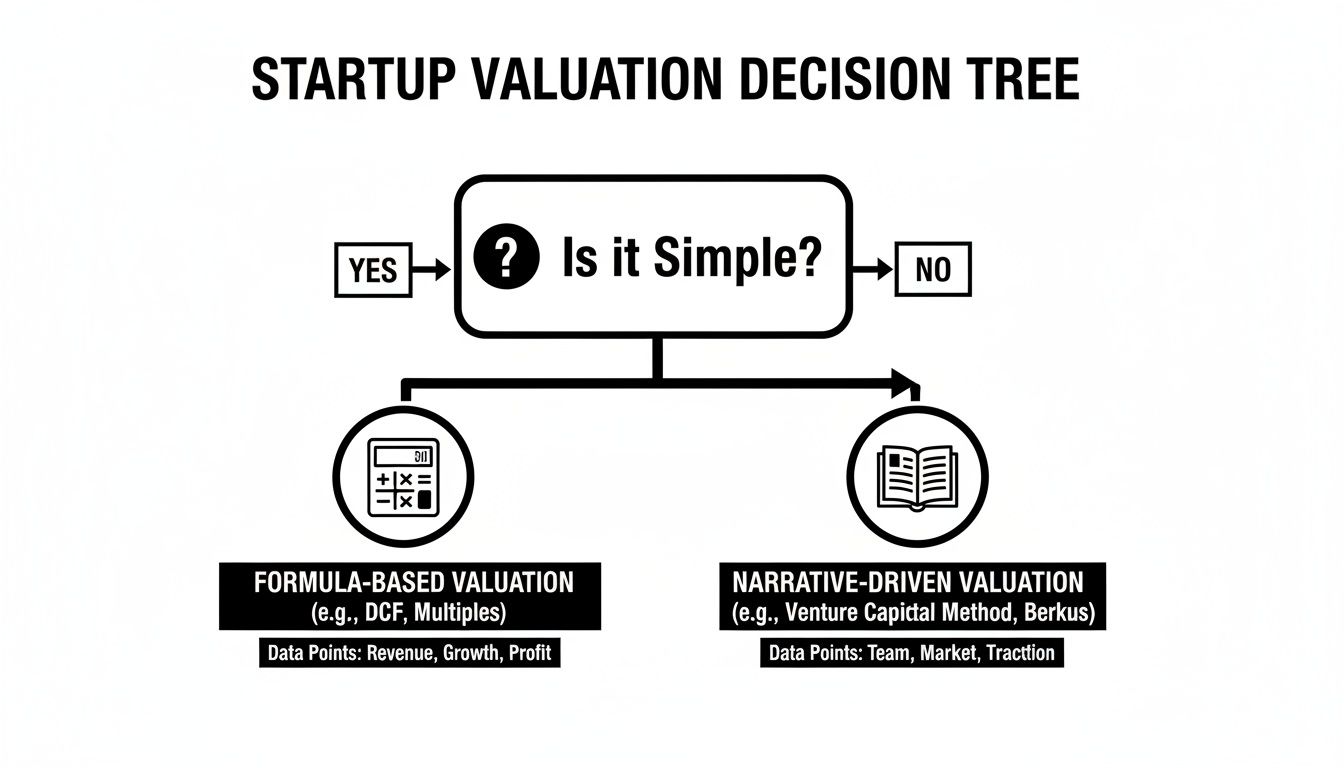
For most founders just starting out, the narrative—backed by solid qualitative data—is often the most powerful tool.
Qualitative Methods for Pre-Revenue Startups
When you have a big idea but little revenue, your valuation is a story about the future. Qualitative methods help you frame that story with logic that investors can understand. These are perfect for pre-seed and seed-stage companies in the UAE.
- The Berkus Method: This method assigns value to the core components you’ve already built: a strong team, a working prototype, key partnerships, etc. It values the foundational pieces that prove you’re reducing risk, usually up to a certain maximum amount per category. It’s simple and fast.
- The Scorecard Method: This starts with an average valuation for similar pre-revenue startups in your region and then adjusts it based on how your company compares. You score your startup on key factors—like team strength, market size, and product uniqueness—to land on a valuation that reflects your relative strengths.
These approaches are especially useful when pitching to angel investors or joining an early-stage accelerator program in the MENA region, because they focus on potential and team quality over financial history. Often, the valuation you land on will set the terms for instruments like convertible notes. For a deeper look, our guide on convertible notes versus equity breaks down what regional angel investors tend to prefer.
Quantitative Methods for Startups with Traction
Once your startup has revenue or clear financial projections, you can use more data-driven methods. These are more common for Series A rounds and beyond.
- The Venture Capital (VC) Method: This is all about the exit. It works backward from a potential future sale price. An investor estimates what your company might be worth in 5-7 years, then discounts that back to today to figure out a present value, making sure it accounts for their required return on investment (ROI).
- Comparable Company Analysis (CCA): Think of this as the real estate approach. You look at what similar companies (publicly traded or recently acquired) are worth. For SaaS companies, this often means applying a revenue multiple, like 7x Annual Recurring Revenue, based on market rates.
- Discounted Cash Flow (DCF): This is the most financially intense method. You project future cash flows and discount them back to what they're worth today. It’s powerful but very sensitive to your assumptions, so it’s best for more mature startups with a predictable revenue history.
Which Valuation Method Should You Use?
Valuation MethodBest For (Startup Stage)Key Input NeededProsConsBerkus MethodPre-Seed/Idea Stage (Pre-Revenue)Team quality, prototype, partnershipsSimple, fast, focuses on key risk factorsSubjective, capped at a low maximum valueScorecard MethodPre-Seed/Seed StageAverage regional valuation, competitive factorsMore nuanced than Berkus, regionally relevantStill highly subjective, relies on good compsVC MethodSeed to Series A/BProjected exit value, target investor ROIAligns directly with investor expectationsHighly dependent on exit assumptionsComparable AnalysisSeries A and Beyond (With Revenue)Revenue multiples, public/M&A compsMarket-based, grounded in real-world dataFinding truly comparable companies is hardDiscounted Cash FlowLate Stage/Pre-IPO (Mature)Detailed financial projections, discount rateFinancially rigorous, based on fundamentalsVery sensitive to assumptions, complex
Actionable Tip: Don't just pick one method. The most credible founders use two or three different methods—ideally a mix of qualitative and quantitative—to triangulate a defensible valuation range. For an early-stage UAE fintech, you might blend the Scorecard Method with a conservative model using the VC Method.
Choosing the right method grounds your "ask" in a logical framework, turning your valuation from a wild guess into a well-reasoned argument.
How to Calculate Your Pre-Money Valuation
Let's move from theory to a real number. For an early-stage founder in the UAE, figuring out your pre-money valuation is about building a credible, defensible range by blending your startup's qualitative strengths with some logical assumptions.
This process starts with getting your core metrics on paper. From there, you'll mix a couple of valuation methods to land on a number investors will take seriously. The key is to justify that number with a compelling narrative grounded in the regional market.

Step 1: Gather Your Core Metrics
Before you can put a price tag on anything, you need to know what you’ve got. For an early-stage company, your most valuable assets are often things you can’t plug into a spreadsheet. A fundamental step for any founder is understanding how to calculate the valuation of a company.
Start by documenting these key points:
- Team Strength: Who are your founders and key hires? List their specific experiences that reduce execution risk. Mention past successes or deep industry know-how.
- Market Size (TAM): Quantify the opportunity. Get specific about your addressable market within the UAE, then the GCC, and finally the wider MENA region. Use credible sources.
- Product Progress: How far along is your Minimum Viable Product (MVP)? Do you have a working prototype or a beta with users? The more you’ve built, the more risk you’ve removed.
- Early Traction: This is any proof your idea is clicking with people. It could be user sign-ups, letters of intent (LOIs), or positive feedback from a pilot program.
Step 2: Combine Two Valuation Methods
Relying on a single method can feel like you pulled a number out of thin air. A smarter approach is to triangulate a valuation by combining two relevant methods. For a pre-revenue startup, a blend of the Scorecard and Berkus methods gives you a balanced perspective.
Let's walk through a quick example. Imagine "FinSustain," a UAE-based fintech startup with a prototype for a sustainable investing app.
Applying the Scorecard Method:
- Find a Regional Average: Research shows the average pre-money valuation for pre-seed fintechs in the MENA region is around $2.0 million. This is our starting point.
- Score Your Startup: Now, we compare FinSustain to that "average" startup.
FactorWeightFinSustain ScoreResultStrength of Team30%125% (Strong team)$750,000Market Size25%120% (Large MENA market)$600,000Product/Tech15%90% (Good MVP, needs work)$270,000Competitive Environment10%80% (Competitive space)$160,000Marketing/Sales10%75% (No strategy yet)$150,000Need for More Funding5%100% (Standard)$100,000Other Factors5%110% (Strong advisory board)$110,000Total Weighted Valuation$2,140,000
This method gives us a valuation of roughly $2.14 million.
Applying the Berkus Method:
This method is simpler. It assigns a dollar value to key milestones that reduce risk, with each category capped at $500,000.
- Sound Idea: ($500k) - The concept is strong and taps into a growing market.
- Prototype: ($400k) - The MVP works, but still needs real user testing.
- Quality Management Team: ($500k) - One founder has fintech exit experience.
- Strategic Relationships: ($250k) - In early talks with a local bank.
- Product Rollout/Sales: ($0) - No customers yet.
Total Berkus Valuation: $1,650,000
By using both methods, FinSustain now has a solid, defensible valuation range of $1.65 million to $2.14 million.
Step 3: Build Your Valuation Narrative
The final step is to wrap this range in a story. The UAE's venture capital scene is navigating economic shifts, but early-stage funding is holding strong. Investors are sharpening their focus on sustainable, tech-driven startups, pushing valuations toward models that value both ethical and digital innovation.
Next Action: Fire up a spreadsheet and build your own simple valuation model. Use the Scorecard and Berkus methods as a template. This exercise will force you to be brutally honest and get you ready to defend your numbers to investors.
This hands-on approach takes your valuation from a guess to a well-reasoned estimate, giving you the confidence and data to anchor those crucial fundraising conversations.
Understanding How Valuation Impacts Your Equity
Your startup's valuation isn't just a vanity metric. It's the single most important number that determines how much of your company you keep. Mess this up, and you'll face painful dilution down the line.
The game boils down to three core concepts: pre-money valuation, the investment amount, and post-money valuation. Master how these three pieces interact, and you'll be in a much stronger position to make smart fundraising decisions.

From Pre-Money to Post-Money
Imagine your company's equity is a pie. Before an investor's cash comes in, the value of that pie is your pre-money valuation. It’s what you and the investor agree your startup is worth before their capital arrives.
The investment amount is the new cash coming in. Add that to your pre-money valuation, and you get your post-money valuation.
The formula is simple:
Pre-Money Valuation + Investment Amount = Post-Money Valuation
The investor's ownership slice is calculated from this new post-money value.
Calculating Dilution: A Practical Example
Let’s make this real. A hypothetical Dubai startup, "CareemEats," agrees to a $4 million pre-money valuation and is raising $1 million.
- Calculate Post-Money Valuation:
- $4,000,000 (Pre-Money) + $1,000,000 (Investment) = $5,000,000 (Post-Money)
- Calculate Investor's Equity:
- Investor's ownership = Investment / Post-Money Valuation.
- $1,000,000 / $5,000,000 = 20%
- Calculate Founder's Dilution:
- Before the deal, founders owned 100%. After, the investor owns 20%, so the founders' collective stake is diluted to 80%.
- Post-Money Valuation: $9M + $1M = $10M
- Investor's Stake: $1M / $10M = 10%
- Founder's Stake: 90%
- "Your valuation seems high for your current revenue."
Acknowledge their point, then pivot to forward-looking metrics. "You're right, our current MRR is early, but our 30% month-over-month user growth and the enterprise pilots we've landed show a steep trajectory. Our valuation is priced for that validated potential." - "I saw a similar company raise at a lower valuation."
This is where your research pays off. "That's a great point. The key difference is our proprietary tech, which gives us a defensible advantage and 50% higher gross margins. We believe that justifies the premium."
- Build Your First Model (Today): Open a spreadsheet and build a simple valuation worksheet. Use the Scorecard and Berkus method examples to create a preliminary range. This forces you to honestly assess your startup's strengths and weaknesses.
- Pressure-Test Your Assumptions: Set up a 30-minute call with a trusted mentor, advisor, or another founder. Walk them through your model and ask them to poke holes in it. Critical feedback from someone who understands the UAE/MENA ecosystem is priceless.
- Define and Obsess Over Your Key Metrics: What are the top three metrics that make your valuation story undeniable? It could be user growth, monthly recurring revenue (MRR), or customer acquisition cost (CAC). Make them your team's North Star. Get them on a dashboard and update it weekly. Progress is your most powerful negotiation tool.
- Launching your MVP and signing up your first users.
- Landing a major strategic partnership or a big-name client.
- Achieving product-market fit (shown by strong user retention).
- Crossing a significant revenue threshold, like hitting $1 million ARR.
That's dilution. It isn't automatically bad—you now own a smaller piece of a much more valuable, better-funded company. But understanding the math is the first step to managing it. To get inside their heads, check out our guide on what founders need to know about angel investment returns.
Why a Higher Valuation Isn’t Always Better
It's tempting to chase the highest valuation possible, but it can be a dangerous trap for your next fundraising round.
Imagine CareemEats had pushed for an aggressive $9 million pre-money valuation for that same $1 million investment.
This looks great on paper, but 18 months later, the company will need to raise its Series A. New investors will expect significant growth to justify a valuation well north of $10 million. If the company hasn't hit massive milestones, it faces a "down round"—raising money at a lower valuation than before.
A down round can be devastating. It crushes morale, damages founder credibility, and hurts the ownership stakes of your team and early investors. It’s often smarter to take a fair valuation you can realistically grow into.
Treat your valuation as a strategic decision, not a scorecard. It has a direct impact on your cap table, investor relationships, and your ability to raise capital later.
Next Action: Open a spreadsheet and model two or three valuation scenarios for your current fundraising ask. Calculate how a low, medium, and high pre-money number would affect your ownership stake. This will arm you for negotiations.
Negotiating Your Valuation with MENA Investors
Walking into a negotiation without a clear strategy is a surefire way to get a bad deal. Once you have a defensible valuation range, the real work begins: communicating it with confidence to investors across the UAE and the wider MENA region. This is as much about building trust as it is about the numbers.
Your goal isn't to win an argument; it’s to find a partner who believes in your vision and agrees on a fair price. The key is to anchor the conversation, handle pushback with data, and be prepared.
Anchoring the Conversation
In any negotiation, the first number dropped often becomes the anchor for the discussion. As the founder, you should set it.
Instead of a single, rigid figure, present a well-reasoned range—like, "$2.5 million to $3 million pre-money." This shows you've done your homework but are open to discussion. Justify the range by walking them through your valuation methods, market analysis, and any comparable deals you've seen in the region.
Handling Common Investor Pushback
Investors will almost always challenge your number—that’s their job. Don’t take it personally. Use their questions as opportunities to highlight your startup’s strengths.
Here’s how to handle common objections:
The UAE has minted multiple unicorns, each smashing the $1 billion valuation mark. This proves that massive outcomes are possible in MENA, especially when structured through common-law free zones that foreign investors trust. Dive deeper into the UAE's top startups and what it means for your fundraising for startups strategy on Founder Connects.
Knowing When to Be Flexible
While you should defend your valuation, remember that the right investor brings more than just cash. A strategic partner who can open doors to customers, offer priceless mentorship, or help you hire A-players might be worth giving up more equity for.
Key Insight: The best deal isn't always the one with the highest valuation. It's the one with the right partner on terms that set your company up for long-term success. Evaluate an investor's non-monetary value before you make a final call.
A successful negotiation is about finding a fair middle ground. By anchoring the conversation, justifying your numbers with data, and recognizing the value of a true strategic partnership, you can lock in terms that will fuel your startup's growth.
Your Action Plan: Moving from Theory to a Term Sheet
Reading about valuation is one thing; building a number you can stand behind in front of investors is another. This is your roadmap to move from thinking to doing. Your valuation is a story, and you need to back it up with a solid model and a smart negotiation strategy. Start building that story now, not the night before your first pitch.
Your Immediate Next Steps
Don't let this guide become just another open browser tab. Here are three concrete things you can do this week to get ahead:
Final Takeaway: A strong valuation isn’t built overnight. It’s the result of disciplined execution, clear storytelling, and doing your homework long before you walk into an investor meeting.
When you're ready to face that investor scrutiny, you'll want to be prepared. Make sure you've covered all your bases by working through this ultimate due diligence checklist. This level of preparation is what turns a good pitch into a signed term sheet.
Frequently Asked Questions About Startup Valuation
Even after digging into the methods, founders in the UAE and MENA usually have a few more practical questions.
How Much Does My Industry Affect My Valuation in the UAE?
It’s a massive factor. Investors here focus on sectors with explosive growth potential. A SaaS startup with $500k in Annual Recurring Revenue (ARR) will almost always get a higher valuation multiple than an e-commerce business with the same revenue.
Why? SaaS businesses have predictable, recurring income and high gross margins. In today's market, a solid B2B SaaS company might get a multiple of 5x to 8x its ARR. An e-commerce startup is more likely to be valued around 1x to 2x its Gross Merchandise Value (GMV). Hot sectors like FinTech, HealthTech, and AI currently attract premium valuations in the MENA region.
What Are the Biggest Mistakes Founders Make When Pitching Their Valuation?
The classic mistake is throwing out a number without showing your work. When a founder says, "We're worth $3 million," and can't explain the logic, they lose credibility. It suggests you haven't done your homework.
Another misstep is using generic, global comparisons. Citing a deal in Silicon Valley is not as compelling as referencing a similar funding round in Dubai or Riyadh. You must ground your assumptions in regional data.
How Often Should I Re-evaluate My Startup’s Worth?
Think of your valuation as a living number. A quick, informal re-evaluation every six months is a good rhythm, or anytime you hit a major milestone.
These "value inflection points" are the perfect triggers for an update:
A formal, deep-dive valuation is only necessary when you're actively fundraising. But regular check-ins mean you'll always know where you stand and can talk confidently about your startup's value.
This proactive mindset keeps you ready for investor chats and helps you see if your hard work is building real enterprise value.
Building a business is tough, but you don't have to do it alone. At Founder Connects, we match you with a curated peer group of fellow founders in the MENA region for the accountability, insights, and real connections you need to grow. Stop navigating the journey in isolation and start making real progress with a community that gets it. Join the waitlist today.

Building in MENA? You don't have to do it alone.
Join 300+ founders in the Founder Connects Residency. Monthly squad calls, warm intros, $3M+ in perks, and much more. All for less than your monthly coffee budget.
Popular posts





Founder Connects is a premium MENA tech founder community. Meetups in Dubai and across MENA, Residency Squads of 8–10, and 400+ vetted WhatsApp founders (apply and screened).