

A Founder's Guide to Launching a Startup in Dubai

Building in MENA? You don't have to do it alone.
Join 300+ founders in the Founder Connects Residency. Monthly squad calls, warm intros, $3M+ in perks, and much more. All for less than your monthly coffee budget.

Launching a startup in Dubai isn't just a change of scenery; it's a strategic move for founders with global ambitions. The ecosystem is built for speed, offering 100% foreign ownership in most sectors and a fast setup process that can get you operational in weeks. This guide cuts through the noise to give you the practical, founder-to-founder insights you need to get started.
Why Dubai Is a Smart Launchpad for Your Startup
Dubai has intentionally engineered itself into a global business hub. For a founder, this means you’re entering a pro-business environment designed to help you grow, not slow you down. The government's support is tangible, visible in the world-class digital and physical infrastructure.
The growth is real. Dubai's startup ecosystem is attracting founders who want to scale fast and connect globally. In 2025, the ecosystem grew by an impressive 33.4%, placing Dubai at #44 in global rankings. That’s 987 active startups that have raised over $1.1 billion in total funding. This growth is anchored by specialised free zones like Dubai Internet City, home to over 1,600 tech companies.
The Real Advantages for Founders
What are the tangible benefits that impact your startup's success? Here are the critical ones:
- Speed to Market: Forget months of red tape. In many of Dubai's free zones, you can incorporate your company in as little as two weeks.
- Access to Capital: The region has significant capital. Venture funds, family offices, and angel investors are actively funding tech startups.
- Global Talent Pool: Dubai attracts skilled professionals from around the world, offering a diverse and experienced pool of talent to hire from.
- Geographic Sweet Spot: Positioned between Europe, Asia, and Africa, Dubai is an ideal hub for logistics, sales, and international expansion from day one.

Navigating this landscape requires a clear plan. For a deeper dive into the setup process, this Founder's Guide to Business Setup in Dubai is a useful resource. One of your first and most critical decisions will be choosing your jurisdiction.
Choosing Your Path: Free Zone or Mainland?
This is the first critical decision for any founder launching in Dubai. The right choice provides a solid foundation; the wrong one creates future headaches. This isn't about which is "better"—it's about which is right for your business model.
The decision boils down to one simple question: Where are your customers?
If you're building a global SaaS platform, a regional FinTech app, or an international e-commerce brand, a free zone is almost certainly your best option. It offers the most direct path to 100% foreign ownership and streamlined global banking.
However, if your startup needs to bid on UAE government tenders, work with local distributors, or operate in a regulated local industry (e.g., specific professional services), a mainland setup is non-negotiable. It's your license to operate across the entire domestic UAE market.
What Is a Free Zone, Really?
Think of a free zone as a self-contained business ecosystem with its own regulations, designed to attract foreign investment. The UAE has over 40 free zones, many with an industry focus, like Dubai Media City for creative industries or DMCC for commodities.
For tech founders, the advantages are clear:
- Total Control: You retain 100% equity. No local partner is required. This is the primary reason founders choose free zones.
- Tax Efficiency: You get a 0% corporate tax rate on profits (though the new 9% federal tax now applies to mainland firms and some free zone companies earning over AED 375,000, specific exemptions exist for qualifying free zone entities).
- Painless Setup: The incorporation process is generally simpler and faster than a mainland setup.
The main restriction is that a free zone company cannot trade directly on the mainland. To sell to a mainland company, you typically need a local agent or distributor. For a digital-first startup, this is rarely an issue.
Getting to Grips With the Mainland Option
A mainland company, registered with the Department of Economy and Tourism (DET), is an onshore business with the freedom to operate anywhere in the UAE.
For years, the main drawback was the requirement for an Emirati partner to hold 51% of the shares.
Key Update: The 51% local ownership rule is now gone for most businesses. Recent legal reforms opened over 1,000 commercial and industrial activities to 100% foreign ownership on the mainland. This change makes the mainland a much more attractive option for startups.
While an equity partner is no longer needed for most activities, mainland companies often appoint a Local Service Agent (LSA). An LSA is an Emirati national or a corporate entity who acts as your government liaison for processes like visa applications and license renewals. They charge a fixed annual fee, hold zero shares, and have no control over your business operations.
Free Zone vs Mainland: A Quick Decision Framework
Use this simple framework to make your decision:
FactorFree ZoneMainlandOwnership100% Foreign Ownership is standard.100% Foreign Ownership now available for most activities.Market AccessGlobal and within the free zone. Requires an agent for direct mainland sales.Unrestricted access to the entire UAE market, including government contracts.Office SpaceMust have a physical or virtual office within the free zone.A physical office lease is mandatory and subject to inspection.VisasVisa eligibility is often linked to your office size or license package.Visa allocation is generally more flexible but still tied to office size.Setup CostGenerally lower initial costs, ideal for bootstrapping founders.Can have higher upfront costs due to stricter office and approval requirements.
If you're leaning towards a free zone, it's worth exploring the specific options. Our deep dive on the best UAE free zones for early-stage startups can help you choose.
Your Next Action: Write down your top three customer profiles for the next 18 months. Are they primarily inside the UAE, or are they global? Your answer points directly to your ideal setup.
The Incorporation Playbook: From Paperwork to Visa
You've chosen your path. Now it's time to turn your idea into a legal entity. This process is a logical sequence, and the best way to avoid delays is to get your documents organized before you start.
First, you need to reserve your trade name and define your business activities. Your trade name must be unique, and approval usually takes about 24 hours. You'll also select your business activities from an official list. Be precise, as this defines the legal scope of your company's operations.
Navigating the Core Documentation
With your name and activities approved, you apply for initial approval, which is the government's green light to proceed. This typically takes three to five business days.
Next, you'll prepare your core legal documents:
- Memorandum of Association (MOA): Your company’s constitution, outlining shareholders, ownership, and business scope.
- Passport Copies: Clear, valid copies for all shareholders and the appointed manager.
- Business Plan: A concise, one-page business plan is highly recommended, especially for opening a corporate bank account.
Founder Tip: Do not underestimate the document attestation process. Documents from outside the UAE often need to be notarized in their country of origin, stamped by the UAE Embassy there, and then attested by the Ministry of Foreign Affairs (MoFA) in the UAE. This can take weeks. Start this process early.
From Licence to Residency: The Visa Journey
Receiving your trade license is a major milestone, but the next step is securing your residency. For most founders, this means an investor or employment visa under your new company, which is essential for getting an Emirates ID and opening a bank account.
The visa process follows a clear order:
- Establishment Card: Your company must first obtain an Establishment Card, which is its immigration file, before it can sponsor any visas.
- Entry Permit (E-Visa): Once the card is issued, you can apply for your entry permit. If you are already in the UAE, you can apply for a "change of status" to activate it without leaving the country.
- Medical Test and Biometrics: With an active entry permit, you complete a mandatory medical screening and provide biometric data for your Emirates ID.
- Visa Stamping and Emirates ID: After passing the medical test, your residence visa is stamped into your passport. Your Emirates ID card usually arrives within a week.
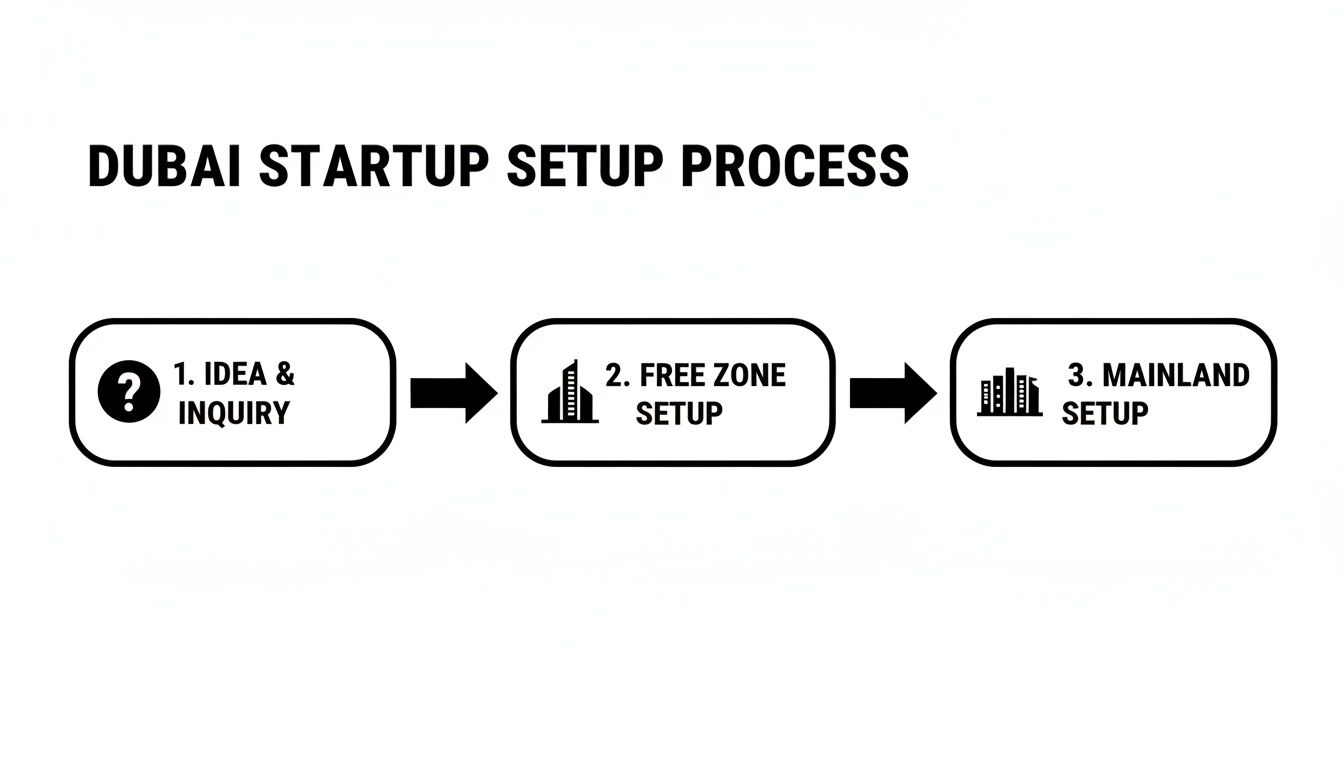
This flowchart maps out the initial decision that shapes your entire setup process.
Your Document Checklist for a Smooth Setup
Prepare these documents in a digital folder to save time:
Founder & Shareholder Documents:
- Scanned passport copy (with at least six months validity)
- High-resolution passport-style photo (with a white background)
- UAE entry stamp or current visa copy (if in the UAE)
- A recent utility bill from your home country as proof of address
Company & Application Documents:
- Three proposed trade names in order of preference
- A detailed list of your planned business activities
- A concise business plan summary
- Signed application forms from the relevant authority (free zone or DET)
- Attested educational certificates (sometimes required for professional licenses)
Next Action: Organize all your personal documents into one digital folder. Review the official list of business activities from your chosen jurisdiction and select the 3-5 that best fit your startup. This simple preparation can save days.
Managing Your Money: Banking, Taxes, and Fundraising
Once incorporated, your focus shifts to managing finances. This involves navigating the local banking system, understanding the new tax landscape, and tapping into Dubai's fundraising ecosystem.

Cracking the Corporate Bank Account Code
Opening a corporate bank account in the UAE can be a challenge for new founders. Banks conduct thorough due diligence to ensure you are a real, operational business.
Key Insight: A virtual office address is a major red flag for banks. Securing a physical office lease, even a small flexi-desk, significantly increases your credibility and the likelihood of a successful account opening.
Come prepared with a comprehensive application file:
- A Solid Business Plan: Include a one-page summary and a more detailed plan with first-year financial projections.
- Founder Profiles: Provide CVs for all shareholders to demonstrate your experience.
- Proof of Business: A website, early client contracts, or letters of intent show you are already operational.
Be prepared for a minimum initial deposit, which can range from AED 25,000 to AED 50,000 or more, depending on the bank.
Understanding UAE Corporate Tax
The introduction of a federal Corporate Tax was a major shift, but the UAE's tax system remains highly competitive for startups.
The headline rate is 9%, but it only applies to taxable profits above AED 375,000. If your annual profit is below this threshold, your effective tax rate is 0%. This structure allows early-stage companies to reinvest all profits back into growth.
This also means that proper financial management is now a legal requirement. Using an ultimate guide to accounting services for startups in Dubai and UAE from day one is a smart move.
Tapping into the Local Fundraising Ecosystem
Dubai's venture capital scene is maturing rapidly. A strong and growing community of local and regional VCs, angel networks, and family offices are actively investing in startups.
Local investors understand the regional market and can provide strategic connections that are often more valuable than capital alone. Key VCs to have on your radar include Shorooq Partners, BECO Capital, and Middle East Venture Partners (MEVP). The angel investor scene is also becoming more accessible through networks like Dubai Angel Investors.
Certain sectors are attracting significant attention. In 2025, 80% of VCs are actively looking for AI startups, backed by over $100 billion committed to AI investments. This is projected to add 35% to the non-oil GDP from AI by 2030, creating an ideal environment for growth.
Your Next Action: Research and create a target list of 5-10 local investors whose portfolios align with your business. Use LinkedIn to find a mutual connection for a warm introduction. A trusted referral is far more effective than a cold email.
Building Your Team and Finding Your Community
Your company is more than just a license; it's the people you build it with. For any founder of a startup in Dubai, assembling the right team and connecting with a support system are critical for success.
Nailing the Hiring Basics in the UAE
Hiring your first employees means you become their visa sponsor, a responsibility with clear legal duties.
Familiarize yourself with the UAE Labour Law, which governs everything from employment contracts to termination. You must also register with the Wage Protection System (WPS), a mandatory electronic salary transfer system that ensures your team is paid on time. Adhering to these regulations builds trust and protects your business.
Tapping into Dubai’s Global Talent Pool
Dubai’s greatest asset is its international talent. You can build a team with diverse experience from major tech hubs, all in one location. This diversity is a significant competitive advantage.
However, the competition for top talent is intense. A competitive salary is just the starting point. To stand out, you need to offer more:
- Meaningful Equity: Employee Stock Ownership Plans (ESOPs) are becoming standard for aligning incentives and attracting talent with an ownership mentality.
- A Pain-Free Relocation: A smooth visa and relocation process signals that you are a top-tier employer.
- Showcase Your Mission: The best people want to solve interesting problems. Your company's mission is your most powerful recruiting tool.
Dubai was ranked #3 globally in the 2025 Multipolitan Index for being startup-friendly, attracting young talent with its high quality of life. The ecosystem hosts over 3,500 active startups valued at $28 billion as of 2023, which raised over $2 billion in funding. You can explore the details of Dubai's startup-friendly environment to see the full picture.
Beyond Employees: Finding Your Founder Community
The founder journey can be isolating. Finding a community of fellow founders is essential for your survival.
Founder Insight: Avoid generic networking events. Your time is your most valuable asset. Seek out curated communities focused on genuine connection and problem-solving.
Find groups where you can have honest conversations about the real struggles of building a company.
High-Signal Communities and Events in Dubai:
- Founder Connects: Curated peer groups and one-to-one introductions for serious founders focused on accountability and progress.
- GITEX Global: The startup-focused tracks, like Expand North Star, are invaluable for meeting investors, partners, and other founders.
- Sector-Specific Meetups: Look for smaller gatherings on platforms like Meetup.com focused on your industry, such as FinTech, HealthTech, or AI.
Building your network in Dubai is about creating a trusted support system that provides resilience, strategic partnerships, and a shared sense of purpose.
Your Next Action: In the next 30 days, find one high-signal community or event. Go with the intention of having two or three meaningful conversations. Ask good questions, listen more than you talk, and follow up.
Your Most Pressing Questions Answered
Here are practical, no-fluff answers to the most common questions founders have about setting up a startup in Dubai.
What’s the Real All-In Cost to Get Started?
For a typical tech startup in a free zone, realistically budget between AED 25,000 and AED 50,000 for your first year's essential setup costs.
This figure should cover:
- Trade license and registration fees.
- Company establishment card.
- Processing for your first investor visa.
Important: This budget is for the legal setup only. It does not include operational cash. You must also factor in the minimum deposit for your corporate bank account (often AED 25,000+), office rent, and living expenses. Always request a fully itemized quote from any setup provider.
Can I Run My Dubai Company While Living Abroad?
Technically yes, but practically no. While you can own a free zone company without being a UAE resident, you will face a major obstacle: opening a corporate bank account. Banks in the UAE almost always require the founder or manager to be a UAE resident with a valid Emirates ID. Without a local bank account, you cannot run payroll through the official Wage Protection System (WPS) or manage local finances effectively. For any serious operation, obtaining a residence visa is a non-negotiable first step.
How Many Visas Can My New Company Get?
Your visa allocation is directly tied to your office space. A basic flexi-desk or virtual office package will typically grant you only one or two visa slots. To hire more people, you must lease more physical office space. The general rule is approximately one visa per 80-100 square feet.
Pro Tip: Align your office lease with your 12-month hiring plan. If you plan to hire five people, ensure your office is large enough to secure those five visa slots from the start. Mismatching this can create a significant bottleneck to your growth.
Do I Still Need a Local Partner for a Mainland Company?
For most businesses, no. The old rule requiring an Emirati partner to own 51% of your company has been abolished for the vast majority of commercial and industrial activities. Today, you can have 100% foreign ownership for over 1,000 business activities on the mainland. Only a few strategic sectors, like banking or oil and gas, still have local ownership requirements.
Some founders still choose to appoint a Local Service Agent (LSA). An LSA is not a partner; they hold zero equity and have no say in your business. For an annual fee, they act as your government liaison, managing administrative tasks like visa paperwork and license renewals, freeing you up to focus on your business.
At Founder Connects, we believe no founder should build alone. If you're ready to move from questions to action and want a trusted peer group to support your journey in the UAE, learn more about joining our private community at https://www.founderconnects.com.

Building in MENA? You don't have to do it alone.
Join 300+ founders in the Founder Connects Residency. Monthly squad calls, warm intros, $3M+ in perks, and much more. All for less than your monthly coffee budget.
Popular posts





Founder Connects is a premium MENA tech founder community. Meetups in Dubai and across MENA, Residency Squads of 8–10, and 400+ vetted WhatsApp founders (apply and screened).