
The Middle East startup scene isn't just "emerging"—it's a global force. We're witnessing a massive, deliberate shift away from oil and into knowledge-based economies. Countries like the UAE and Saudi Arabia are pouring billions into tech and innovation, creating a gold rush moment for founders ready to build something big. This guide gives you the practical, on-the-ground answers you need to build, fund, and scale your venture here.
Forget the old narrative. The story for startups in the Middle East has completely changed. What was once a tech afterthought is now a magnet for ambitious founders, fueled by powerful economic and demographic tailwinds. This isn't just hype; it's a calculated, top-down transformation creating very real opportunities.
Three key drivers are lighting this fire, making right now the perfect time to build.
Governments across the Gulf Cooperation Council (GCC) are serious about diversifying their economies. National strategies like Saudi Arabia's Vision 2030 and the UAE's Centennial 2071 plan aren't just policy documents—they're multi-trillion-dollar roadmaps funneling public and private money into non-oil sectors. For you, this means direct, actionable advantages.
This strategic shift gives you:
The MENA region has one of the youngest and most connected populations on the planet. Smartphone use is through the roof, and social media is a way of life. Consumers here don't just accept new tech—they expect it. This creates a massive, hungry market for digital solutions built with them in mind.
This isn't about slapping an Arabic interface on a Western product. It's about building from scratch for a consumer with unique needs, languages, and cultural habits. The founders who really get this are the ones who will win big.
This demographic wave means you have a ready-made audience for anything innovative in fintech, e-commerce, edtech, and healthtech. They are mobile-first, socially savvy, and happy to try new services that solve a real problem. Your job is to find that specific pain point and start testing a solution.
Deciding where to base your startup in the Middle East is one of the most critical early calls you'll make. This isn't just about a mailing address; it's about embedding yourself in an ecosystem that clicks with your business model, target market, and fundraising strategy.
Think of it like choosing the right soil. Some startups thrive in the established environment of a mature market, while others flourish in the rapidly expanding soil of an emerging one. Let's break down the top contenders to help you plant your flag in the right spot.
The diagram below shows how the big picture—the economy, government, and consumers—all work together to fuel startup growth across the Middle East.
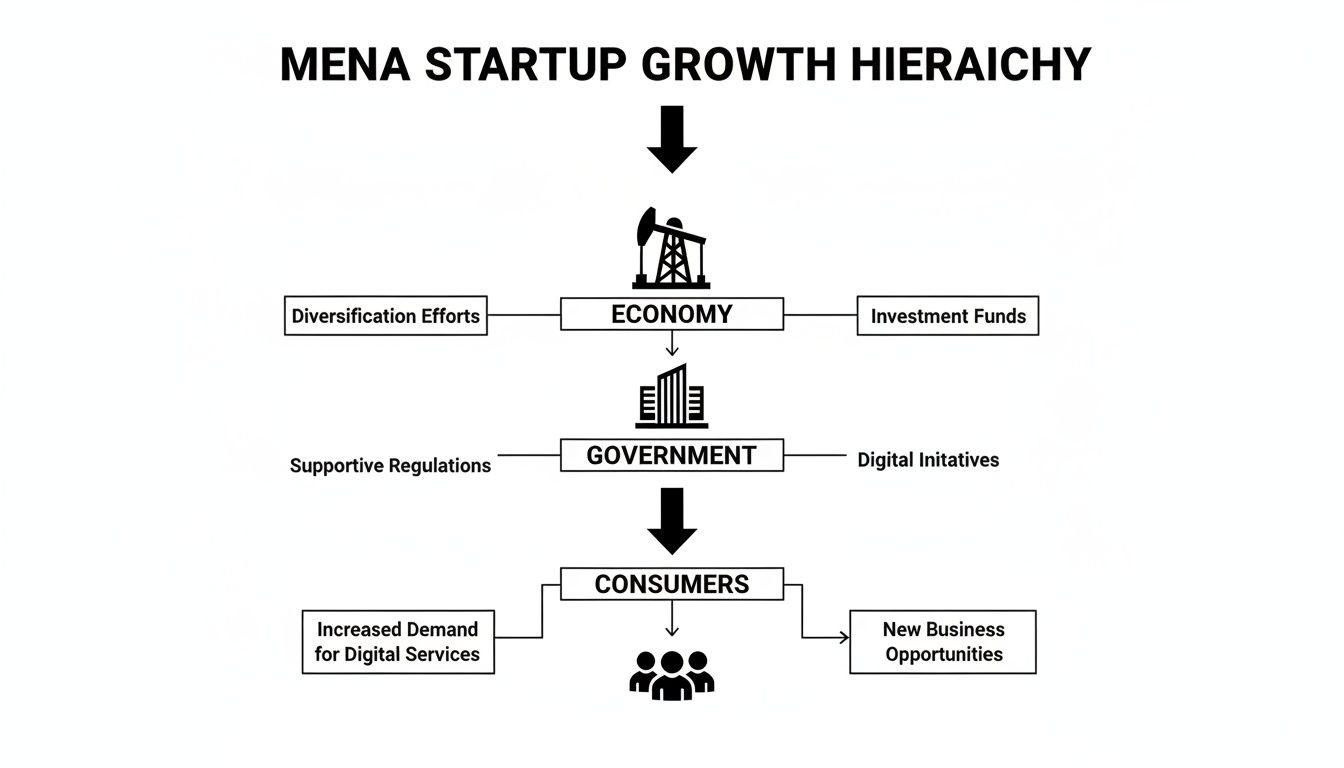
It’s a top-down effect: national economic goals drive government action, which in turn creates massive opportunities to serve a young, hungry, and digitally-savvy population.
To help you quickly size up the landscape, here's a founder-focused comparison of the major hubs.
This table gives you a quick snapshot of where each hub shines, helping you match your startup's needs with the right ecosystem.
While this table offers a high-level view, the right choice depends entirely on your specific goals, whether that’s tapping into a massive local market or building a global empire from day one.
The United Arab Emirates, especially Dubai and Abu Dhabi, is the region's long-standing gateway to the world. It’s the most mature ecosystem, boasting stability, world-class infrastructure, and deep ties to international markets. If your ambition is to build a global company from day one, the UAE is your strongest bet.
Dubai is the undisputed commercial center, a magnet for global talent and capital. Abu Dhabi, meanwhile, is carving out a niche in deep tech and AI, powered by serious government investment. The combined valuation of Dubai's active startups has already shot past $28 billion. And with programs like the Golden Visa offering long-term residency, the country is all-in on attracting and keeping top-tier founders.
Next Action: Get familiar with the different UAE free zones and accelerator programs. Our guide comparing Hub71, DIFC, and Area 2071 breaks down which is best for a pre-seed venture like yours.
Saudi Arabia offers a completely different prize: exclusive access to an enormous, rapidly digitizing domestic market. Driven by its Vision 2030 agenda, the Kingdom is in the middle of a massive economic overhaul. For any startup targeting Saudi consumers or businesses, being on the ground is a game-changing advantage.
Riyadh is the heart of this boom. The city is climbing the global ecosystem rankings at an incredible pace, posting 134.1% growth recently. The government is rolling out the red carpet for startups with funding, simpler regulations, and huge national projects.
If you're eyeing KSA, here's what you need to know:
Egypt’s proposition is built on two killer strengths: a massive consumer base of over 100 million people and a deep, affordable pool of tech talent. This combo makes it a powerhouse for building your operations, establishing an engineering hub, and launching products for a huge Arabic-speaking market.
The red tape can be trickier to navigate, but the payoff is huge for founders who figure it out. Cairo is the main hub, famous for its resilient and vibrant startup scene. It's a common strategy for founders to build their product and tech teams in Egypt before expanding into the GCC to raise bigger rounds and scale commercially. Your capital simply goes much further here, making it the perfect place to build an MVP and find that crucial initial product-market fit.
Capital in the Middle East isn't just cash in the bank—it’s strategic partnership that can unlock new markets and fast-track your growth. The good news is there's a lot of capital flowing through the region. The trick is knowing who’s writing the checks and what they're looking for.
The investment scene is a dynamic mix of local heavyweights, family offices, and international players. You'll find everyone from sovereign wealth funds to a rapidly growing network of angel investors. It's a rich ecosystem, but one that requires a clear strategy to navigate.

Investors are placing their biggest bets on industries that solve urgent regional challenges or align with national economic goals, like Saudi's Vision 2030 or the UAE's diversification plans.
These are the hot spots getting the most attention:
The explosion in AI funding is something every founder in the region should be watching. In just the first half of one year, AI startups in MENA pulled in over $2.1 billion—a jaw-dropping 134% jump from the year before. This isn't just a trend; it's positioning the Middle East as a serious global AI contender.
Abu Dhabi, in particular, is becoming the region's AI hub, now home to hundreds of AI companies. For founders, this translates to real access to capital, a growing pool of specialized talent, and supportive ecosystems like Hub71 that are built to help AI-first startups win.
But this is just the beginning. Research from key partners like STV points to a massive gap—and a massive opportunity. Right now, AI startups in MENA only get about 1.5% of all venture capital, while in the U.S., that number is 38%. That gap signals enormous untapped potential for founders who are building the next generation of AI-native companies.
Key Takeaway: Investors in the region are getting more sophisticated. They're looking past simple consumer apps and focusing on deep tech and defensible business models. The smart money is flowing into B2B SaaS, enterprise AI, and platforms with clear, scalable paths to revenue.
Not all money is the same. Where your funding comes from will shape your support, network access, and expectations. You need a different game plan for each type of investor.
As you get ready to start conversations, it’s crucial to understand the fundraising process from the investor's side. This founder's guide to venture capital due diligence clearly lays out what VCs are looking for before they write a check.
In the startup world, identifying the right market gap is everything. For founders in the Middle East, this means zeroing in on sectors where regional demand, government backing, and investor interest create a perfect storm of opportunity.
It’s not just about what’s hot globally, but what solves an urgent, local problem right now. The smartest founders are strategically targeting verticals where the need is greatest and the tailwinds are strongest. Let's break down where the real action is.

Here's a quick look at where the smart money is flowing and where you should be looking to build.
This table gives a high-level view of the sectors buzzing with activity, driven by unique regional dynamics.
These sectors represent more than just trends; they're foundational shifts in how the region's economies will operate for decades to come.
FinTech continues to dominate the regional scene because a massive, young, and digitally savvy population is leapfrogging traditional banking. This is blowing the doors wide open for disruption.
The massive success of companies like Tabby (buy-now-pay-later) and Rain (crypto exchange) proves the enormous appetite for financial innovation. For founders exploring this space, understanding who is writing the checks is key. Digging into lists of top Fintech investors in Israel can offer valuable intel on regional investor appetites and dynamics.
Both healthcare and education are going through huge digital transformations, but with a distinctly local flavor. Generic, one-size-fits-all platforms aren't cutting it here. The real opportunity lies in building solutions purpose-built for regional needs.
In HealthTech, the focus is on:
In EdTech, the demand is for:
Next Action: Ask yourself, "What is a major pain point in healthcare or education that I or my family have personally experienced in the UAE or KSA?" The best HealthTech and EdTech ideas often come from solving a problem you deeply understand.
While FinTech, HealthTech, and EdTech are established pillars, a new wave of sectors is picking up serious momentum.
Artificial Intelligence (AI) is the big one. As we touched on in the funding section, AI is quickly becoming the foundational layer for innovation across every industry. Abu Dhabi, in particular, is making a huge play to become a global AI hub. Startups building AI-native solutions—not just tacking on an AI feature—will have a serious advantage when fundraising.
Software as a Service (SaaS) is another high-growth area. Businesses across the region are digitizing their operations at an incredible clip. This has created a massive market for B2B SaaS solutions that automate workflows, manage data, and improve efficiency, especially if they’re tailored to local business practices and regulations.
Finally, Climate Tech is rapidly moving from a niche interest to a national priority. With the UAE having hosted COP28 and countries like Saudi Arabia launching massive sustainability initiatives, the demand for innovation in renewable energy, water conservation, and sustainable agriculture is set to explode. This is a sector where startups can align with multi-billion-dollar national visions.
Building a startup is hard. Building one in the Middle East has its own unique set of challenges. Knowing what’s coming is half the battle won. Your success will likely come down to how well you handle three things: the maze of regulations, the fight for great talent, and a customer base that is anything but monolithic. Let's get into what these challenges look like on the ground.
Finding and keeping top-tier developers, product managers, or growth marketers is a constant struggle. You’re competing against other startups, global tech giants, and deep-pocketed government projects, all fishing from the same pond.
A competitive salary is just the entry ticket. To stand out, you need to build an employer brand people want to join.
Next Action: Take a hard look at your current job descriptions. Do they read like a laundry list of skills, or do they sell a mission? Rewrite them to attract people with a founder's mindset, not just employees looking for a paycheck.
The Middle East is not one market. Each country—and sometimes each free zone within a single city—has its own set of laws for business setup, licensing, and compliance. What works in Dubai’s DIFC might be irrelevant in Abu Dhabi’s ADGM, and completely different again in Riyadh.
This fragmentation can lead to expensive delays and legal headaches. The single most important rule? Don’t go it alone.
This is the most underestimated challenge: assuming a one-size-fits-all product or marketing strategy will work. A consumer in Jeddah has completely different buying habits and cultural touchstones than someone in Cairo or Dubai. Lumping them into a generic "MENA" bucket is a classic—and costly—mistake.
Deep, authentic localization is everything.
Making it in the Middle East means being as good at navigating culture and bureaucracy as you are at building an amazing product.
Figuring out the Middle East startup scene is one thing. Building a company that lasts is rarely a solo mission. The smartest founders are deliberate about creating their own "personal board of directors"—a handpicked circle of peers, mentors, and advisors who hold them accountable and offer real-world advice.
Building a company can be incredibly isolating. The constant weight of making payroll, shipping products, and chasing funding is a perfect recipe for burnout. A solid founder community gives you a safe space to solve tough problems with people who actually get it. It’s where you can have frank conversations, test a half-baked idea, and get straight feedback from people who want to see you win.
We’ve all been to networking events filled with transactional conversations that lead nowhere. A curated peer group delivers something far more valuable: consistent, high-impact engagement.
These small, dedicated circles offer tangible advantages:
A strong founder network is your unfair advantage. It collapses the time it takes to learn critical lessons, avoid common mistakes, and make the connections that will actually move your business forward.
Don't leave building this support system to chance. It needs to be a priority. You need a clear strategy to find the right people—those who will challenge your assumptions and champion your vision. Start by looking for environments built for real talk, not surface-level schmoozing.
The ROI on structured guidance and peer support is massive. Pouring time into these relationships is one of the highest-leverage activities you can do.
Your Next Action:
Think about the biggest challenge you’re wrestling with right now. Find three other founders—ideally at a similar stage but in a different industry—and set up a quick, informal call to hash it out. Just the act of saying the problem out loud and hearing fresh takes will show you the power of a support system. For founders serious about building something that lasts in the Middle East, this is how you build resilience and make better decisions, faster.
Here are some of the most common questions we get from founders, with straightforward answers to help you move forward.
Hands down, the biggest mistake is treating the region like one big country. A go-to-market strategy that crushed it in Dubai will almost certainly need a major rethink to work in Riyadh or Cairo. Founders often underestimate just how different the cultural nuances, consumer habits, and business etiquette are from one city to the next.
Another classic error is trying to build from a distance. Success here is built on trust and relationships, which requires a real presence on the ground. You have to commit to understanding the local context, not just copy-pasting a playbook that worked somewhere else.
This part is actually much faster than people assume. In the UAE, you can get a business set up in a free zone like ADGM or DIFC surprisingly quickly—often in just a few weeks. These zones are designed to be efficient and founder-friendly.
Saudi Arabia has also made incredible progress, launching initiatives that have dramatically simplified company registration. What used to take months can now be done far more efficiently.
The key takeaway: while governments have made it faster, navigating the paperwork still requires precision. Engaging a professional setup agent or local law firm is not a luxury; it's a critical investment to avoid costly mistakes that can stall your launch.
Legally, the old requirement for a local partner or sponsor has been largely removed. In both the UAE and Saudi Arabia, 100% foreign ownership is now possible for most business activities, which has been a game-changer for international founders.
But don't confuse legal necessity with strategic advantage. The value of a great local partner or a well-connected local advisor is still immense. It's not about compliance anymore; it's about acceleration. An influential local ally can open doors to networks you could never access on your own, give you the real story on navigating bureaucracy, and help you understand cultural subtleties that no market research report will ever teach you. The right local connection is the ultimate unfair advantage.
Ready to stop building in isolation and start making real progress? Founder Connects is a private community designed for MENA founders who want curated peer groups, meaningful connections, and practical support to build stronger businesses, faster. Learn more and apply to join at https://www.founderconnects.com.


