
A Founder's Practical Guide to Launching Your Startup in the UAE

Building in MENA? You don't have to do it alone.
Join 300+ founders in the Founder Connects Residency. Monthly squad calls, warm intros, $3M+ in perks, and much more. All for less than your monthly coffee budget.

If you're a founder deciding where to launch, the UAE offers a powerful mix of global market access, serious government backing, and deep pools of capital. It’s an ecosystem purpose-built for startups that want to scale fast. This guide gives you the practical answers you need to make the right moves.
Why the UAE Is a Strategic Launchpad
Setting up a business here isn't just about an office in the Middle East. It’s a strategic decision to partner with a country laser-focused on helping you succeed globally.
Think of the UAE government as an enabler, not a gatekeeper. They've rolled out founder-friendly policies like the Golden Visa, simplified regulations, and invested heavily in tech. This isn't a happy accident; it's a deliberate national strategy to build a world-class hub for ambitious companies.
Engineered for Founder Ambition
The UAE's appeal for startups rests on a few core pillars. For founders, this means real-world advantages you can act on.
- Actionable Insight: The UAE is a launchpad to the MENA region and beyond. Its world-class logistics and digital infrastructure make expansion more straightforward.
- Concrete Example: The Golden Visa programme is a clear signal of government support, designed to attract and retain top talent like you and your team.
- Simple Framework: The government has simplified regulations to cut through red tape, creating a stable environment for you to build and grow.
- Local Context: The region is home to significant capital from sovereign wealth funds, VCs, and family offices, all actively looking to back ambitious startups.
The UAE's startup scene is a global contender, climbing to 21st worldwide in the Global Startup Ecosystem Index 2026. The numbers are clear: Dubai captured 96% of all UAE tech funding in early 2026, and its local ecosystem has grown by over 33%, now valued at more than $23 billion. You can discover more insights about how the UAE's startup boom is attracting global investors.
Before we dive deeper, here’s a quick snapshot of why the UAE has become such a compelling destination for founders.
UAE Startup Ecosystem at a Glance 2026
MetricKey Figure/AdvantageGlobal Ranking21st in the Global Startup Ecosystem Index 2026Ecosystem ValueOver $23 billion in Dubai alone, with 33% growthFunding DominanceDubai secured 96% of all UAE tech funding in early 2026Government SupportPro-business policies, Golden Visas, and simplified regulationsMarket AccessStrategic gateway to MENA, Europe, and AsiaCapital AvailabilityDeep pools of capital from VCs, sovereign wealth funds, and angel investorsTalent & InfrastructureAccess to a global talent pool and world-class digital and physical infrastructure
These figures paint a clear picture: the UAE is a mature, well-funded, and strategically vital hub for any startup with global ambitions.
Next Action: Ask your team this question: "Does our business model require access to international markets to succeed?" If yes, the UAE's global connectivity should be a core part of your strategy.
Choosing Your Legal Structure and Home Base
You’ve decided the UAE is the place to build. Now for the first big, practical decision: where and how do you legally set up? This choice defines how you operate, who you can sell to, and how you attract investment.
For nearly every founder in the UAE, this comes down to two paths: setting up on the Mainland or in a Free Zone. Your business model and long-term vision will point you to the right answer. Don't just pick the cheapest option—choose the structure that helps you grow.
Mainland vs. Free Zone: The Core Decision Framework
- Mainland Company: Registered with the Department of Economic Development (DED), this structure allows you to operate anywhere in the local UAE market without restriction. You can work directly with government bodies and sell to any customer in the country. Thanks to recent reforms, most businesses now qualify for 100% foreign ownership.
- Free Zone Company: Registered within a specific business park, these are self-contained ecosystems often built for industries like tech or media. There are over 40 Free Zones, all offering 100% foreign ownership, zero corporate and personal taxes, and full profit repatriation. The main trade-off? To sell directly into the Mainland market, you usually need a local distributor.
This flowchart gives you a simple way to think through the decision based on your main goal.
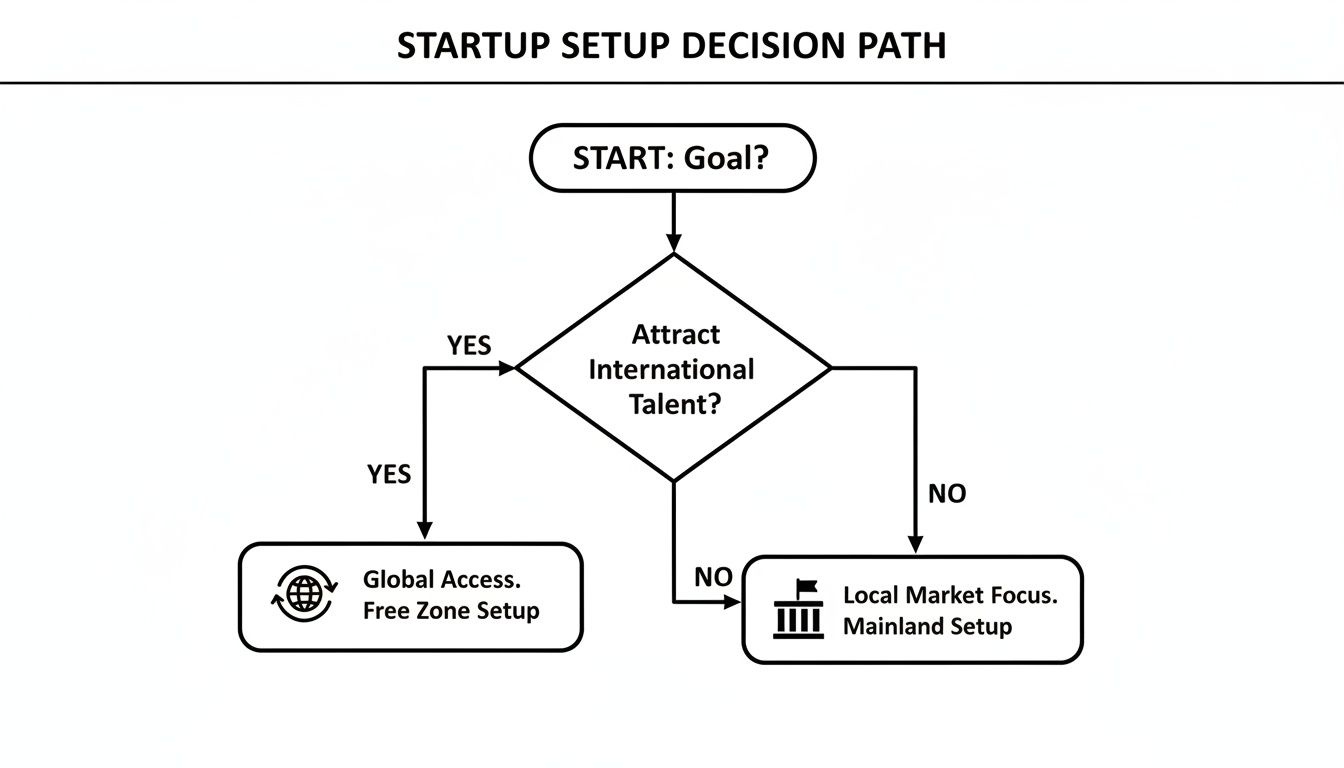
Simple framework: If your business depends on direct trade within the UAE (e.g., a local retail app) or government contracts, a Mainland setup is your path. If your focus is on international clients or serving customers outside the UAE (e.g., a SaaS platform), a Free Zone is often the smarter choice.
High-Impact Free Zones for Tech Startups
The best Free Zones offer more than a trade licence—they plug you into an ecosystem with mentors, investors, and other founders.
- DIFC Innovation Hub (Dubai): The epicentre for FinTech. It runs on an independent, common-law judicial system, which global VCs love. Its accelerator programmes are a huge draw.
- Abu Dhabi Global Market (ADGM): A major financial free zone with an English common law framework, focused on FinTech, sustainable finance, and digital assets. Its "RegLab" is a fantastic place to test new financial products.
- Dubai Multi Commodities Centre (DMCC): A solid all-rounder. Its dedicated DMCC Crypto Centre has made it the go-to hub for Web3 and blockchain startups.
- in5 (Dubai): An incubator platform with dedicated hubs for tech, design, and media. A cost-effective option for early-stage companies needing mentorship and training.
Choose a Free Zone based on its industry focus, not just location. Pick the one whose community, rules, and network will give your business the biggest advantage. For a deeper analysis, check our guide on the best UAE free zones for early-stage startups.
To stay lean, consider a guide to flexible office space rental instead of locking into a long, expensive lease.
Next Action: Open a spreadsheet. Compare your top two choices (e.g., Mainland vs. DIFC). List your priorities—like local market access, setup cost, and investor appeal. Score each option. This will force clarity and help you make a confident decision.
Securing Capital in the UAE Funding Arena

Let's talk about money. In the UAE, securing capital isn't about whether the money exists—it’s about finding the right money. The region is full of capital, but investors have distinct expectations. Success demands a targeted strategy.
The numbers are compelling. MENA startups, led by the UAE and Saudi Arabia, pulled in a record USD 1.2 billion in just Q3 2025. Abu Dhabi’s Hub71 ecosystem alone attracted $2.17 billion (AED 8.02 billion) by 2026. This translates to real funding rounds: seed rounds average $1.8 million, and Series A deals close at $9 million. Hot sectors like FinTech (a projected USD 52.07 billion market by 2026) and AI (21% of new digital startups) are in a strong position.
Pinpointing the Right Investors
The right investor is an accelerator; the wrong one is a drag. Understand the key players and what they want.
Comparison of Funding Sources for UAE Startups
Funding SourceTypical Investment SizeBest ForKey AdvantageVenture Capital (VC) FirmsLate-Seed/Series A+ ($500K - $10M+)Startups with proven traction and a clear path to scale.Institutional capital and structured support for rapid growth.Angel Investors & NetworksPre-Seed/Seed ($25K - $500K)Early-stage ideas and MVP-stage companies.Early-believer capital, mentorship, and industry connections.Family OfficesVaries widely (Seed to Growth)Startups needing patient, long-term strategic capital.Deep regional networks and a focus on legacy building.Corporate VCs & Govt. FundsVaries (often Series A+)Startups that align with a corporate or national strategic goal.Strategic partnerships, distribution channels, and government support.
VCs like BECO Capital, Middle East Venture Partners (MEVP), and Shorooq Partners offer institutional firepower. Angel networks like WOMENA and Dubai Angel Investors provide crucial early-stage belief. And Family Offices or strategic players like Mubadala Ventures often seek a strategic fit beyond just a financial return.
Actionable Insight: The most effective way to reach these investors is through a warm introduction. Cold emails rarely work. Start building genuine relationships now to find someone who can vouch for you.
Crafting a Pitch That Resonates
UAE investors are pragmatic and ROI-focused. A big vision is great, but a credible plan for execution and a deep understanding of the regional market is what truly impresses.
Before you build your deck, get your numbers straight. The integrity of your financial data is non-negotiable. Understanding Financial Reporting Best Practices Your Investors Will Actually Trust will build instant credibility.
A compelling pitch deck is table stakes. If you need help, our guide on fundraising for startups breaks down the entire process.
Next Action: Use a spreadsheet to create a "dream list" of 10 ideal investors. Research their portfolio and investment thesis. Use LinkedIn to map out potential first and second-degree connections who can make an introduction. This turns fundraising into a concrete networking plan.
Finding Your Tribe in High-Signal Communities

In the UAE, your network is your most valuable asset. But most networking events are a waste of time. The secret isn't meeting more people; it's finding the right people in high-signal environments where real work gets done.
Successful founders tap directly into curated communities and ecosystem hubs. These are the places that connect you with peers who get it, mentors who’ve solved your problems, and partners who can help you grow.
Key Ecosystem Hubs to Know
The UAE has several fantastic hubs that act as launchpads, offering structured programmes, direct lines to capital, and even help with visas.
- Hub71 (Abu Dhabi): A global tech hub with incredible access to government and corporate partners. If you're chasing strategic partnerships, Hub71 is your place. They also offer incentives like subsidised housing.
- DIFC Innovation Hub (Dubai): The centre of the universe for FinTech in the region. It operates under an English common-law framework, a massive draw for international VCs.
- in5 (Dubai): A brilliant platform with centres for tech, design, and media. Known for its hands-on incubation programmes, it's perfect for early-stage founders needing direct support.
These hubs are curated gateways into the core of the UAE's innovation economy.
Why Community Is Your Strategic Advantage
The right community provides a support system you can't get anywhere else. It’s where founders share honest advice and make warm introductions. This is especially true in the UAE, where business is built on relationships. It's no surprise Dubai was named the third most startup-friendly city in the world. With over 52,000 startups in the country, you need to find your niche. You can get the full breakdown of Dubai’s startup ecosystem to dig deeper.
Actionable Insight: The true value of a community is its signal-to-noise ratio. A small, curated group of peers is more valuable than a huge, unfocused network. Prioritise depth over breadth.
For more ideas on where to find these groups, our guide on the best business clubs in Dubai can be useful.
Next Action: Pick one hub that fits your startup. Find a founder from one of their portfolio companies on LinkedIn and ask for a 15-minute chat. Ask them two questions: "What’s been the single most valuable part of this community?" and "What do you wish you knew before joining?"
Learning from the UAE's Unicorn Playbook
Success leaves clues. By reverse-engineering the journeys of the UAE’s unicorns, you can find a practical playbook for building your own company. This is about decoding the strategies that work in this market.
The UAE has a growing list of unicorns like Tabby (fintech), G42 (AI), Kitopi (food tech), and Careem (mobility). This isn't a fluke; it's the result of companies learning to combine global capital and a strategic home base to own their sectors. You can find more insights on the UAE's largest private companies and their impact.
Their script was simple: find a massive regional problem, build a solution tuned to local nuances, and use the UAE as a launchpad for expansion.
Solving for Local Nuance First
The most successful startups here don't copy-paste a business model from the West. They win by obsessing over local details. This is their moat.
- Concrete Example: Careem: Before its acquisition, Careem let users book rides for later, pay with cash, and call their driver directly—features that were non-negotiable for local customers but missing from Uber's initial app. That deep understanding built fierce loyalty.
- Concrete Example: Tabby: The region’s top Buy Now, Pay Later (BNPL) platform adapted the model for a market with lower credit card use and a culture familiar with installment payments. They solved a distinctly regional credit problem.
Actionable Insight: Your biggest opportunity might be a proven model re-engineered for the specific cultural and logistical realities of the MENA region. What "obvious" friction point are global players ignoring?
Using the UAE as a Scaling Engine
Once these startups nailed their model in the UAE, they used it as a stable base to expand across the MENA region. This is the unicorn playbook: prove it here, then scale it everywhere.
- Access to Capital: Unicorns like Kitopi, the cloud kitchen giant, raised huge funding rounds from UAE-based investors, giving them the war chest to expand into Saudi Arabia and Kuwait.
- Talent Hub: The UAE’s ability to attract global talent lets these companies build world-class teams for cross-border operations.
- Regulatory Stability: A supportive regulatory environment gives investors confidence to back ambitious growth plans.
By building a strong operational machine in the UAE first, these companies created a repeatable model they could deploy across different countries.
Next Action: Whiteboard your expansion plan. After the UAE, what are your next two target markets? For each, list the top three local nuances you'd need to adapt for (e.g., payment methods, delivery logistics). This brings clarity to your path from local champion to regional leader.
Your First 90 Days: A Founder's Action Plan
Information is useless without action. This is a 90-day plan to build momentum. Find your stage and zero in on these priorities. It's time to stop reading and start doing.
Stage 1: For the Idea-Stage Founder
Your mission is simple: validate your idea fast and cheap. Prove there's a real problem before you sink time and money into building.
- Pressure-Test Your Idea: Talk to 20 potential customers. Don't pitch. Ask open-ended questions about their biggest frustrations related to the problem you think you solve.
- Map the Competition: Find 5 direct or indirect competitors in the MENA region. Dig into what their customers are complaining about online. That’s your opening.
- Build Your "Kitchen Cabinet": Get a 15-minute gut check from 3 experienced founders in the UAE. A warm intro from a community like Founder Connects is your best bet.
Stage 2: For the Pre-Seed Founder with Early Traction
You have a basic product and a few users. Your next 90 days are about finding product-market fit and a repeatable way to get customers. The goal is momentum.
- Find Your North Star Metric: Pick the one key metric that signals value—weekly active users, transactions, or retention rate. Track it like a hawk.
- Run 3 Growth Experiments: Test three different ways to get users (e.g., targeted ads, content marketing, direct outreach). Measure the cost and conversion for each to see what sticks.
- Sharpen Your Investor Story: Draft a one-page executive summary. Pitch it to other founders for unfiltered feedback before you talk to an investor.
Stage 3: For the Seed-Stage and Scaling Founder
You have product-market fit and funding. Now it's time to build a growth machine. Stop doing things that don't scale and start building systems that do.
- Lock in 3 Strategic Partners: Find companies that serve your customers but aren't competitors. A warm intro could open up a massive distribution channel.
- Make 2 Key Hires: Identify the single biggest bottleneck holding you back. Hire the person who can solve it.
- Master Investor Relations: Send a monthly update to your current and potential investors. Be transparent about wins, struggles, and learnings. This builds trust and keeps you top-of-mind.
Common Questions About UAE Startups
Here are the straight-up answers to the most common questions founders ask about launching in the UAE.
What’s the Real Cost to Launch a Startup in the UAE?
There’s no magic number, but you can budget for it. A lean Free Zone setup typically costs AED 25,000 to AED 50,000. This covers your trade licence, initial visa costs, and basic admin fees.
A Mainland setup is more expensive, ranging from AED 50,000 to AED 85,000+, especially if you need a physical office.
Don’t forget operational costs for the first six months (salaries, marketing, etc.). A solid financial plan from day one is crucial.
How Simple Is It to Get Visas for My Team?
The UAE has made attracting talent a priority. The Golden Visa offers a 10-year residency for founders without needing a local sponsor, a powerful signal of stability.
For your team, most Free Zones have a streamlined system for employee visas and handle most of the paperwork. You’ll need to meet sponsorship and salary requirements, but the process is efficient for legitimate businesses.
Actionable Insight: The most time-consuming part of the visa process is gathering attested documents from your home country. Start this early.
What Are the Biggest Mistakes to Avoid?
Learning from others' missteps is a huge advantage. Here are the most common traps for founders in the UAE:
- Misjudging Local Behaviour: Don’t just copy-paste a Western business model. Success here demands a deep understanding of local consumer habits and cultural nuances.
- Choosing the Wrong Legal Structure: Picking a Free Zone when you need Mainland access (or vice-versa) creates massive headaches. Let your long-term strategy drive this decision, not just cost.
- Hiring Too Fast or Too Senior: In the early days, you need an agile team. Avoid expensive senior hires until you have a clear, scalable role for them.
Which Industries Are Attracting the Most Investor Money?
Capital follows the biggest problems. Right now, UAE investors are focused on sectors with huge regional potential. FinTech remains dominant, with startups plugging gaps in digital payments.
Beyond that, AI, HealthTech, and Sustainability are magnets for capital. AI startups, like those in the Google for Startups AI for GovTech program, are tackling public service efficiency. HealthTech is booming, and Sustainability/Climate Tech has exploded, driven by national initiatives like COP28, opening massive opportunities in greentech and urban management.
At Founder Connects, we believe no founder should build alone. Our private community is designed for meaningful connections and practical support, helping you navigate the UAE startup ecosystem with a trusted peer group by your side. Join us to make smarter decisions and grow faster. Learn more and apply to join.

Building in MENA? You don't have to do it alone.
Join 300+ founders in the Founder Connects Residency. Monthly squad calls, warm intros, $3M+ in perks, and much more. All for less than your monthly coffee budget.
Popular posts





Founder Connects is a premium MENA tech founder community. Meetups in Dubai and across MENA, Residency Squads of 8–10, and 400+ vetted WhatsApp founders (apply and screened).