

UAE Startup Success Stories: Tech-Driven Growth

Building in MENA? You don't have to do it alone.
Join 300+ founders in the Founder Connects Residency. Monthly squad calls, warm intros, $3M+ in perks, and much more. All for less than your monthly coffee budget.

The UAE has become a global hotspot for tech startups, driven by a mix of government initiatives, regulatory support, and cutting-edge digital infrastructure. With internet penetration exceeding 99% and the e-commerce market projected to reach AED 48.8 billion by 2028, the region offers fertile ground for innovation. Key highlights include:
- Hub71 and DIFC Innovation Hub: These platforms have supported hundreds of startups, facilitating billions in funding and revenue.
- Global Expansion: Startups like Astra Tech and Nadeera are scaling internationally, showcasing the UAE’s global market focus.
- AI and Fintech Integration: Companies like Astra Tech are merging advanced technology with practical solutions, such as voice-based money transfers.
- AgriTech and Food Security: Pure Harvest Smart Farms is tackling the UAE’s agricultural challenges with climate-controlled farming systems.
- Cloud Kitchens: Kitopi has redefined food delivery logistics, enabling rapid expansion across the GCC.
These success stories underscore how startups in the UAE are leveraging technology and ecosystem support to solve regional challenges and scale globally.
Case Study 1: Astra Tech - Building the Region's First Ultra App
Early Vision and Initial Obstacles
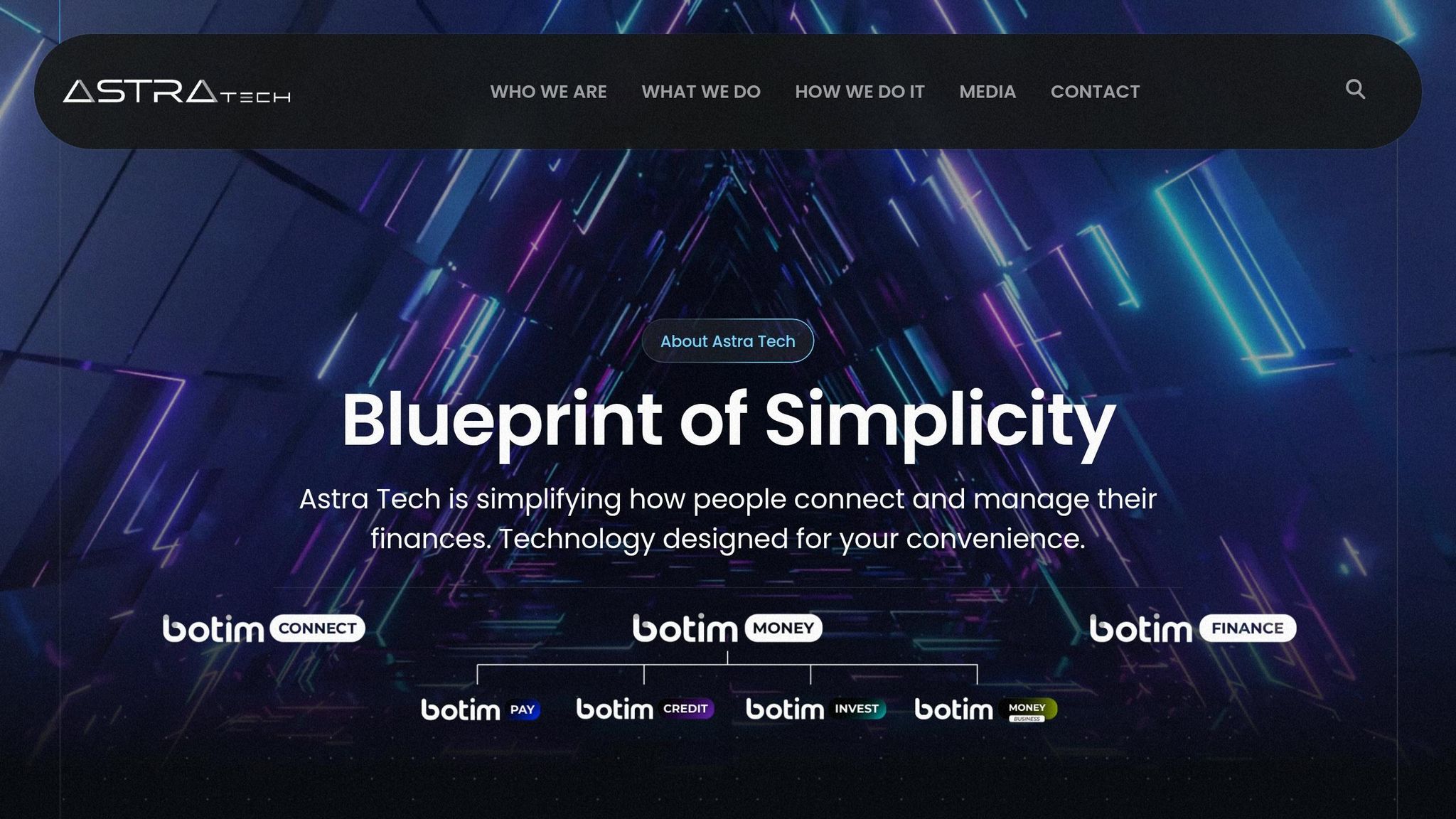
Abdallah Abu-Sheikh, the founder of Astra Tech, noticed a major challenge in the Middle East: people were overwhelmed by the sheer number of apps needed for everyday tasks like making calls, shopping, paying bills, and sending money. This "App Fatigue" was particularly frustrating in a region where internet penetration exceeds 99%, yet no single app offered a unified solution, such as China's WeChat or Southeast Asia's GoJek [1].
To tackle this, Astra Tech built its Ultra App by acquiring key platforms - Rizek, PayBy, BOTIM, and Y Finance - between July 2022 and July 2023. The biggest hurdle? Integrating these platforms, each with its own unique security protocols and user interfaces, into a seamless experience while retaining BOTIM's well-regarded voice service.
"Our goal is not to reinvent the wheel or build things from scratch but leverage the existing familiar platforms to create an Ultra Platform – an ecosystem for digital communication and commerce that will revolutionise the way people live their everyday lives."
- Abdallah Abu Sheikh, Founder, Astra Tech [4]
The company also had to meet the UAE Central Bank's strict cybersecurity standards, which further validated their approach. This integration effort became the foundation for introducing advanced AI and fintech capabilities.
AI and Fintech Integration
Astra Tech's transformation gained momentum when it introduced voice-first AI and fintech tools directly into its chat interface. In October 2025, they implemented Azure AI's Voice Live API, enabling users to complete money transfers through simple conversations instead of navigating confusing menus. This feature proved especially useful for individuals with limited digital skills or language barriers [3].
Currently, the BOTIM AI assistant serves 3.6 million users, including 300,000 monthly active users and 100,000 daily active users. Wallet transactions have surged by 375% year-over-year, and international remittances are expected to surpass AED 10 billion by 2025 [3]. Astra Tech's fintech arm, Quantix, achieved a major milestone in July 2024 by becoming the first fintech platform since 2008 to secure a full Finance Company License from the Central Bank, enabling it to offer micro-loans and Buy Now, Pay Later services [5].
In May 2023, Astra Tech partnered with Etihad Airways, allowing users to book flights by simply typing or speaking their travel details into the chat. This process is powered by an Arabic ChatGPT integration, developed in collaboration with MBZUAI, which handles the entire booking process [4]. This conversational commerce approach has turned everyday chat users into active financial consumers. To support the heavy transaction load, the platform maintains an impressive uptime of 99.99% [3].
"Voice simplifies interactions, making it ideal for users with low digital literacy or language barriers."
- Frenando Ansari, Lead Product Manager, Astra Tech [3]
Astra Tech's growth has been backed by significant financial investments. In late 2022, the company secured AED 1.84 billion (USD 500 million) from Abu Dhabi's G42. This was followed by another AED 1.84 billion debt facility from Citigroup in December 2024 to support its consumer lending products. Today, the platform serves over 150 million users across 155 countries, with BOTIM becoming the UAE's top fintech card in 2023 [5].
sbb-itb-f597d8f
Why is Everyone Investing in UAE Startups Right Now?
Case Study 2: Bayzat - Cloud-Based HR and Payroll Solutions
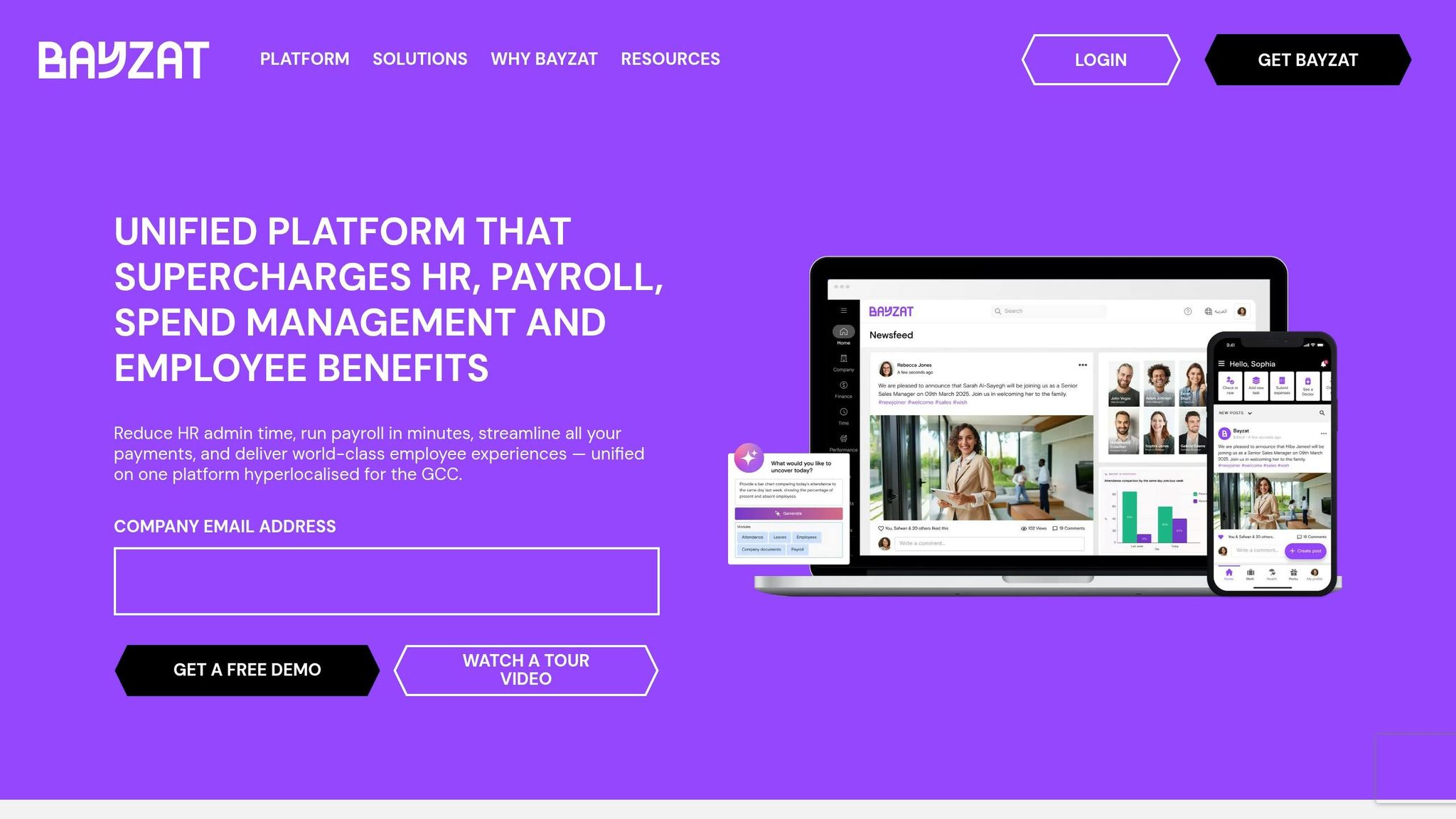
When Talal Bayaa founded Bayzat, over 70% of UAE-based SMEs still relied on manual methods for handling HR and payroll tasks [6]. Businesses were juggling spreadsheets, independent brokers, and disconnected systems, which often resulted in inefficiencies and compliance issues. To tackle this, Bayaa introduced a cloud-based platform tailored to the Middle East. Bayzat integrates HR management, payroll, and health insurance into a single, streamlined solution.
Today, Bayzat serves over 4,000 companies and 250,000 employees across the UAE and GCC [7]. In 2023 alone, its payroll module processed nearly AED 7.3 billion (USD 2 billion) and recorded close to 4 million platform interactions by January 2024 [6]. The company has also secured AED 220 million (USD 60 million) in funding, including an AED 92 million (USD 25 million) Series C round in late 2022, led by DisruptAD and Ischyros New York [8].
Managing Regulatory Requirements
As Bayzat expanded, navigating the complex regulatory environment in the UAE became a critical focus. Compliance with local labour laws and systems is non-negotiable. For example, businesses must integrate with the Wage Protection System (WPS), generate Salary Information Files (SIF) in the exact format required by MOHRE and the Central Bank, and calculate End of Service Benefits according to Article 51 of UAE labour law. Errors in these processes can lead to fines of up to AED 50,000 [7].
To address these challenges, Bayzat developed direct integrations with government systems. The platform simplifies payroll by automatically generating SIF files and offering a one-click processing experience. It also tracks Emiratisation ratios in real time and creates ready-made reports for MOHRE submissions [7]. Additionally, an AI-powered anomaly detection system identifies payroll errors and potential regulatory violations before they escalate [9].
"Integrating with the UAE's Wage Protection System streamlined the process, providing a seamless one-click experience for customers."
- Talal Bayaa, CEO & Co-Founder, Bayzat [6]
Strategic Partnerships Driving Growth
Strategic collaborations have played a key role in Bayzat's success. Being part of Hub71 opened doors to capital, learning programmes, and partnerships with both public and private entities [10]. Support from UAE-based institutional investors like DisruptAD (ADQ's venture platform) and Mubadala Capital enhanced Bayzat's reputation, particularly in managing sensitive salary and insurance data. This backing also facilitated the company’s regional expansion into Saudi Arabia [8][9].
Bayzat has also partnered with business setup firms like Creative Zone to integrate its HR solutions into the onboarding process for new SMEs. These partnerships have significantly improved efficiency for clients, with HR-related processing times reduced by 40% within six months and onboarding times cut by 80% thanks to automation [9].
Case Study 3: Kitopi - Cloud Kitchens Transforming Food Delivery
When Mohamad Ballout and his co-founders launched Kitopi in Dubai, they identified a major challenge in the food delivery industry. Traditional restaurants struggled with high operating costs and inconsistent quality. Kitopi addressed this by creating a network of cloud kitchens powered by advanced technology.
At the heart of their operations is the Smart Kitchen Operating System (SKOS), a comprehensive software suite that manages everything from order processing to inventory and cooking workflows. SKOS integrates seamlessly with food delivery platforms, predicting rider arrival times down to the minute. This allows dishes to be prepared and delivered promptly, ensuring fresher meals and faster service for customers [11].
By 2022, Kitopi reached a valuation of AED 5.7 billion (USD 1.55 billion) and operated over 200 locations across five GCC markets, including the UAE, Saudi Arabia, Kuwait, Qatar, and Bahrain [11][14]. The company has raised over AED 2.9 billion (USD 800 million) in funding, including a recent AED 183 million (USD 50 million) growth capital round in early 2026 [11][12]. In 2020 alone, Kitopi saw a 300% year-over-year increase in orders [11].
Technology-Driven Logistics and Expansion
SKOS manages the entire supply chain, from sourcing ingredients to providing real-time analytics across all locations [11][13]. This centralised system enables restaurant partners to expand into new areas in just 14 days, a stark contrast to the months it typically takes to open a traditional restaurant [11]. Additionally, the platform uses AI-powered demand forecasting to identify market gaps, allowing Kitopi to create delivery-only "virtual brands" tailored to emerging consumer preferences [11].
Initially, Kitopi faced hesitation from restaurant partners over concerns about recipe confidentiality and quality control. To address this, the company introduced strict non-disclosure agreements and digital training modules through SKOS [11]. Transparent performance dashboards further eased concerns by offering real-time insights into order volumes, customer feedback, and operational efficiency. This data-driven approach helped establish trust among partners.
Kitopi's technology also aligns with the UAE's environmental goals. Advanced forecasting tools reduce food waste, supporting the Dubai Integrated Waste Management Strategy 2041, while predictive logistics cut idle delivery times and fuel use, contributing to the UAE Net Zero 2050 initiative [11][13][15]. In collaboration with Yellow Door Energy, Kitopi installed a 523-kilowatt solar plant, generating 838 megawatt-hours of clean energy annually. The company has also transitioned 89% of its packaging to plastic-free materials as part of its zero-landfill commitment [16].
Reflecting on the company's growth and future plans, CEO Mohamad Ballout remarked:
"As we continue to scale our loyalty app alongside our regional growth and international franchise expansion, this funding round positions us perfectly to capitalise on the growing demand for our brands."
- Mohamad Ballout, CEO and Co-Founder, Kitopi [14]
Kitopi has also diversified its business model by acquiring AWJ Investments, the Dubai-based group behind popular brands like Operation Falafel and Catch 22. This acquisition added over 30 physical restaurants to its portfolio, creating a hybrid model that combines cloud kitchens with traditional dining spaces. This approach not only improves margins but also provides valuable customer data [11].
Today, Kitopi employs over 5,000 people globally and continues to explore automation technologies, such as robotic frying stations and AI-driven assembly systems, to enhance both speed and consistency [11].
Case Study 4: Pure Harvest Smart Farms – AgriTech for Food Security
When Sky Kurtz launched Pure Harvest Smart Farms, many doubted the feasibility of growing fresh produce in the UAE's unforgiving desert climate. With nearly 90% of its food imported and only about 5% of its land suitable for farming, the UAE faces significant challenges in achieving food security [18][21]. Traditional farming methods falter in temperatures exceeding 50°C, making the country heavily reliant on international supply chains.
Pure Harvest tackled this issue head-on with its advanced overpressure climate control system. This system maintains an optimal growing environment year-round by creating a pressurised space where air escapes through rooftop vents, significantly reducing the need for pesticides. Their controlled-environment facilities now produce 26 types of tomatoes, 6 varieties of strawberries, and 14 types of leafy greens [18]. This approach highlights how UAE startups are using advanced technology to address regional challenges.
The results speak for themselves: Pure Harvest achieves 10–15 times higher yields per square metre compared to traditional farming, while using only 10–14% of the water required by conventional greenhouses. This is made possible through hydroponics and water condensation recapture, which reduce the strain on groundwater resources [18].
Between 2017 and 2024, the company secured AED 1.1 billion (USD 287 million) in funding to build state-of-the-art, temperature-controlled facilities. These farms now produce over 15 million kilogrammes of fresh produce annually, allowing Pure Harvest to supply UAE supermarkets at prices 20–40% lower than European imports [22].
Addressing Climate Issues with AgriTech
Pure Harvest’s innovative systems are specifically designed to combat the harsh environmental conditions of the UAE. Their approach, described as realistic high-yield farming, focuses on sustainable production despite extreme temperatures. In March 2021, CEO Sky Kurtz raised AED 220 million (USD 60 million), including a AED 183 million (USD 50 million) structured sukuk, to complete three high-tech hybrid greenhouse projects in the UAE and Saudi Arabia [18]. These facilities harness the Gulf’s abundant sunlight to drive photosynthesis naturally, avoiding the high energy costs often associated with indoor vertical farming.
"We battle the environment so that our plants don't have to. Then we let nature run its course, and the outcome is extraordinary quality, pesticide-residue free fresh produce with world-leading yields."
- Sky Kurtz, CEO, Pure Harvest Smart Farms [17]
In 2022, Pure Harvest integrated ABB Ability™ Energy Manager into its smart farms to monitor HVAC and pump systems continuously. This technology identifies ways to improve efficiency and ensures healthy crops even when external temperatures soar past 50°C [19]. Majed Halawi, Vice President for Growth, explained:
"We strive to use the most efficient technologies in our smart farms, using natural lighting and IoT-enabled climate control to manage our energy... ABB Ability Energy Manager provides real-time understanding of our energy consumption and identifies optimisation opportunities."
- Majed Halawi, Vice President for Growth, Pure Harvest [19]
Pure Harvest's resource efficiency is impressive - up to 30 times better than traditional field farming and 7 times more efficient than standard desert greenhouses [20]. By combining CO₂ dosing for enhanced photosynthesis with water condensation recapture, the company has created a closed-loop system that supports both food security and environmental sustainability. Beyond the UAE, Pure Harvest has expanded operations to Saudi Arabia and Kuwait, with plans to introduce its climate-management technology to Southeast Asia.
Key Lessons from UAE Tech Startup Success
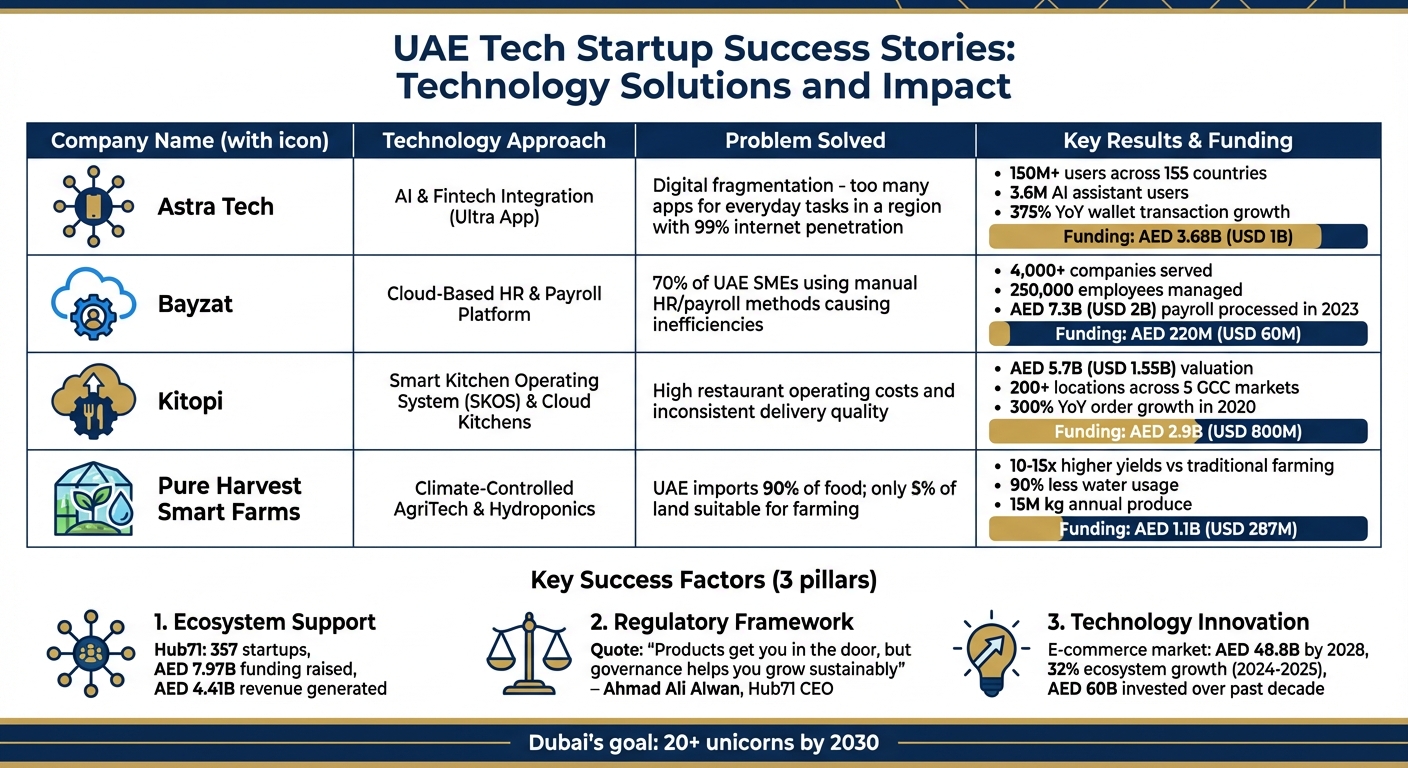
UAE Tech Startup Success: Key Metrics and Growth Strategies Comparison
The stories behind UAE's thriving tech startups reveal some shared strategies that have driven their rapid growth within the region's competitive market. One standout approach is the use of "ultra apps." Astra Tech, for instance, combined communication, fintech, and e-commerce into BOTIM, showcasing how integrating multiple services can achieve massive scale [1]. Similarly, Hulexo leveraged AI to turn static reports into real-time, actionable insights, scaling its operations to serve over 100 retailers, including global names like Adidas and DKNY [23]. Kitopi's cloud kitchen model highlighted how tech-enabled logistics can support expansion across multiple countries. Meanwhile, Pure Harvest used AgriTech to tackle food security challenges, proving how innovation in agriculture can drive growth. These examples underline the key strategies that have fueled the success of tech startups in the UAE.
In addition to innovation, regulatory frameworks have played a crucial role in enabling sustainable growth. Startups that navigate these frameworks effectively often find themselves better positioned for long-term success. As Ahmad Ali Alwan, CEO of Hub71, aptly put it:
"Products get you in the door, but governance is what helps you grow sustainably." - Ahmad Ali Alwan, CEO, Hub71 [2]
For early-stage founders, establishing strong corporate structures early on can attract institutional investment and pave the way for scalable growth.
Another critical factor has been ecosystem support. Initiatives like Hub71 have significantly shortened development timelines for startups. With a community of 357 startups, Hub71 has collectively raised AED 7.97 billion (USD 2.17 billion) in funding, generated AED 4.41 billion (USD 1.2 billion) in revenue, and created over 1,100 jobs across more than 20 industries [2]. Huzaifa Hameed, Co-founder and CEO of Hulexo, credited the Mohammed Bin Rashid Innovation Fund (MBRIF) for playing a pivotal role in their success:
"The MBRIF programme has provided us with everything our startup needs to scale, from experienced mentors to one-on-one consultations." - Huzaifa Hameed, Co-founder and CEO, Hulexo [23]
Community Platforms for Growth
Community platforms have become a cornerstone for UAE founders tackling the challenges of scaling. These platforms go beyond simple networking - they create spaces for collaboration, where founders can work together on issues like regulatory compliance and fundraising strategies. Hub71 exemplifies this collaborative spirit, with Ahmad Ali Alwan explaining:
"Founders here aren't just building companies, they're building together, in a shared space with a shared mission." - Ahmad Ali Alwan, CEO, Hub71 [2]
Platforms like Hub71 not only simplify networking but also provide the structural backbone for the UAE's startup ecosystem.
Another example of this collaborative model is Founder Connects, which offers UAE founders group-matched virtual masterminds. These masterminds connect entrepreneurs facing similar challenges, providing networking opportunities, exclusive events, and resources like live talks with seasoned entrepreneurs and curated investor lists. For founders, this means access to expert advice and real-time solutions for scaling, fintech, and AI-related challenges.
Comparison Table: Technology Solutions and Results
| Startup | Tech Approach | Problem Solved | Funding / Results |
|---|---|---|---|
| Astra Tech | AI & Fintech Integration (Ultra App) | Combines key services to address digital fragmentation | Over 150 million users and major funding achievements [1] |
| Hulexo | AI-Powered Decision Engine | Converts static data into actionable, real-time insights | Scaled to 100+ retailers, including Adidas and DKNY [23] |
| Kitopi | Cloud Kitchen Logistics & AI | Optimises operations for expansion across multiple countries | Achieved extensive multi-country growth |
| Pure Harvest | AgriTech Innovations | Solves desert farming challenges and boosts food security | Gained traction through advanced agricultural practices |
These examples highlight how a blend of strategic technology use and collaborative ecosystems has been instrumental in driving the success of UAE tech startups.
Conclusion: Technology and Collaboration Drive Growth
The journey of UAE tech startups highlights an important lesson: technology alone doesn't guarantee success. Take Astra Tech's rise to 150 million users or Pure Harvest's advancements in AgriTech - both achieved rapid growth by blending innovation with strong ecosystem support. The UAE's startup ecosystem, which expanded by 32% between April 2024 and April 2025, shows how combining advanced technology with vibrant community networks fuels sustainable progress [24].
Strong governance and peer networks play a pivotal role in long-term success. Leaders like Ahmad Ali Alwan emphasise that while having a strong product is essential, it’s mature governance that ensures enduring growth. Founders who actively participate in community platforms gain access to mentorship, regulatory insights, and practical advice from peers who’ve faced similar hurdles. This is where collaboration platforms become invaluable.
For entrepreneurs dealing with the challenges of scaling, these platforms offer practical tools. For instance, Founder Connects provides virtual mastermind groups, exclusive events, and curated investor connections, helping UAE founders tackle scaling obstacles effectively.
As the ecosystem continues to expand, the blend of innovation and community support remains key. With over AED 60 billion (USD 16.34 billion) invested in startups over the past decade and Dubai's ambitious goal of nurturing 20+ unicorns by 2030, UAE founders who combine technological advancements with active collaboration are poised to lead the next wave of success [24].
FAQs
How do UAE startups get funding fast?
Startups in the UAE have several avenues to secure funding, especially when targeting sectors like fintech, AI, and technology. One effective approach is connecting with angel investors and venture capital firms that specialise in these industries. Their focus on innovation makes them ideal partners for emerging businesses.
Another way to raise funds is by participating in seed funding rounds. These can come from government-backed programmes or private entities, both of which actively support the region’s entrepreneurial ecosystem.
For founders looking to expand their networks and gain insights, joining startup communities like Founder Connects is a smart move. Such platforms provide access to mentorship, investor connections, and valuable resources, making it easier to navigate the funding landscape and unlock growth opportunities.
What UAE rules do startups need to comply with?
Startups in the UAE need to follow several important regulations to operate within the law. First, they must secure the correct licenses - such as commercial, professional, or industrial - from authorities like the Department of Economic Development (DED) or the Abu Dhabi Department of Economic Development.
Compliance with foreign ownership laws is crucial, as well as adhering to tax regulations, including VAT registration. Additionally, startups must meet employment law requirements, which cover areas like employee visas and contracts.
For businesses in specialised fields, such as fintech or artificial intelligence, there may be extra rules to consider, particularly around data protection and cybersecurity standards.
How can I join a UAE founder community like Founder Connects?
To become part of a UAE founder community such as Founder Connects, head over to their platform, which is tailored to assist startups. They offer a range of benefits, including virtual masterminds, networking opportunities, exclusive events, and access to resources like tools, live talks, and connections with investors.
All you need to do is register on their platform, take part in the events, and start engaging with other founders. It's a great way to collaborate, tackle challenges, and thrive within the UAE's vibrant startup ecosystem.
Related Blog Posts

Building in MENA? You don't have to do it alone.
Join 300+ founders in the Founder Connects Residency. Monthly squad calls, warm intros, $3M+ in perks, and much more. All for less than your monthly coffee budget.
Popular posts





Founder Connects is a premium MENA tech founder community. Meetups in Dubai and across MENA, Residency Squads of 8–10, and 400+ vetted WhatsApp founders (apply and screened).