
Startups in the UAE are transforming customer experiences by using data and AI for personalization. Here's why this matters and how they're doing it:
Startups are leveraging tools like Customer Data Platforms (CDPs), AI for dynamic content, and automation to deliver personalized experiences across channels like WhatsApp, email, and social media. By integrating local preferences, bilingual campaigns, and compliance with UAE data laws, they’re turning personalization into a growth driver.
This article explores how UAE startups are using data, AI, and automation to meet consumer expectations, improve engagement, and drive profitability.
UAE Consumer Personalization Statistics and Market Impact
Startups in the UAE are tapping into the power of Customer Data Platforms (CDPs) like Segment and Adobe Real-Time CDP to bring together information from various sources. These include CRM systems like Salesforce and HubSpot, communication tools such as WhatsApp, email, and live chat, as well as tag management systems like Google Tag Manager, which track real-time website activity. Additionally, session replay tools help uncover browsing habits, price sensitivity, and brand preferences [3][8].
Cloud platforms such as Azure and AWS, with their UAE-based data centres, ensure compliance with local data residency regulations while offering the scalability needed for processing large volumes of information [4]. These startups are also breaking down silos, making data accessible across teams, from marketing to product development. In fact, 37% of tech leaders in the UAE have prioritised this capability [4].
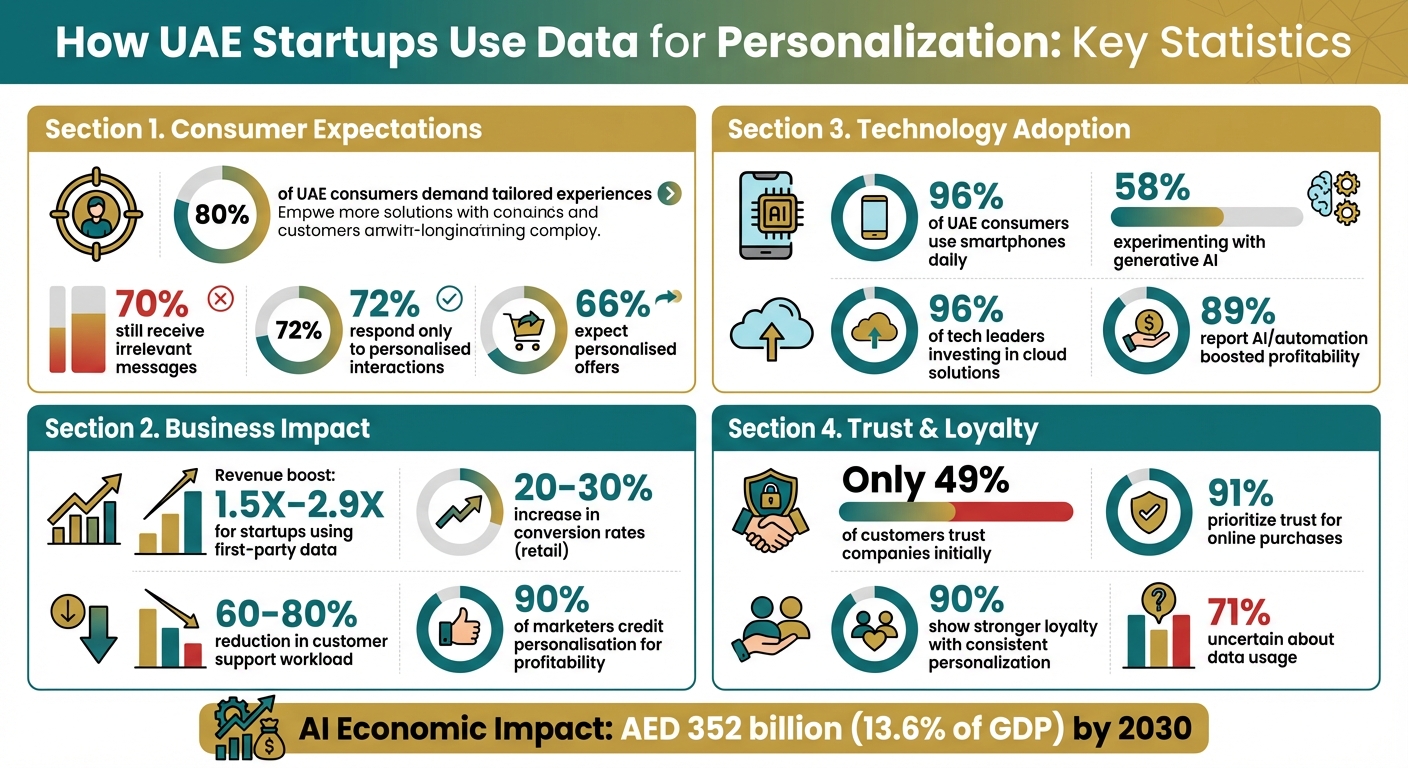
However, transparency plays a crucial role. While 66% of UAE consumers expect personalised offers, 71% feel unsure about how their data is being used [1]. To bridge this gap, startups focus on clearly communicating the benefits of data sharing. Explaining how data leads to tailored recommendations helps build trust while gathering the behavioural and transactional insights essential for effective personalisation [8].
Once startups establish unified customer profiles, they turn to AI tools to transform raw data into meaningful insights.
With streamlined data processes in place, UAE startups are embracing AI-powered solutions to elevate personalisation. Custom AI agents and conversational avatars, fluent in both Arabic and English, are being used to handle customer queries, qualify leads, and provide 24/7 support [10][11]. These tools analyse previous purchases and browsing behaviour to recommend products or offer timely promotions [2].
The impact of AI on personalisation in UAE retail has been significant, boosting conversion rates by 20–30%. Meanwhile, conversational AI tools have reduced customer support workloads by 60–80% [13]. Generative AI further enables startups to create personalised marketing content at scale, from email subject lines to product recommendations, tailored to individual preferences [7]. With AI projected to contribute AED 352 billion (13.6% of GDP) to the UAE economy by 2030, startups are treating these technologies as essential building blocks for growth [9].
"AI is no longer an upgrade. It's becoming the baseline for how UAE companies run, scale, and compete." - Codiant [13]
But AI is only part of the equation. Automation ensures these personalised experiences can be scaled efficiently.
Automation allows startups to deliver tailored experiences to thousands of customers without increasing their workforce. Low-code platforms like Tray.io and n8n connect different systems and automate tasks, such as updating CRM records or scoring leads. This approach reduces processing time by up to 75% and cuts operational costs by more than 30% [11][12].
Startups are also leveraging no-code AI CRM platforms like Airtable to streamline customer relationship management [10]. These platforms automatically segment audiences based on real-time behaviour, trigger personalised email campaigns, and synchronise customer records across all channels.
With 96% of UAE tech leaders planning to invest in XaaS (Anything-as-a-Service) solutions, the adoption of automated, cloud-based personalisation systems is accelerating [4]. This early adoption positions startups to meet the demands of a tech-savvy market, where over 90% of the population uses smartphones and expects instant, personalised interactions [2].
With advanced data collection and AI-driven insights, startups in the UAE are now leveraging targeted strategies to amplify the effectiveness of their marketing campaigns. By focusing on first-party data and automation, they’re creating more tailored and impactful customer experiences.
Gone are the days of relying solely on basic demographic data. UAE startups are now embracing behaviour-based segmentation powered by machine learning [8]. This shift is addressing a key challenge - 70% of UAE consumers report receiving messages that don’t resonate with their needs [3].
Leading startups compile data from multiple sources - physical store visits, call centre interactions, and app usage - to build detailed customer profiles. These profiles help segment audiences by lifecycle stages, such as first-time visitors, occasional buyers, or loyal repeat customers [3][5]. Some have taken it a step further by incorporating contextual triggers like local weather, time of day, and real-time location data to refine their audience segments [8].
A great example of this is Maggi’s 2022 campaign. Using AI-powered tools, the brand achieved a 66% boost in website registrations across the Middle East and North Africa. Click-through rates surged by 118%, all thanks to personalised content and first-party data integration [5].
The results speak for themselves: companies leveraging first-party data in their marketing efforts see revenue increases of 1.5 to 2.9 times compared to those that don’t [5]. This level of segmentation sets the stage for seamless, omnichannel engagement.
Building on precise audience segmentation, startups are now focusing on creating a unified customer experience across all platforms. Whether it’s email, WhatsApp, social media, or websites, interactions remain consistent and synchronised. For instance, when a customer saves an item to their wishlist on a mobile app, it’s instantly visible on the website [14].
This synchronisation is made possible by breaking down data silos through tools like Customer Data Platforms (CDPs) and CRMs, which provide a single, comprehensive view of each customer [14][8]. And the impact is clear: 72% of customers say they respond only to personalised interactions [8][16]. However, challenges remain - 25% of UAE consumers still express frustration over not being able to use their preferred communication channels [3].
In early 2024, IKEA took a bold step by launching an AI assistant on OpenAI’s GPT store. This tool offered personalised furniture and décor recommendations, with 20% of interactions leading to direct visits to IKEA’s storefront within just a few months, according to Francesco Marzoni, IKEA’s Chief Data and Analytics Officer [8].
To succeed, startups must give customers control over how they interact with brands. While 44% of UAE consumers prefer personalised emails, 45% expect tailored customer service experiences [3]. The key lies in channel orchestration - delivering consistent messages optimised for each platform, whether it’s WhatsApp, email, or in-store touchpoints [14][3].
Dynamic content takes personalisation to the next level by adapting in real time to the individual viewer. UAE startups are using generative AI to create tailored versions of digital ads, emails, and website content based on user data [8]. This goes beyond simply adding a name - it involves personalised product recommendations, exclusive offers, and customised visuals based on browsing habits and purchase history.
Take Loftie, for example. In November 2025, the wellness company reached 15,000 subscribers for its Loftie Rest app. By leveraging AI, they segmented users based on screen time, Apple Health data, and self-reported sleep quality to deliver personalised content. This approach highlighted the power of dynamic, data-driven personalisation [8].
Startups are also using trigger-based messaging to engage customers at the right moment. Examples include abandoned cart reminders, birthday discounts, and special offers tailored to a customer’s price sensitivity [14][15]. The statistics back it up: 56% of customers are more likely to make repeat purchases when offered personalised loyalty rewards [8]. With 90% of marketers crediting personalisation as a key driver of profitability [16], dynamic content has become a must-have for UAE startups looking to stay ahead.
Startups in the UAE evaluate the success of personalisation efforts using metrics like revenue growth, engagement levels, speed, and trust. Revenue lift stands out as a central indicator, with companies leveraging first-party data for marketing seeing 1.5 to 2.9 times higher revenue. This helps identify which personalised touchpoints create the most value [5].
Engagement metrics such as click-through rates and website registrations play a key role in validating these strategies. Additionally, startups track Net Promoter Score (NPS) and Customer Experience Excellence (CEE) scores to measure customer loyalty and satisfaction. Interestingly, 90% of UAE consumers express stronger loyalty to brands that offer consistent, personalised experiences [1]. Speed also matters - 84% of customers in the UAE prioritise quick digital interactions, particularly fast checkout processes [3].
Trust is another critical element. Startups monitor data privacy satisfaction and consent rates to build stronger relationships with their customers. In fact, 55% of UAE consumers directly link data protection to brand trust [5]. This makes tracking privacy-related metrics just as important as traditional performance indicators.
"In the AI era, CX leadership belongs to those who build with trust, scale with purpose, and never lose sight of the human behind the screen." - Gonçalo Traquina of KPMG Lower Gulf [6]
By focusing on these metrics, UAE startups not only measure their performance but also lay the groundwork for long-term success.
These metrics come to life in the success stories of UAE startups. In 2024, Careem showcased how combining digital innovation with personalised experiences can drive results. The multi-service platform climbed 32 spots in the KPMG UAE Customer Experience Excellence rankings, achieving an overall CEE score of 7.98 - a 0.44-point improvement from the previous year - and an NPS of 35 [6].
Similarly, Emirates Islamic Bank made remarkable progress, advancing 42 positions in the same index in 2024. The bank achieved a CEE score of 8.16 and an NPS of 49, reflecting a year-over-year improvement of 0.54 points. These gains were powered by customer-focused digital strategies that anticipated needs and delivered personalised experiences across every interaction [6].
The broader trend is undeniable: 89% of UAE tech leaders report that AI and automation investments have boosted profitability over the past two years [4]. Additionally, 80% of marketers in the UAE have seen a direct increase in customer engagement after implementing AI-driven personalisation [18]. These examples illustrate how startups are transforming customer connections through data-driven strategies.
For UAE startups, selecting the right personalisation tools means balancing advanced features with the specific demands of the local market. A top priority is data residency. Platforms leveraging local data centres, such as those provided by Microsoft Azure or Amazon Web Services, not only enhance performance but also comply with UAE data sovereignty requirements. It's worth noting that 96% of tech leaders in the UAE plan to invest in cloud-based solutions within the next year [4].
Another critical factor is integration capabilities. The most effective platforms easily connect with existing systems like Customer Relationship Management (CRM) tools, Customer Data Platforms (CDPs), and tag management solutions such as Google Tag Manager. This seamless interoperability ensures personalisation strategies are built on a holistic view of customer data, avoiding the pitfalls of siloed information [4].
In the UAE’s highly connected market, omnichannel support is non-negotiable. With widespread smartphone usage, tools need to handle multiple channels, including WhatsApp, SMS, email, in-app notifications, and chatbots. Platforms that incorporate Arabic language models and recognise Emirati-accented voices are better suited to local preferences [19]. Furthermore, cloud-based scalability enables startups to process massive data volumes for personalised experiences without requiring significant upfront investments in infrastructure.
Lastly, compliance and transparency are essential. Platforms must adhere to the UAE's Personal Data Protection Law (PDPL) and offer robust mechanisms for detecting Personally Identifiable Information (PII). Transparency is a key trust factor, as 71% of UAE customers are more likely to trust businesses that clearly explain how their data is used [20]. Tools that facilitate open communication about data practices provide a clear competitive edge.
"By prioritising data-driven strategies and leveraging cloud platforms, UAE tech leaders are transforming challenges into opportunities for sustained growth and efficiency." – Mohamad Majid, KPMG Lower Gulf [4]
These considerations pave the way for adopting platforms that meet both global standards and the specific needs of the UAE market. Together, they form the backbone of effective, data-driven personalisation strategies.
With these criteria in mind, UAE startups are turning to platforms that offer localised performance and seamless integration. One standout is SAP Emarsys, which has gained traction in retail by using generative AI to deliver personalised product recommendations tailored for UAE businesses [7]. For customer service, Zendesk AI leads with advanced Arabic triage and sentiment analysis, while Freshdesk's Freddy AI supports translations in over 60 languages [19].
A homegrown option, the Etisalat Smart Messaging Platform, provides a unified system for managing campaigns across SMS, email, and chatbots, making it a strong choice for startups that prioritise local support and UAE-specific integrations [17]. For e-commerce, Gorgias offers deep Shopify integration, enabling instant personalisation for orders and refunds. Meanwhile, Intercom excels in conversational user experiences with high resolution rates for WhatsApp and in-app messaging [19].
| Tool | Primary Application | Why Popular in UAE? |
|---|---|---|
| Zendesk AI | Customer Service | Advanced Arabic triage and sentiment analysis [19] |
| Freshdesk | Omnichannel Support | Freddy AI offers 60+ language translations [19] |
| Gorgias | E-commerce | Deep Shopify integration for personalisation [19] |
| Intercom | Conversational UX | High WhatsApp resolution rates [19] |
| Etisalat Smart Messaging | Marketing/SMS | Localised platform for UAE campaigns [17] |
| SAP Emarsys | Retail Personalisation | Generative AI for product recommendations [7] |
To ease adoption, startups can start small by piloting AI personalisation in a single area, such as automating FAQ responses [19]. This allows teams to test the waters and refine their approach as they scale. With 89% of UAE marketers reporting positive profitability impacts from AI and automation investments over the past two years [4], selecting tools that align with both local market dynamics and regulatory frameworks is more important than ever.
For startups in the UAE, leveraging data-driven personalisation isn't just an option - it's a strategic move to gain a competitive edge. With 70% of UAE consumers expressing frustration over irrelevant marketing messages [3], the opportunity to differentiate through smarter data use is immense. Addressing this gap means startups can position themselves to capture a larger share of the market.
Building trust is key. A striking 91% of UAE consumers prioritise trust when making online purchases [3]. By adopting transparent data practices and incorporating AI-powered automation, startups can deliver seamless, personalised experiences across popular channels like WhatsApp, email, and in-app notifications. It's no wonder that recent trends highlight AI investments as a driver of profitability [4].
The benefits of personalisation are not just theoretical:
"Right now, the ability to personalise offers and service for our passengers is our biggest asset." – Naveed Memon, Programme Director, Data & Analytics, Emirates [23]
Personalisation doesn’t require massive budgets to get started. Affordable tools like AI chatbots and basic analytics can serve as a foundation to test and refine strategies in specific areas. From there, insights can guide incremental scaling [2]. With the UAE's AI market forecasted to exceed AED 2.9 trillion by 2030 [2], startups that act early will be poised to ride this wave of growth.
The UAE’s dynamic ecosystem further supports this journey. Venture capital funds like Dtec Ventures and Global Ventures [22], along with government initiatives such as the July 2024 AI Challenge, which awarded AED 550,000 to startups creating AI-based customer solutions [21], provide fertile ground for innovation. By combining accessible tools, transparent practices, and unified customer data platforms, startups can turn personalisation into a powerful driver of growth.
Founders looking to accelerate their efforts can join Founder Connects to collaborate, share ideas, and refine their approach to data-driven personalisation. The path to success is clear - start small, think big, and let personalisation fuel your growth.
UAE startups are striking a balance between delivering personalised experiences and safeguarding data privacy, guided by Federal Decree Law No. 45 of 2021 (Personal Data Protection Law). This law mandates clear consent for processing personal data, ensures individuals can modify or delete their information, and sets strict rules for transferring data beyond UAE borders. To comply, many startups rely on local cloud storage facilities and employ measures like encryption, pseudonymisation, and regular audits to strengthen data security.
When it comes to personalising marketing efforts, startups focus on collecting first-party data through methods like opt-in forms, loyalty programmes, and direct transactions. They use AI-powered platforms that prioritise privacy by design - removing personal identifiers, managing user consent, and ensuring personalised campaigns are only launched with explicit permission. Transparency plays a big role here, as UAE consumers appreciate clear communication about how their data is used. Brands that embrace these principles often enjoy higher levels of trust and customer engagement.
Founder Connects plays an essential role in supporting startups by offering resources, expert guidance, and tools to help integrate privacy compliance into every stage of personalisation. This enables UAE-based tech, AI, and fintech startups to craft tailored marketing strategies while staying fully aligned with national data protection laws.
UAE startups are tapping into AI-driven tools to craft deeply personalised customer experiences. Platforms like SAP Emarsys are gaining traction for their advanced features, such as automated email subject line generation and AI-powered product recommendations. These tools allow marketers to streamline tasks like segmentation, content creation, and product suggestions, making personalisation both efficient and data-driven.
Conversational AI solutions, such as chatbots and voice assistants, are also playing a key role. These technologies enable startups to collect first-party data and instantly customise messaging, offers, and pricing. Meanwhile, generative AI tools like ChatGPT and Google Gemini are being embraced for tasks like content creation and audience segmentation, empowering startups to roll out tailored campaigns across various channels with minimal manual input.
By integrating these technologies, UAE startups are creating dynamic AI ecosystems that not only boost customer engagement but also optimise operations in a highly competitive market.
Personalisation is a cornerstone for building trust and loyalty among consumers in the UAE. According to research, 83% of UAE customers feel a strong sense of loyalty to certain brands, largely because of personalised, AI-driven experiences that make them feel recognised and appreciated. At the same time, transparency plays a vital role, with 89% of shoppers expecting brands to manage their personal data responsibly and clearly communicate their privacy policies. When executed effectively, personalisation not only establishes trust but also nurtures lasting loyalty.
That said, irrelevant messaging can do more harm than good. A study found that 70% of UAE consumers are exposed to poorly targeted messages, which can undermine trust and weaken brand loyalty. To avoid this, startups should prioritise the use of accurate first-party data and leverage AI-powered segmentation while maintaining a strong commitment to data privacy. By offering relevant, respectful, and transparent experiences, brands in the UAE can strengthen customer trust, encourage loyalty, and inspire advocacy.


