

Checklist for UAE Startups Expanding to GCC Markets
Building in MENA? You don't have to do it alone.
Join 300+ founders in the Founder Connects Residency. Monthly squad calls, warm intros, $3M+ in perks, and much more. All for less than your monthly coffee budget.

Expanding into the GCC markets offers UAE startups access to a $2 trillion economy and over 62 million consumers. But success hinges on preparation, understanding local regulations, and building strong networks. Here's what you need to know:
- Opportunities: The GCC's combined GDP is projected to grow by 4.4%-4.5% in 2026, driven by initiatives like Saudi Vision 2030 and Qatar’s LNG expansion.
- Key Sectors: Fintech, AI, and SaaS are thriving, with UAE startups raising AED 7.34 billion in 2025.
- Market Entry: Use GCC trade agreements like the Common Market and Customs Union for easier cross-border operations and tax benefits.
- Preparation Checklist: Evaluate your UAE performance, study target markets, and align with local regulations like Saudization or VAT compliance.
- Setup Costs: Costs vary by country - Saudi LLC setup is around AED 91,960, while UAE Free Zone licenses start at AED 10,000.
- Funding: UAE startups benefit from federal initiatives, sovereign funds, and regional VCs like Mubadala and MEVP.
- Challenges: Extended payment cycles (60-120 days), skills shortages, and compliance complexities require careful planning.
Bottom Line: A clear strategy, regulatory understanding, and strong local connections are essential for UAE startups to thrive in GCC markets.
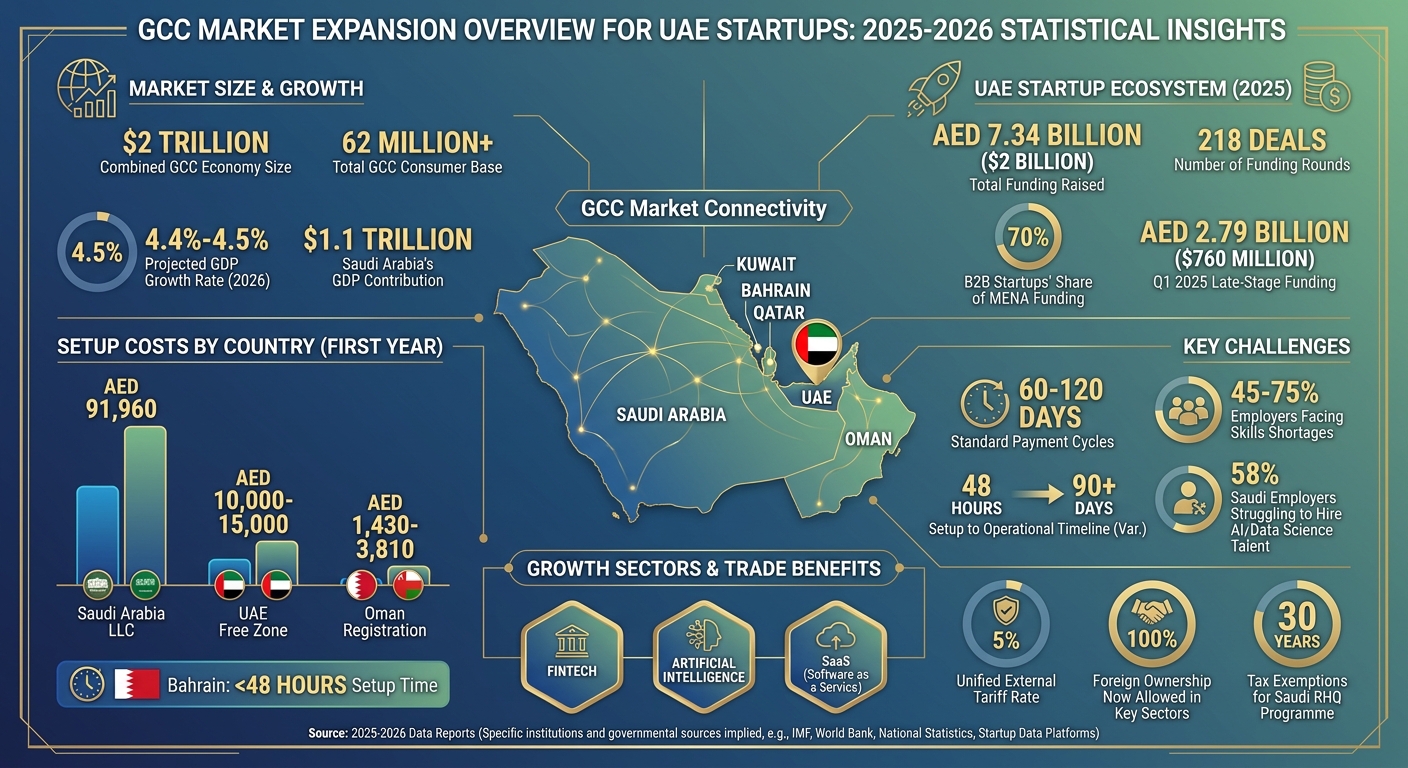
UAE Startup GCC Expansion: Key Statistics and Market Opportunities 2026
Pre-Expansion Preparation Checklist
Expanding into GCC markets requires thorough groundwork. A well-planned preparation phase can mean the difference between a successful entry and an expensive misstep. Here's a checklist to help you navigate key areas, from assessing your current performance to addressing regulatory and cultural factors.
Evaluate Current Business Performance
Start by conducting a detailed review of your existing operations. A strong performance in the UAE is often a good indicator of readiness for regional expansion. Investors today expect clear financial metrics and defensible market positions [1]. In the UAE, non-oil activities contribute over 70% of GDP, underscoring the importance of a solid domestic base before venturing into neighbouring markets [2].
Key performance indicators to focus on include:
- B2B revenue strength: In early 2025, B2B revenue accounted for 70% of total MENA funding, highlighting its importance in the region [1].
- Working capital: Ensure you can manage 60–90-day payment cycles.
- Sales pipeline velocity: Aim to secure Letters of Intent (LOIs) within the first 60 days of market entry [1][5].
Assess your unit economics to ensure your business model can handle higher operating costs in markets like Saudi Arabia [1].
In early 2026, UAE-based cloud kitchen operator Kitopi raised AED 183.65 million (US$50 million) to expand into Saudi Arabia, Qatar, Bahrain, and Kuwait. By May 2026, Kitopi operated over 200 outlets across these markets, using tech-driven solutions to address logistical challenges [2].
Kitopi’s success story highlights the importance of a strong foundation before scaling into new territories [2].
Conduct Target Market Research
Each GCC country presents its own opportunities and challenges. The region's combined GDP exceeded AED 7.34 trillion (US$2 trillion) in 2026, with Saudi Arabia alone contributing AED 4.04 trillion (US$1.1 trillion) and projecting 4.3% growth [5]. Meanwhile, Bahrain’s economy is heavily driven by non-oil sectors, which account for 84% of its GDP [2][5].
Align your market research with the region’s transformation agendas. For example:
- Saudi Vision 2030: Creates demand for technology and professional services.
- Qatar’s North Field LNG expansion: Opens doors for industrial services [2][5].
Leverage reliable sources like reports from the UAE Ministry of Economy and bilateral economic forums (e.g., UAE-Saudi and UAE-Kuwait Economic Forums) to uncover sector-specific opportunities. Additionally, organisations such as Bahrain’s Economic Development Board and Oman’s Global Financial Centre (established in 2026) provide feasibility studies for niche markets [2].
Cross-border trade trends also offer valuable insights. For instance, UAE non-oil exports to Saudi Arabia grew by 17% year-to-date in 2025, reflecting strong regional demand [2]. However, note that 58% of Saudi employers report challenges in finding qualified professionals in areas like AI and data science - something to consider when planning your expansion [2].
Review Regulatory and Cultural Requirements
Regulations differ significantly across GCC countries, making compliance a critical part of your preparation. For example:
- Saudi Arabia: Opening a branch requires a minimum share capital of SAR 500,000. Additionally, bidding for Vision 2030 projects necessitates setting up a Regional Headquarters (RHQ), which comes with 30-year tax exemptions [2][5].
You’ll also need to meet nationalisation quotas like Saudization and adhere to local content rules. Skills shortages, affecting between 45% and 75% of employers in the GCC, may require you to invest in training and upskilling local talent [2].
"Most companies that fail in the GCC don't fail because the market rejected them. They fail because they entered it wrong - wrong structure, wrong market, wrong sequence."
- Chandan Kumar, The Growth Consultants [5]
Relationships and networking play a crucial role in GCC markets. Be prepared for longer payment cycles and ensure your legal framework aligns with the jurisdiction of your primary market [5].
sbb-itb-f597d8f
Using GCC Trade Agreements for Expansion
The GCC Common Market and Customs Union provide UAE startups with a straightforward route to expand regionally. These agreements remove many hurdles that often complicate cross-border growth, making market entry faster and more cost-effective. Here's how you can leverage these frameworks to grow your business across the Gulf.
Access GCC Common Market Benefits
The GCC Common Market facilitates the free movement of locally produced goods and GCC nationals across the six member states - UAE, Saudi Arabia, Qatar, Bahrain, Kuwait, and Oman [6]. This opens up access to a combined consumer base of over 62 million people and a GDP of nearly AED 8.81 trillion (US$2.4 trillion) [6][7].
To take advantage of tariff-free trade, you'll need a Certificate of Origin confirming your products meet local value-add requirements [6][8]. Goods imported from outside the GCC are subject to a unified 5% external tariff, simplifying cost projections for materials sourced from third-party countries [6][8]. Additionally, agreements like the 2024 UAE-Saudi tax treaty help avoid double taxation for businesses operating across borders [2].
With the region's GDP expected to grow by 4.5% by 2026 and most GCC countries now allowing 100% foreign ownership in key sectors, the economic landscape is ripe for UAE startups to scale their operations [7][2].
Follow Customs Union Protocols
The GCC Customs Union further streamlines cross-border operations. By 2025, all GCC nations will use a standardised 12-digit HS code system under the GCC Integrated Customs Tariff [8]. This uniformity minimises errors in paperwork and product classification, which are common causes of shipment delays and penalties.
The one-port entry protocol is a game-changer for startups managing regional inventory. Import goods into a single Gulf free zone, like Dubai's Jebel Ali, and distribute them across the GCC without needing to clear customs at each border [8]. This approach supports centralised inventory management while enabling localised delivery to customers.
"In the Gulf, logistics doesn't just move your product. It moves the deal. Retailers and distributors care how fast you can replenish and how clean your paperwork is." - CrossBridge [8]
Digital e-clearance systems, such as Dubai Trade, simplify approvals by requiring advance submission of product data and HS codes [8]. Saudi Arabia's ZATCA e-invoicing system will become mandatory by 30 June 2026, with the UAE planning a similar rollout starting the same year [8]. Make sure your ERP systems can generate bilingual (Arabic/English) invoices to meet growing GCC expectations [8].
For consumer goods, permanent Arabic labelling - including details like ingredients and shelf-life - is mandatory for cross-border trade [8]. Free zones like Jebel Ali or Bahrain's US Trade Zone offer duty-deferred storage, with import duties only applying when goods enter the local market [8].
Obtain Regional Work Permits
A UAE trade licence doesn't automatically grant work rights across the GCC. To operate regionally, you'll need to set up a local legal entity or register a branch to sponsor employee visas [4][5]. For example, in Saudi Arabia, this requires registration through MISA, while in Qatar, it's done via the Qatar Financial Centre (QFC) [4][5][7].
After securing a local licence, you must apply for an Establishment Card (Immigration File), which is essential for visa processing and portal access [7]. Be aware of nationalisation quotas like Saudi Arabia's Saudization (Nitaqat), which now covers 41 sectors, including a 30% quota for engineering firms with five or more engineers [7][2].
For UAE startups eyeing Saudi Arabia, the Regional Headquarters (RHQ) Programme offers significant incentives, such as up to 30 years of corporate tax exemptions, priority access to government tenders, and relaxed Saudization rules for the first decade [2]. The programme does require hiring at least 15 full-time specialised employees within 12 months of obtaining the licence [7].
Other sponsorship options are emerging across the GCC. Saudi Arabia's Premium Residency programme and Oman's Investor Visa (offered in 5- or 10-year renewable terms) let entrepreneurs and investors reside without a local sponsor [7]. Under the India-Oman CEPA, work permits for EPC contractors in oil, gas, and port projects can be issued within 10 working days [7].
Plan visa processing carefully, typically between Day 46 and Day 75 after completing document attestation and office setup [7]. Costs vary by country: approximately OMR 485 (AED 4,630) per employee in Oman and around SAR 14,000 (AED 13,720) for three staff visas in Saudi Arabia [7]. Most GCC work permits also require a local medical exam and the issuance of a national ID before they are finalised [7].
Operational Setup and Financial Planning
Expanding into the GCC requires careful planning around legal structures, team building, and securing funds. By aligning your operations with the region's trade benefits, you can streamline your market entry and set the stage for success.
Establish Local Entities
Choosing the right type of entity is critical - it impacts your ability to sell, invoice, hire, and even bid for government contracts. For example:
- Mainland setups provide direct access to local markets.
- Free Zones offer perks like 100% foreign ownership and tax benefits. In the UAE, dual licensing now allows Free Zone companies to operate on the mainland without needing a local agent [7].
Setting up typically takes about 90 days and involves steps like document attestation, licensing, visa processing, and opening a corporate bank account [7][5].
Costs vary by country. For instance:
- A Saudi Arabia Service LLC costs around 94,000 SAR (AED 91,960) in the first year, with office rent making up 61,000 SAR (AED 59,670) and MISA licensing fees at 9,400 SAR (AED 9,200) [7].
- UAE Free Zone licenses range from AED 10,000 to AED 15,000.
- In Oman, commercial registration costs between 150–400 OMR (AED 1,430–AED 3,810) [5][7].
- Bahrain offers one of the fastest setups, with commercial registrations often completed in under 48 hours via the Sijilat portal [7].
If your focus is on government contracts in Saudi Arabia worth over 1 million SAR, you'll need to establish a Regional Headquarters (RHQ) in the Kingdom. The RHQ programme offers up to 30 years of corporate tax exemptions, priority for government tenders, and relaxed Saudization rules for the first decade. However, it requires hiring at least 15 specialised full-time employees within a year of licensing [7].
"The entity question is not a legal formality. It determines who you can sell to, what visas you can issue, whether you can invoice locally, and how your revenue is taxed." - Chandan Kumar, GCC Market Entry Specialist [5]
Starting commercial discussions early is essential, as setup timelines shouldn't slow your market entry [5]. Once your legal structure is in place, the next step is building a strong, compliant team.
Build Regional Teams
Hiring in the GCC comes with specific nationalisation quotas. For example:
- Saudi Arabia mandates a 30% Saudization rate for engineering firms and 40% for tourism companies [7].
- Qatar's Local Value system, mandatory for government tenders by July 2026, evaluates bidders based on their contributions to the national economy [7].
Finding skilled talent can be challenging. Between 45% and 75% of employers in the GCC face skills gaps, with 58% of Saudi employers struggling to hire for fields like AI, data science, and engineering [2]. To address this, you can deploy experienced UAE-based professionals to establish operations and train local staff, meeting nationalisation quotas while transferring knowledge [2].
Key considerations include:
- Mandatory medical insurance, costing 150–300 SAR per employee in Saudi Arabia.
- Compliance with the Wage Protection System (WPS), which requires electronic salary transfers in the UAE, Saudi Arabia, and Qatar [7].
Avoid hiring senior staff before building a solid sales pipeline. Relationships are crucial in the GCC, and a senior hire without local connections may take months to establish a network. Instead, work with experienced local advisers who can offer immediate access to key contacts [5]. Government programmes like Saudi Arabia's Human Resources Development Fund and Qatar's Career Development Centre are also valuable for recruiting and training national talent [2].
For networking and recruitment, platforms like Founder Connects (https://founderconnects.com) can introduce you to regional experts, advisers, and peers, helping you identify talent and build connections across GCC markets.
Secure Funding and Partnerships
With your operations and team in place, securing funding and partnerships becomes the next priority.
In 2025, startups in the UAE raised AED 7.34 billion (US$2 billion) across 218 deals, with B2B startups accounting for 70% of MENA funding in the first half of the year [1]. Late-stage funding also saw significant growth, with AED 2.79 billion (US$760 million) raised in Q1 2025 alone [1].
Federal initiatives like the Scale Up Platform and the Mohammed Bin Rashid Innovation Fund (MBRIF) provide support through loan guarantees and direct equity [4][9]. The Dubai International Growth Initiative offers AED 500 million for Dubai-founded SMEs, providing loans of up to AED 15 million with repayment terms of up to seven years [4].
Other funding avenues include:
- Sovereign wealth funds like Mubadala, ADQ (via DisruptAD), and the Abu Dhabi Investment Office (ADIO), which focus on growth-stage equity [4][1].
- Regional venture capital firms such as Middle East Venture Partners (MEVP), Wamda Capital, and Shorooq Partners, which often require startups to have regional expansion plans from the start [1][3].
Accelerators like Hub71 (Abu Dhabi) and DIFC FinTech Hive (Dubai) offer grants, subsidies (housing and office space), and direct connections to funding partners. For example, Hub71's Access Programme offers a subsidy package worth AED 200,000 or more per startup over two years [9].
For project-specific financing, UAE-based banks like Emirates NBD may offer competitive rates for GCC expansion projects due to the country's stable fiscal position [2]. Be prepared for long payment cycles, as standard terms in the GCC range from 60 to 90 days, with government entities often exceeding 120 days [5].
Here’s a breakdown of typical funding stages and their requirements:
| Funding Stage | Typical Check Size | Requirement for Success |
|---|---|---|
| Seed | AED 1.8M – AED 7.3M | Accelerator participation + MVP [3] |
| Series A | AED 18.4M – AED 36.7M | Proven GCC revenue [3] |
| Series B | AED 55M+ | Established Saudi Arabia pipeline [3] |
Take advantage of the heightened interest following a funding announcement - this 1–2 week window is ideal for reaching out to potential partners or vendors, as their buying intent and scaling activities are typically at their peak [1].
Risk Management and Scaling Strategies
When it comes to expanding within the GCC, managing risks and scaling strategically are key to long-term success. For UAE startups, this isn't just a one-time task - it's an ongoing effort to adapt and evolve.
Adapt Products and Services for GCC Markets
One of the biggest mistakes companies make is treating the GCC as a single, uniform market. What works in Dubai might not resonate in Riyadh due to differences in cultural norms, language, and business etiquette [5]. Each country has its own set of requirements, from compliance to customer expectations.
Start with localisation. This means more than just translating your website or app into Arabic. You’ll need to align your offerings with local laws and cultural practices. For example, fintech companies face different regulations across the region: Saudi Arabia mandates registration with the Ministry of Investment (MISA), while Qatar operates under an English common law system via the Qatar Financial Centre (QFC) [2]. Meanwhile, Oman’s regulatory sandboxes allow startups to experiment with blockchain and digital payment solutions under controlled conditions [11]. These steps not only ensure compliance but also smoothen your market entry.
"Most companies that fail in the GCC don't fail because the market rejected them. They fail because they entered it wrong - wrong structure, wrong market, wrong sequence." - Chandan Kumar, The Growth Consultants [5]
Manage Financial Risks
Financial risks can catch even the most prepared startups off guard. One major challenge is extended payment cycles. While private contracts may take 60 to 90 days to pay, government entities can stretch this to 120 days or more [5]. This makes having enough working capital essential during the early stages of expansion.
Plan for these delays by budgeting accordingly. UAE banks like Emirates NBD often offer competitive financing options for GCC expansion projects, leveraging the UAE’s stable financial environment [2].
Although currency fluctuations in the GCC are minimal due to the US dollar peg, compliance with VAT regulations is critical. A 5% VAT rate applies in the UAE, Saudi Arabia, Bahrain, and Oman, while Qatar and Kuwait currently have no VAT [10]. Also, aligning financial statements with IFRS standards is crucial for maintaining investor confidence and meeting due diligence requirements.
Another common pitfall is structural misalignment. For instance, setting up a UAE Free Zone entity might restrict your ability to transact with mainland customers, especially if your primary market is in Saudi Arabia [5]. Your legal structure should be based on where your first customers are located, ensuring alignment with operational and trade protocols.
The funding landscape has also shifted. As of April 2026, equity funding in the GCC dropped by 84.07% compared to the previous year, with AED 1.88 billion (US$512 million) raised across 46 rounds [12]. This means startups must show proven revenue streams and strong unit economics to attract investors.
Beyond financial strategies, building strong regional relationships can help mitigate risks.
Build Connections Through Networking
In the GCC, business relationships often hold more weight than digital marketing campaigns. Networking and warm introductions are crucial for building trust and securing partnerships [5]. Instead of relying solely on inbound leads, focus on connecting with local advisors, industry peers, and partners who can open doors to critical opportunities.
Startup communities in the UAE, like Founder Connects (https://founderconnects.com), offer invaluable resources such as virtual masterminds, networking events, and curated investor lists. These platforms provide real-time support, live talks, and access to mentors who can guide your expansion efforts.
Participating in events like UAE-Saudi or UAE-Kuwait Economic Forums can also help you identify collaborators and understand market specifics [2]. Additionally, innovation hubs like Hub71 in Abu Dhabi - which generated AED 15.4 billion (US$4.2 billion) in ecosystem value between 2021 and 2023 - and In5 in Dubai offer mentorship, funding, and global partnerships [11].
Strategic partnerships can also reduce risks. For example, UAE logistics giant DP World teamed up with the Omani government to develop the Al Rawdah Special Economic Zone, a AED 7.34 billion (US$2 billion) project designed to integrate supply chains across the UAE-Oman border [2].
Finally, connect with regional venture capital firms like Wa’ed Ventures (Saudi Arabia), Dubai Angel Investors, and 500 Global, which have backed startups such as Tabby, Ziina, and Floward [10][12]. The GCC is home to over 78,276 startups as of April 2026, with funded companies raising AED 1.05 trillion (US$287 billion) in venture capital and private equity [12]. Strong networking can unlock partnerships and provide critical market insights.
Post-Expansion Maintenance and Growth
Keeping operations on track after regional expansion requires consistent compliance, performance tracking, and the ability to adapt to new challenges.
Conduct Regular Compliance Audits
Expanding across GCC countries means navigating a patchwork of regulations. Each country has its own rules on business licensing, taxation, and labour laws, and these can change unexpectedly. To stay ahead, work with local legal experts or consultants who understand the specific requirements of each market. For instance, in Saudi Arabia, this could mean completing ZATCA tax registration, while in other countries, it might involve adhering to different local laws [2][4].
"Managing a business in the UAE requires a proactive approach to compliance." - Hawksford [4]
Labour compliance is particularly critical. Nationalisation quotas like Saudization in Saudi Arabia, or similar policies in Bahrain and Qatar, demand careful management. Companies participating in Saudi Arabia's Regional Headquarters (RHQ) programme may enjoy relaxed Saudization rules for the first decade, but it's still essential to monitor hiring practices closely [2].
Regular audits can help you catch compliance issues early, preventing costly penalties. In the UAE, taking advantage of its network of over 190 double taxation agreements can significantly reduce withholding taxes on dividends and interest [4]. Applying for Tax Residency Certificates and maintaining OECD-aligned transfer pricing documentation (Master and Local Files) are practical steps for managing cross-border transactions [4].
Additionally, implementing strong internal controls and Enterprise Risk Management frameworks is vital. These measures help mitigate risks related to politics, credit, and AML/KYC compliance, especially as global scrutiny remains high despite the UAE's removal from the FATF grey list [4].
Once compliance is under control, the next step is to measure how well your expansion is performing.
Measure ROI and Performance
After ensuring compliance, it's time to evaluate the success of your regional expansion. Start by setting clear KPIs to measure performance. Many businesses run into trouble by failing to establish baseline metrics before expanding [14].
Key metrics like the Synergy Capture Ratio can help you gauge whether you're meeting your cost and revenue goals at 12, 24, and 36 months post-expansion [15]. For tech-focused UAE startups, the LTV:CAC ratio (Customer Lifetime Value to Customer Acquisition Cost) is a reliable growth indicator, with a ratio above 3.0 considered healthy [15]. Meanwhile, UAE-based Deeptech companies leveraging AI are seeing valuations of 15 to 20 times revenue, compared to 6 to 8 times for companies without AI [13].
Customer-centric metrics such as Customer Effort Score (CES), Customer Satisfaction (CSAT), and Net Promoter Score (NPS) are equally important. Real-time dashboards can help you monitor these KPIs and adjust strategies quickly to respond to market trends [14].
Regional data can also provide valuable insights. For example, non-oil exports from the UAE to Saudi Arabia increased by 17% year-to-date in 2025, while digital finance services between the UAE and Qatar grew by 22% in early 2025 [2].
Once you’ve measured your performance, the next step is to act on the insights and refine your operations.
Improve Based on Feedback
Adaptability is key to staying competitive. Incorporate customer feedback into your processes to improve products and services. Using AI and predictive analytics can help you personalise customer experiences and optimise operations, giving your business an edge in the crowded GCC market [2].
Engaging local consultants can also make a difference. They can assist with audits of local content requirements and tax treaties, as well as address skills shortages - a challenge affecting up to 75% of GCC employers. By leveraging UAE-based experts, you can train local staff and ensure effective knowledge transfer for long-term success [2].
Staying connected with the regional business community is another way to refine your strategy. Platforms like Founder Connects (https://founderconnects.com) offer virtual networking opportunities, expert advice, and insights from other UAE founders who’ve faced similar challenges.
Finally, keep a close eye on customer feedback loops. Improving delivery speed and quality based on this feedback can position your startup for further growth across the GCC [2].
Conclusion
Expanding into GCC markets provides UAE startups with access to a combined regional GDP exceeding $2 trillion [5]. With the region expected to grow at an average rate of 4.4% to 4.5% by 2026 [2], the opportunity is immense - but success requires a clear strategy. The foundation lies in thorough preparation, leveraging trade agreements, and building strong networks. These pillars guide the steps needed to craft an effective expansion plan.
Start by conducting a detailed business evaluation and market research before establishing a local presence. Entering GCC markets without the right structure or sequencing can lead to significant challenges, as many industry experts caution [5]. Choose a legal entity that aligns with your customers' needs and geographic focus, rather than opting for convenience.
Take advantage of frameworks like the GCC Common Market and agreements such as the 2024 UAE-Saudi tax treaty to ease operational hurdles and access regional funding opportunities. The UAE's CEPAs also provide a gateway for scaling operations beyond the GCC [2]. Companies like Kitopi have successfully utilised these strategies, showcasing the potential of a well-planned regional approach [2].
Equally important is relationship-building. In a region where business often thrives on personal connections, cultivating strong networks is key. Platforms like Founder Connects (https://founderconnects.com) can be invaluable, offering UAE founders tools for networking, expert advice, and virtual collaboration. These resources can help navigate regulatory landscapes, establish local partnerships, and refine market entry strategies - saving time and avoiding costly errors.
To maintain growth, focus on regular compliance checks, track performance diligently, and adapt based on customer feedback. These ongoing efforts reinforce earlier groundwork in regulatory and market research. With careful planning and a supportive network, UAE startups can transform regional expansion into a long-term growth driver across the GCC.
FAQs
Which GCC country should I enter first?
The UAE is a popular launchpad for businesses looking to expand into the GCC region. Its appeal lies in a business-friendly environment that includes an English-speaking market, straightforward licensing processes, and top-tier infrastructure. The presence of free zones allowing full foreign ownership further simplifies establishing operations. On the other hand, Saudi Arabia presents immense opportunities but comes with a more intricate regulatory framework. Many startups choose to start in the UAE to benefit from its global connectivity and supportive business ecosystem.
Do I need a local entity to sell and hire in each GCC market?
In the GCC region, whether you need a local entity to sell or hire depends on the specific country and the nature of your business activities. For instance, in the UAE, free zones offer the advantage of 100% foreign ownership, making it easier for international businesses to operate independently. However, in countries like Qatar or Saudi Arabia, local entities may be mandatory for certain types of activities.
That said, establishing a local entity is often a good idea. It can provide broader market access, ensure compliance with local regulations, and streamline your operations.
How can I use GCC trade agreements to cut costs and delays?
Reducing costs and avoiding delays in the GCC region is achievable by taking advantage of GCC trade agreements. These agreements simplify regional trade through unified customs processes and standardised regulations.
To make the most of these benefits, it's important to:
- Understand the tariffs, regulations, and trade corridors specific to each GCC country.
- Build local partnerships to help navigate the unique requirements of different markets.
Additionally, the UAE's free zones provide significant advantages. These zones offer benefits like full foreign ownership and advanced infrastructure, which can streamline your supply chain and reduce delays, making expansion into the region much smoother.
Related Blog Posts

Building in MENA? You don't have to do it alone.
Join 300+ founders in the Founder Connects Residency. Monthly squad calls, warm intros, $3M+ in perks, and much more. All for less than your monthly coffee budget.
Popular posts





Founder Connects is a premium MENA tech founder community. Meetups in Dubai and across MENA, Residency Squads of 8–10, and 400+ vetted WhatsApp founders (apply and screened).