

UAE Startups with $10M+ Funding: Lessons Learned

Building in MENA? You don't have to do it alone.
Join 300+ founders in the Founder Connects Residency. Monthly squad calls, warm intros, $3M+ in perks, and much more. All for less than your monthly coffee budget.

The UAE's startup ecosystem is booming, with tech startups raising $872M (AED 3.2B) in Q1 2025 alone - a 194% increase from the previous quarter. Late-stage funding dominated with $760M, reflecting growing investor trust. Reaching $10M (AED 36.7M) in funding is now a key milestone for UAE startups, enabling global competition and scaling. Examples include qeen.ai, which raised $10M in seed funding led by Prosus Ventures, and Tabby, valued at $3.3B after securing $160M in Series E funding.
Key drivers of this growth:
- Top sectors: AI, fintech, agritech, and enterprise applications
- Government support: Free zones, regulatory sandboxes, and funds like MBRIF
- Major hubs: Dubai (96% of Q1 2025 funding) and Abu Dhabi (Hub71 ecosystem)
Success stories like Careem, Souq, and Noon show the importance of solving local challenges, building infrastructure, and diversifying services. Investors now focus on sustainable growth and milestone-based funding, with rigorous due diligence. For founders, clear KPIs, strong governance, and leveraging communities like Hub71 are critical for achieving funding milestones.
The UAE is on track to create 20 unicorns by 2030, with a thriving ecosystem and increasing global investor interest. Now is the time for bold founders to shape the future.
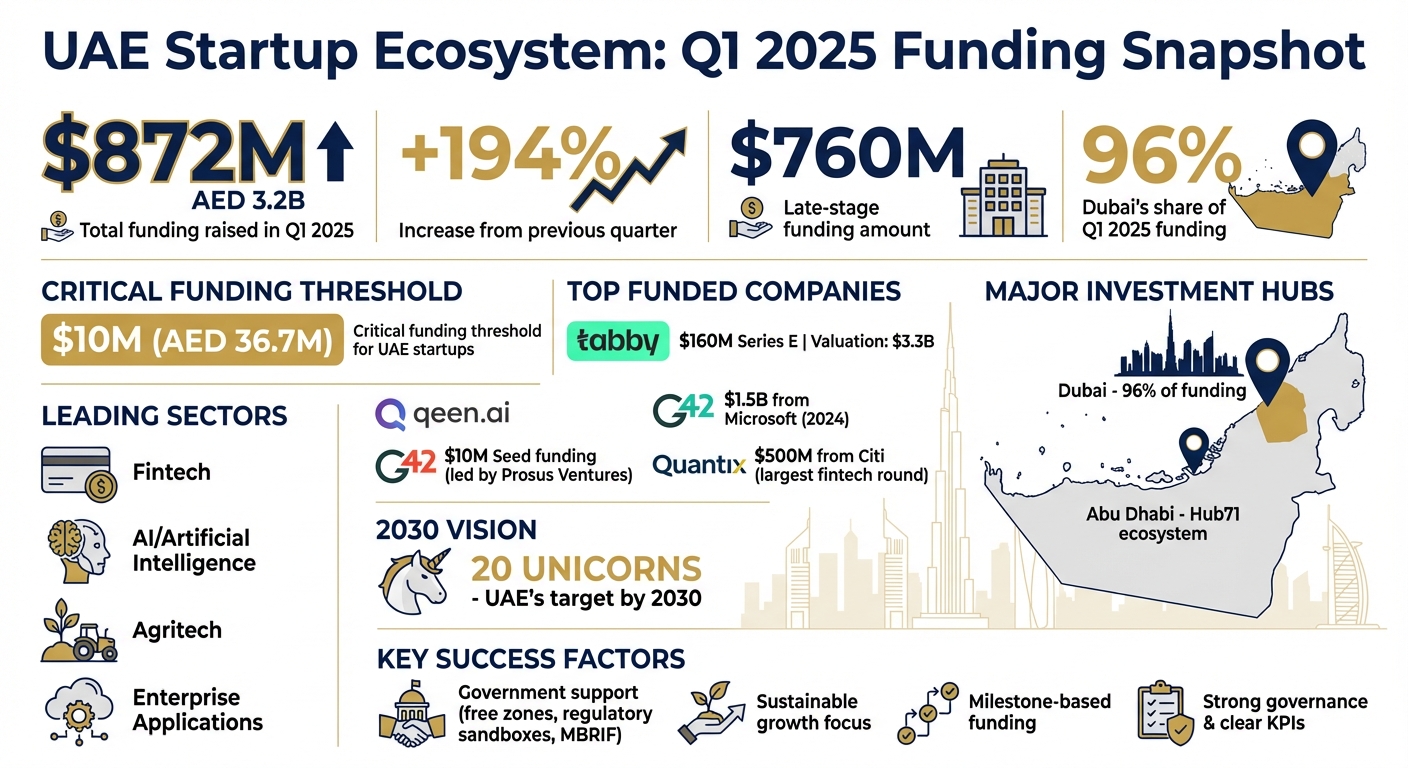
UAE Startup Funding Statistics Q1 2025: Key Sectors and Investment Trends
Funding Trends and High-Growth Sectors
Sectors Achieving AED 36.7M+ (USD 10M+) Funding
The UAE's fintech, AI, and agritech sectors are leading the charge in high-value funding rounds, thanks to their alignment with national transformation goals and strong regulatory frameworks. These industries are drawing significant attention from both regional and international investors [6].
Fintech is at the forefront, with Quantix (a subsidiary of Astra Tech) making waves by securing $500 million from Citi in December 2024. This marks the largest funding round in UAE fintech history. The sector's momentum is largely driven by initiatives like the UAE's Open Banking Framework and the regulatory clarity provided by DIFC and ADGM [6].
In the realm of artificial intelligence, investments are soaring. Abu Dhabi-based G42 raised a staggering $1.5 billion from Microsoft in April 2024. This partnership not only brought capital but also strategic advantages, including Microsoft President Brad Smith joining G42's board and a shift to Azure cloud services [4][6]. The collaboration also strengthened security measures, benefiting both UAE and US governments. Another major deal came in 2025, when Mubadala Capital spearheaded a $1.4 billion funding round for Crusoe, a data centre startup. This pushed Crusoe's valuation beyond $10 billion in just a year [3].
"We will combine world-class technology with world-leading standards for safe, trusted, and responsible AI, in close coordination with the governments of both the UAE and the United States."
- Brad Smith, President, Microsoft [4]
Agritech is also making strides, reflecting the UAE's focus on food security and sustainability. A joint venture between Plenty and Mawarid, backed by Alpha Dhabi Holding, secured $680 million to advance vertical farming technologies [6].
The mobility fintech space is another area of growth. In March 2024, Moove raised $100 million in a Series B round, led by Mubadala Investment Company and Uber. With an Annual Recurring Revenue (ARR) exceeding $115 million and 30 million trips completed before the funding round, Moove reached a valuation of $750 million. The funds are set to expand operations into 16 markets by 2025 and accelerate electric vehicle adoption [5].
These funding milestones highlight the UAE's dynamic investment landscape, where local and global players collaborate to drive growth.
UAE Investor Landscape
The UAE's thriving startup ecosystem is powered by a diverse and active investor network.
The country's investor base includes sovereign wealth funds, regional venture capital firms, and global tech giants. Sovereign wealth funds like Mubadala and ADQ (via DisruptAD) play a critical role in providing early and growth-stage capital. They not only offer funding but also lend credibility and strategic direction, helping startups access regional markets [6].
Regional venture capital firms such as Wamda Capital and STV are instrumental in supporting startups during their seed to Series A stages. Their deep understanding of local markets enables them to provide hands-on guidance to founders navigating the UAE's startup ecosystem.
On the global stage, growth investors are showing strong confidence in UAE startups. Microsoft's $1.5 billion investment in G42 and Citi's $500 million backing of Quantix are clear examples of international trust in the UAE's tech landscape [4][6]. Uber's involvement in Moove's Series B round further underscores the appeal of UAE-based companies with regional growth potential [5].
Investor strategies are evolving. The "growth-at-all-costs" approach is being replaced by a focus on sustainable unit economics and profitability [6]. Many deals now include milestone-based tranches, where funds are released only when specific KPIs or revenue targets are met. This ensures startups demonstrate tangible progress before accessing additional capital.
"This follow-on investment exemplifies Mubadala's strategy of deploying capital to drive positive change in communities, in addition to fostering innovation and entrepreneurship across the UAE."
- Ali Eid Al Mheiri, Executive Director of UAE Diversified Assets, Mubadala [5]
Co-investment platforms like the Dubai Future District Fund and DisruptAD are also making a mark. By partnering with private investors, these platforms reduce the risks associated with early-stage investments, creating a more accessible funding environment for startups [6].
Each successful funding round further cements the UAE's position as a hub for strategic investment and innovation. Stay updated on the latest UAE startup news and trends to track how these sectors evolve.
Case Studies: UAE Startup Success Stories
Careem: From Ride-Hailing to a Regional Super-App
Careem's transformation from a ride-hailing service to being acquired by Uber in 2019 for AED 11.4 billion (USD 3.1 billion) is a testament to how tailoring services to local needs can drive success [9]. Instead of forcing markets to adapt to its technology, Careem aligned its services with local realities.
For instance, in Pakistan (2012–2015), where safety was a key concern, Careem partnered with security firms, conducted background checks at drivers' homes, and implemented GPS verification to build trust [7].
"There's generally a view that the world is going to adapt to you versus you adapting to the world... we adapt to our customers and that just gives us the edge." - Mudassir Sheikha, Co-founder and CEO, Careem [7]
Recognising the cash-dominated nature of many regional economies, Careem introduced CareemPay to streamline cash collections and settlements [7]. It then shifted focus from geographic expansion to a Super App model, adding over 15 services in the UAE, including food delivery and digital payments. This strategy boosted customer lifetime value without the high costs of entering new markets [7].
The results speak for themselves: Careem has provided income opportunities for over 2.5 million drivers and served more than 50 million customers across 70+ cities [9]. In 2024, e& (formerly Etisalat) invested AED 1.47 billion (USD 400 million) for a majority stake in the Careem Super App [10]. Careem's customer-first approach is legendary - its founders have even delivered chocolate boxes to apologise for service disruptions [7].
This hyper-local approach has set a benchmark for other startups in the region, proving that local challenges can be turned into strategic opportunities.
Souq: Pioneering E-Commerce in the UAE
Founded in 2005, Souq.com laid the groundwork for e-commerce in a region where online shopping was still a novelty. The company tackled logistical challenges by building its own warehouses, logistics networks, and payment systems designed for cash transactions. It also addressed "last-mile" delivery issues by developing in-house logistics capabilities rather than relying solely on third-party providers. This infrastructure-focused strategy paid off when Amazon acquired Souq in 2017 for approximately AED 2.20 billion (USD 600 million), giving Amazon an established logistics network and a loyal customer base across six countries.
This foundation set the stage for other e-commerce players, such as Noon, to refine and expand the marketplace model.
Noon: Scaling a Regional Marketplace
Launched in 2017, Noon started with AED 3.67 billion (USD 1 billion) in funding from Mohamed Alabbar and Saudi Arabia's Public Investment Fund. Noon's strategy revolved around rapid platform development, building a regional logistics network, and deeply understanding local markets. By establishing fulfilment centres in the UAE and Saudi Arabia, Noon ensured fast delivery times while scaling its product offerings through a marketplace model that minimised inventory costs.
By 2024, Noon had diversified its services to include categories like electronics, groceries, and even quick-commerce and food delivery options, cementing its position as a regional e-commerce leader.
Property Finder: Redefining Real Estate Search

Property Finder's journey to becoming a AED 3.67 billion (USD 1 billion) unicorn showcases how data-driven solutions can transform traditional industries. The platform serves both consumers and real estate professionals by offering premium listings (B2C) and software tools for agents and developers (B2B). In May 2024, Property Finder raised AED 330 million (USD 90 million) in debt from Francisco Partners, allowing it to buy out its first institutional investor, BECO Capital, while maintaining founder control and its unicorn valuation [8].
"A real estate market that grows at 50% is not going to be sustainable for the long run, and everybody knows that." - Michael Lahyani, CEO and Founder, Property Finder [8]
Acknowledging that rapid growth was unsustainable as the real estate market matured, Property Finder shifted to a sustainable growth model. Its use of data analytics has become indispensable for agents looking to understand market trends, solidifying the platform's importance.
Fetchr: Tackling Last-Mile Delivery Challenges
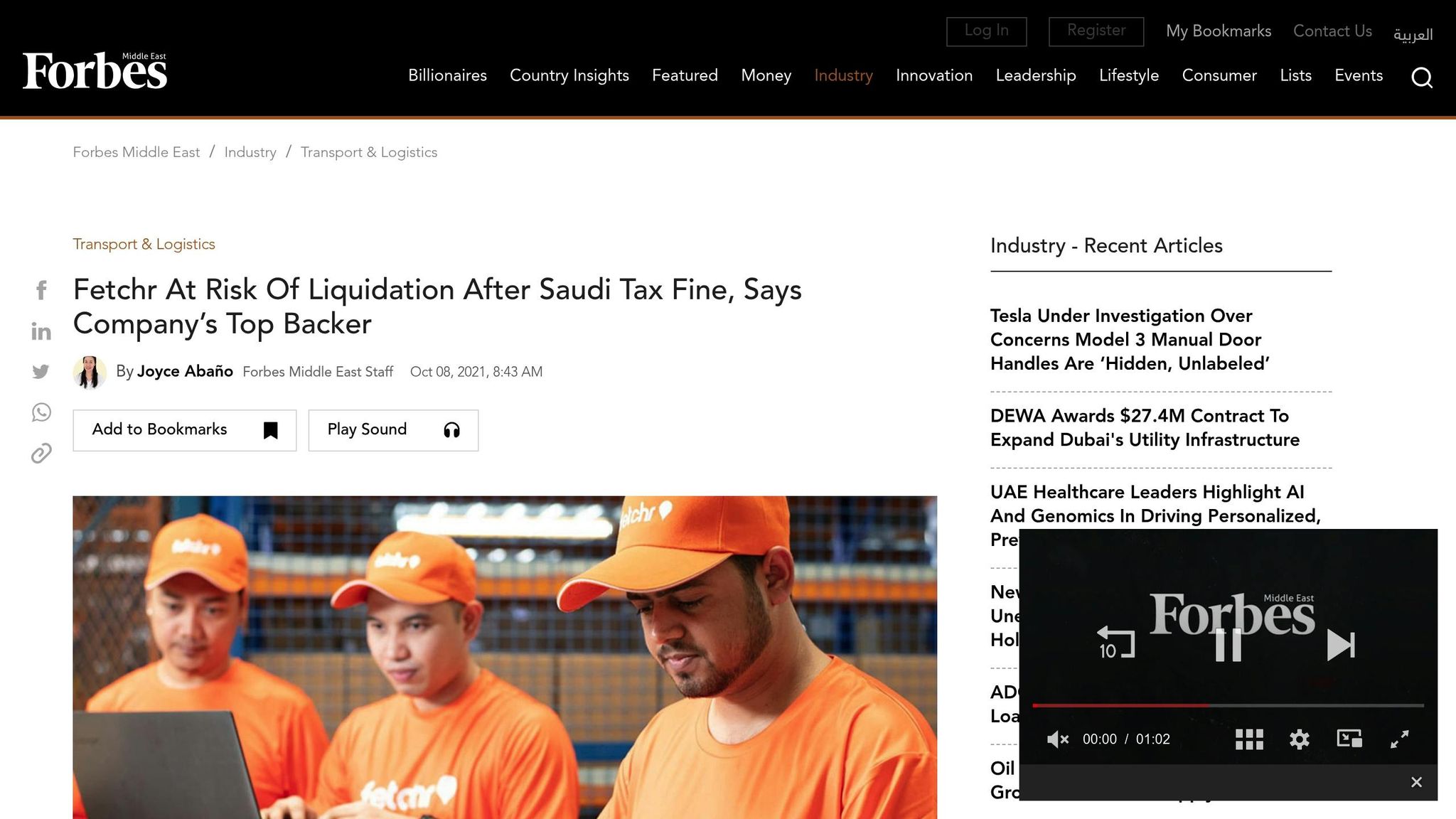
Fetchr addressed a critical logistics issue in the Middle East: the lack of formal addresses. By using GPS coordinates and mobile phone numbers instead of traditional addresses, Fetchr enabled deliveries in areas where street names and building numbers were inconsistent or absent. While this innovative approach solved delivery challenges, high operational costs and complex cash flow issues ultimately led to the company's closure in 2024. Fetchr's story highlights that while groundbreaking technology is essential, it must be supported by sustainable operations.
These success stories illustrate that understanding local contexts and building strong infrastructure are key to scaling UAE startups beyond the AED 36.7M threshold.
Lessons from UAE Startups with AED 36.7M+ (USD 10M+) Funding
Common Growth Strategies Among Top-Funded Startups
Tackling large-scale infrastructure challenges has proven to be a fast track to securing significant funding. For instance, Souq built its e-commerce logistics from the ground up, while Property Finder developed advanced data systems to inject much-needed transparency into the real estate market. Haider Ali Khan, CEO of Dubizzle Group MENA, emphasised this approach:
"The foundation of success lies in building a strong, scalable tech infrastructure from the beginning" [11].
Diversification is no longer optional - it’s essential. Expanding into broader ecosystems not only increases customer lifetime value but also makes businesses more resilient to external disruptions compared to single-service models. This focus on scalable infrastructure directly appeals to investors, as seen in the success of UAE’s leading startups.
Another trend reshaping the funding landscape is the move towards asset-free business models. Vista Global’s achievements in aviation highlight how traditionally capital-heavy industries can scale globally without owning physical assets. Supporting this shift, Enterprise Applications - dominated by SaaS and asset-light models - secured AED 2.53 billion (USD 688.1 million) in Q1 2025, marking a staggering 1,111% year-on-year growth [1].
These strategies are not just theoretical - they form the blueprint for attracting high-value funding rounds and offer practical lessons for founders aiming to scale their ventures.
Practical Advice for Founders Raising AED 36.7M+ (USD 10M+)
Today’s investors are laser-focused on sustainable unit economics and clear profitability plans [6]. A great example is FlapKap, which raised AED 124.7 million (USD 34 million) in pre-Series A funding in September 2024 by showcasing strong unit economics through its AI-powered lending platform for SMEs [12][2].
Founders also need to adapt to shifting funding structures. Milestone-based funding is now the norm for large rounds. Instead of receiving the full amount upfront, capital is released in stages, tied to specific KPIs such as revenue goals, customer acquisition metrics, or market expansion achievements [6]. For instance, in April 2024, G42 secured AED 5.51 billion (USD 1.5 billion) from Microsoft, with funding contingent on meeting integration benchmarks [6][13]. To navigate this, founders should prepare detailed milestone roadmaps that align with these structured funding requirements.
Additionally, due diligence has become far more rigorous. When Tabby raised AED 587 million (USD 160 million) in its Series E round in Q1 2025 - achieving a valuation of over AED 12.1 billion (USD 3.3 billion) - the process involved extensive reviews of legal, financial, and regulatory frameworks [1]. Late-stage investors now scrutinise every operational detail, from intellectual property rights to compliance and governance structures. Founders must ensure all legal documentation and compliance frameworks are in order well ahead of fundraising efforts [6].
For UAE entrepreneurs navigating these funding complexities, learning from peers who’ve successfully raised large rounds can be incredibly beneficial. Platforms like Founder Connects offer virtual masterminds and curated investor lists, providing founders with direct access to insights and strategies for meeting the high expectations of today’s funding landscape.
sbb-itb-f597d8f
Building Investor Relationships and Using Community Support
The Role of Community in Scaling Startups
In the UAE, startups are thriving not just through funding but also by tapping into vibrant communities that help bridge the gap with investors. Drawing inspiration from success stories like Careem and Property Finder, founders are learning to combine active community engagement with strong investor governance to drive growth well past the AED 36.7 million mark.
Initiatives like Hub71's Tech Barza, which saw a 10% growth in 2024, and corporate partnerships valued at AED 103 million (USD 28 million), highlight how these ecosystems validate market potential while deepening investor relationships [2]. Additionally, capital partners have channeled AED 238 million (USD 65 million) directly into the Hub71 startup network, fostering direct connections between founders and high-net-worth individuals [2].
For those seeking more structured guidance, platforms such as Founder Connects provide tools like virtual masterminds, curated investor lists, and networking opportunities. These resources complement the broader ecosystem, offering mentorship and peer learning opportunities that are invaluable for scaling businesses.
These community-driven networks do more than just improve access to funding - they create a foundation for long-term investor relationships that can sustain and scale startups.
Best Practices for Long-Term Investor Partnerships
While community platforms help establish those initial connections with investors, maintaining and strengthening these relationships requires a focus on governance and transparency. For example, having board representation, such as Microsoft's Vice Chair Brad Smith joining G42’s board following a AED 5.51 billion (USD 1.5 billion) investment, ensures alignment on strategic goals [14][6]. This type of governance creates accountability structures that go beyond the standard quarterly updates.
Milestone-based funding is becoming the norm, meaning founders must implement clear and transparent reporting systems. Instead of receiving the full investment upfront, funding is now tied to achieving specific benchmarks and meeting compliance standards [6][13].
Another key to deepening investor ties is strategic collaboration. A great example is G42 migrating its data platform to Microsoft Azure, which not only integrated the startup into Microsoft's ecosystem but also created mutual dependencies that benefited both parties [14]. This kind of co-innovation turns investors into active partners who are directly invested in the startup's growth. Ahmad Ali Alwan, CEO of Hub71, summed it up well:
"Hub71 began as an ambitious idea to enable founders to build from Abu Dhabi. That idea has since grown into a thriving community of entrepreneurs, investors, and partners working together to drive lasting impact" [2].
Regulatory compliance has also become a cornerstone of maintaining investor confidence. For instance, G42’s agreement with the US and UAE governments to ensure responsible AI deployment provided the framework necessary for Microsoft’s investment [14][13]. Startups aiming to secure funding exceeding AED 36.7 million (USD 10 million) must ensure all legal, financial, and regulatory requirements are in place, especially as due diligence processes become increasingly stringent.
Why is Everyone Investing in UAE Startups Right Now?
Conclusion: The Future of UAE Startups
The UAE’s startup ecosystem has firmly established itself on the global stage. Recent funding achievements highlight the region’s growing maturity. Companies like Careem, Property Finder, and Tabby have shown that resilience, scalability, and well-structured partnerships with investors are the driving forces behind ventures that cross the AED 36.7 million (USD 10 million) funding threshold. These success stories have laid a solid foundation for the next wave of entrepreneurial growth.
Looking ahead to 2030, the UAE’s goal of creating 20 new unicorns is supported by tangible initiatives. Programmes like Hub71+ AI, Hub71+ ClimateTech, and regulatory sandboxes are fostering advancements in areas such as artificial intelligence and carbon mineralisation. As Jigar Sagar, Founder of Triliv, aptly expressed:
"It's not a question of 'if' but 'when.' For too long, we've celebrated millionaires flying into the UAE. Now, it's time to see millionaires being born here" [17].
The rise in late-stage funding - reaching AED 2.79 billion (USD 760 million) in Q1 2025 - signals strong investor confidence [1]. That said, early-stage entrepreneurs should not feel disheartened. The ecosystem is creating a ripple effect, where successful exits lead to experienced founders launching new ventures, further enriching the community [11].
Another critical factor is the power of community. Startups with access to mentorship show an impressive 70% survival rate [15]. Platforms like Founder Connects, which offer virtual masterminds and curated investor resources, are helping founders navigate the challenges of growth. A combination of funding, mentorship, and strategic alliances will shape the next generation of UAE startups.
The future will favour founders who keep their focus on customers, practise financial discipline, and adapt to change quickly. With the UAE accounting for 38% of all new venture capital deals in the MENA region as of Q3 2024, the opportunity is immense [16]. The time to act is now. Bold founders must rise to the occasion and take advantage of this thriving ecosystem.
FAQs
What drives the rapid growth in startup funding across the UAE?
The UAE's startup ecosystem is thriving, driven by a mix of government initiatives, a booming tech sector, and strong international partnerships. Just in Q1 2025, tech startups raised an impressive AED 3.20 billion (≈ $872 million), marking a staggering 194% jump compared to the previous quarter. Leading the pack were sectors like fintech, enterprise software, and retail. Unsurprisingly, Dubai emerged as the star of the show, accounting for a massive 96% of this funding, solidifying its position as a tech powerhouse.
Meanwhile, Abu Dhabi’s Hub71 ecosystem is making waves of its own. In 2024 alone, it attracted AED 8.02 billion (≈ $2.17 billion) in funding, reflecting a 44.7% increase from the previous year. This growth is largely thanks to its ability to draw in global founders and investors. Major investments, such as Microsoft’s AED 5.51 billion (≈ $1.5 billion) stake in AI frontrunner G42, underscore the UAE’s bold vision to lead on the global innovation stage.
Adding to this momentum are community-driven platforms like Founder Connects, which provide startups with essential tools like curated investor databases, expert guidance, and networking opportunities. These initiatives ensure that startups are not only able to secure funding but also scale successfully, reinforcing the UAE’s reputation as a vibrant and thriving startup hub.
What is the impact of milestone-based funding on UAE startups?
Milestone-based funding, where investors release capital in stages tied to specific goals like product development or revenue targets, is a key element of the UAE's thriving startup ecosystem. This structured approach allows founders to align their growth strategies with investor expectations, while maintaining equity and avoiding the pitfalls of over-capitalisation.
Take Dubai-based fintech Upfront as an example. The company secured AED 36.7 million in pre-seed funding to validate its AI-powered cash-flow solution for SMBs across the MENA region. Once it achieved product-market fit, additional funding was unlocked. Similarly, the prop-tech firm PRYPCO raised AED 36.7 million in seed funding, using the capital to scale operations and introduce new services, all tied to pre-defined milestones.
This funding model benefits both sides: it minimises risks for investors, incentivises startups to meet critical goals, and enables faster scaling with stronger governance. For startups in the UAE, it also promotes efficient cash flow management, keeps founders in control, and improves their position for future fundraising in a highly competitive market.
How does community support help UAE startups scale successfully?
Community support is a cornerstone for UAE startups looking to scale, particularly those that have crossed the AED 10 million funding mark. Incubators like in5 and Intelak do more than just provide financial resources - they create a thriving network of mentors, peers, and investors. This collaborative environment helps founders fine-tune their product-market fit, tackle regulatory hurdles, and connect with top talent, laying a strong groundwork for sustained growth.
Platforms such as Founder Connects add another layer to this ecosystem by offering virtual masterminds and tailored investor connections. These tools equip founders with expert advice, help them measure their progress, and address challenges more efficiently. Regular networking events and peer feedback sessions also play a big role in aligning startups with investor expectations, which can strengthen their credibility and attract larger funding rounds.
Initiatives like Hub71 highlight how community-driven ecosystems can have a wider impact. By bringing together entrepreneurs, investors, and partners, these hubs encourage collective growth. This collaborative approach enables startups to scale faster and positions well-funded ventures as leaders in the UAE market.
Related Blog Posts

Building in MENA? You don't have to do it alone.
Join 300+ founders in the Founder Connects Residency. Monthly squad calls, warm intros, $3M+ in perks, and much more. All for less than your monthly coffee budget.
Popular posts





Founder Connects is a premium MENA tech founder community. Meetups in Dubai and across MENA, Residency Squads of 8–10, and 400+ vetted WhatsApp founders (apply and screened).