

How UAE Supports SpaceTech Startups

Building in MENA? You don't have to do it alone.
Join 300+ founders in the Founder Connects Residency. Monthly squad calls, warm intros, $3M+ in perks, and much more. All for less than your monthly coffee budget.

The UAE is positioning itself as a global hub for SpaceTech innovation. Here's how the country is creating opportunities for startups in this sector:
- Government Funding: AED 3 billion National Space Fund supports research, engineering, and satellite projects like the Sirb constellation. The Ghadan 21 Innovation Programme adds AED 1.84 billion for R&D, equity investments, and relocation support for international founders.
- Space Economic Zones: Special zones in Abu Dhabi and Dubai offer fast-tracked permits, advanced labs, cost-effective workspaces, and tailored licences for space-related activities.
- Major Projects: Initiatives like the Emirates Mission to the Asteroid Belt (launching in 2028) actively involve private startups, creating high-value contract opportunities.
- Partnerships & Networking: Collaborations with entities like Masdar City, MBRSC, and DIFC Innovation Hub connect startups with expertise, funding, and pilot project opportunities.
- Focus Areas: Beyond space exploration, the UAE uses SpaceTech to address agriculture, climate monitoring, and infrastructure challenges under its 'Space for Earth' strategy.
With robust financial support, specialised infrastructure, and a focus on public-private collaboration, the UAE is building a vibrant ecosystem for SpaceTech startups.
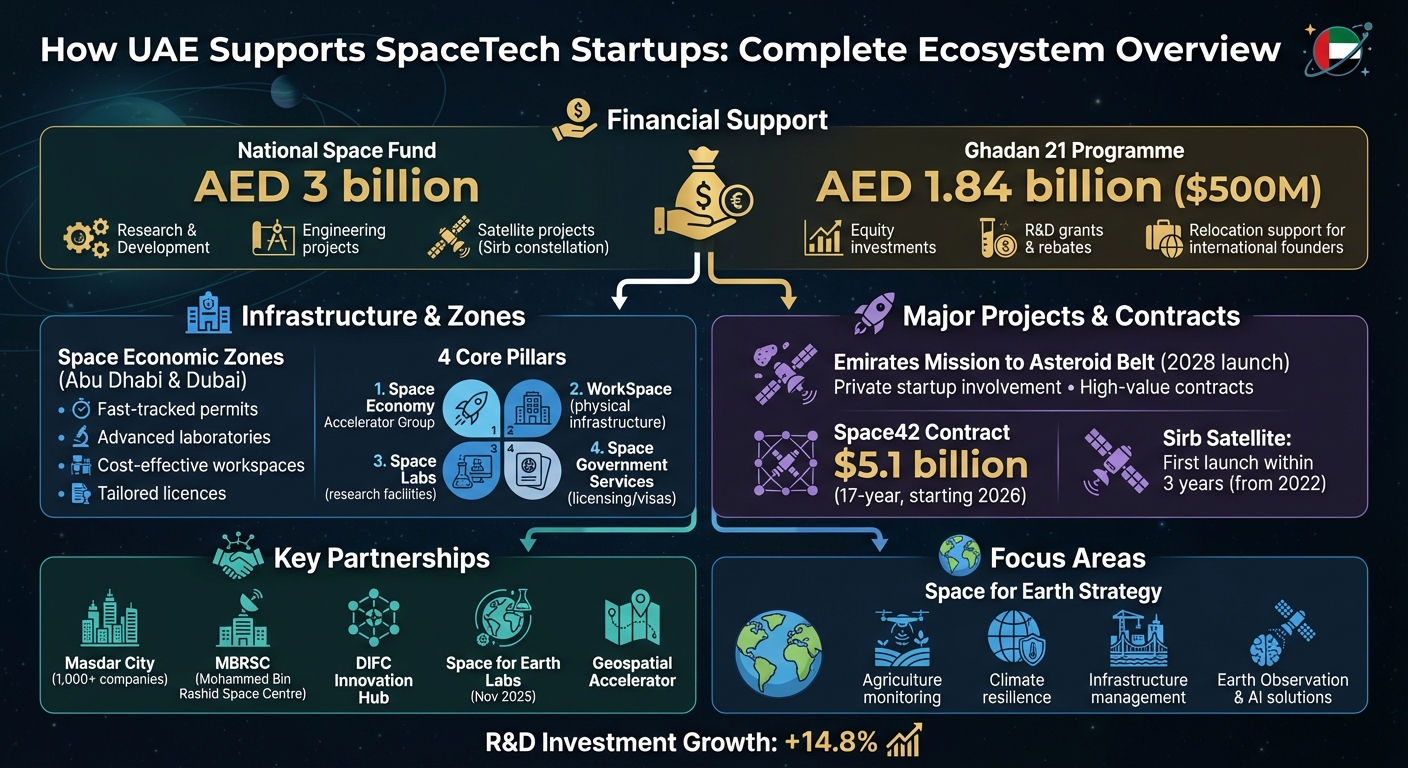
UAE SpaceTech Startup Support: Funding, Infrastructure & Opportunities Overview
Space Cafe Radio - Shaping Tomorrow: UAEs Path in the Global Space Sector with H.E. Salem Al Qubaisi
sbb-itb-f597d8f
Government Funding and Financial Support
The UAE government has crafted a range of funding programmes tailored to support startups at every stage of their journey. For global entrepreneurs, aligning their ventures with the UAE's space sector priorities opens doors to these valuable initiatives.
The National Space Fund
The AED 3 billion National Space Fund, overseen by the UAE Space Agency, is a flagship programme designed to propel SpaceTech innovation. This fund supports research and development, engineering projects, and critical infrastructure while fostering collaborations between Emirati and international companies. One of its standout projects is the Sirb satellite constellation, which was announced in July 2022. The first satellite from this initiative is expected to launch within three years. Startups can access financial incentives and specialised resources by registering through the Space Economic Zones Programme, provided their projects align with national space priorities [2].
"The National Space Fund will encourage global partnerships to establish themselves here in the Emirates, providing new and vital technology platforms and development to answer the needs of the UAE Space Programme." – Salem Al Qubaisi, Director General of the UAE Space Agency [2]
Ghadan 21 Innovation Programme
Adding to the National Space Fund, the Ghadan 21 Innovation Programme is another critical initiative. Administered by the Abu Dhabi Investment Office (ADIO), this programme offers over $500 million (AED 1.84 billion) in incentives for high-growth sectors, including SpaceTech. Its support package includes equity investments, grants, and rebates aimed at advancing R&D and technology pilot projects. Additionally, it provides relocation support for international founders, with ADIO assisting entrepreneurs in setting up their businesses and integrating into Abu Dhabi's ecosystem [5].
Together, the National Space Fund and Ghadan 21 create a robust funding pathway. They enable startups to progress from initial R&D to scaling operations, all while aligning with the UAE's ambitious space missions. This approach highlights the nation's dedication to fostering innovation and supporting the growth of its dynamic startup ecosystem.
Space Economic Zone Program Benefits
With robust government backing, the UAE has strengthened its commitment to the space sector, as highlighted in recent UAE startup news through the Space Economic Zone Program. This initiative, launched in September 2022, connects the UAE Space Agency with key hubs like Masdar City and DIFC, creating a launchpad for SpaceTech ventures. The programme offers tailored licences and cutting-edge laboratories to accelerate growth in the space industry [6].
The programme is built on four core pillars:
- Space Economy Accelerator Group: Focused on strategic initiatives and partnerships.
- WorkSpace: Provides physical infrastructure and incubation support.
- Space Labs: Offers expert guidance and advanced research facilities.
- Space Government Services: Simplifies licensing and visa processing [7].
Financial perks include priority access to government contracts, investment opportunities, and a dedicated stimulus package aimed at attracting small and medium-sized enterprises (SMEs) in the space sector. Additionally, the programme ensures comprehensive visa services, covering residency stamping, medical tests, and Emirates ID processing [6]. Masdar City, the programme’s primary hub, already houses over 1,000 companies, fostering a collaborative and thriving environment [6].
"The new stimulus package by the Space Economic Zone Program in Masdar City, is designed to help attract and develop more businesses in the space sector." – H.E. Ibrahim Al Qasim, Deputy Director General of the UAE Space Agency [6]
How to Join the Space Economic Zone
To become part of the Space Economic Zone, choose the hub that aligns with your business focus. For Earth Observation and AI solutions, apply through the DIFC Innovation Hub. For ventures involving physical R&D, Masdar City Free Zone is the ideal choice. You’ll receive a customised business licence covering activities like satellite engineering and data analysis [3][6].
Once accepted, the programme provides a comprehensive package, including registration services, office space, and access to its four operational pillars.
The Geospatial Accelerator at the DIFC Innovation Hub offers additional support, including licensing assistance, soft-landing services, and collaboration with UAE government entities to implement Proof-of-Concept projects. This pathway is particularly beneficial for global and regional scale-ups looking to test solutions for challenges like climate resilience and infrastructure management using satellite data [3].
"Masdar City has developed a unique ecosystem that enables business and innovation to thrive together." – Ahmed Baghoum, Executive Director, Masdar City [6]
Access to Space Labs and Accelerators
Once your venture secures a specialised licence, you’ll gain access to Space Labs and accelerators, helping transform R&D into commercial solutions. Space Labs serve as the technical foundation of the Space Economic Zone, offering consultancy, advanced lab equipment, and mentorship from industry leaders [7].
In November 2025, the Mohammed Bin Rashid Space Centre (MBRSC) and DIFC Innovation Hub launched "Space for Earth Labs." Backed by RELM Insurance, this platform focuses on space finance, insurance, and Earth Observation technologies. Startups benefit from access to satellite imagery, data resources, and AI-driven tools that are often hard to acquire elsewhere [3].
The Geospatial Accelerator within Space for Earth Labs provides startups with direct access to government entities, enabling them to pilot solutions. It also offers technical support for developing and implementing Proof-of-Concept projects. The DIFC ecosystem, valued at USD 4.2 billion and home to over 1,500 FinTech and innovation firms, provides ample networking opportunities [3].
"Through Space for Earth Labs, we are building the mechanisms that translate data, research and innovation into tangible value for governments, industries and society." – His Excellency Salem Humaid AlMarri, Director General, MBRSC [3]
This comprehensive framework aligns with the UAE’s broader initiatives to establish itself as a global leader in SpaceTech innovation.
Networking and Community Platforms
SpaceTech startups in the UAE are thriving not only because of government programmes and infrastructure but also through strategic partnerships and community-driven initiatives. These connections help startups participate in national missions and engage with key industry stakeholders, complementing the financial and infrastructural support already in place.
UAE Space Agency Partnerships
The UAE Space Agency takes its support further by fostering partnerships that connect startups with vital resources and opportunities. For example, collaborations with Masdar City and the Mohammed Bin Rashid Space Centre (MBRSC) provide startups access to ecosystems that combine technical expertise with commercial prospects. A great example is Farmin, a UAE-based remote-sensing platform. In 2025/2026, Farmin leveraged the MBRIF Innovation Accelerator Programme to establish partnerships with MBRSC, Abu Dhabi Maritime Academy (ADMA), and Abu Dhabi Ports. These collaborations helped the company secure over AED 1.1 million in project funding[8].
Another key initiative is the partnership between MBRIF and AzurX, which extends networking opportunities to include international giants like Blue Origin. The seventh cohort of the MBRIF Innovation Accelerator Programme, chosen from over 230 applicants across 41 countries, highlights the competitive yet accessible nature of these programmes[8].
"At MBRIF, we believe partnerships are crucial to the development of the innovation ecosystem. Our collaboration with AzurX is a strategic move to enhance the impact and reach of innovative endeavors within the space sector." – Fatima Yousif Alnaqbi, Acting Assistant Undersecretary for Support Services Sector, UAE Ministry of Finance[8]
These partnerships, combined with peer-to-peer networking, provide SpaceTech founders with tools to grow and innovate.
Founder Connects for SpaceTech Growth
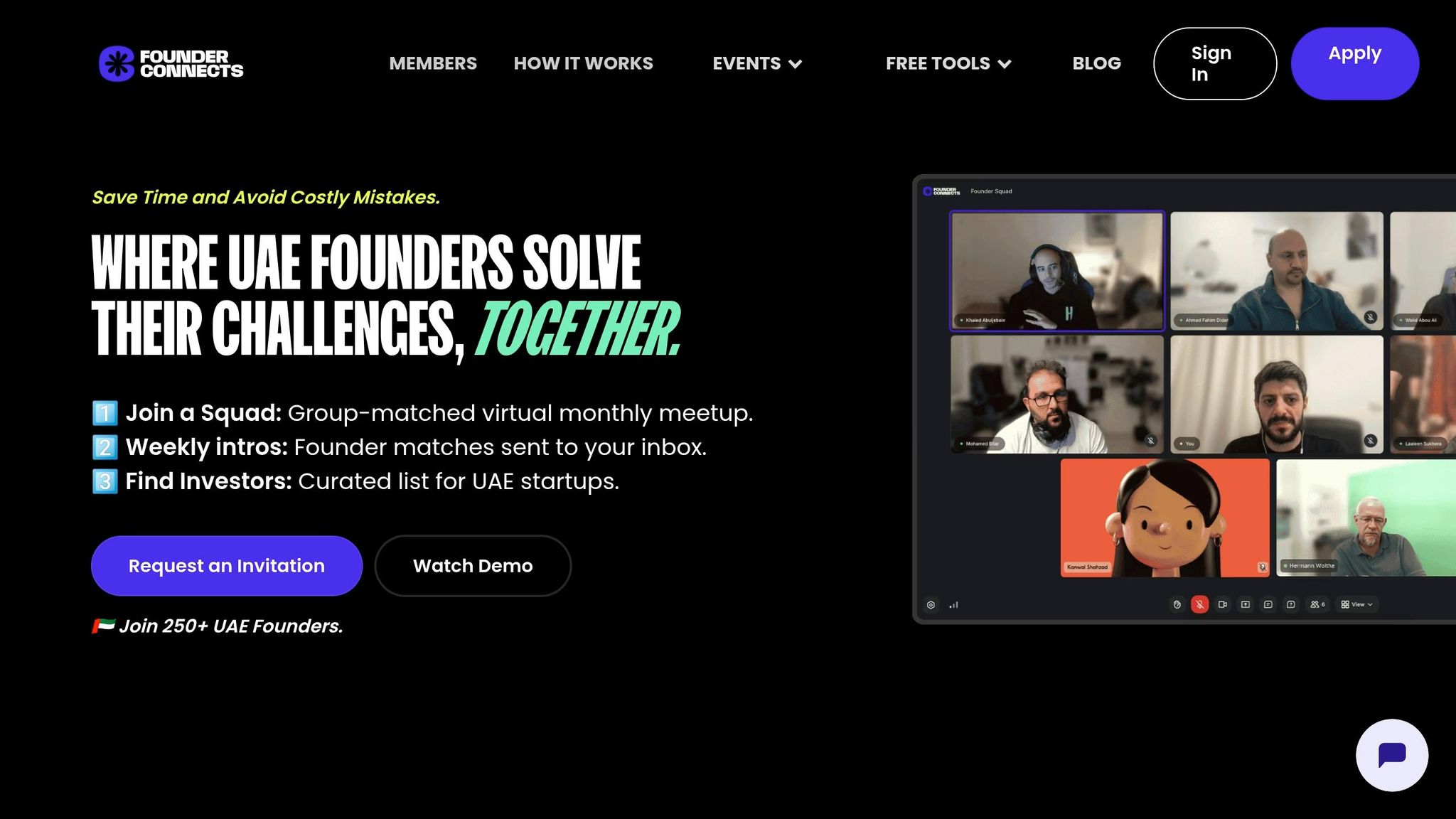
The UAE also supports SpaceTech entrepreneurs through platforms like Founder Connects, which organises virtual mastermind groups tailored to specific challenges in the sector. Founders can collaborate with peers, exchange ideas, and tackle industry-specific hurdles together.
Members gain access to a carefully curated list of investors who understand the unique financial needs of space-related ventures. The platform also hosts exclusive community events that connect founders with UAE-based startup investors. Live talks by industry experts offer actionable advice on navigating the UAE startup ecosystem, from securing funding to tapping into government support programmes.
Additionally, SpaceTech entrepreneurs benefit from networking introductions to mentors who are well-versed in the technical and regulatory complexities of the industry. This mix of expert guidance, peer collaboration, and tailored resources creates an environment where startups can commercialise their technologies and scale their operations across the region.
Conclusion
The UAE provides a well-rounded support system for SpaceTech startups, offering much more than just financial assistance. Key elements include the AED 3 billion National Space Fund [2], dedicated Space Economic Zones, and initiatives like Space for Earth Labs. These programmes are designed to offer financial support, simplify regulatory processes, and open up commercial opportunities. High-profile projects, such as the Emirates Mission to the Asteroid Belt and Space42's $5.1 billion, 17-year contract starting in 2026 [4], highlight the tangible opportunities available within the UAE's space sector.
What sets the UAE apart is its emphasis on bringing space innovations into practical use. Partnerships like the one between MBRSC and DIFC Innovation Hub demonstrate how space data can address real-world challenges, including climate resilience, agriculture, and infrastructure. This "Space for Earth" strategy ensures that startups contribute to both space exploration and solutions for pressing global issues.
With these resources in place, entrepreneurs can easily integrate into the UAE's ecosystem. Whether it's by joining the Geospatial Accelerator for access to satellite data and expert guidance, setting up in Space Economic Zones to take advantage of tailored benefits, or finding investors through platforms like Founder Connects, the support system is designed to assist startups at every stage, from ideation to scaling across the Middle East, Africa, and Asia.
The UAE's startup ecosystem is thriving across sectors like tech, AI, and fintech, with a strong focus on SpaceTech. Backed by regulatory frameworks aligned with OECD and UN standards, a 14.8% rise in R&D investment [1], and a government committed to fostering public-private partnerships, the groundwork for long-term growth is firmly in place. For SpaceTech founders, the UAE offers an unmatched combination of government support, advanced infrastructure, and a collaborative community to turn bold ambitions into successful ventures.
FAQs
Am I eligible for UAE SpaceTech funding as a foreign founder?
Foreign entrepreneurs can tap into UAE SpaceTech funding by partnering with Emirati or local companies, joining government-supported programmes such as the National Space Fund, or competing in initiatives organised by the UAE Space Agency. Eligibility requirements vary by programme, but the funding aims to support both international and Emirati businesses contributing to the space industry.
How do I join the Space Economic Zone and get the right licence?
To become part of the UAE's Space Economic Zone and secure the necessary licence, adhere to the guidelines set by the UAE Space Agency. This includes applying for an express permit, which encompasses licences, permissions, and approvals as outlined under Federal Law No. (12) of 2019.
Situated in Abu Dhabi’s Masdar City, the zone provides customised business licences, incubation programmes, and mentorship opportunities. For more details on the application process and specific requirements, reach out directly to the UAE Space Agency.
Which UAE programmes help startups pilot Earth Observation solutions with government?
The UAE actively encourages startups to explore Earth Observation solutions through various initiatives. One notable example is the Space Startup Pitch Competition, which provides mentorship and training in areas like satellite imagery and AI-powered solutions.
Additionally, the UAE Space Agency's Space Applications - Earth Observation training programme plays a key role in building expertise. This programme focuses on equipping Emirati professionals, researchers, and graduates with practical space knowledge, driving forward new ideas and advancements in the field.
Related Blog Posts

Building in MENA? You don't have to do it alone.
Join 300+ founders in the Founder Connects Residency. Monthly squad calls, warm intros, $3M+ in perks, and much more. All for less than your monthly coffee budget.
Popular posts





Founder Connects is a premium MENA tech founder community. Meetups in Dubai and across MENA, Residency Squads of 8–10, and 400+ vetted WhatsApp founders (apply and screened).