
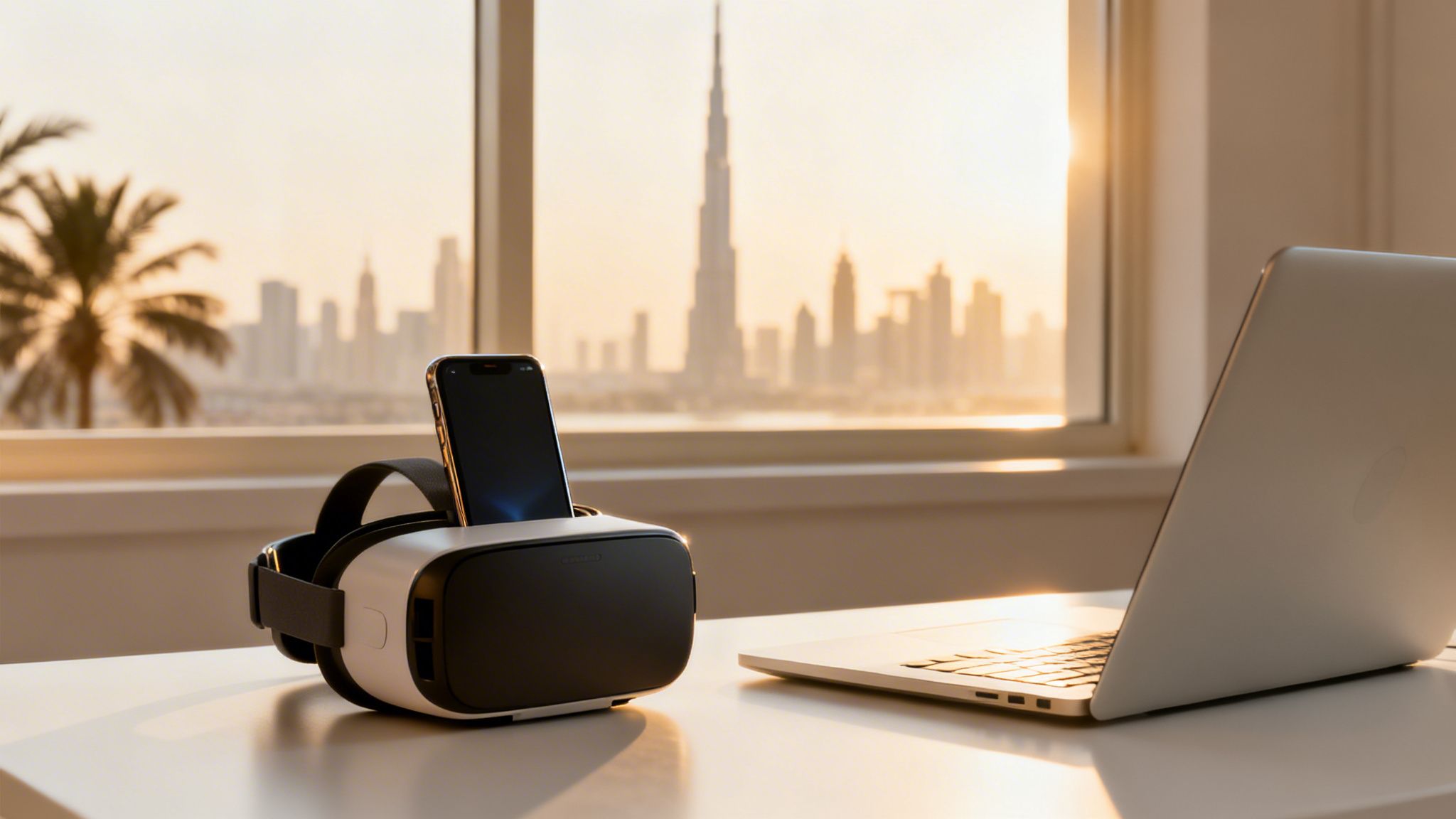
For founders in the UAE, the fastest entry into immersive tech might be on your desk right now. The concept is virtual reality headset phones: your smartphone provides the screen, processor, and sensors, while an inexpensive headset acts as the shell. This pairing creates a powerful bridge between high-end VR systems and the mass market, giving you a low-cost way to test your ideas.
If you're a startup founder in Dubai or Abu Dhabi, building for virtual reality might seem complex and expensive. But by slotting a capable phone into a simple headset, you can instantly create an immersive experience. This approach sidesteps the need for dedicated VR hardware, dramatically lowering the barrier to entry. Think of it as turning a device everyone already owns into a ready-made development kit.
The UAE has one of the highest smartphone penetration rates in the world. This means your target audience already owns the most critical piece of the mobile VR puzzle. For a founder, this is a massive, pre-existing market waiting for your app.
This translates into three immediate wins:
Next Action: Ask your team: "Could we test our core value proposition using a mobile VR experience that costs less than AED 200 per user to deploy?" This frames the conversation around accessibility and speed, not technical complexity.
Using virtual reality headset phones is about smart leverage. It lets you explore an exciting tech frontier with minimal financial risk, making it a sharp move for any agile startup in the region.
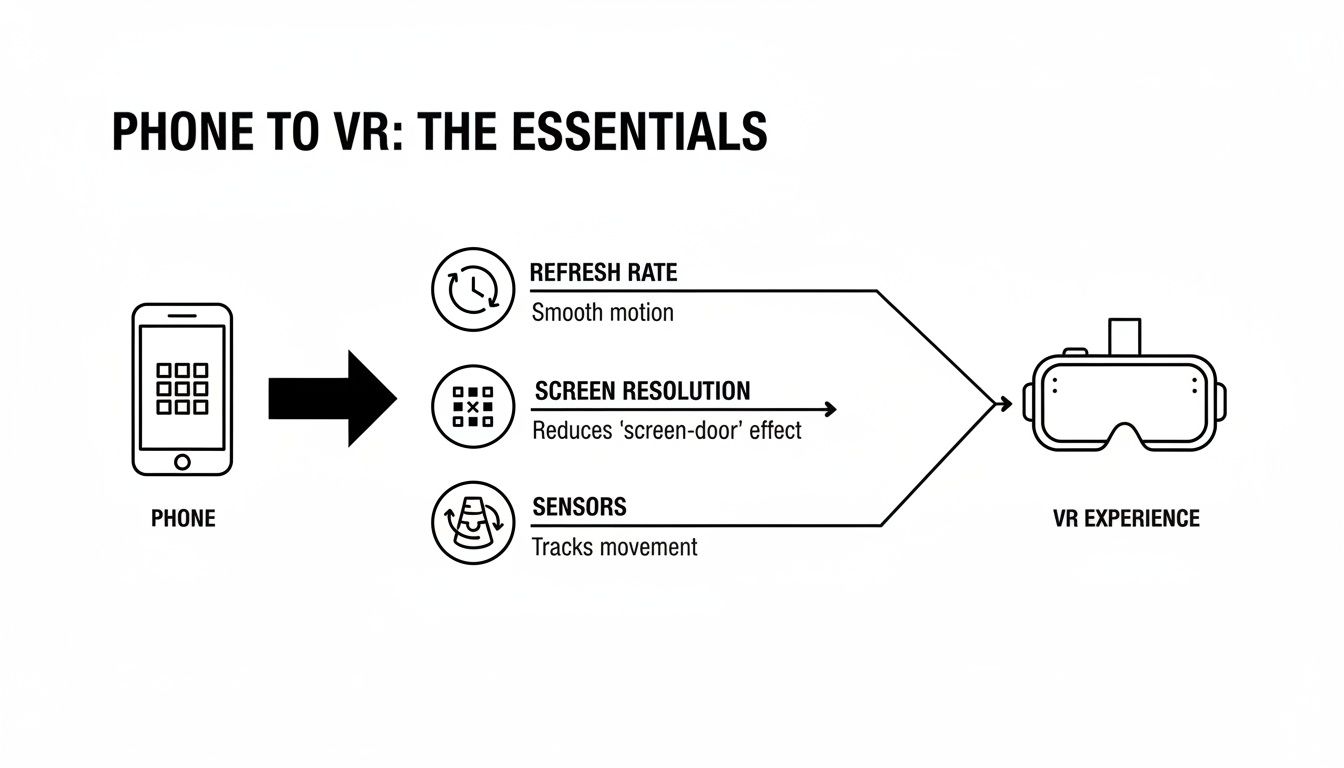
You don't need an engineering degree to grasp how virtual reality headset phones work. When you slide your smartphone into a headset, you're giving its existing tools a new job. Your phone’s screen becomes your window into the virtual world, and its internal sensors act as your guide, tracking every movement.
The most critical piece of the puzzle is your phone's display. For VR, two specs are non-negotiable: resolution and refresh rate.
How does the virtual world know when you turn your head? Your phone's internal sensors act like an inner ear, giving the device a sense of orientation.
Together, they feed data to the VR app, telling it where you're looking. The magic is low latency—the tiny delay between your head movement and the screen update. If the delay is too long, the experience feels laggy and can cause nausea. High-quality sensors are essential for keeping this gap small.
To stay ahead, keep up with emerging app development technologies exploring AR, VR, and wearables. Understanding these core components will help you select the right phones for testing your next big idea.
For founders in the UAE, getting started with mobile VR is straightforward. The local market offers a solid range of hardware and software options to take you from prototype to polished app.
On the hardware side, you have a spectrum of choices. Basic viewers like Google Cardboard clones are cheap and can be sourced in bulk from marketplaces like Noon or Amazon AE, making them perfect for mass giveaways or initial concept validation. For investor demos, a sturdier plastic headset with better lenses will deliver a more convincing experience.
Finding hardware locally is easy. The more strategic decision is your software platform. Two major players dominate immersive development:
Both engines offer powerful mobile VR SDKs (Software Development Kits) that help your team build and launch your app.
Once your app is built, your primary gateway to users is the Google Play Store. Given Android's dominance in the MENA region, this is where your audience is.
The opportunity is massive. According to Statista, the UAE's AR/VR market is set for explosive growth, with revenue projected to reach nearly USD 500M by 2028. This boom is fuelled by industries like real estate, where virtual property tours are already proving highly effective. As noted by Global Brands Magazine, the UAE VR market is shaping the future, with Dubai expected to drive a significant portion of regional demand.
Next Action: Task your technical lead with spending a day reviewing the mobile VR documentation for both Unity and Unreal Engine. This small time investment provides a realistic picture of the development path for your MVP. For firsthand advice, connect with other tech founders at local startup events in Dubai.
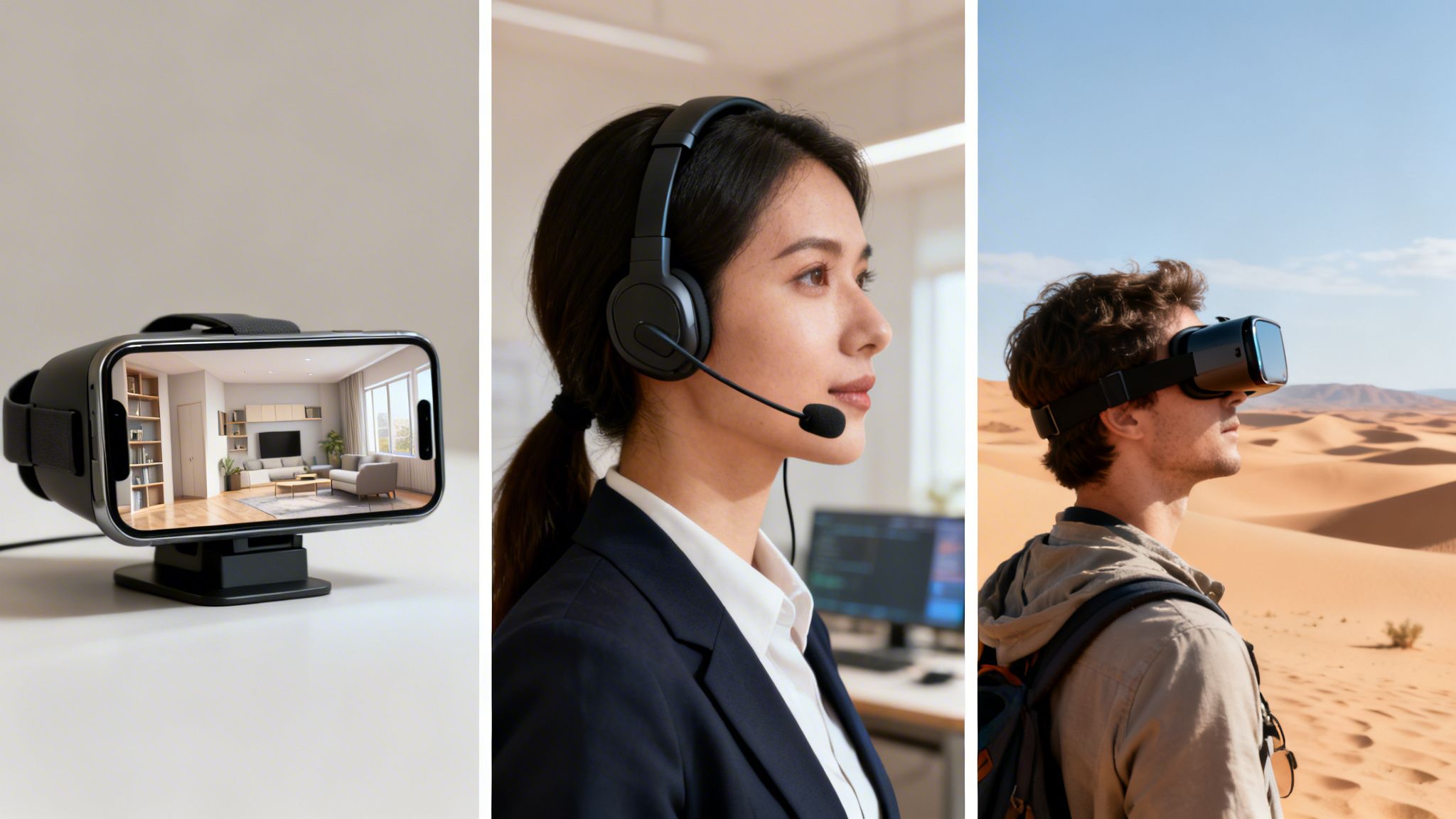
Understanding the tech behind virtual reality headset phones is one thing; spotting its business potential is another. For founders in the MENA region, the accessibility of mobile VR creates practical openings that solve real market problems without a massive upfront investment. The key is to focus on applications where an immersive experience delivers immediate, tangible value.
Next Action for Your Team: Brainstorm one specific problem in your industry that could be solved by giving customers a powerful sense of 'being there'. How could a simple, phone-based VR experience de-risk their decision or improve their understanding of your product?
Gaming is also a massive opportunity. The GCC's VR gaming market is projected to grow significantly, and Dubai's VR gaming cafes offer a direct channel for testing new games. If this is your space, check out the top gaming and esports startups in the region.
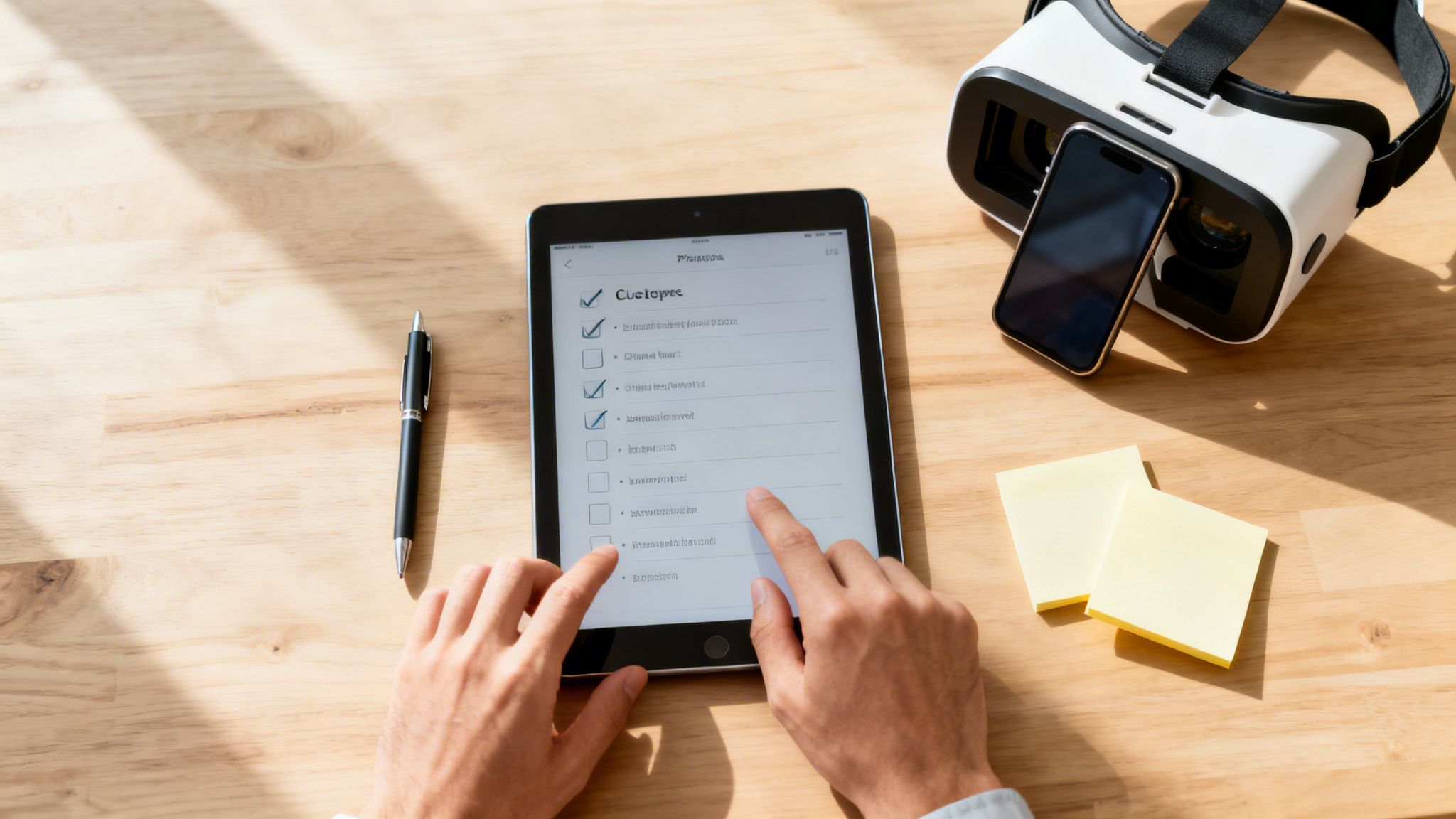
Execution separates a neat idea from a real business. For founders using virtual reality headset phones, an MVP is about being lean, fast, and focused on user feedback. This blueprint provides a simple, step-by-step framework to get your first prototype built and tested without breaking the bank. Your goal isn't perfection; it's learning.
Before writing any code, define your target hardware. In the UAE, the market is dominated by a handful of phone models.
For mobile VR, performance is everything. A clunky experience kills the concept. Agree on these non-negotiables before you start:
Key Insight for Founders: Your first prototype's job is to prove your core experience is engaging without making users feel sick. Nail performance basics first, then add features.
Once you have a prototype, put it in front of real people. Don't ask vague questions like, "Did you like it?" Focus on specific, observational feedback. For more structured guidance, explore MVP development options for companies in the UAE. This is especially relevant as the growth of the AR/VR market in the United Arab Emirates accelerates, driven by affordable phone-based units.
Next Action: Run a small test. Get 5-10 people from your target audience. Hand them the phone and headset with minimal instruction, and just watch. Ask targeted questions afterward: "What felt intuitive?" "Where did you get stuck?" This feedback is gold.
The world of VR headset phones is moving fast. For founders in the UAE, this is an opportunity to get in on the ground floor. The accessibility you see today is just the beginning.
The rollout of 5G across the MENA region is a game-changer. It reduces the smartphone's processing bottleneck, enabling high-fidelity VR content to be streamed from the cloud. This means rich, immersive experiences won't require a top-of-the-line phone, opening the door for mass adoption.
Additionally, AI will create more dynamic virtual worlds, while principles from futuristic user interface design will shape the next wave of AR and VR.
While standalone headsets like the Meta Quest are gaining ground, they are still deeply connected to the smartphone for setup, content management, and social features. This hybrid model keeps the phone at the center of the VR experience, cementing its role as the main gateway to immersive tech for the foreseeable future.
Your Next Action: Use today's virtual reality headset phones as your low-cost R&D lab. Start experimenting now to test your core ideas. Connect with your local founder network to build and test the next generation of immersive apps made for the MENA market.
If you’re a founder in the UAE, you probably have specific questions about using mobile VR. Here are practical answers to help you make smart, fast decisions. This is strategic advice tailored for the MENA ecosystem.
To avoid lag and overheating, focus on three core specs:
For any startup in the MENA region, the answer is simple: start with Android. Its massive market share in the UAE means you're building for the majority of your potential customers. Testing on a variety of compatible Android devices is also easier and more affordable. The Google Play Store is generally more forgiving with experimental apps, allowing for faster iteration during the critical MVP stage.
You don't need a massive budget. A good starting point for a founder in Dubai or Abu Dhabi is AED 2,500 - AED 4,000.
At Founder Connects, we believe in building with purpose and clarity. Our community is designed to provide the peer support and practical insights you need to navigate challenges like these. Join a network of founders who are building, testing, and scaling their ideas right here in the MENA region. Connect with us at https://www.founderconnects.com.


