
So, what exactly is a startup? It's a loaded question, and for a founder in the UAE, the answer isn't just academic—it shapes your entire strategy.
Put simply, a startup is a company engineered from day one for fast growth. It’s built on a scalable and repeatable business model designed to solve a specific problem in a massive market. Unlike a traditional small business focused on steady profits, a startup's entire mission is to capture a huge market, often by shaking things up with a disruptive idea and venture capital backing.
Let's cut through the buzzwords you hear at pitch competitions. What truly defines a startup isn't a clever idea or a flashy app; it's a specific kind of business DNA.
Think of it this way: a startup is like a rocket ship, meticulously designed for an exponential trajectory. A small business is like a reliable car built for a steady, predictable journey. Both are valuable, but their core purpose, design, and fuel are fundamentally different. For founders here in the UAE and across MENA, getting this distinction right is crucial for attracting the right talent, securing investment, and building a company that can truly make an impact.
This operational DNA boils down to three core pillars that set a startup apart from any other new business. If you're missing even one, you're likely building a different kind of venture.
A true startup is defined by its relentless pursuit of these three elements working in harmony.
Getting the operational side right is non-negotiable. Manual processes, for example, can be a huge drain on resources for growing finance teams at startups and will slow you down.
UAE Context: In the UAE, the definition of a startup is also shaped by the nation's ambitious Vision 2031. Here, a startup is seen as an innovative venture poised to help the country create 10 unicorns by 2031.
For founders, this means building a scalable, tech-driven company—often registered in a free zone—and leveraging government incentives like the Golden Visa for entrepreneur residency. With over 5,600 new startups registered by Q2 2024 alone, the ecosystem is buzzing and ready for ventures that can scale fast. You can read more about how the UAE is redefining itself as a global startup hub on taxadepts.com.
Now that we have the core DNA down, let’s look at the practical differences between a startup and a traditional small business.
This table breaks down the fundamental distinctions to help you clarify which camp your venture falls into.
Understanding these differences isn't just academic—it dictates your entire strategy, from how you build your team to the story you tell investors. A startup founder pitches a vision of the future; a small business owner presents a plan for sustainable profit today. Both are valid paths, but they lead to very different destinations.
While big ideas get you in the door, what really defines a startup for investors in the UAE are the cold, hard numbers. Theory is great, but tangible metrics are what prove you have a real, scalable business.
These aren't just vanity figures for a pitch deck; they're the vital signs of your venture’s health and potential. For any founder in the MENA region, speaking this language fluently is non-negotiable if you want to attract serious capital.

Let's break down the essential metrics that truly separate a high-potential startup from just a promising idea.
Your Total Addressable Market (TAM) is the maximum revenue you could earn if you captured 100% market share. It’s the size of the entire pie. Investors hunt for massive TAMs because it signals a huge opportunity. A small market, even if you dominate it, simply doesn't offer the potential for the 10x returns venture capital funds need to see.
Actionable Insight: A Dubai-based FinTech startup targeting cross-border remittances for blue-collar workers in the GCC isn't just serving a few people. It’s tapping into a market where remittance outflows from the UAE alone topped $47.5 billion in a single year. That’s the kind of number that makes an investor pay attention.
So the market is huge. But is your business actually profitable at its core? This is where unit economics come in, specifically the critical ratio between your customer's Lifetime Value (LTV) and your Customer Acquisition Cost (CAC).
A healthy startup aims for an LTV/CAC ratio of 3:1 or higher. In simple terms, for every dirham you spend acquiring a customer, you should be getting at least three dirhams back over time. If your ratio is below 1:1, you're losing money on every new customer—that’s a business built to fail.
Need to get granular on this? Our ultimate guide to KPI development for startups offers practical frameworks for tracking these critical numbers.
Traction is the proof that people actually want what you're building. Crucially, in the early days, it’s not just about revenue. Investors in this region are savvy; they look for real engagement and validation.
Local Insight: Early-stage MENA investors often care more about user engagement than initial revenue. A rapidly growing, highly active user base—even if it isn't fully monetized yet—proves you've solved a real problem for a specific audience.
Demonstrable traction can come in many forms:
Finally, your runway is a brutally simple metric: how many months can your startup survive before the cash runs out? It shows investors you’re not just a visionary but also a responsible steward of capital. A founder who can clearly explain their burn rate, key financial milestones, and exactly how a new investment will extend their runway demonstrates operational maturity. It tells an investor you have a plan.
For an investor in the MENA region, the question "what constitutes a startup" is simple. A startup isn't just a business with a cool app; it's a fundable opportunity.
Venture capitalists and angel investors are hunting for massive returns, often looking for a 10x return on their money. This isn’t greed; it’s the fundamental math of their business model. For every big win, they’ll have a portfolio of startups that don’t make it. So, they aren’t just looking for a solid business. They’re looking for a rocket ship.
Understanding this mindset is the first step for any founder who wants to raise capital. Your job isn’t just to pitch your product; it’s to pitch a compelling investment thesis.
When an investor skims your pitch deck, they’re pressure-testing your venture against three core pillars. A crack in any one of these dramatically lowers your chances of getting funded.
The Founding Team’s Expertise: Why you? Seriously, why is your team the one to crack this problem? Investors search for founder-market fit. This means you have deep domain expertise, a proven track record, or a unique insight into a customer’s pain. They need to believe you have the grit and skills to win.
Defensibility of the Innovation: What’s your "unfair advantage"? This is your moat—the thing that stops a well-funded competitor from crushing you. It could be proprietary tech, exclusive data, a powerful network effect, or a business model that’s hard to copy. A strong moat protects your future profits.
Clarity of the Go-To-Market (GTM) Strategy: How will you get customers without burning through all your cash? Investors need to see a clear, data-driven plan for how you’ll reach your target audience, what channels you’ll use, and what your unit economics look like. They need proof you can acquire customers sustainably and at scale.
Key Takeaway: Investors are pattern-matchers. They’ve seen thousands of pitches and spot weaknesses from a mile away. They fund teams who have found a massive opportunity and de-risked the key variables: the team, the moat, and the plan to conquer the market.
The funding scene in the UAE has become incredibly competitive. To give you an idea, a staggering $704.3 million was poured into just 26 UAE startups in Q3 2025 alone. This is part of a bigger wave, with year-to-date funding across MENA hitting a record $6.6 billion in 2025. You can read the full analysis of MENA's Q3 funding on Wamda.com to get a sense of the momentum.
This flood of capital means investors are hungry for deals, but it also means their expectations are higher than ever. You have to speak their language.
When you walk into that investor meeting, remember: you’re not just selling your product, you’re selling a financial outcome.
Want to go deeper on what goes through an investor's mind? Check out our guide on how angel investors evaluate founders and their ideas.
Next Action: The Pitch Audit
Before your next pitch, ask your co-founders these brutally honest questions:
Nailing these answers separates a product demo from a compelling investment opportunity. It's often the difference between a polite "no" and a term sheet.
In the UAE, picking your legal structure isn't just a box-ticking exercise. It's a strategic move that dictates your ability to raise funds, own your company, and operate freely. For any founder building a high-growth venture, this is one of the first and most critical decisions you'll make.
The right structure helps you scale smoothly and attract global investors. The wrong one can throw up roadblocks at every turn.
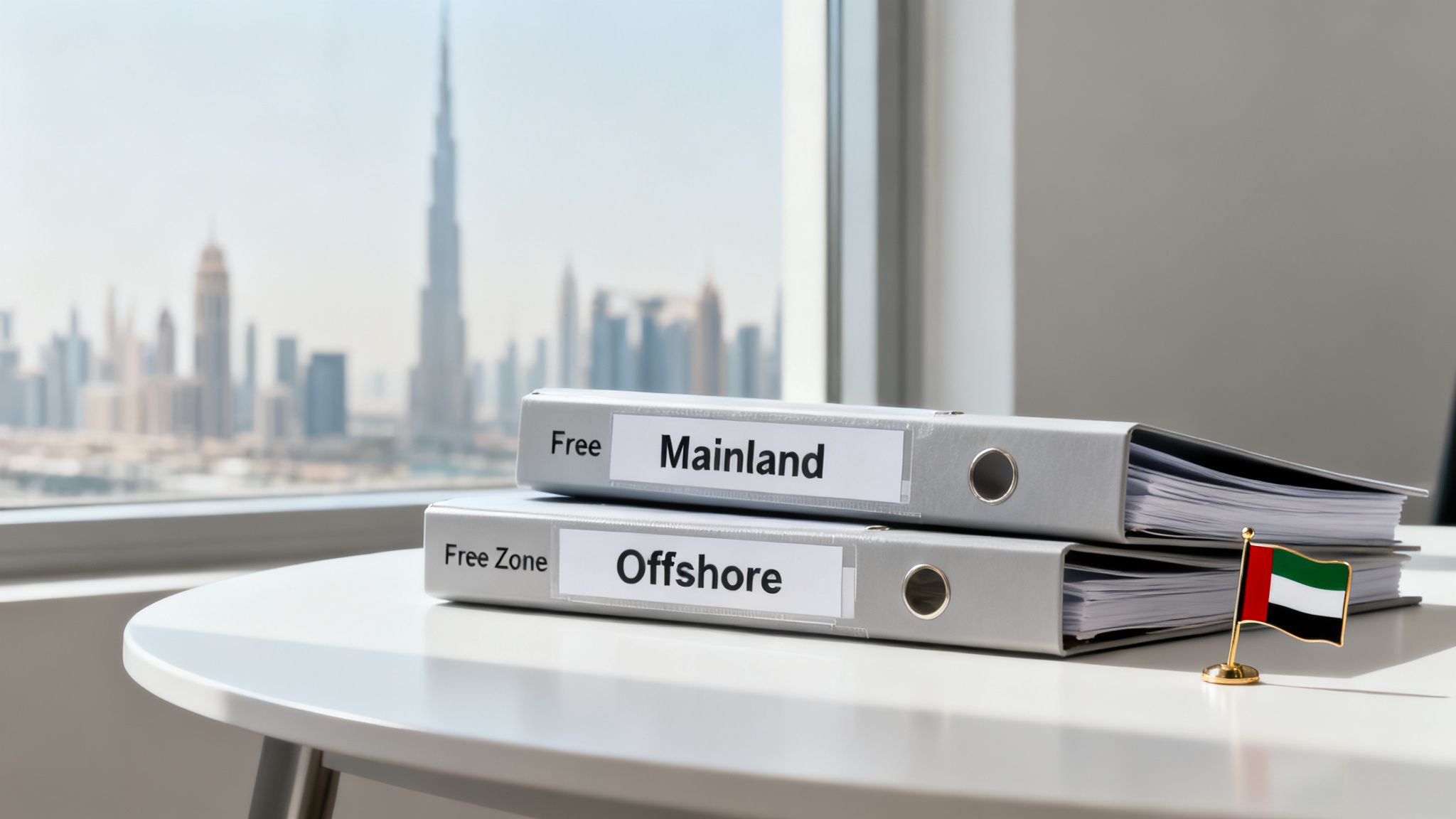
For most tech startups here, the choice boils down to setting up on the Mainland or in one of the UAE's many specialized Free Zones. Getting your head around the free zone vs mainland Dubai debate is a non-negotiable first step.
Mainland (LLC): This setup allows you to trade directly across the entire UAE market without restriction. Recent reforms now allow 100% foreign ownership for most activities, making it a much stronger contender for startups focused on serving the local economy.
Free Zone (e.g., ADGM, DIFC, DMCC): These are special economic zones with their own rules, often based on international common law. They are magnets for startups, offering 100% foreign ownership, 0% corporate tax, and efficient setup processes. Zones like ADGM and DIFC are gold standards for FinTech and venture-backed startups because they run on legal systems international investors know and trust.
So, which path is right for you? If your customers are local businesses and consumers across the Emirates, a Mainland license gives you direct access. But if your vision is to build a regional hub and you have your eye on international VC funding, a reputable Free Zone is almost always the smarter play. For a detailed walkthrough, our guide on how to start a business in Dubai breaks down the steps.
This choice shapes your startup's DNA. One structure optimizes for local dominance, while the other is built from day one for global scale.
Looking beyond the setup, your legal structure echoes through your startup’s entire journey. Here’s what you need to be thinking about:
Fundraising and Ownership
International VCs are creatures of habit. They feel comfortable with legal frameworks in Free Zones like ADGM or DIFC because they mirror what they see in London or Singapore, with clear shareholder rights and governance. A Mainland LLC can sometimes slow down due diligence for foreign investors unfamiliar with the nuances.
Operational Freedom
A Free Zone company is generally restricted to operating within its zone and internationally. If you need to do business on the Mainland, you’ll likely need a local distributor or a branch office, which adds cost and admin.
Regulatory Environment
Your legal structure determines how you handle things like:
Next Actionable Step: Before you register anything, map out your ideal customer and your fundraising plan for the next 24 months. Ask your founding team: "Where are most of our customers, and what structure will make a VC in London or Singapore nod in approval?" The answer will point you straight to either Mainland or a specific Free Zone.
The "startup" definition isn't always a clean fit. Many founders in the UAE find themselves in a grey area, running businesses that don’t quite match the high-burn, venture-backed stereotype.
The truth is, the startup label is less about your company's age and more about your operational mindset and growth ambition. It’s about building a scalable system to capture a massive market.
Picture a Dubai-based software agency. It’s profitable, has solid clients, and brings in steady revenue. But its growth is linear—add a client, add revenue. It's not a hockey stick curve. Is it still a startup?
Most investors would say no. It’s matured into a successful SME. While it's a tech business, its focus has shifted from explosive market capture to sustained profitability. It’s a great, valuable business, but it's missing the core startup DNA of chasing exponential scale.
Now, think about a new F&B concept in Riyadh. They’ve designed a super-efficient kitchen model that lets them open new locations quickly and cheaply. It’s not a software company, but its operation is built for scalability and repeatability, just like a tech startup.
This is a classic edge case. It might not get the attention of a traditional tech VC, but its scalable model makes it a startup in spirit. This kind of business could be a perfect match for investors specializing in consumer brands. The key is the ambition: to dominate a large market with a system that can be duplicated without costs spiraling.
Actionable Insight: The startup label comes down to your ambition and your business model design. If your goal is to build a repeatable system that can capture a massive market, you're operating with a startup mindset, no matter your industry.
So, when does a startup officially "graduate"? The transition happens when a company stops searching for a scalable business model and starts executing on one. A scale-up has found product-market fit and is now laser-focused on building the teams and processes to handle rapid growth.
You'll know you're making the leap when:
Knowing which stage you're at is crucial. Pitching yourself as an early-stage startup when you're actually a scale-up sends the wrong message to investors and suggests you aren’t ready for the challenges of scaling.
Theory is one thing, but applying it is where the work begins. Is your venture built with that high-growth DNA?
This isn't just a quiz; it's a practical tool to help you decide your next move. Use the checklist below as a mirror for your venture. The goal is to figure out exactly what you need to do next.
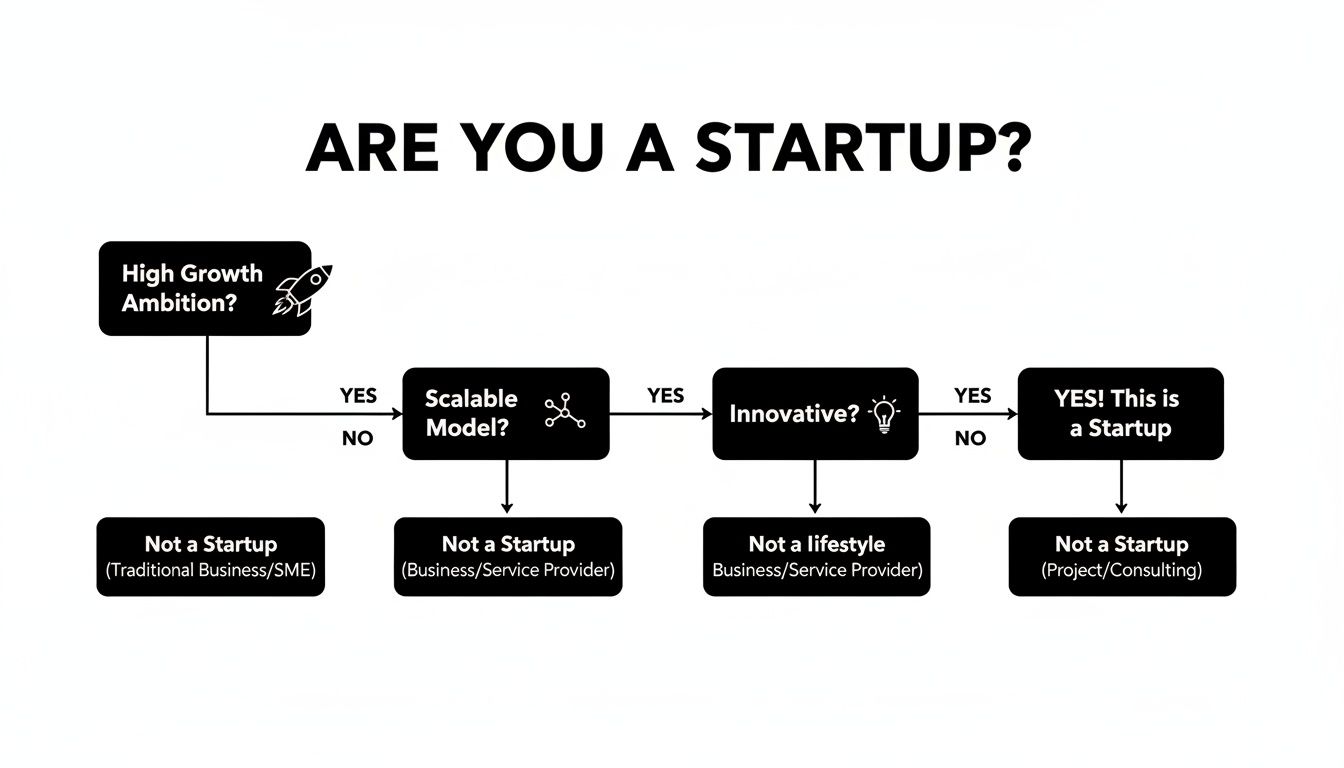
It really boils down to three non-negotiables: massive ambition, a scalable model, and genuine innovation.
Use these questions to pressure-test your idea with your co-founders. Be brutally honest—the clarity you’ll gain is invaluable.
1. Growth Ambition: Do we have a credible plan to achieve 10x growth?
A startup runs on ambition. Are your goals aggressive enough to get a VC's attention, or are you building a solid lifestyle business? There's no wrong answer, but you need to know which path you're on.
2. Scalability: Can our business model scale exponentially?
Can you multiply your revenue without multiplying your costs? Think software, not services. Can you serve 10,000 customers nearly as easily as 100?
3. Innovation: Are we fundamentally changing how something is done?
A true startup is disruptive. Are you creating a whole new category or just a slightly better version of what’s already out there?
4. Team & Mindset: Is our core team obsessed with this problem?
Investors in the UAE and elsewhere don't just back ideas; they back founders. They want to see unwavering conviction and deep expertise in the problem you’re solving.
Your Final Action: Based on your answers, write down one single, concrete action you will take this week. Share it with a peer in a group like Founder Connects to hold yourself accountable. This simple step is how you turn a self-assessment into actual progress.
Here are straightforward answers to the questions we hear most often from founders in the UAE and MENA region.
Absolutely. A solo founder can definitely run a startup. What matters isn't the number of people on day one, but the potential for massive growth baked into the business model.
A solo developer building a SaaS product with a global vision is a startup. A freelance consultant selling their time by the hour is a professional services business. The test is whether the ambition and model are geared for exponential scale.
There's no official expiry date, but a company usually sheds the "startup" label when its main focus shifts from searching for a repeatable business model to executing and optimizing a proven one.
This shift is usually marked by:
Think of "startup" as a temporary phase. Once you nail your model and start scaling hard, you evolve into a "scale-up" and, eventually, just a company.
No. Using technology doesn't automatically make a company a startup. A local IT support business is a tech company, but it's a small business because its growth is tied directly to hiring more technicians (linear scaling).
A tech startup uses technology to build a product that scales non-linearly. A cybersecurity firm that develops a software platform to automatically monitor threats for thousands of clients at once is a startup. The difference is the scalability of the business model, not just the presence of tech.
Not at all. While headlines are full of massive funding rounds, seeking venture capital isn't a requirement. Many incredible startups are bootstrapped, funding their growth entirely from their own revenue.
If your company is built on an innovative, scalable model with high-growth ambitions, it’s a startup. Here in the UAE, many founders choose to bootstrap early on to prove their model and retain full ownership before speaking to investors.
Are you a founder in the UAE looking for a community that prioritises real progress over superficial networking? Founder Connects offers curated peer groups, meaningful introductions, and practical support to help you make smarter decisions and grow your business. Avoid isolation and build alongside a trusted circle of peers. Learn more and apply to join Founder Connects.


