

You’re building in Dubai, Abu Dhabi, Riyadh, or across the wider MENA market, and people keep giving the same advice: network more.
That sounds useful until you try to act on it. Do you show up to another breakfast meetup. Join a WhatsApp group that goes quiet after two days. Spend ninety minutes in a room full of people who can’t help with product, hiring, fundraising, or your next customer conversation.
That’s why bni business builder keeps coming up. It offers something most networking advice doesn’t. Structure. Cadence. A defined system for turning relationships into referrals and repeat business.
BNI deserves serious credit. Over the past 12 months leading to mid-2025, BNI members worldwide generated $26.4 billion USD in revenue through 17.4 million referrals, according to BNI’s mid-year global report. That’s not vague community language. That’s a very large, very organised referral machine.
The real question for a UAE or MENA founder isn’t whether BNI works for anyone. It clearly does. The better question is simpler and more useful.
Will it work for your kind of business, at your current stage, with your actual constraints?
If you run a local service business, BNI can be a strong growth system. If you’re building a tech startup, especially one that’s still validating, iterating, or selling a product that chapter members may not fully understand, the answer gets more nuanced.
A founder often reaches the same moment. Pipeline feels inconsistent, intros are random, and “community” starts to look like a calendar full of low-signal events.
In the UAE, that problem gets sharper because the ecosystem moves quickly. Founders need relevant introductions, honest peer feedback, and people who understand what a pivot, a sales cycle, or a delayed round means. Generic networking rarely gives that. It gives visibility. Sometimes it gives energy. It doesn’t always give progress.
BNI’s appeal is straightforward. It replaces vague networking with a repeatable operating model. You meet regularly, build trust, learn how to ask for introductions properly, and pass referrals with intention.
For many operators, that’s a relief. You’re not guessing how to stay top of mind. You’re working inside a system.
Practical rule: If you hate unstructured mixers and want process, BNI will feel more useful than most open networking formats on day one.
The tension is fit.
A UAE founder building a fintech tool, B2B SaaS product, marketplace, or venture-backed consumer business usually doesn’t need broad referral activity from a room of generalists. They need a smaller set of highly relevant people. Often that means founders at a similar stage, strategic operators, ecosystem partners, or a customer profile that isn’t obvious to a traditional referral group.
That doesn’t make BNI bad. It makes it specific.
BNI is strongest when your offer is easy to understand, your ideal customer is easy to spot, and the people around you can confidently open doors. If your business needs education before it needs referrals, or strategic thinking before it needs introductions, then a different room may produce better outcomes.
BNI is a structured referral networking organisation. The simplest way to understand it is as a trusted business circle with clear rules, repeat meetings, and a strong expectation that members will help one another grow through introductions.

A BNI chapter usually works like a council of specialists. One seat might go to a lawyer, one to an accountant, one to a branding consultant, one to a mortgage broker, one to a recruiter. The principle is exclusivity. One profession per chapter.
That rule matters because BNI isn’t designed as a loose community. It’s designed as a referral channel. If members know there’s only one person in the room for a given category, it becomes easier to remember who to recommend.
For founders, that creates both clarity and friction.
bni business builder is the learning layer behind the networking model. It supports the habits BNI wants members to develop, including how to make specific asks, how to build referral trust, and how to follow up properly.
That’s useful because many people say they want referrals, but describe their business too broadly to get any. Business Builder exists to reduce that problem. It teaches members to be clearer, more actionable, and more consistent.
BNI’s member profile also tells you who the system has historically served well. According to BNI’s Hidden Value overview, 44% of members have been in business for over 5 years and 25% operate as one-person businesses. That points to a strong base of established solo-preneurs and smaller service-led firms.
If you want a broader primer on the chapter model itself, this short guide on what BNI is in practical terms is a useful companion.
BNI works best when members can explain your value in one sentence and spot your buyer in everyday conversation.
For a local consultant, agency founder, accountant, or service provider in the UAE, that setup can make a lot of sense. Trust compounds. Repetition helps. Referrals become part of weekly operations.
For a startup founder, the fit depends on whether your immediate bottleneck is sales access or strategic clarity.
If it’s sales access to well-defined local buyers, BNI may help. If it’s product-market fit, hiring, investor readiness, or founder accountability, the Business Builder training may be useful, but the chapter model itself may still feel too narrow.
BNI’s weekly meeting format is one of its biggest strengths. It removes ambiguity. You know what happens, when it happens, and what’s expected from you.

Most chapters follow a tight, repeatable agenda. The exact rhythm can vary, but the structure is usually close to this:
For some founders, this level of discipline is refreshing. For others, it feels rigid from the first visit.
The weekly pitch gets the attention, but the main value usually sits in what members learn to ask for. Good BNI participation depends on specificity.
A weak ask sounds like this: “I’m looking for anyone who needs software.”
A strong ask sounds more like this: “I want an introduction to operations leaders at multi-location businesses who are struggling with manual reporting.”
That distinction is exactly why the Education Slot matters.
According to this overview of BNI Business Builder’s meeting education system, BNI uses a structured weekly Education Slot lasting 3 to 5 minutes, where the Education Coordinator teaches practical skills such as referral quality, specific asks, relationship building, and follow-up. The point isn’t theory. The point is behavioural repetition.
The founders who get value from structured rooms usually don’t just attend. They learn how to translate their business into referral-ready language.
Here’s a quick look at the style and cadence many people associate with BNI meetings:
A founder should evaluate this structure thoroughly.
| Meeting element | Works well when | Struggles when |
|---|---|---|
| Short weekly pitch | Your offer is simple and easy to repeat | Your product needs explanation |
| Referral passing | The chapter meets your buyer regularly | Your buyer sits outside members’ networks |
| Feature presentation | You need education and visibility | You need deep peer problem-solving |
| Education Slot | You benefit from skill repetition | You already know referral mechanics |
BNI meetings reward consistency more than charisma. If you show up, refine your ask, and build real trust, the system can produce value. If you attend casually, describe your startup vaguely, or expect instant results from people who don’t understand your market, it usually won’t.
For startup founders in this region, BNI is neither an automatic yes nor an automatic no. It’s a trade-off.
The first advantage is accountability. Founders often say they want to build relationships, but without a fixed rhythm, networking drifts to the bottom of the list. BNI solves that with regular attendance, clear roles, and repeated follow-up.
The second advantage is local business development. If you sell a service that local companies already understand, a chapter can become a practical channel for warm intros.
BNI can also sharpen founder communication. The discipline of describing your business in a short, concrete way is useful even outside the chapter. Many early founders need that pressure.
The biggest issue is relevance. A tech founder may sit in a room full of capable people and still get little value if those people don’t understand the customer, product, or buying trigger.
That challenge is especially important in MENA, where many founders operate across cultures, sectors, and markets at once. A one-category-per-chapter model can feel neat on paper and limiting in practice.
According to a source summarising local fit gaps in BNI-style structured groups, 40% of MENA founders report “referral irrelevance” in structured groups, and 65% prefer multicultural, cross-industry peer groups over the one-profession-per-chapter format. That doesn’t invalidate BNI. It does show why some founders feel misaligned from the start.
If the room can’t recognise your buyer, you won’t fix that with a better sixty-second pitch.
A few issues come up repeatedly for startup operators:
BNI is often stronger for founders with a stable offer, a clear market, and a need for trusted local referrals.
It’s usually weaker for venture-style startups that need stage-matched peers, operator insight, and introductions that sit beyond standard chapter relationships.
That distinction matters in the UAE because many founders are building in fast-moving, cross-border conditions. The wrong room doesn’t just waste a morning. It can delay better decisions.
The easiest mistake is to compare these models as if they solve the same problem. They don’t.
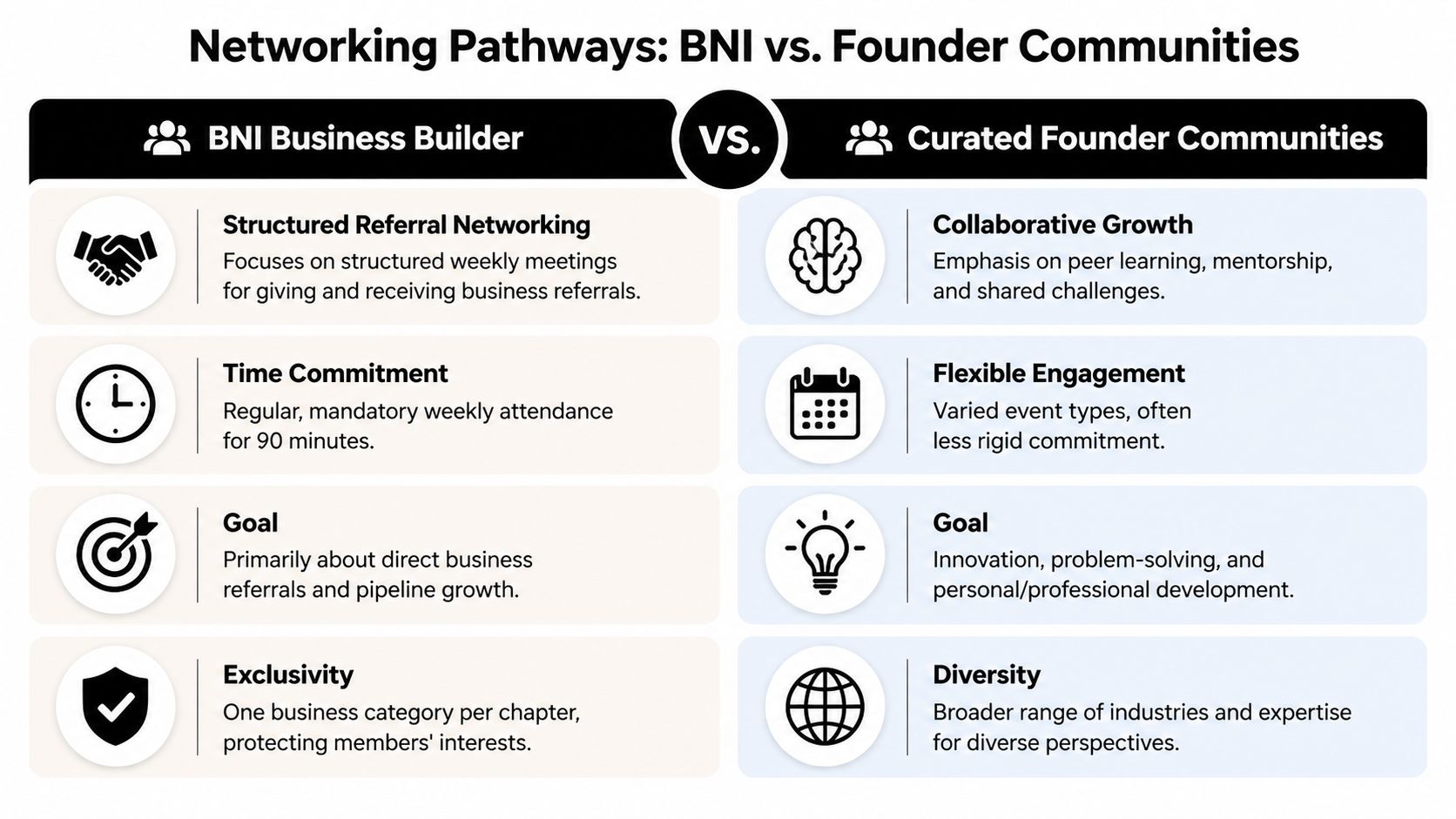
BNI business builder is built to support a structured referral system. Its learning model, chapter rhythm, and member behaviour all point toward one practical outcome. Better introductions that can turn into business.
A curated founder community usually aims somewhere else. The value comes from peer learning, stage-relevant conversations, accountability, strategic intros, and trusted context around hard decisions.
Those are not minor differences. They shape everything from member fit to meeting design.
| Criteria | BNI Business Builder | Curated founder communities |
|---|---|---|
| Primary outcome | Referral generation | Peer support and strategic growth |
| Best member profile | Clear-category service business | Founders facing startup-specific challenges |
| Group design | Profession-based exclusivity | Stage, challenge, or relevance-based matching |
| Weekly focus | Visibility, asks, referrals, follow-up | Problem-solving, accountability, pattern sharing |
| Value horizon | Often strongest when referrals can happen quickly | Often strongest when decisions improve over time |
One useful signal sits in the underlying infrastructure. According to BNI Business Builder’s platform overview, the platform is built for desktop and mobile access, single sign-on, and role-based content delivery. That matters because modern communities need more than live events. They need synchronous and asynchronous touchpoints that reduce friction.
That principle also shows up in strong community design more broadly. If you’re thinking carefully about how founder groups create value between meetings, this guide on actionable strategies for founder communities is worth reading.
A founder choosing between these paths should ask what kind of help they need most.
If they need local business referrals from people who can confidently recommend them, BNI may be the better instrument. If they need a room where other founders understand churn, runway, GTM confusion, co-founder tension, or fundraising timing, a curated founder environment usually performs better.
The difference also shows up in conversation quality. BNI asks, “Who can you introduce me to?” A curated founder group often asks, “What are you trying to solve, and who in this room has seen it before?”
For founders exploring the broader networking environment in the city, this overview of Dubai business network options for startup operators adds useful local context.
A better networking decision starts with diagnosis, not hype. Most founders join the wrong room because they answer the wrong question. They ask, “Which network is best?” instead of “What problem am I trying to solve this quarter?”

Write down the one outcome that would make networking feel worthwhile in the next few months.
A stable local service business behaves differently from a startup still shaping demand.
If your offer is clear, repeatable, and easy for others to explain, structured referral systems can work. If you’re still refining positioning, ICP, pricing, or product use cases, founder peers often create more value than referral partners.
Be specific. “Good connections” is too vague to help.
| If you need more of this | Better-fit room |
|---|---|
| Local buyers and service referrals | Structured referral groups |
| Honest feedback from people building companies | Curated founder groups |
| Investor warm-ups and ecosystem context | Founder ecosystems and targeted events |
| Cross-functional operator insight | Founder or operator communities |
Decision check: Choose the room where other members can solve your current bottleneck without needing a long explanation of what you do.
Some founders want mandatory rhythm. Others need flexibility.
BNI rewards regularity and process. That’s a plus if you want an external system to keep you engaged. It’s a minus if your week changes constantly and your highest-value conversations happen outside fixed chapter mechanics.
Before you join anything, run this test:
If you can’t answer those clearly, don’t join yet. Visit first. Ask harder questions. Watch who gets value and why.
The best networking path isn’t the most famous one. It’s the one that matches your stage, sales motion, and decision needs right now.
Good networking isn’t about attending more events. It’s about entering the right environment with the right expectation.
BNI offers a disciplined referral model. For founders with clear local offers and relationship-led sales, that can be productive. For startup operators who need candid peer support, strategic context, and stage-matched conversations, a founder-focused community will often feel more useful.
That’s the main takeaway. The room should match the job.
If you’re considering BNI in the UAE, don’t join because someone told you to “get out there more”. Join because your business is referral-ready, your buyers are reachable through that structure, and you’re willing to work the system consistently. If that isn’t true, choose a format better aligned with how startups grow.
For founders weighing local chapter options, this guide to BNI Dubai chapters in 2026 can help you assess fit more practically.
If you want a more founder-specific alternative to generic networking, Founder Connects is built for meaningful introductions, small peer groups, practical support, and real momentum across the UAE and wider MENA ecosystem.


