

Most founders approach bni dubai chapters like a directory problem. Which chapter is closest, which one has an open seat, which one meets at a tolerable time. That’s too shallow. The better question is whether a chapter will produce the kind of relationships your company needs.
If your goal is steady referral flow for a clear service offer, BNI can work very well. BNI Dubai says its chapters have generated over AED 1.3 billion in closed business for members to date, with 35,000 referrals generated over the last year, across 18 chapters and 680 members in Dubai’s network according to the Deira Dubai network overview. Those numbers matter because they show this isn’t casual coffee networking. It’s a structured system with weekly expectations, profession-based seat limits, and a clear bias toward measurable introductions.
That same structure is also the main trade-off. If you’re an early-stage founder still refining the offer, still changing your pitch, or mainly looking for founder empathy, investor warm intros, and strategic peer support, some bni dubai chapters may feel too sales-led. You’re joining a machine built for referable asks, not a loose founder circle.
That’s why it helps to understand the model before picking a room. If you need a quick refresher on understanding how referrals work, start there, then come back with one practical lens in mind. Ask whether you need lead generation, accountability, or true founder peer support. Those are related, but they’re not the same thing.
Below is the shortlist worth looking at if you want practical outcomes, not just attendance. I’m focusing on how each chapter fits different founder situations across Dubai, where the BNI model helps, where it gets in the way, and when a curated founder community is the better move.
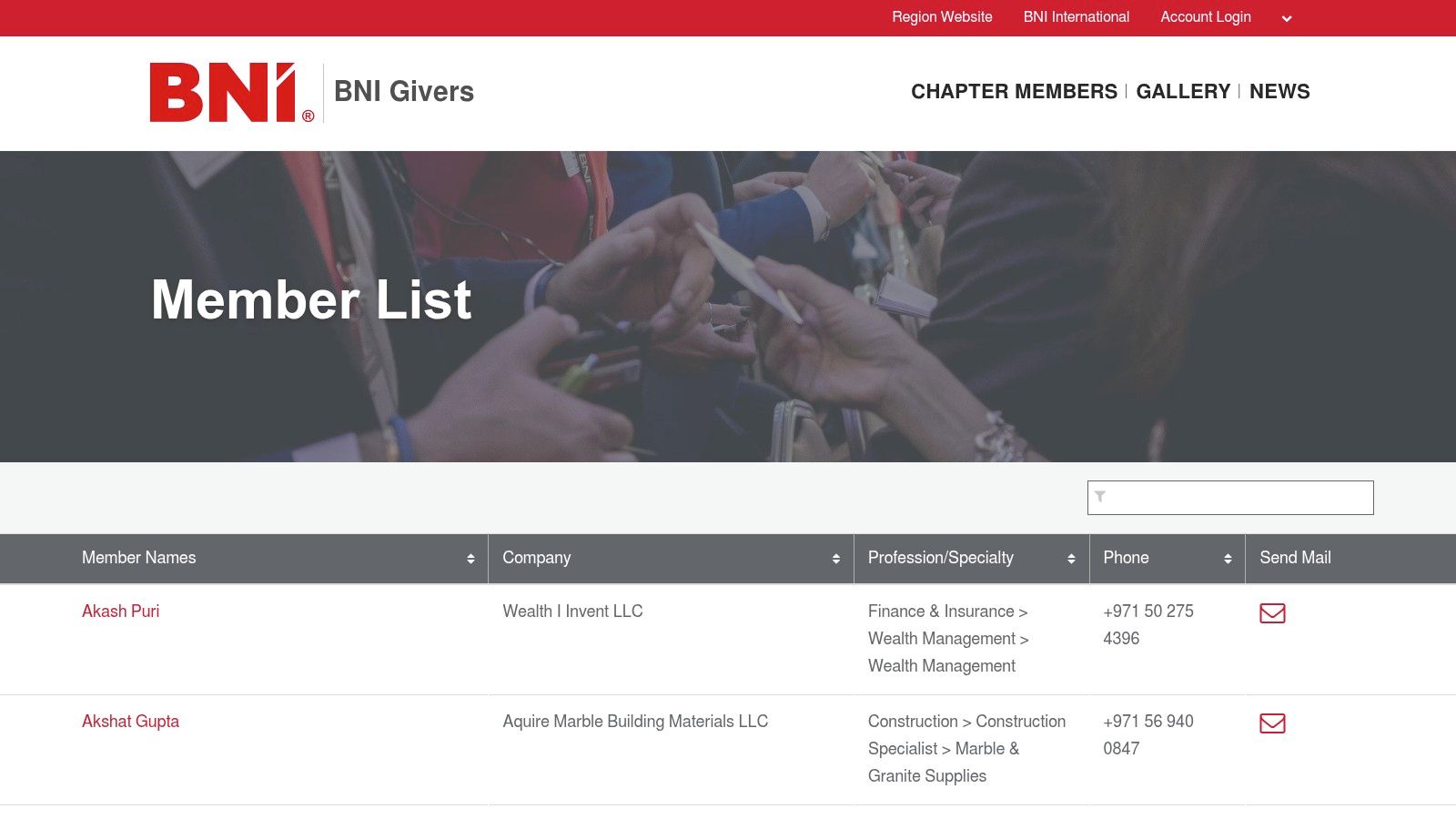
BNI Givers is one of the cleaner fits for founders who want networking to behave like pipeline work. Deira is still a strong commercial corridor for trading, services, and relationship-led business, so a chapter here can make sense if your buyers or referral partners already operate in that part of Dubai.
This isn’t the chapter I’d pick for vague startup visibility. It’s better for founders with an offer they can explain in one sentence and a referral target they can name without hesitating. If you sell marketing services, business setup support, finance, tech implementation, HR, logistics support, or another referable service, the rhythm can work in your favour.
The core advantage is predictability. Weekly meetings, structured referral tracking, and a visible member directory make it easier to build a repeatable 1:1 habit instead of relying on random networking chemistry.
Deira also gives you access to a business community that often values trust and consistency over polished founder storytelling. That’s useful if you win business through warm introductions rather than public brand building.
For founders who are still deciding whether this model is even right for them, this explainer on what BNI is and how it works is a useful primer before visiting a room.
Practical rule: Don’t visit Givers asking for “any startup leads.” Show up with three clear referral triggers, specific buyer profiles, and examples of the conversations you want members to listen for.
What works:
What doesn’t:
My take: Givers is practical, not glamorous. That’s a compliment. If you want a disciplined referral room in an established business district, it’s a solid option. If you want vulnerable founder conversations about product-market fit, co-founder stress, or fundraising timing, this won’t replace a curated peer group.
How much structure do you want from a networking group?
BNI Elevate is one of the better fits in Deira for founders who prefer a defined weekly system over casual room chemistry. If you work well with cadence, follow-up rules, and clear expectations, this chapter will make more sense than founder communities built around open discussion.
That distinction matters. BNI is designed to produce referrals through repetition and accountability. If you need a refresher on the model itself, this breakdown of how Business Network International works for founders gives the right context before you visit.
This chapter is more useful once your positioning is settled.
A founder with a clear service, a defined buyer, and a short explanation of the problem they solve can usually get traction faster here than a founder still testing messaging every week. The room rewards clarity. It also exposes weak referral language fast, which is useful if you can handle direct feedback and adjust quickly.
I like this type of chapter for B2B service businesses that already know who should introduce them. Think finance consultants, HR partners, legal advisors, operations specialists, recruiters, or niche agencies with a proven client profile. In that case, the weekly format helps turn vague networking effort into a repeatable lead source.
The upside is consistency. The cost is rigidity.
That last point highlights the founder lens here. If your priority is lead generation, this chapter can be productive. If your priority is working through pricing, hiring mistakes, co-founder tension, or go-to-market uncertainty with people building similar companies, BNI usually stops short of that.
A good test before visiting is simple. Can another member explain who should refer you, what problem you solve, and what a good introduction sounds like in under 30 seconds? If the answer is no, fix that first.
My view: this Deira chapter suits founders who want referral discipline more than founder intimacy. That is a valid trade. Just be honest about which outcome you need.
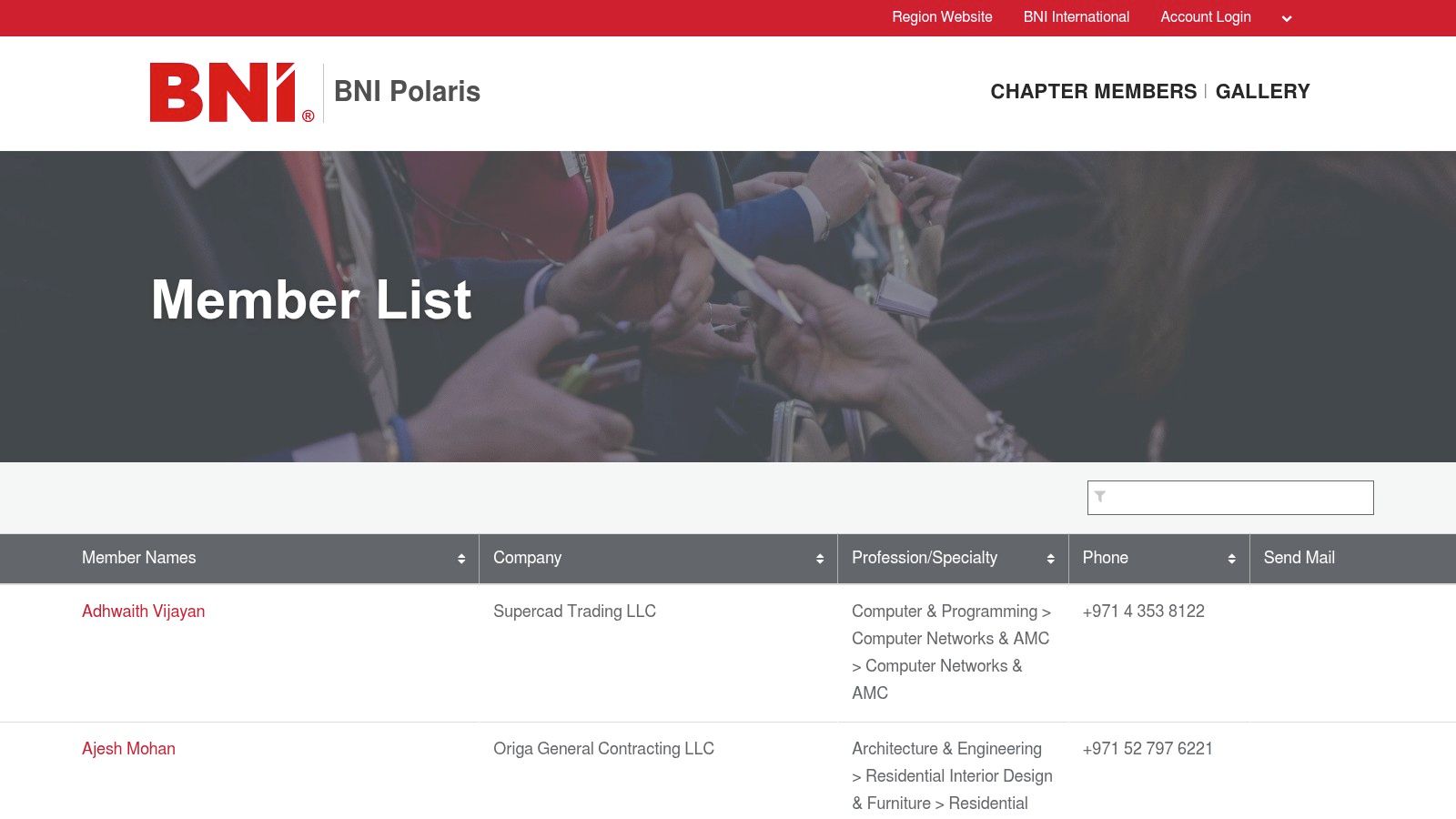
BNI Polaris is the central-Dubai option I’d look at first if your company lives around Business Bay, Downtown, or the wider DIFC corridor. Geography matters more in networking than people admit. The closer the room is to your real operating zone, the easier it is to turn introductions into actual meetings.
Polaris is attractive for founders who need service-partner density. Agencies, consultants, operators, and business support firms tend to cluster around central Dubai, which makes this chapter more useful for partnership development than a purely residential corridor chapter.
Central chapters often give you faster access to adjacent providers. That’s good if your growth depends on accountants, legal partners, recruiters, HR firms, media buyers, software implementers, or strategic channel partners who already serve your target clients.
It can also be a good room for venture-adjacent founders who aren’t looking for investors directly, but do want introductions to the service ecosystem around growth-stage businesses. That’s a different use case from classic referral selling, but it’s still valuable.
If you want a broader founder-oriented view of the organisation before joining a specific room, this breakdown of Business Network International and how founders use it helps frame the model.
The upside of a central chapter is density. The downside is that density can reduce intimacy.
There’s also a practical founder issue here. Central business districts attract many service businesses with polished offers and years of referral language behind them. If you’re a newer founder, that can be motivating, but it can also make your offer feel undercooked by comparison.
If you join Polaris, don’t compete on energy. Compete on clarity. The room will respond faster to a precise ask than a passionate speech.
I’d choose Polaris if your company already sells into central Dubai and you want business adjacency. I wouldn’t choose it if your main need is a tight founder support circle. For that, a curated community is usually stronger than a high-density referral room.
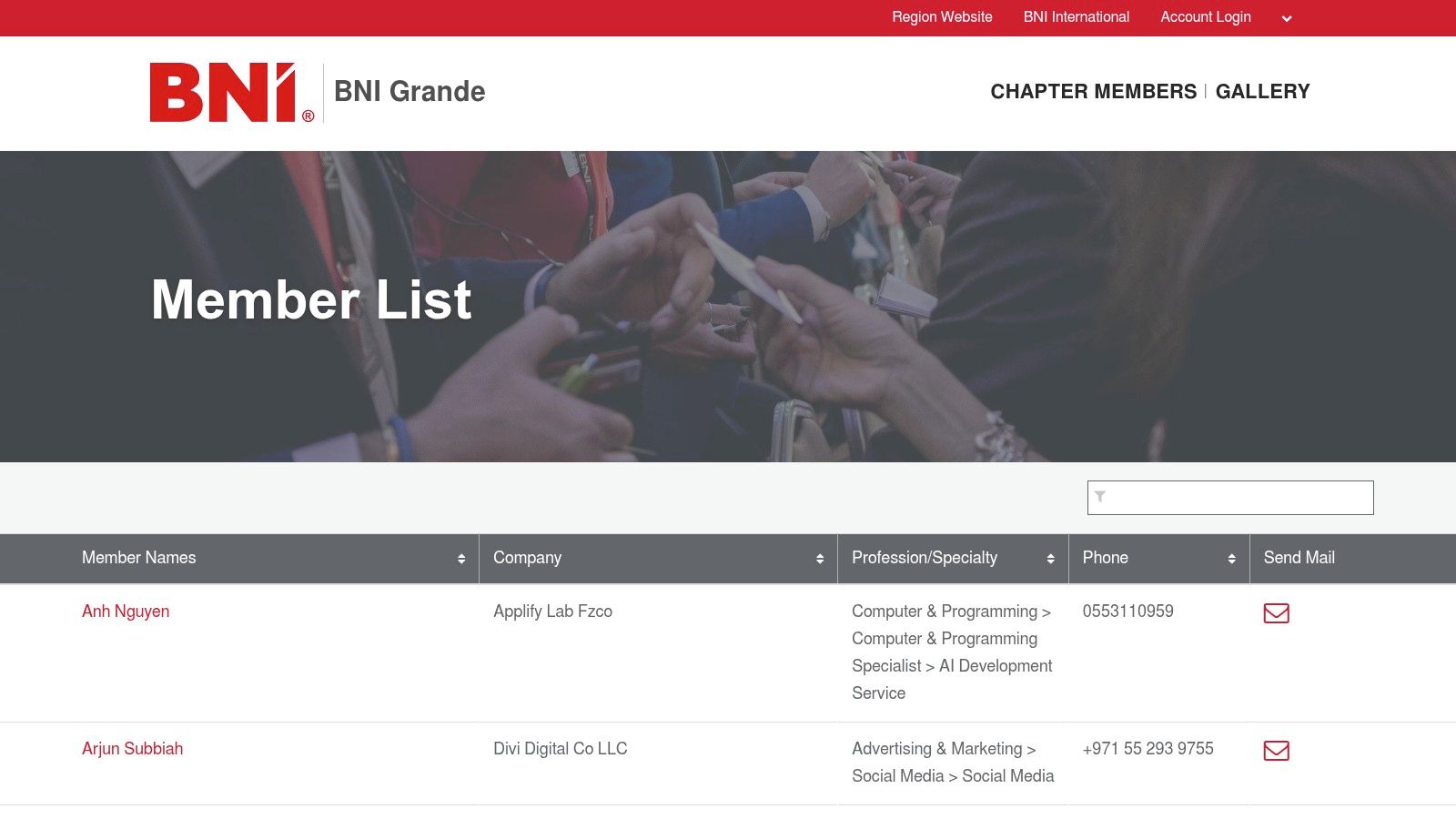
BNI Grande makes the most sense for founders targeting SMB demand outside the city-core image zones. If your customers live in the Jumeirah, Al Barsha, or JVC corridors, or if your best referral partners serve those communities, this chapter can be more commercially useful than a more prestigious central address.
That’s one of the practical mistakes founders make with bni dubai chapters. They overvalue brand perception and undervalue local buyer concentration. A chapter doesn’t need to feel elite to be commercially effective.
North Dubai chapters are often useful for founders selling into owner-led businesses and practical service demand. Think consulting, operations support, digital marketing, implementation, business services, home-adjacent services, and SMB SaaS with a clear use case.
Grande’s value comes from precision. The member directory and weekly referral format make it easier to ask for specific introductions, especially when your target customer is an operating business owner rather than a corporate procurement team.
A few founder realities matter here:
If your ICP is heavily enterprise, institutional, or DIFC-centric, Grande may not match your market. You can still find partners there, but the chapter may not map neatly to your ideal buyer journey.
Pre-revenue founders also need to be honest with themselves. BNI doesn’t reward broad ambition. It rewards a clear ask that another person can repeat confidently.
Founder filter: If a member asked, “Who exactly should I introduce you to this week?”, would your answer be specific enough to act on immediately?
Grande is a practical chapter for founders who want local business access and a weekly system. It’s less useful for founders whose main problem is strategic loneliness, fundraising, or product direction. Those needs usually require founder-first conversations, not just referral mechanics.
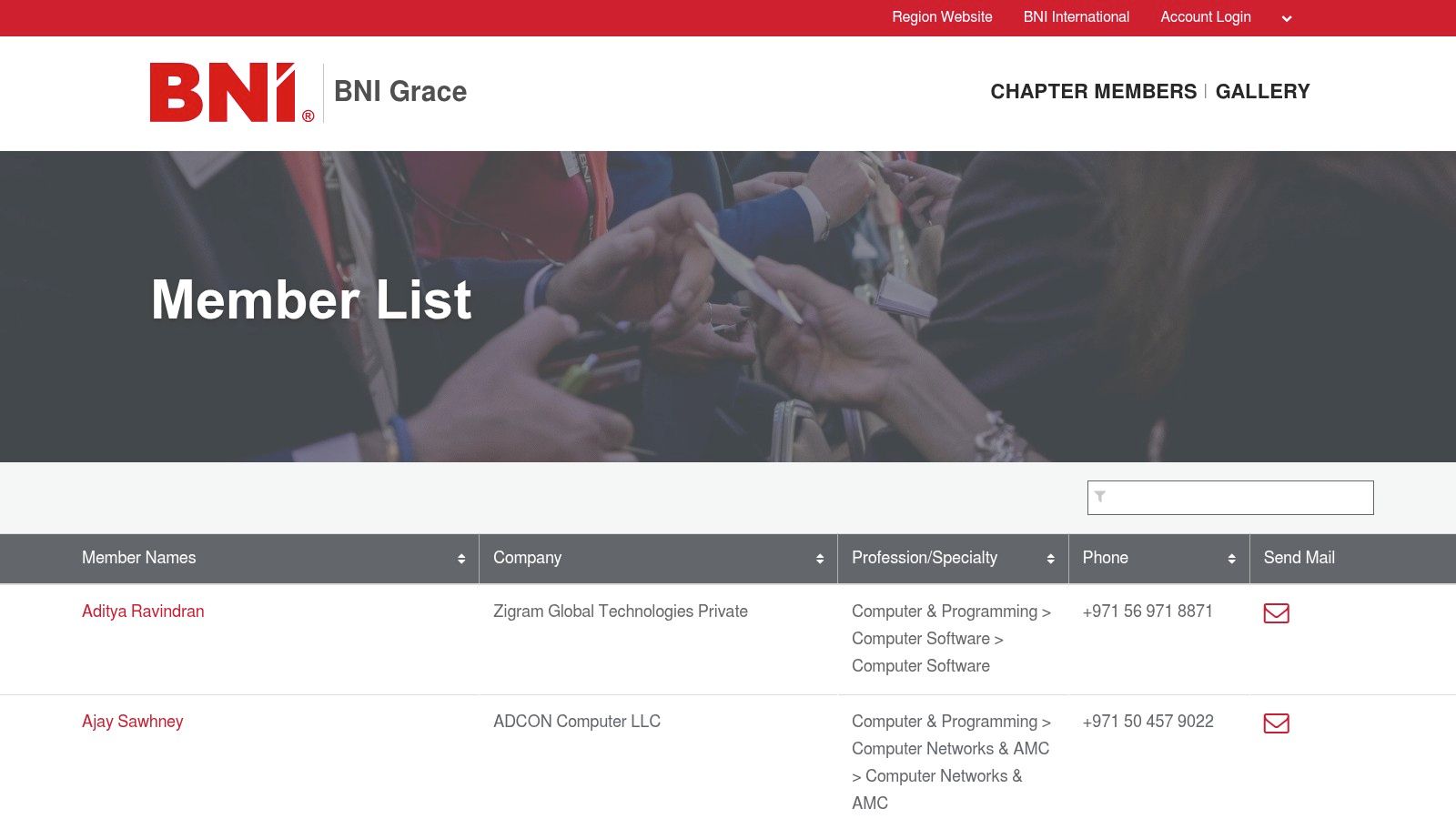
BNI Grace is the chapter I’d describe as dependable. Not flashy. Not especially founder-branded. Just useful if what you need is a steady weekly rhythm, consistent introductions, and enough structure to keep business development from slipping behind product or operations work.
That matters because many founders don’t fail at networking from lack of intent. They fail from inconsistency. Grace’s leadership roles, mentoring structure, and recurring 1:1 expectations help solve that problem better than most one-off networking events ever will.
This chapter fits founders who already know that weekly accountability improves execution. You’re not looking for inspiration. You’re looking for a room that makes you show up, speak clearly, follow through, and stay visible.
That’s especially useful for solo founders and small teams where the founder is still carrying sales. A chapter like Grace can become the external cadence that keeps outreach alive during busy operating weeks.
The use cases I’d rank highest here are:
BNI’s structure is built around referral sales first. So if your main goal is fundraising access, founder therapy, or strategic decision support, Grace won’t fully cover that.
It also inherits the one-seat-per-category limitation that affects all chapters. For common founder categories, entry can become a timing issue rather than a fit issue.
Another point founders should face directly: if your business is still difficult to describe in practical terms, the room can’t advocate for you well. Members can refer “tax consultant”, “branding agency”, or “fractional CFO” much more easily than they can refer a broad startup thesis.
I’d put Grace on the shortlist for disciplined founders who want consistency over novelty. If your sales motion improves when someone expects an update from you every week, this kind of room can help. If you need challenge, honesty, and nuanced founder feedback on hard decisions, a founder-only peer group will usually go deeper.
BNI Genesis is one of the more startup-friendly names in the mix, but the practical question is whether the chapter helps first-time founders turn activity into traction. For some, it will.
The best use case is a founder who has enough offer clarity to ask for introductions, but still needs process. Genesis can be helpful when you’re no longer guessing what you sell, yet you’re still learning how to make other people speak for you accurately.
The appeal is structure without needing you to invent your own networking system. A time-boxed agenda, education moments, member list, and recurring 1:1s create a repeatable operating rhythm.
That’s good for founders who tend to network reactively. One event this week, nothing next week, a few coffees later, then silence. Genesis can replace that randomness with something more useful.
A chapter like this tends to work best when the founder does three things well:
Miss any of those and the chapter won’t feel productive, even if the room itself is good.
Genesis still runs on contribution. If you expect to sit back and absorb value without actively bringing introductions, context, and energy into the group, you probably won’t last.
That can be uncomfortable for first-time founders who are still building confidence. The upside is that the discomfort often reveals what needs work. Usually it’s one of three things: the offer, the target buyer, or the referral language.
There’s also the familiar seat issue. If your category is already occupied, the practical answer isn’t to force the fit. It’s to check another chapter or wait.
The bigger strategic point is this: Genesis can help you build pipeline discipline, but it won’t replace founder peers who understand cap table stress, hiring mistakes, or the emotional drag of uncertain traction. If you need both, treat BNI as a sales channel and get your founder support elsewhere.
BNI Terra is the most obvious pick if your business lives around Dubai Marina, JLT, or nearby free zone ecosystems. For founders in newer commercial corridors, that geographic fit alone can make the chapter worth a visit.
South Dubai chapters also sit closer to a lot of service operators, consultants, agencies, and free-zone businesses that actively trade in referrals. If your growth depends on partnerships with those profiles, Terra deserves attention.
One of the under-discussed issues with bni dubai chapters is travel friction. Founders say they’ll commute across town every week. Then client meetings stack up, traffic gets old, and attendance drops. A chapter near your real operating zone has an advantage before the meeting even starts.
Terra also sits in the part of Dubai where hybrid and flexible work preferences feel especially relevant. BNI’s global chapter finder says hybrid chapters meet in person on the first week of each month and online the remaining weeks, but the Dubai-specific gap is that there’s no chapter-level local data showing how hybrid affects engagement or referrals in Dubai, even as flexible work preferences have grown according to BNI’s chapter finder context and the gap noted in related coverage.
That means founders should evaluate hybrid convenience carefully instead of assuming it preserves the same trust quality as fully in-person attendance.
Terra is useful when you want partnership density and geographic convenience. It’s weaker if what you really want is deep peer advisory.
For a wider look at founder networking options beyond pure referral groups, this guide to the Dubai business network landscape for founders gives useful context.
Some founders need introductions. Others need honest conversations. Don’t confuse the two.
A few quick calls:
If your business is rooted in South Dubai, Terra is one of the more practical chapter options. If your sales are concentrated in Old Dubai, the cross-town cost may outweigh the benefit.
Which chapter gives a founder the best return on weekly time spent?
That depends less on branding and more on fit. For founders, the comparison is simple. Which chapter is most likely to produce qualified introductions, and which one only gives the appearance of activity? BNI can work well if your offer is clear and easy to refer. If you need candid peer support, operator-level perspective, or room to talk through messy founder decisions, a curated founder community will usually do that job better.
| Chapter (Location) | 🔄 Implementation complexity | ⚡ Resource & commitment | 📊 Expected outcomes (quality) | 💡 Ideal use cases | ⭐ Key advantages |
|---|---|---|---|---|---|
| BNI Givers (Deira Dubai) | Moderate, weekly structured agenda and referral tracking | Weekly meetings, active 1:1s; category exclusivity limits placement | Consistent, measurable referral pipeline; good for steady lead flow ⭐⭐⭐ | Founders seeking predictable, structured introductions in Deira | Predictable cadence; cross‑UAE introductions |
| BNI Elevate (Deira Dubai) | High, KPI and education focused with mentoring elements 🔄 | High, weekly morning sessions plus education slots; disciplined reporting | Improved networking ROI through measurable habits; stronger development focus ⭐⭐⭐⭐ | Founders who value KPIs, mentoring and process discipline | Built‑in mentoring and education; KPI clarity |
| BNI Polaris (Central Dubai) | Moderate to High, larger chapter size, same structured referrals | Weekly meetings; proximity reduces travel but seat competition is high | Higher referral volume and variety from dense business district ⭐⭐⭐⭐ | Venture‑minded founders near DIFC/Business Bay seeking partners | Proximity to agencies/service providers; greater referral variety |
| BNI Grande (North Dubai) | Moderate, metrics‑driven meetings with regional support | Weekly meetings; regional training for ramping members | Effective SMB pipeline building outside city core; steady local demand ⭐⭐⭐ | Founders targeting SMBs in residential/commercial corridors | Regionally coordinated training; SMB focus |
| BNI Grace (North Dubai) | Moderate, formal leadership and mentoring structure | Weekly rhythm with 1:1s and referral tracking; category exclusivity applies | Reliable local referrals and partner warm‑ups; sales‑oriented impact ⭐⭐⭐ | Founders seeking consistent local referrals and residential service demand | Stable weekly rhythm; access to residential service segments |
| BNI Genesis (North Dubai) | Moderate, time‑boxed agenda designed for early founders | Weekly commitment with emphasis on education and 1:1 cadence | Supportive conversion of network activity into pipeline for early traction ⭐⭐⭐ | First‑time founders needing guided structure and momentum | Strong onboarding/education; consistent 1:1 follow‑ups |
| BNI Terra (South Dubai) | Moderate, hybrid meeting formats and regional reporting | Weekly (hybrid) meetings; may require cross‑town travel depending on ICP | Good partnership and service provider connections in growth corridors ⭐⭐⭐ | Founders in Dubai Marina/JLT/TECOM or free‑zone ecosystems | Geographic access to free zones and hybrid meeting flexibility |
A few patterns matter.
Polaris looks stronger if lead generation is the main goal and you already know how to work a referral system. Givers and Grace are steadier choices for founders who want consistency over scale. Genesis is more forgiving for earlier-stage operators who still need structure. Terra is practical if geography is a real attendance constraint. Grande sits in the middle and makes more sense for SMB-focused businesses than for venture-backed startups trying to build high-trust founder relationships quickly.
That last point matters. BNI chapters are built to create introductions and accountability. Founder communities such as Founder Connects serve a different purpose. They are usually better for honest peer discussion, strategic feedback, and relationships that are not tied to weekly referral output.
For a startup founder, the best chapter is rarely the one with the most activity. It is the one where your category is easy to understand, members can describe your buyer clearly, and the room includes businesses your customers already trust.
What are you buying when you join one of the bni dubai chapters. More leads, or better founder judgement?
That question clears up a lot of bad networking decisions.
From a founder’s perspective, BNI works best as a structured lead generation system. It rewards a clear offer, a buyer profile members can repeat without confusion, and the discipline to show up every week, book 1:1s, and ask for specific introductions. If your business already has a defined service, sales process, and referral-ready positioning, the right chapter can produce real commercial value.
If you are still working out your positioning, pricing, or ideal customer, BNI can feel harder than it looks. The format does not give much room for messy thinking. It expects clarity.
That is the core trade-off. BNI chapters are usually stronger at referral flow than at deep peer support. Curated founder communities such as Founder Connects serve a different job. They are often better for strategic candour, pattern recognition, and honest conversations about hiring, burn, co-founder tension, or whether the current growth plan is even worth pursuing.
Founders should choose the room based on the outcome they need. A chapter like Polaris can make sense if pipeline is the priority and you already know how to brief a room for referrals. Givers, Grace, and Genesis are often easier fits for founders who want steadier structure, a more predictable rhythm, or a better learning curve while building referral habits. Terra matters if geography affects attendance. Grande is more useful for some service businesses than for founders looking for high-trust peer relationships first.
A simple scorecard helps more than gut feel:
If those answers are fuzzy, keep visiting.
My advice is straightforward. Use BNI for structured introductions, repetition, and accountability. Use founder communities for better judgement, sharper feedback, and conversations that do not need to end in a referral ask. That mix is usually stronger than expecting one network to do both jobs well.
If you’re still refining your go-to-market and want a broader playbook beyond referrals, this guide on How to Market a Small Business is a useful next read.


