

BSS Trading LLC: A Founder's Due Diligence Guide

Building in MENA? You don't have to do it alone.
Join 300+ founders in the Founder Connects Residency. Monthly squad calls, warm intros, $3M+ in perks, and much more. All for less than your monthly coffee budget.

You've probably seen this before. Someone mentions bss trading llc in a supplier thread, a WhatsApp intro, or a proposal deck, and you need to decide quickly whether this is a real operating partner, a broker, or a risk you shouldn't bring into your startup's cap table, procurement flow, or customer delivery chain.
A fast web search rarely settles that question in the UAE. Some legitimate firms have a thin public footprint. Some weak operators look polished online. Some names are so generic that search results blur together. The only sensible approach is to treat the company name as a starting point, not an answer.
Who Is BSS Trading LLC An Initial Assessment
The first useful finding is negative, but it matters. No specific statistical or historical facts about BSS Trading LLC were found in publicly available databases, particularly none relevant to the UAE region using standard commercial data sources, based on the available commercial listing result at ZoomInfo's company entry for BSS Co.
That doesn't prove the business is fake. It does mean you don't yet have enough to rely on.

What the LLC label tells you, and what it doesn't
In UAE practice, "Trading LLC" usually points to a company structure and a commercial orientation. It may suggest import, export, distribution, resale, sourcing, or general trading. What it does not tell you is the exact licensed activity, the emirate of registration, the legal owner, the current status of the licence, or whether the company is authorised to perform the services it's pitching to you.
Founders often overread the name. That's a mistake.
If someone says, "They're a trading company, they can handle it," your next question should be: handle what, exactly, under which licence? A trading company may be fine for sourcing hardware or moving stock. It may be the wrong counterpart for technical implementation, regulated work, advisory, maintenance, or subcontracting tied to customer SLAs.
Why a web search isn't enough
A sparse digital footprint creates two risks:
- Identity risk. You may be looking at the wrong entity or a name variant.
- Capability risk. You may be speaking to a company whose actual legal activity doesn't match the commercial pitch.
One quick extra check I like is to ask the contact whether they can verify a DUNS number or provide one if they claim to operate in larger international procurement environments. Not every UAE SME will have this, but the response tells you a lot about how organised their back office really is.
For DIFC-based entities, the official route is better than guessing. Use the DIFC public register if the counterparty claims a DIFC presence. If they aren't in DIFC, ask which mainland authority or free zone issued the licence.
Practical rule: If all you have is a company name, a mobile number, and a promise, you don't have a verified counterparty yet.
Decoding Claimed Services vs Licensed Activities
Founders get into trouble when they buy the story instead of checking the licence. In the UAE, the cleanest way to pressure-test a company is to compare what it says it does against what its licence allows it to do.
Those are not the same thing.
Marketing language can hide a narrow legal scope
A sales contact might say the company handles procurement, consulting, implementation, project management, engineering support, channel partnerships, and after-sales service. That sounds extensive. But if the licence only covers trading in certain product categories, you may be dealing with a reseller that is not legally structured for the delivery work you're expecting.
That matters when something goes wrong. If you need installation quality, technical warranty support, customs compliance, or specialist sign-off, a mismatch between claimed capability and licensed activity can become a contractual problem very quickly.
Use technical specificity as your benchmark
A verifiable firm usually leaves a paper trail of specific, testable claims. One useful benchmark is BSS Technologies, whose profile is described with concrete engineering detail, including close-interval potential surveys (CIPS) and direct current voltage gradient (DCVG) pipeline integrity services, with 95% defect detection per NACE standards and a 30% reduction in leak incidents in Abu Dhabi operations post-remediation, according to ZoomInfo's BSS Technologies entry.
That kind of description is hard to fake well because it invites verification. It gives you service names, operating context, and measurable outcomes.
An ambiguous company usually sounds different. Its language tends to be broad, elastic, and hard to pin down.
Questions that expose the gap
Ask these in writing:
- Which exact activities appear on your current trade licence?
- Are you the principal service provider or acting as a trader or intermediary?
- If technical work is involved, which entity performs it contractually?
- Who holds product warranty obligations after delivery?
- Which emirate or free zone issued your licence?
The more specific a company is about scope, the easier it is to verify. Vague capability claims usually create expensive confusion later.
What works and what doesn't
What works
- Asking for the current trade licence before commercial terms.
- Matching each promised deliverable to a licensed activity.
- Requiring subcontractor disclosure if the company is an intermediary.
What doesn't
- Accepting a company profile PDF as proof.
- Confusing "we've done similar work" with legal authorisation.
- Assuming a trading entity can absorb specialist technical liability.
If bss trading llc is being positioned as more than a product supplier, this check isn't optional. It's where many founder-led partnerships should pause until documents arrive.
Your UAE Due Diligence Checklist for Any Partner
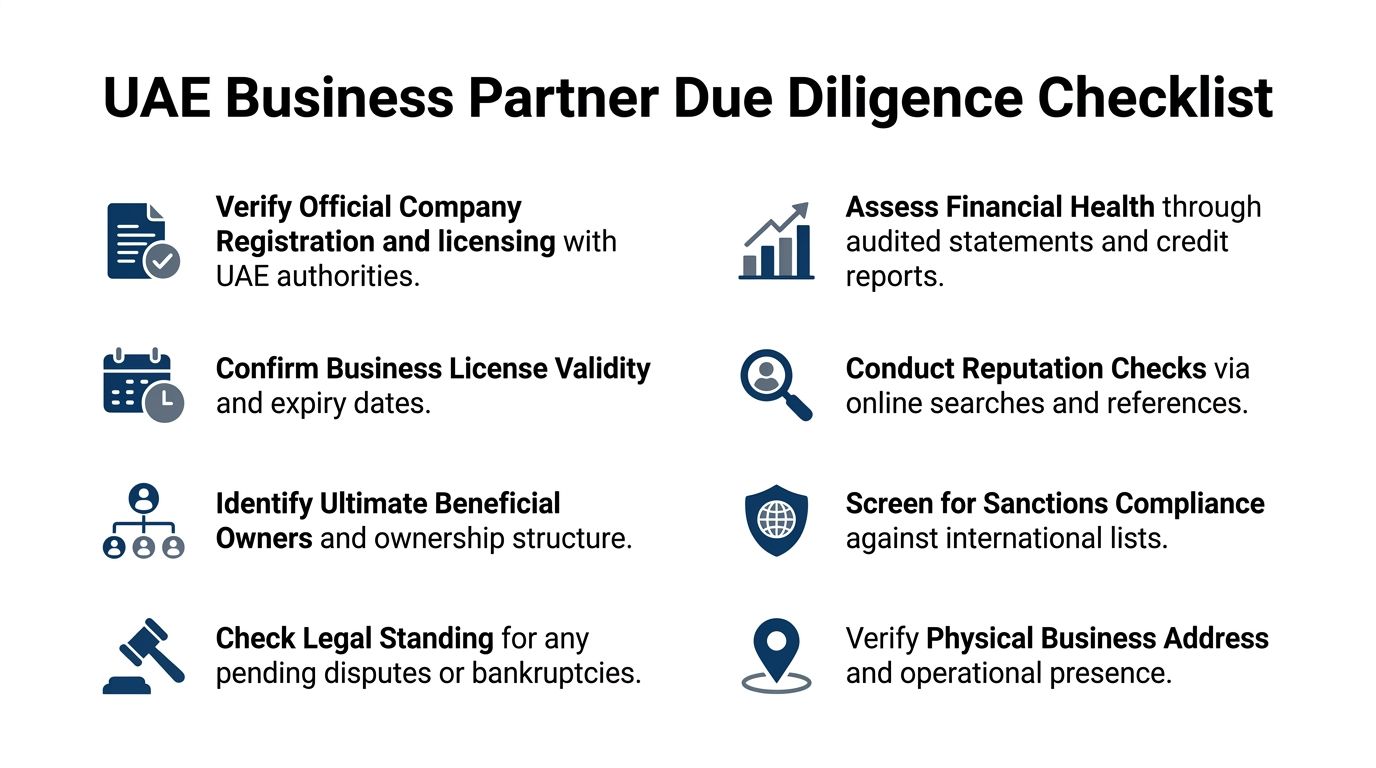
If you're assessing bss trading llc, don't debate it endlessly on email. Run a standard checklist and force the company into a verifiable shape.
The documents to request first
Start with the minimum pack. Ask for:
- Trade licence copy. You want the legal name, licence number, issuing authority, issue date, and expiry date.
- Commercial Registration details. If they use a CR number, ask for it exactly as registered.
- VAT registration evidence. If they're charging VAT, they should be able to support that position.
- Shareholder or authorised signatory proof. You need to know who can bind the company.
- Office address and landline. A P.O. Box alone isn't enough for partner onboarding.
A founder shouldn't feel awkward asking for this. Serious companies expect it.
Where to verify in the UAE
Use official channels tied to the claimed jurisdiction. That usually means the mainland economic department, the relevant free zone authority, or a chamber directory. If the company says it's Dubai-based and commercially active, a practical starting point is the Dubai Chamber of Commerce directory.
For broader screening discipline, this PeopleFinder guide to online checks is a helpful reminder that good verification isn't one search. It's a stack of checks across identity, records, address, and reputation.
An eight-point checklist founders can actually use
1. Confirm legal identity
Match the exact company name on the proposal, invoice, licence, and bank details. Small variations create large problems when money moves.
2. Check licence validity
Don't just collect the licence. Read it. Confirm it's current and issued by a recognised authority.
3. Read the activity list
Many founder teams stop too early. The activity list tells you whether the company is licensed for trading, consultancy, technical services, maintenance, software, logistics, or something narrower.
4. Identify who owns and controls the entity
You don't always need a full ownership map on day one, but you do need clarity on who signs, who benefits, and who you're relying on if a dispute appears.
5. Validate tax position
If VAT is part of the commercial arrangement, confirm the company can support that with proper registration details and invoice formatting.
6. Test physical presence
A real office, warehouse, workshop, or operating base doesn't guarantee quality. But the inability to verify any physical presence should slow you down.
7. Check legal and sanctions exposure
Run a basic legal screen and sanctions review through your counsel or compliance provider if the contract size justifies it. This matters even more if the partner touches cross-border payments, sensitive goods, or regulated sectors.
8. Speak to two references
Don't ask, "Are they good?" Ask, "What did they deliver, what slipped, and would you contract them again?" That question gets better answers.
If a company resists basic onboarding checks, treat the resistance itself as a due diligence finding.
The decision rule
Proceed only when the paperwork, the story, and the operating reality line up. If one of those three breaks, move the company into a higher-risk bucket and narrow the scope of engagement until the gap is resolved.
BSS Trading vs BSS Technologies A Case Study
When founders ask me how to distinguish a credible specialist from an ambiguous counterparty, I look for verifiability density. How many important claims can be checked without relying on the salesperson?
On that basis, the contrast between bss trading llc and BSS Technologies is useful.
What a verifiable technical operator looks like
BSS Technologies is described as a verifiable Abu Dhabi entity specialising in impressed current cathodic protection (ICCP) systems, with a Dubai factory producing transformer rectifiers that deliver 10 to 100A at 24 to 48V DC. The same source states that its systems extend the service life of ADNOC pipelines to over 25 years in a region facing over $10B in annual corrosion costs, according to BSS Technologies office and technical details.
Even before you decide whether to trust every claim commercially, notice the structure of the information:
- Named specialisation
- Stated headquarters
- Stated factory location
- Specific product category
- Technical output data
- A clear industry use case
That's what real diligence can work with.
What an ambiguous entity looks like
With bss trading llc, the current issue isn't proven misconduct. It's the lack of equivalent verifiable detail in the available public trail cited earlier. You don't yet have the same density of hard markers. That means you should treat the company as unverified, not automatically illegitimate.
That distinction matters. Smart founders don't jump from "I can't verify this yet" to "this is a scam". They refuse to rely on unverified assumptions.
Due Diligence Comparison: Verifiable vs. Ambiguous Entity
| Verification Point | BSS Technologies (Example of Verifiable Entity) | Ambiguous Entity (Hypothetical) |
|---|---|---|
| Legal identity | Clear company identity tied to a defined technical field | Name exists, but supporting detail is limited |
| Physical presence | Abu Dhabi headquarters and Dubai factory are stated | Office claim may be unclear or unsubstantiated |
| Service clarity | ICCP systems and related technical products are specified | Services may be described in broad commercial language |
| Technical depth | Output ranges and application context are stated | Few testable operational details |
| Industry fit | Clear relevance to pipeline corrosion control | Fit may depend on verbal assurances |
| Procurement confidence | Easier to map offer to capability | Requires more document-led verification |
| Risk profile | Lower ambiguity if documents align | Higher ambiguity until records are produced |
The practical trade-off for founders
A specialist like BSS Technologies gives you enough substance to build a diligence file quickly. An ambiguous trading entity increases your transaction cost. Your team spends more time chasing documents, clarifying scope, and protecting the contract.
That doesn't mean you should avoid all trading firms. Many are useful, especially in sourcing-heavy or relationship-driven sectors. It does mean you should limit dependence on them until you know exactly what role they're playing.
How I'd frame the decision internally
If bss trading llc is being considered for a low-risk purchase, you might proceed with a small initial order, tight payment controls, and no customer-critical dependency. If they're being proposed as a delivery partner, implementation lead, or strategic representative, the evidence threshold should be much higher.
Use this internal filter:
- Supplier only. Verify identity, licence, bank details, and delivery capability.
- Service partner. Add scope matching, references, staffing proof, and contractual liability review.
- Strategic partner. Add ownership clarity, litigation review, and executive-level reference calls.
A credible partner reduces your need for interpretation. An unclear partner forces your team to fill in the blanks. That's where founders create avoidable risk.
How to Read Reputation Signals and Spot Red Flags
Official checks come first. After that, you need to read behaviour.
A company's reputation is rarely captured by one database result. It's visible in how they answer direct questions, how consistent their documents are, and whether their people behave like operators or sales intermediaries.

Positive signals worth noticing
Good counterparties tend to make verification easier, not harder.
- Fast document sharing. They send the trade licence, tax details, and signatory information without theatre.
- Consistent identity. The website, email signature, proposal, invoice, and licence all reflect the same legal entity.
- Specific answers. When you ask who performs the work, they name the team, site, or subcontractor.
- Traceable leadership. Directors or managers have a credible professional footprint and coherent career history.
- Commercial discipline. Payment terms, scope, and exclusions are written clearly.
Red flags that should slow the deal
The warning signs are usually ordinary, not dramatic.
- Licence avoidance. They keep promising to share the licence later.
- Vague service language. They can sell the outcome but can't explain the operating method.
- Pressure to prepay. Urgency shows up before trust is established.
- Shifting company names. The entity on the quote changes when bank details arrive.
- Address opacity. They offer only a P.O. Box or a pin drop with no verifiable office context.
- Reference friction. They talk about major projects but resist connecting you to a real customer or partner.
Watch how they handle uncomfortable questions
This is often the cleanest signal. Ask direct questions about legal name, ownership, licence scope, and who stands behind performance obligations. Strong operators answer directly. Weak operators redirect, charm, or stall.
For founders who are also screening investors and counterparties more broadly, the logic is similar to the process outlined in this piece on reverse due diligence for investors. The principle is simple. Trust should follow evidence, not the other way around.
A short explainer can help your team calibrate how fraud risk develops in business relationships:
If you discover actual misrepresentation, don't improvise the response. Get legal advice quickly. A basic primer on steps to recover from security fraud can help you think through escalation and record-keeping, even if your situation ultimately falls under a different legal category.
The clearest red flag isn't a bad website. It's a counterparty that wants your commitment before giving you the documents needed to assess them properly.
Your Next Move Assessing BSS Trading LLC
If you're evaluating bss trading llc right now, don't spend another week speculating. Ask for the documents and let the response drive the decision.
Use a short, firm email like this:
Subject: Vendor onboarding documents request
Hi [Name],
As part of our internal onboarding process, please send the following for verification:
- Current trade licence copy
- Commercial Registration details
- VAT registration details, if applicable
- Registered office address
- Name and designation of the authorised signatory
- Brief summary of the exact services or products your entity will provide under this engagement
If any part of the work will be performed by an affiliate or subcontractor, please include that entity's details as well.
Once received, we'll complete our review and revert on next steps.
Best,
[Your Name]
How to interpret the reply
- Prompt, complete response means the conversation can continue.
- Partial response means narrow the scope and verify the missing pieces before signing.
- Deflection or delay means you should pause the deal.
The right posture is simple. Stay polite, stay factual, and don't move ahead because the opportunity feels urgent. In UAE business, the founders who avoid preventable losses are usually the ones who make verification feel routine.
Founder Connects helps UAE and MENA founders make decisions like this with more clarity and less isolation. If you want a stronger peer circle, better intros, and practical founder-level support, explore Founder Connects.

Building in MENA? You don't have to do it alone.
Join 300+ founders in the Founder Connects Residency. Monthly squad calls, warm intros, $3M+ in perks, and much more. All for less than your monthly coffee budget.
Popular posts





Founder Connects is a premium MENA tech founder community. Meetups in Dubai and across MENA, Residency Squads of 8–10, and 400+ vetted WhatsApp founders (apply and screened).