

DIFC Public Register: Search Registered Entities

Building in MENA? You don't have to do it alone.
Join 300+ founders in the Founder Connects Residency. Monthly squad calls, warm intros, $3M+ in perks, and much more. All for less than your monthly coffee budget.

The DIFC Public Register is the free official directory of companies registered in Dubai International Financial Centre. In a few minutes you can confirm legal name, registration number, status (for example Active vs Dissolved), directors, and registered office. This guide shows the exact search path, how to read a profile, and when a DFSA check is also required.
What Is the DIFC Public Register and Why Use It?
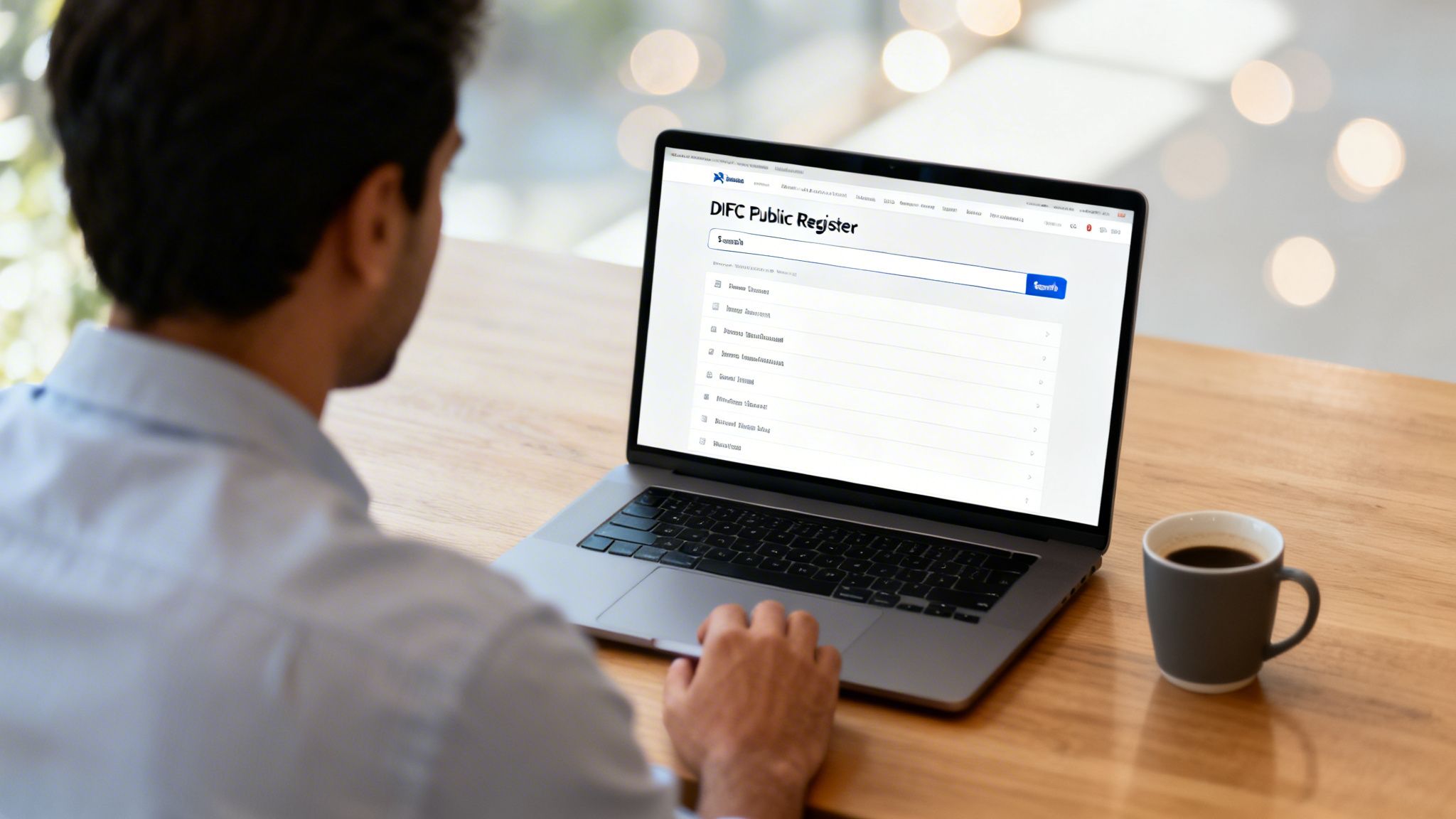
Think of the DIFC Public Register as your first line of defence when doing business in the UAE. It’s a powerful, free tool for making smarter, faster decisions. In a fast-moving ecosystem, knowing exactly who you're dealing with is non-negotiable.
The register gives you immediate, transparent access to crucial corporate data, turning a slow verification process into a simple search. It helps you confirm that a company claiming to be a DIFC entity genuinely exists and is in good legal standing.
Your Go-To Tool for Transparency and Trust
At its core, the register is all about promoting transparency. It lets anyone look up the basic details of a DIFC-registered company, which helps you build trust with credible players and avoid questionable ones. For busy founders, this translates into practical, actionable insights:
- Partner Verification: Before you sign a contract with a new service provider, a quick search confirms their official status and whether they're legally active.
- Investor Validation: When a potential investor says they’re based in the DIFC, you can instantly verify their firm's existence and even see who its key people are.
- Quick Competitive Insight: You can look up competitors to find their registration date, legal structure, and listed directors—clues about their operational history and scale.
With the DIFC's explosive growth, this tool is more vital than ever. The free zone's company numbers continue to surge, with a 28% organic year-on-year growth pushing the total active registered companies to 8,844 as of early 2024. That’s a lot of new players to vet.
Founder Takeaway: The register's greatest value is speed. In just a few minutes, you can get a clear "yes" or "no" on a company's legitimacy, saving you from wasting weeks on a potential deal with an entity that’s either dissolved or never existed.
Using the DIFC Public Register demystifies the corporate landscape. It’s an essential first step for any startup operating in the MENA region. For more on local regulations, check out our guide on the DIFC's crowdfunding rules every founder should know.
How to Search the DIFC Public Register Step by Step
Verifying a company on the DIFC Public Register is a straightforward process you can master in minutes. For busy founders, this quick check provides immediate clarity. This guide gives you the exact steps to move from uncertainty to verified information with confidence.
First, head to the official DIFC Public Register portal. The landing page has a clean search interface, clearly designed for fast lookups.
This is where your due diligence begins. You’ll notice options to search for either regulated (DFSA) or non-regulated entities, a crucial distinction we’ll get into.
Finding a Company by Name or Number
The most common search is by company name. For the most accurate results, however, the company's unique registration number is your best bet. It eliminates any confusion from similar names or spelling variations.
Here’s the step-by-step process:
- Select Entity Type: Choose between "Regulated" (for financial services firms supervised by the DFSA) and "Non-Regulated." If you're unsure, start with "Non-Regulated," as it covers most companies.
- Enter Search Term: Type the company's full legal name or its registration number into the search box.
- Initiate Search: Click the "Search" button.
The system will pull up a list of matching companies. Click "View Profile" to see the detailed information.
Tips for an Effective Search
Searching the register is easy, but a few tricks can help you find what you need faster, especially with partial information. To efficiently extract data, consider applying modern information retrieval techniques when digging through the register.
- Less is More: If you aren't sure of the exact legal name (e.g., does it end in "Ltd" or "Limited"?), start by searching for the core company name. The search function can find partial matches.
- Check Spelling Variations: If your first search is empty, try a few common alternative spellings or abbreviations.
- Use the Registration Number: If a company lists their DIFC registration number on their website or documents, use it. This is the fastest and most reliable method, as each number is unique.
Next Action: If a company claiming a DIFC presence is not on the public register, it is a major red flag. Immediately ask them for their DIFC Registration Number. A legitimate DIFC entity will always be on the register and can provide this number without hesitation.
This simple verification step is a foundational part of your due diligence, protecting your startup from significant legal and financial risk.
How to Read a DIFC Company Profile Like a Pro
Finding a company on the DIFC Public Register is the first step. The real value comes from knowing how to decipher the profile, turning raw data into actionable intelligence. For a founder, every field tells a part of the story and can guide your next move.
When you click a company's profile, you’re looking at its official identity as filed with the DIFC Registrar of Companies—not marketing fluff from a website. Let's break down what to look for and what it means.
The process is refreshingly simple: visit the site, run your search, and verify the details.
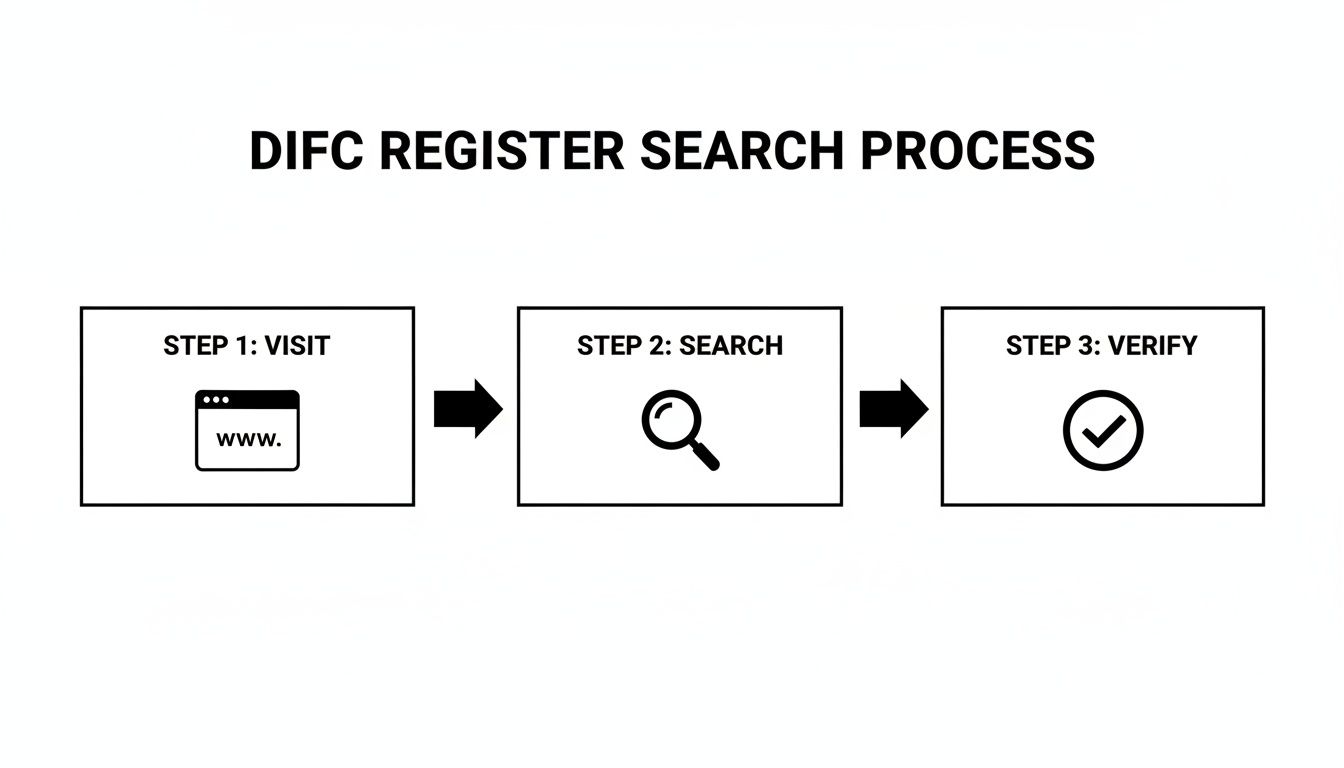
It’s designed to be efficient for busy founders.
Decoding the Details: A Practical Framework
To help you get the most out of every search, here’s a framework for breaking down the key information. Think of each data point as a clue. When you put them all together, a much clearer picture emerges, helping you weigh risks and opportunities.
Key Information and Your Next Action
Data FieldWhat It Tells YouYour Next ActionLegal Name & Registration NumberThe company's official, registered identity. The number is a unique identifier.Cross-check this against their website and contracts. Mismatches are a red flag.Registration DateHow long the company has been established in the DIFC. A simple measure of longevity.A recent date might mean a startup, while an older one suggests a longer track record. Factor this into your risk assessment.Legal StatusThis is critical. ‘Active’ means they are in good standing. Other statuses are serious warnings.If you see ‘Dissolved’ or ‘Struck Off,’ the company legally no longer exists. Steer clear.Company TypeIndicates if it’s a Private Company (Pvt), Prescribed Company (PC), or another structure.This tells you about its regulatory framework. A PC, for instance, is often used for holding structures.DirectorsLists the individuals legally responsible for managing the company.Look these names up on LinkedIn. Do they have relevant experience? Do you have any shared connections?ShareholdersIdentifies the owners of the company, confirming who has a financial stake.Is it owned by an individual, a family office, or a corporation? This helps you understand who you're really dealing with.Registered OfficeThe official legal address of the company within the DIFC.Confirms they have a physical presence in the free zone, a requirement for licenced entities.
By methodically going through these fields, you’re building a strategic profile that can protect you from bad partnerships and highlight great opportunities.
Looking at the People Behind the Business
The register doesn't just give you corporate data; it shines a light on the individuals steering the ship. This is where your due diligence gets personal and more revealing.
Who’s on the board of directors? A quick search of these names on LinkedIn can tell you about their professional journey and reputation. Are they seasoned executives with a history of successful exits or first-time directors?
Likewise, the list of shareholders confirms who owns the company. While the exact share percentage isn't always public, knowing the owners is a fundamental part of any background check. Are you dealing with a company owned by individuals, a prominent local family office, or a major international firm? Each structure has different implications for how they operate and partner with others.
Founder Insight: The 'Directors' list is more than a roll call. Cross-reference these names online. You might discover shared connections, past company affiliations, or specific industry expertise that either builds your confidence or raises new questions you need to ask.
Real-World Scenarios for Using the Register
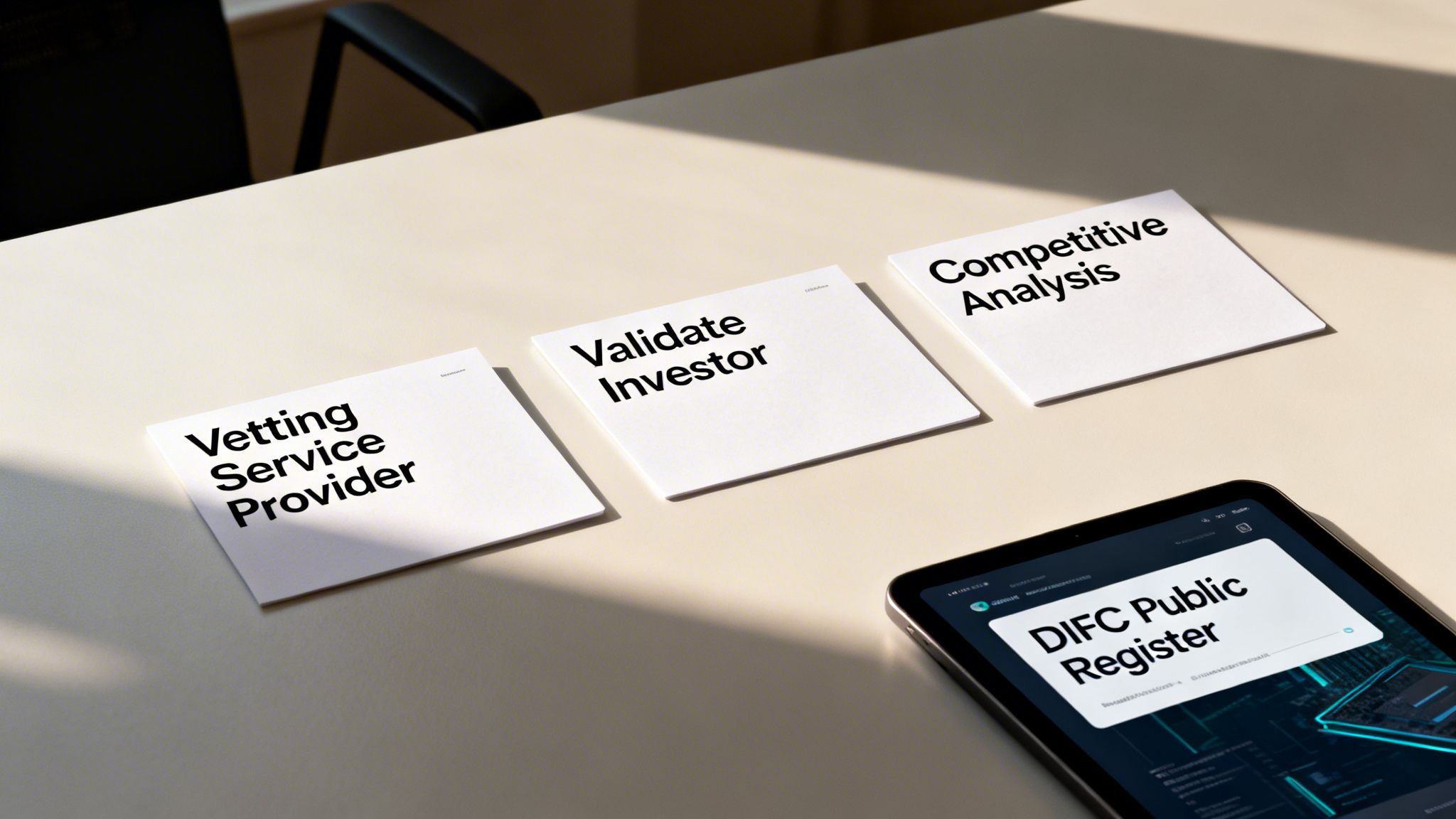
Knowing how to search the DIFC Public Register is one thing. Knowing when to use it is what separates smart founders from the rest. For anyone building a business in the UAE, this free directory is your first line of defence and a powerful source of intelligence.
Let’s walk through three common scenarios where a quick search can save you time, money, and headaches. Each is a critical decision point for a startup where the register helps you move from making assumptions to acting on verified facts.
Scenario 1: Vetting a Service Provider
The Situation: You’re about to sign a contract with a marketing agency. They have a slick pitch and claim to be a "well-established DIFC entity."
Your Action: Before committing, you run a two-minute check on the public register. Your search reveals they were only registered three months ago.
The Insight: This doesn't automatically mean they're a bad company, but it contradicts their claim of being "well-established." The register arms you with facts. Instead of taking their pitch at face value, you can now ask pointed questions: "I saw you're a newer entity in the DIFC. Could you tell me more about the team's prior experience in the region?" This shifts the power dynamic, letting you negotiate from a position of knowledge.
Scenario 2: Validating a Potential Investor
The Situation: An angel investor slides into your DMs, expressing keen interest in your seed round. They mention their investment firm is based in the DIFC.
Your Action: You head to the DIFC Public Register to look up their firm.
The Insight: Here’s what you might uncover:
- Confirm Legitimacy: The firm shows up as an “Active” entity. Good start—it’s real.
- Identify Key People: You pull up the list of directors. A quick LinkedIn cross-check shows one director has a stellar track record in your industry.
- Understand the Structure: The profile lists it as a "Prescribed Company," a structure often used for holding assets, which makes sense for an investment vehicle.
This simple background check provides immediate validation and critical context. You've gone from taking their word for it to confirming their operational status and identifying the exact people to research further.
Scenario 3: Conducting Quick Competitive Analysis
The Situation: You’re building a FinTech app and want to size up a key competitor also based in the DIFC.
Your Action: A quick search on the public register.
The Insight: You discover their registration date, revealing they’ve been in the game for five years—much longer than you realised. You also see the names of their directors, helping you map out their leadership team and dig into their professional backgrounds. This sliver of intelligence helps you understand their history and the expertise they have, giving you a clearer picture of the competitive landscape from a free, public tool.
Understanding the DFSA for Financial Partnerships
For any founder in the UAE, especially in FinTech, there’s a crucial difference you need to understand: a company being in the DIFC is not the same as being regulated by the Dubai Financial Services Authority (DFSA). This distinction is vital when vetting partners, particularly for any service that touches money, investments, or financial data.
While the DIFC Public Register lists every company with a legal presence in the free zone, the separate DFSA Public Register is a much more exclusive list. It only includes firms that have passed a gruelling approval process to carry out regulated financial activities.
Think of it like this: the DIFC is the entire neighbourhood, but the DFSA only gives a special licence to the banks, investment firms, and insurance brokers operating within it.
When to Check the DFSA Register
This extra check is non-negotiable any time you partner with a company that will handle financial services for you or your customers. This covers firms involved in payments, wealth management, advisory, or most FinTech solutions.
Verifying a firm on the DFSA register confirms they are held to a much higher standard of compliance, governance, and capital adequacy. This oversight exists to protect consumers and maintain the integrity of the financial system.
Next Action: If a potential partner claims to be a "regulated financial firm" in the DIFC, your very next step should be to verify them on the DFSA’s own public register. Don't just take their word for it or stop at their DIFC registration. This extra five-minute check is your best defence against regulatory risk.
The Growing Importance of Regulation
The DIFC's financial services framework has strengthened massively. The number of DFSA-regulated firms grew by 17% to 980 in just the first half of 2024 alone, showing how robust the oversight has become. You can read the full report on DIFC's 2025 growth to get a better sense of the landscape.
For founders, this means you have more regulated partners to choose from, but you also have a greater responsibility to ensure compliance. To get a handle on this complex area, learn more about building regulated financial products in the UAE in our detailed guide.
When to Dig Deeper Beyond the Public Register
Think of the DIFC Public Register as your first, essential check. It's the quickest and most reliable way to confirm a company is legally registered and active. For initial screening, it’s perfect. But for a founder in the UAE, knowing its limits is just as crucial.
The register confirms legitimacy, not viability. It won’t tell you about a company’s financial health, operational track record, debt, or legal history. It’s a snapshot of corporate standing, not the full story of its business journey.
Triggers for Deeper Due Diligence
Dig deeper when the stakes get high. It's time for a more thorough investigation when you're:
- Considering a Major Partnership: You need to understand their financial stability and market reputation.
- Preparing for an Acquisition or Merger: A full review of financial records, contracts, and potential liabilities is non-negotiable.
- Onboarding a Critical Supplier: If your business will depend heavily on a single supplier, you must be confident they're financially sound.
- Vetting a High-Value Investor: Beyond their basic registration, you'll want to verify their investment history and source of funds.
Your Actionable Next Steps
When the public view isn't enough, the DIFC provides a clear path forward. You can request official company documents directly from the Registrar for a fee. These documents, like a Certificate of Incumbency, offer far more detail on current directors and shareholders.
While the DIFC Public Register gives you a valuable starting point, a comprehensive strategy often requires more extensive legal due diligence. This multi-layered process is what truly protects your startup. For founders looking at other growth avenues, it’s also worth exploring tech innovation grants in the DIFC for AI, Blockchain, and Web3 funding.
Frequently Asked Questions About the DIFC Register
Here are clear, fast answers to the most common questions founders have about using the DIFC public register.
Is the DIFC Public Register Free to Use?
Yes, searching the register and viewing basic company profiles is completely free. This includes key details like registration numbers, legal status, and director names, making it a perfect no-cost tool for initial due diligence. For official documents like a Certificate of Incumbency, small fees apply.
What Is the Difference Between the DIFC and DFSA Registers?
This is a critical distinction. The DIFC Public Register lists all companies legally established in the free zone. The separate DFSA Public Register only lists firms specifically regulated to provide financial services.
A company can be on the DIFC register without being on the DFSA's, but all DFSA-regulated firms will be on both. If you are in FinTech or partnering with a financial firm, checking both is an essential step.
What if a Company Is Not on the Register?
First, double-check your spelling. Simple typos are common. But if they still don’t appear, it’s a major red flag.
Next Action: Immediately ask the company for their official DIFC registration number. A legitimate DIFC entity will always be on the public register and can provide this number without hesitation. If they can’t or won’t, proceed with extreme caution.
How Current Is the Information on the Register?
The register is a live database, updated in near real-time. As companies file changes with the DIFC Registrar of Companies—like new registrations or director appointments—the online register reflects those modifications almost instantly. This makes it a highly reliable and current source for corporate information you can trust.
Doing proper due diligence is a non-negotiable part of building a successful startup. But it shouldn't be a lonely journey. Founder Connects is a private community designed to connect UAE and MENA founders for meaningful support, peer-driven accountability, and real progress. Learn more and join a trusted network of founders building stronger businesses together.

Building in MENA? You don't have to do it alone.
Join 300+ founders in the Founder Connects Residency. Monthly squad calls, warm intros, $3M+ in perks, and much more. All for less than your monthly coffee budget.
Popular posts





Founder Connects is a premium MENA tech founder community. Meetups in Dubai and across MENA, Residency Squads of 8–10, and 400+ vetted WhatsApp founders (apply and screened).