

You searched for a businessman near me because you need momentum, not another badge scan and weak follow-up. Most founders in the UAE hit the same wall. Generic networking gives you volume, but not relevance. You meet plenty of people, yet very few can help with hiring, pilots, fundraising, distribution, or honest operator feedback.
That gap matters more in a market where access is uneven. Dubai accounted for 71% of all UAE startup funding in Q1 2024, so proximity can distort search results and push founders towards the loudest circles instead of the right ones. If you're serious about building, you need high-signal rooms, trusted introductions, and a repeatable way to turn meetings into working relationships.
This guide covers seven options that are worth your time. Some are best for early-stage founders who need clarity and accountability. Others suit scale-ups, regulated startups, or founders who need investor and corporate access. If your outreach still feels random, fix that first with mastering LinkedIn for B2B growth.
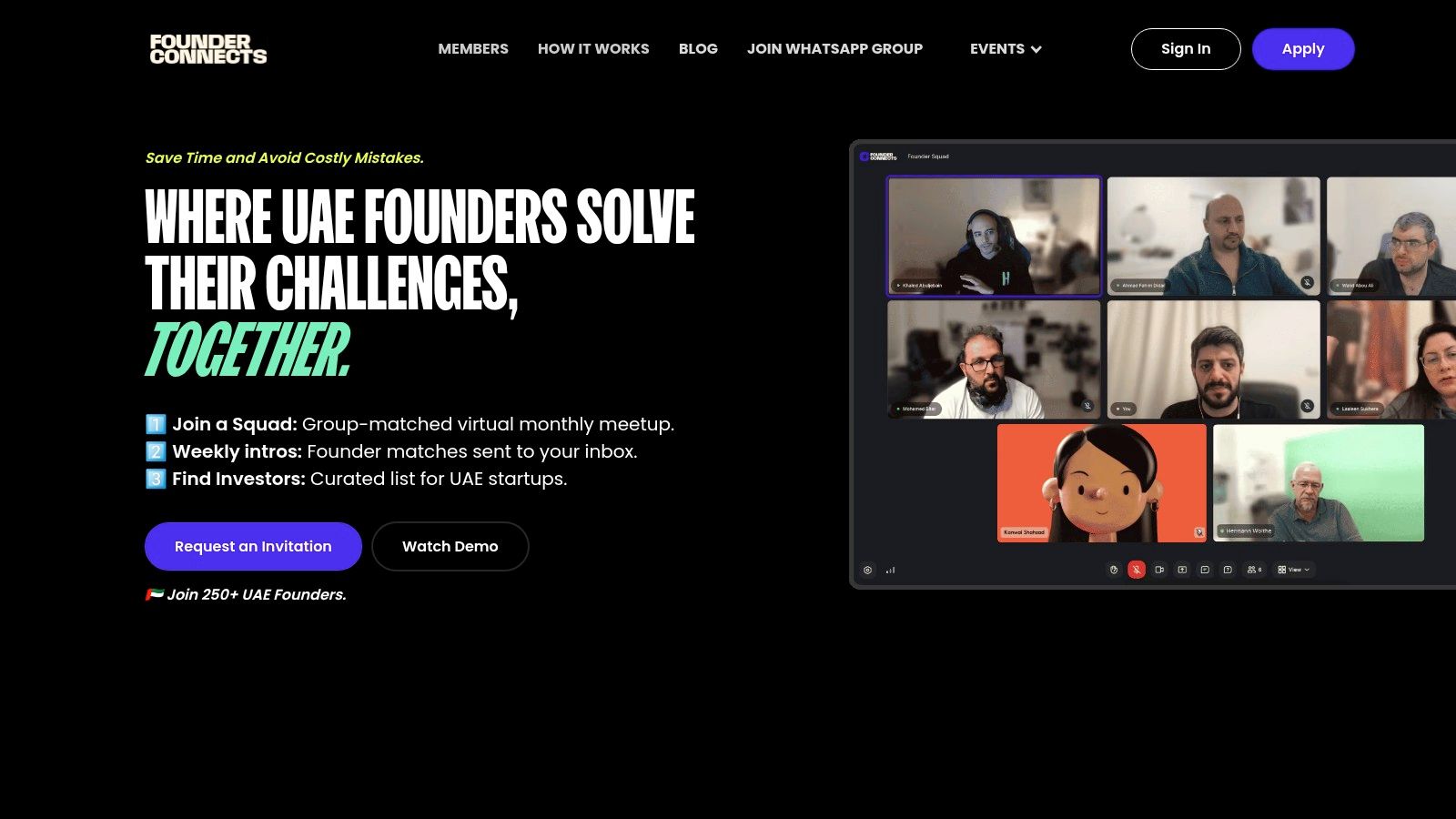
You meet someone at a polished event in Dubai, swap numbers, promise to follow up, and nothing useful happens. Founder Connects solves that specific problem. It is a private UAE founder community built for curated introductions, small peer groups, and practical follow-through.
That structure matters. Members join Founder Squads for moderated sessions, then continue with targeted one-to-one introductions. The result is better than casual networking because the system keeps the right conversations active long enough to produce hires, partnerships, investor warmups, and operator feedback.
Community outcomes are public on the platform's site, including founder participation, collaborations, cost savings, and funds raised. That gives busy founders a cleaner signal than vague claims about “access.”
This option fits founders who already know what kind of relationship they need. Early-stage teams can use it for idea pressure-testing, customer intros, and honest feedback from people who have built in the same market. Scale-ups get a different payoff: hiring help, distribution conversations, investor positioning, and comparisons with operators handling similar growth problems.
The trade-off is selectivity. That usually improves relevance, but it also means this is not the right fit for someone who wants a huge public member directory or instant self-serve access.
For local context on how founder communities differ across the city, this breakdown of a Dubai business network is useful.
If your company is venture-backed or heading that way, pair community access with a sharper investor target list. Find tech investors in UAE before you start asking members for introductions, so your outreach is specific.
Practical rule: Join this if you want accountability, targeted introductions, and candid operator conversations. Skip it if your main goal is broad visibility.
What works:
What to watch:
Use this when applying or messaging a member:
Building in [sector] in the UAE. I'm looking for a small circle of founders who can help on [hiring / GTM / fundraising / partnerships] and who value direct operator feedback. If that matches how you use Founder Connects, I'd be glad to compare notes.
EO Dubai is for founders who want disciplined peer accountability with a strong confidentiality culture. That's the primary product. Not the events. The forum model is what makes EO useful when you're carrying decisions you can't unpack publicly.
The trade-off is simple. EO becomes much more valuable once you're already operating at meaningful scale. If you're still at idea stage, you'll probably get more value from a tighter early-stage founder community or incubator. If you've built revenue, hired a team, and need a room of peers facing similar operator problems, EO gets stronger fast.
EO also gives you global reach, which matters if your UAE business depends on cross-border customers, suppliers, or expansions. It runs a Dubai chapter within a wider international network and has an Accelerator track for earlier-stage founders targeting the revenue threshold listed on its site at EO Dubai. If you're comparing local founder circles first, this overview of a Dubai business network gives useful context.
Confidential peer forums are hard to replace. Founders usually discover that after one bad public overshare.
Pros:
Cons:
If you're fundraising and need a parallel investor search process, keep EO for peer learning and use a separate workflow to find tech investors in UAE.

TiE Dubai is a strong choice if your main need is mentor access. Some founder communities are best for peer accountability. TiE is better when you want exposure to experienced operators, charter members, and investor-facing programming without needing to qualify for a more exclusive founder-only room first.
I usually point founders here when they're coachable, early enough to benefit from outside pattern recognition, and specific about the kind of mentor they need. "I need advice" is too vague. "I need a B2B SaaS founder who has sold into UAE enterprises" is the right level of ask.
TiE's strength is its mission focus around mentoring and education, plus regular events and ecosystem partnerships through TiE Dubai. It's recognisable across markets, which helps if you're using the UAE as a base but thinking regionally.
What works:
What doesn't:
A good message to send after a TiE event:
If your search for businessman near me really means "who can open doors in regulated finance, enterprise partnerships, or serious investor circles", start here. DIFC Innovation Hub and Ignyte by DIFC sit inside a business environment that already carries institutional credibility.
That matters because some intros only convert when the setting itself signals seriousness. A random café meeting with a founder is one thing. A structured ecosystem tied to DIFC is another, especially for fintech, compliance-heavy products, and startups selling into financial services.
The offer is broader than office space. You get access to a curated community, visible programming, mentor and investor discovery, innovation challenges, and a path towards the Innovation Licence through DIFC Innovation Hub.
The trade-off is equally clear. DIFC isn't built to feel casual. There are application, setup, and compliance realities, and the ecosystem naturally skews toward founders who can use them.
Worth remembering: Prestige only helps if it matches your sales motion. A fintech founder benefits from DIFC credibility. A general consumer startup may not.
Choose this if:
Skip it if:

in5 is one of the better practical answers for founders who don't need prestige first. They need setup support, workspace, mentorship, and a recognisable Dubai launchpad. That's why I usually see it as an execution choice, not a status choice.
It's particularly useful for early-stage founders in tech, media, and design who want a structured path without trying to piece together company setup, community, and support from five different places. The appeal isn't just networking. It's the combination of business setup and ecosystem access under one roof through in5.
The strongest use case is simple. You're building something real, you're early, and you need lower-friction operating support while meeting relevant people. That mix is hard to replicate with standalone event communities.
Pros:
Cons:
A lot of founders overrate "networking" and underrate convenience. If one ecosystem lets you license, work, meet mentors, and build local visibility faster, that's often the better ROI decision.
Hub71 is for venture-backable tech companies that want scale infrastructure, not just founder company. The centre of gravity is different here. You're stepping into an Abu Dhabi ecosystem designed around growth programs, sector clusters, institutional partners, and accepted-startup support.
For the right startup, that can materially change your trajectory. For the wrong one, it becomes an impressive logo with weak practical fit.
Hub71 runs themed support across areas such as AI, ClimateTech, Digital Assets, and Life Sciences, alongside access and market-entry pathways on Hub71. If you're trying to decide between Abu Dhabi and Dubai ecosystem routes, this guide comparing Hub71 vs DIFC vs Area 2071 pre-seed options is a useful shortcut.
The upside is strongest when your business can use institutional depth:
The downside is just as real:
A practical filter I use. If your startup deck depends on ecosystem logos more than customer traction, you're probably too early. If you already know which partners, regulators, or investors you need, Hub71 becomes much more compelling.

A founder has early traction, a messy operating cadence, and too many loose introductions that never turn into decisions. Sheraa is a strong option for that stage. It gives structure, accountability, and market-facing support without taking equity just for entry, which is why many UAE founders use Sheraa as a build phase, not just an events calendar.
The fit is clearest for founders who need a programme to create momentum. If your business benefits from deadlines, mentor pressure, and a cohort that keeps moving, Sheraa can shorten the distance between idea, validation, and first serious commercial conversations. That is different from joining a network mainly for social proximity to other founders.
Sharjah works for founders who want access without the noise tax. Dubai gives range and volume. Sharjah often gives clearer signal, closer institutional ties, and a better chance of forming repeat relationships with mentors, universities, operators, and public-sector stakeholders.
That makes Sheraa a strategic choice, not a second-tier alternative.
Its strengths are practical:
There are trade-offs too:
A simple filter helps. Choose Sheraa if you need a system around your progress and you are ready to show up consistently. Skip it if you already have strong founder density around you and only need occasional introductions.
For outreach, keep it specific. A short note works better than a broad "would love to connect" message: "I'm building X for Y customer in the UAE. We're at Z stage, and I want help with mentor fit, pilot access, and programme timing. Is Sheraa the right route, or am I too early?" That gets you a faster and more honest response.
| Program | Implementation complexity 🔄 | Resource requirements ⚡ | Expected outcomes 📊 / Quality ⭐ | Ideal use cases 💡 | Key advantages ⭐ |
|---|---|---|---|---|---|
| Founder Connects | Low–Moderate 🔄, curated onboarding, selective application | Moderate ⚡, monthly 90‑min squads + weekly intros (time) | High 📊 / ⭐⭐⭐⭐, measurable collaborations, fundraising & cost‑savings metrics reported | Early to scaling founders wanting focused peer accountability and warm intros | Curated small squads, weekly intros, proven member outcomes |
| Entrepreneurs' Organization (EO), Dubai | High 🔄, membership + confidential forum commitments | High ⚡, annual dues, forum time; US$1M+ revenue expectation | High 📊 / ⭐⭐⭐⭐, deep global introductions, peer accountability | Revenue‑generating founders (>US$1M ARR) seeking global network and peer forums | Global reach, confidential moderated forums, Accelerator for sub‑US$1M founders |
| TiE Dubai | Moderate 🔄, mentor programs and event coordination | Low–Moderate ⚡, event/mentor hour attendance; typical member fees | Moderate 📊 / ⭐⭐⭐, mentor access, learning and investor touchpoints | Founders seeking mentors, sector events and cross‑border exposure | Strong mentor culture, frequent programming, global brand recognition |
| DIFC Innovation Hub / Ignyte | Moderate–High 🔄, application, compliance and platform onboarding | Moderate ⚡, licence pathway and compliance; finance‑sector focus | High 📊 / ⭐⭐⭐⭐, investor/regulator visibility within DIFC ecosystem | Fintech and regulated startups needing DIFC presence and investor access | DIFC credibility, curated investor/regulator networks, Innovation Licence pathway |
| in5 Innovation Centers | Moderate 🔄, competitive selection and incubation timeline | Low–Moderate ⚡, subsidised licensing, workspace and mentorship | Moderate–High 📊 / ⭐⭐⭐, cost savings and structured company setup | Early‑stage tech/media/design founders needing affordable setup and support | Subsidised licensing, clear setup path, hands‑on incubation support |
| Hub71 (ADGM) | High 🔄, competitive selection and program commitments | Moderate–High ⚡, relocation/participation logistics but strong incentives | High 📊 / ⭐⭐⭐⭐, scaling support, partner introductions and incentives | Venture‑backable tech companies ready to scale with institutional partners | ADGM credibility, sector clusters, tangible incentives (housing, office, insurance) |
| Sheraa, Sharjah Entrepreneurship Center | Moderate 🔄, cohort programs and fellowship coordination | Low ⚡, equity‑free support but may require onsite participation | Moderate–High 📊 / ⭐⭐⭐, market access, mentorship and public‑sector links | Founders targeting UAE market access, regulation and local partnerships | Equity‑free programs, matched EIRs/mentors, strong market‑access orientation |
You leave a breakfast in DIFC or a startup night in Dubai with a pocket full of contacts and no real movement. A week later, nobody has replied, the warm intros have gone cold, and the event added activity, not progress.
That pattern usually comes from poor matching and weak follow-up.
Strong founders in the UAE treat relationship-building like a repeatable operating system. They choose the room based on stage, sector, and current bottleneck. Then they make a specific ask, track responses, and follow up while the context is still fresh. That approach gets better results than collecting more business cards.
That is the core use of this list. It helps a founder choose the right node in the market, not just another place to show up. Founder Connects fits operators who want curated peer access and practical conversations. EO Dubai fits established founders who get value from structured peer forums. TiE Dubai suits founders who want wider exposure across mentors, investors, and events. DIFC Innovation Hub and Ignyte by DIFC are better suited to regulated or finance-linked companies. in5, Hub71, and Sheraa are stronger choices when setup support, incentives, market access, or scale partnerships matter more than general networking.
Start small and make it measurable.
A short note usually beats a polished deck at this stage. Use a message like this:
I'm building [startup] in [sector]. Our focus right now is [one priority]. I found you through [community]. Your experience with [specific topic] looks directly relevant. If useful, I'd value a short conversation and will come prepared with specific questions.
There is a real trade-off here. Broad networking gives reach. Targeted networking gives traction. In the UAE, where founder, investor, operator, and platform circles overlap, one relevant relationship can lead to a customer intro, a hiring lead, a regulatory conversation, or a better decision on market entry. That only happens when the first outreach is specific and the follow-up is disciplined.
Choose one option from this list this week. Review the application or membership path. Then contact one relevant person. If you need help finding the right person behind the company, use these Icypeas email finder methods. For founders who want a tighter circle and practical accountability in the UAE, Founder Connects is a sensible starting point, as noted earlier.


