

Dubai Chamber Careers 2026: Roles & Growth Tips

Building in MENA? You don't have to do it alone.
Join 300+ founders in the Founder Connects Residency. Monthly squad calls, warm intros, $3M+ in perks, and much more. All for less than your monthly coffee budget.

A lot of founders in Dubai hit the same career fork, even if they don't say it out loud.
The company is stable but no longer exciting. Or the startup didn't fail, exactly, but it stopped being the best use of your time. Or you've built enough in the private sector to realise your next edge might come from understanding how the ecosystem works from the inside.
That's where Dubai Chamber careers become interesting. Not as a backup plan. As a strategic move.
For operators and founders in the UAE, a role inside a chamber can change what you see, who you meet, and how you understand the machinery behind trade, business formation, expansion, and policy execution. The upside isn't only salary or job title. It's access, pattern recognition, and institutional context.
Is a Dubai Chamber Career Your Next Move?
A founder I'd advise in this position usually isn't asking, “Can I get hired?” They're asking something sharper. “If I spend two or three years inside this institution, will I come out more valuable to the market?”
That's the right question.
Dubai Chamber is not a short-cycle startup and not a generic corporate employer either. It was established in 1965, and workforce estimates place it in the 500 to 700 employee range, with 17.0% year-on-year workforce growth according to Revelio Labs employee data for Dubai Chamber. That combination matters. You're looking at an institution with deep continuity, but not one that appears frozen.
For a founder, that creates an unusual proposition:
- Institutional credibility: You get a recognised platform in the UAE business ecosystem.
- Broader exposure: You're likely to work across business, government-facing, and ecosystem stakeholders.
- Signal value: Future investors, regulators, partners, and large corporates read chamber experience differently from ordinary back-office public sector experience.
Practical rule: If your next move needs to improve your network quality, not just your monthly income, a chamber role can be worth serious attention.
It also helps if you already understand how Dubai's business ecosystem works in practice. If you don't, start with this guide to the Dubai business network. The people who do well in chamber-adjacent roles usually know how to move between founders, corporates, service providers, and government-linked stakeholders without getting lost in any one world.
The wrong reason to pursue Dubai Chamber careers is boredom with startup chaos. The right reason is that you want a front-row seat to how the market is organised.
Understanding the Modern Dubai Chambers
A founder considering Dubai Chamber careers should start with the operating model, not the job title. Dubai Chambers no longer works like a single, generic business institution. The 2022 restructuring created three chambers with different mandates across commerce, international expansion, and the digital economy. That shift changes the career math.

A candidate joining this system is not merely entering "the Chamber." They are joining a specific institutional lane, with its own speed, stakeholders, and definition of success.
That distinction matters more than many applicants realise. A role tied to the commerce side can feel close to market infrastructure and member service. A role tied to international activity can look more like external representation, delegation support, and relationship management across borders. A role connected to the digital economy can sit nearer to ecosystem development, sector building, and startup-facing programmes.
The brand is shared. The day-to-day work is not.
For founders and operators, a key trade-off emerges. Chamber roles can give unusually strong access to decision-makers, business groups, and regional market signals. They also require more discipline than startup people often expect. Progress often depends on alignment, timing, and stakeholder management rather than speed alone. Someone who needs full autonomy will feel constrained. Someone who wants influence inside a structured system may find the fit surprisingly strong.
The stronger candidates usually bring two abilities at once. They understand commercial reality, and they can operate with institutional patience. That combination is rare, which is why experienced founders can outperform more traditional applicants in the right roles.
Another useful signal sits in the public-facing hiring setup. Dubai Chambers maintains an active careers portal, and its broader organisation and contact structure are visible through Dubai Chambers' official web presence. That suggests a standing hiring function inside an institution with multiple priorities, not a one-time recruitment push.
For a founder, the better question is not whether a vacancy looks interesting this quarter. The better question is what kind of career capital this platform helps you build. If you want policy exposure, cross-border access, and a stronger position inside the UAE business ecosystem, the structure can work in your favour. If you mainly want freedom, rapid experimentation, and direct control over outcomes, the same structure may feel slow.
Decoding Roles from Policy to Partnerships
Individuals searching for Dubai Chamber careers only see a vacancy title and a job application button. That's not enough. You need to decode what kind of work sits underneath the title.
For founders, four role families matter most. They attract different strengths and produce different long-term advantages.
Policy and advocacy roles
These roles sit closest to business environment issues. The work often involves synthesising market feedback, engaging stakeholders, preparing briefs, and helping shape positions that affect members or sectors.
A founder with strong policy instincts tends to do well here if they can stop speaking like a founder.
That trade-off matters. In startup mode, speed and conviction are rewarded. In policy-adjacent roles, nuance, documentation, and institutional alignment matter more. You can't treat every issue as a rapid-fire product sprint.
International trade and partnerships roles
Commercially minded operators often find their strongest fit within these roles. The work can include relationship-building, external representation, market coordination, and cross-border ecosystem development.
The upside is obvious. You build a serious regional and international network.
The downside is subtler. Many founders enjoy relationship-building when they control the agenda. In chamber work, you often represent a broader mission. That means patience, protocol, and message discipline matter as much as hustle.
If you want pure autonomy, partnership roles can frustrate you. If you want leverage through trusted representation, they can be excellent.
Digital economy and ecosystem development roles
Founders are often drawn here first, for good reason. These roles usually connect most naturally with innovation, startups, platform-building, and digital market growth.
Founder experience can become an advantage instead of something you need to explain away. If you've built products, worked with founders, or operated inside early-stage environments, you can often read ecosystem dynamics faster than a generalist manager can.
But there's a catch. You're no longer building only for your own company. You're serving a wider market agenda. That means programme design, stakeholder balance, and public-value thinking become core skills.
Member services and operations roles
Many founders overlook these roles because they sound administrative. That's a mistake.
In chamber environments, operations is often where business reality becomes visible. You see recurring friction, compliance patterns, service expectations, and the actual quality of process execution. For founders who want to become stronger operators or future service-business builders, this exposure can be highly valuable.
Here's the simplest way to map the fit.
| Role Family | What It Involves | Ideal Founder Skills | Long-Term Strategic Value |
|---|---|---|---|
| Policy and Advocacy | Stakeholder input, briefing materials, business environment issues, coordination across interests | Structured thinking, ecosystem awareness, clear writing, listening under pressure | Builds policy literacy and credibility with institutional stakeholders |
| International Trade and Partnerships | External relationships, market engagement, cross-border coordination, representation | BD, negotiation, partner management, commercial judgement | Expands regional network and improves access to trade-facing decision-makers |
| Digital Economy and Ecosystem Development | Startup programmes, innovation initiatives, ecosystem support, sector development | Product thinking, founder empathy, programme design, community building | Positions you well for future ecosystem, venture, or platform roles |
| Member Services and Operations | Service delivery, process ownership, compliance-heavy workflows, internal coordination | Operational rigour, SLA discipline, process improvement, cross-functional execution | Sharpens execution and gives you direct insight into business pain points at scale |
How to choose the right lane
Founders usually go wrong in one of three ways:
- They chase prestige over fit: A flashy strategy title is less useful than a role where you own meaningful workflows.
- They overvalue brand and undervalue manager quality: Your direct manager will shape the experience more than the institution's reputation.
- They ignore rhythm: Some roles are external and dynamic. Others are process-heavy and internal. Know which environment gives you energy.
If your long game is venture, ecosystem building, or advisory work, digital economy and partnership roles often create stronger external signal. If your long game is policy influence, public-private strategy, or regulated-sector leadership, policy and operations roles can compound better.
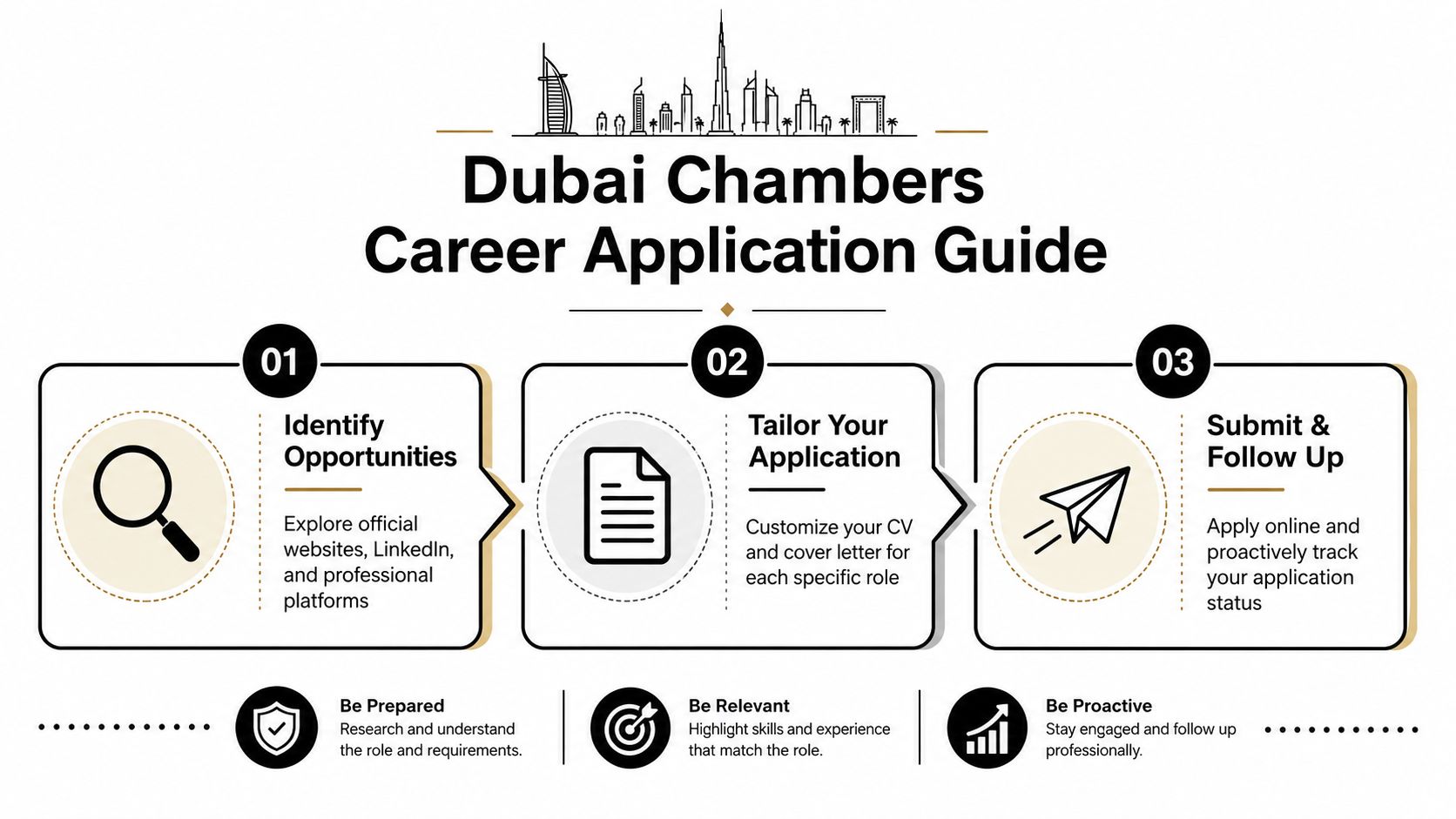
How to Find and Apply for Open Positions
Most candidates make the search process harder than it needs to be. They browse casually, apply broadly, and submit a founder CV that reads like it belongs to someone who still wants to run their own show.
That usually doesn't work.
Where to look first
Start with the official careers environment. Dubai Chambers' active hiring portal is Dubai Chambers Careers, which is the cleanest place to monitor open roles and set up alerts.
Then add a second research layer. Review public business listings, member-facing directories, and adjacent context around the organisation's ecosystem footprint. This overview of the Dubai Chamber of Commerce directory is useful because it helps you understand the stakeholder environment surrounding the institution, not just the vacancies themselves.
If you're new to UAE hiring norms, this practical guide for expats seeking jobs is worth reading before you apply. It won't replace role-specific preparation, but it does help you avoid the usual market-entry mistakes.
How to read a chamber job description properly
A representative Dubai Chamber posting for a Government Relations Assistant Manager calls for 3 to 5 years' experience, includes responsibility for visas, permits, licences, registrations, onboarding and offboarding, renewal processing, and supervision of PROs and team members. It lists English fluency as required, Arabic as an advantage, and shows a salary band of AED 12,000 to AED 15,000 monthly in the Indeed listing for Dubai Chamber roles.
That tells you more than most candidates realise.
It tells you the organisation values compliance capability, local process fluency, and operational reliability. It also tells you that a “manager” title here may involve detailed execution, not just strategy decks.
Application filter: If a role mentions permits, licences, onboarding, renewals, or government coordination, don't pitch yourself as a pure visionary. Pitch process ownership.
How founders should rewrite their CV
Don't send the version of your CV that impressed investors. Send the version that reassures institutional hiring teams.
Translate your experience like this:
- “Raised a seed round” becomes “secured multi-stakeholder buy-in for strategic initiatives”.
- “Built GTM from scratch” becomes “designed and executed cross-functional market-entry processes”.
- “Managed startup chaos” becomes “operated effectively in ambiguous, high-change environments with direct accountability for outcomes”.
A useful test is simple. If every bullet on your CV sounds founder-centric, you haven't translated enough.
This short explainer may also help you prepare before applying:
A tighter application workflow
- Track selectively: Save a small number of relevant roles instead of spraying applications.
- Mirror the language: Use the job description's operational vocabulary where it truthfully matches your experience.
- Show institutional maturity: Highlight collaboration, documentation, compliance, and stakeholder management.
- Follow up professionally: Brief, respectful follow-up beats repeated nudging.
The strongest applications for Dubai Chamber careers don't try to look entrepreneurial. They look dependable, commercially aware, and easy to trust.
Navigating Interviews and Salary Negotiations
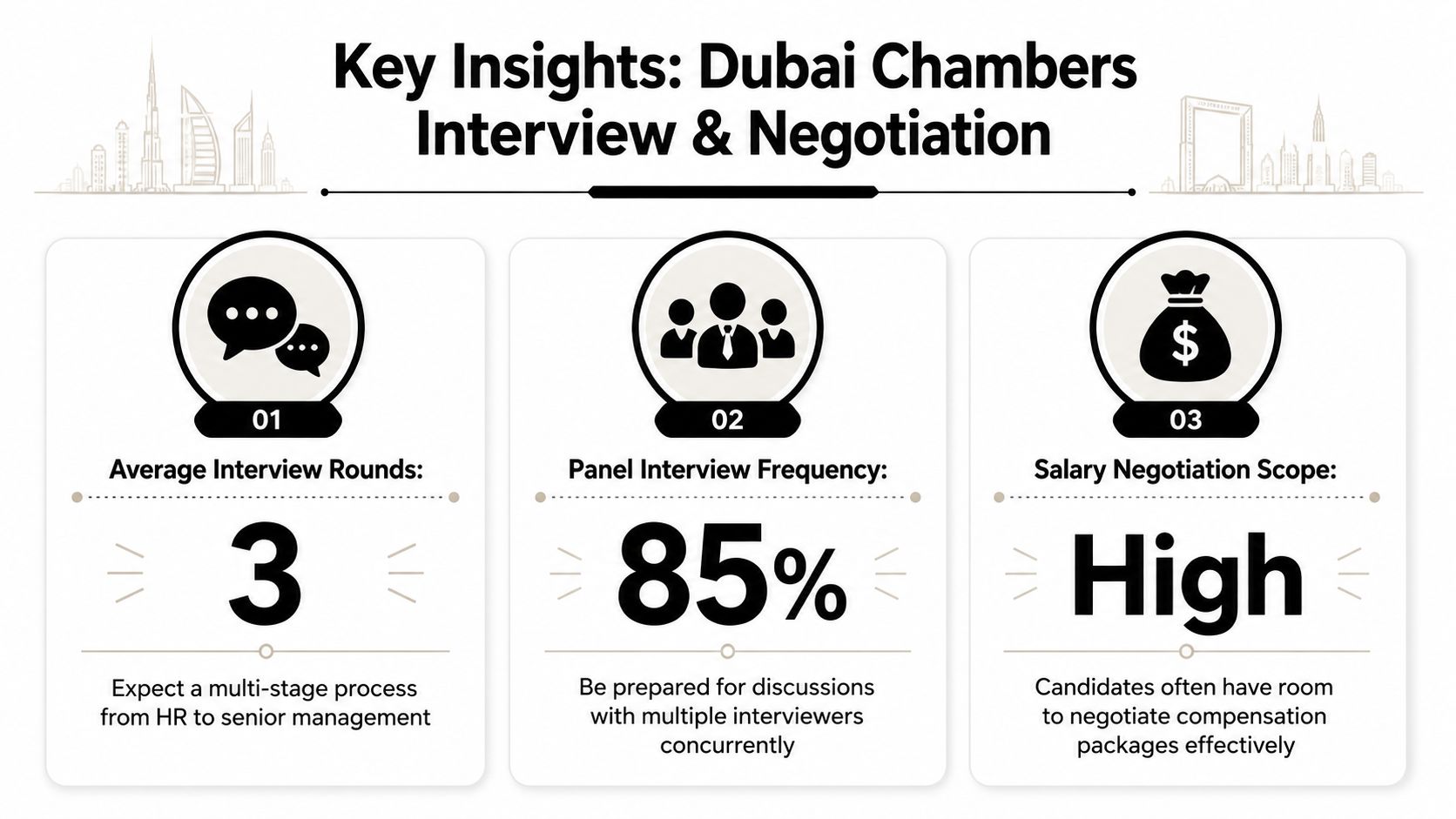
Interviewing for a chamber role feels different from interviewing with a startup. The room often tests for maturity before brilliance.
That catches many founders off guard.
They enter ready to talk about initiative, disruption, and big ideas. The panel is often listening for something else: judgment, diplomacy, discipline, and whether you can represent the institution without creating unnecessary friction.
What they're usually trying to assess
As noted earlier, Dubai Chamber operates like a mid-sized, lean institution with significant role breadth and a premium on adaptable operators rather than narrow specialists. That matters in interviews because they're not only assessing what you know. They're assessing how you handle shared ownership, process-heavy environments, and cross-department execution.
Expect questions that probe how you work when:
- Authority is distributed
- Timelines depend on multiple stakeholders
- Documentation matters as much as speed
- You need to represent policy or process you didn't personally design
Founders who answer well usually show restraint. They don't present themselves as lone heroes. They show they can operate inside a system.
A strong interview answer in this context sounds less like “I took over and fixed it” and more like “I aligned the right parties, clarified responsibilities, and moved the work forward without breaking trust.”
Questions worth preparing for
You'll probably face some version of these:
- Tell us about a time you managed competing stakeholder priorities
- How do you handle delays caused by external approvals
- Describe a process you improved without disrupting compliance
- Why do you want to move from a startup or founder path into an institutional role
- How would you balance business urgency with procedural requirements
These aren't trick questions. They're compatibility questions.
If you answer every question with a startup war story about speed and boldness, you may unintentionally signal poor fit. The better move is to show range. Demonstrate that you know when to push, when to document, and when to escalate.
Salary conversations without guesswork
The clearest compensation anchor in the available public market data is the Government Relations Assistant Manager example referenced earlier, which lists AED 12,000 to AED 15,000 monthly. Treat that as a role-specific benchmark, not a universal salary map across all chamber functions.
That distinction matters. External-facing strategy roles, specialist technical roles, and operations-heavy roles won't necessarily be framed the same way.
When negotiation starts, focus on the full package and the role mandate:
- Role scope: What decisions will you own directly?
- Team design: Are you inheriting a working process or a broken one?
- Reporting line: Does your manager have decision-making authority?
- Growth path: Is this a platform role or a holding pattern role?
For the mechanics of handling an offer conversation, this guide on how to secure a higher tech salary is useful even outside pure tech. The specific market context differs, but the framing around bargaining power, timing, and countering thoughtfully still applies.
If you're comparing this route with startup roles, this overview of startup jobs in Dubai helps clarify the trade-off. In a chamber role, you may give up some upside and autonomy. In return, you often gain institutional signal, steadier operating conditions, and different kinds of strategic access.
The Founder's Playbook for Ecosystem Roles
You have built a company, fought for customers, and made decisions with incomplete information. Then a Dubai Chamber role appears. The question is not whether you can get the job. It is whether stepping inside the institution improves your position in the UAE market over the next three to five years.
For the right founder or operator, it can.
The value sits in vantage point, pattern recognition, and access. A chamber role can show you how business support systems work, where approvals stall, which stakeholder groups carry weight, and how public-private priorities are translated into programs, partnerships, and execution. That view is hard to get from the outside, even with a strong network.

When this move makes strategic sense
This path usually works best for founders who want to build one or more specific assets before the next chapter.
- Policy literacy: You want direct exposure to how economic priorities, business facilitation, and sector agendas are turned into operating decisions.
- High-trust network access: You want working relationships with business leaders, institutional counterparts, and ecosystem intermediaries that are difficult to build through cold outreach.
- Sector positioning: You want a stronger seat in commerce, international trade, or digital economy conversations.
- Reputation reset: You want to translate founder experience into institutional credibility before launching again, joining a fund, or taking on a regional strategy role.
As noted earlier, the post-2022 structure creates separate lanes across commerce, international trade, and the digital economy. That matters because the career outcome is not the same in each lane. A partnerships role tied to trade access builds a different profile from a policy or ecosystem development role tied to digital economy initiatives.
The costs founders should admit honestly
This move rewards patience and disciplined stakeholder work. It punishes people who need constant autonomy.
Inside a chamber environment, process is part of execution. Alignment across teams matters. Language is more careful. Decision velocity is often slower than in a startup because the institution is managing risk, reputation, and multiple constituencies at once. Founders who read that as simple inefficiency usually burn out or become politically clumsy.
There is also an identity trade-off. In a startup, the founder is the center of gravity. In an ecosystem role, your value often comes from helping other companies, coordinating actors, and improving outcomes you do not fully own. Some founders find that maturity-building. Others find it draining.
A simple test helps. Take the role only if you can still respect the mission on a slow week, in a consensus-heavy project, with limited room to improvise.
How to use the role as a tour of duty
The strongest candidates treat the role as a defined strategic chapter. They do not use it as a break from founder pressure. They use it to collect assets they can later convert into better judgment, better access, and better positioning.
| Asset to Build | What to Seek Inside the Role |
|---|---|
| Regulatory understanding | Exposure to approvals, compliance workflows, and government-facing coordination |
| Relationship capital | Projects that involve founders, corporates, trade actors, and ecosystem partners |
| Institutional fluency | Work that requires briefing, committee input, or structured stakeholder management |
| Sector insight | Direct involvement in commerce, trade, or digital economy initiatives |
The career calculus comes into sharp focus. If the role gives you title prestige but little exposure to decisions, it is probably a weak trade. If it gives you recurring contact with serious operators, visibility into how market priorities are set, and enough scope to ship meaningful work, it can be one of the better mid-career moves in the UAE ecosystem.
Used well, a chamber role can sharpen your next move substantially. That next move might be another company, a fund platform, a corporate innovation seat, or a public-private strategy role with more influence and better context.
Your Next Steps and Red Flags to Avoid
Dubai Chamber careers are a smart move when you want more than a pay cheque. They make sense when you want institutional signal, stronger ecosystem access, and a better grasp of how Dubai's business environment is organised.
Use this quick filter before applying:
- Apply if you want structured exposure to business, trade, or digital economy systems.
- Pause if you need full autonomy and immediate decision power.
- Lean in if you're good at stakeholder management, disciplined execution, and operating with shared ownership.
- Walk away if you mainly want a prestigious logo without caring about the day-to-day work.
Watch for these red flags during the process:
- Vague role scope: If no one can explain what success looks like, the role may be reactive and poorly owned.
- Misaligned reporting line: If the hiring manager lacks real authority, execution can become political.
- No clarity on cross-functional expectations: In chamber environments, unclear interfaces create daily friction.
- Founder experience treated as novelty: If interviewers can't see how your background maps to the role, the fit may be weak on both sides.
Your next action is simple. Identify two people who moved from startup or operator roles into chamber, public-private, or ecosystem institutions in the UAE. Study what changed in their positioning, title language, and network quality after the move.
If you're weighing a move like this and want sharper founder-to-founder perspective, Founder Connects is built for exactly that kind of decision. It brings UAE and MENA founders into high-signal conversations, curated peer groups, and practical introductions that help you test major career and company choices with people who understand the trade-offs.

Building in MENA? You don't have to do it alone.
Join 300+ founders in the Founder Connects Residency. Monthly squad calls, warm intros, $3M+ in perks, and much more. All for less than your monthly coffee budget.
Popular posts





Founder Connects is a premium MENA tech founder community. Meetups in Dubai and across MENA, Residency Squads of 8–10, and 400+ vetted WhatsApp founders (apply and screened).