

The story of cricket isn't just about a game; it's a powerful lesson in how to scale a product, build a die-hard community, and conquer new markets. For any founder in the UAE and MENA, its journey from a sleepy English pastime to a multi-billion-dollar global machine is a practical blueprint for growth.
This guide breaks down cricket’s history, pulling out actionable insights on how standardizing rules can create a scalable product and how launching new formats can capture entirely new audiences. The core idea is simple: the very principles that turned a niche sport into a global powerhouse can be plugged directly into your startup.
We'll look at how cricket’s journey provides a clear roadmap for building a brand, navigating massive market shifts, and using the UAE's unique position as a global hub. The goal is to arm you with practical frameworks you can use immediately, whether you're trying to find product-market fit or planning your next expansion.
Think of cricket's history as a founder's case study in strategic growth. It shows you how to codify an idea (the rules), pivot to meet new customer demands (ODIs and T20), and build a massive economic engine around a passionate user base (franchise leagues).
This is a journey with clear, tangible lessons for any business leader. We’ll examine the key milestones through the eyes of a startup founder, focusing on:
Your next step is to read this guide not as a sports fan, but as a founder. With every section, ask yourself: “How does this apply to my business? Where can I use this lesson in product development, market expansion, or community building?” That mindset will turn cricket’s history into your playbook for success.
Every great idea, whether it’s a global sport or a tech startup, needs a framework to survive. Before cricket could conquer the world, it had to move from being a chaotic local pastime to a structured, repeatable game. Think of this as cricket’s "minimum viable product" (MVP) moment—a vital lesson for any UAE founder looking to scale.
That journey kicked off in the 18th century with the Hambledon Club. This group formalized the rules, doing for cricket what a founding team does for its product. They created a standard set of guidelines that brought consistency, meaning a match in one village looked and felt the same as one fifty miles away.
This standardization was the key that unlocked growth. Without it, cricket would have remained a messy collection of village games. For founders, the lesson is clear: well-defined processes and consistent product features aren't just bureaucracy; they're the bedrock of a scalable business.
The Hambledon Club didn't just write down rules—they started keeping score. This simple act of record-keeping created a history and a set of metrics that could be tracked and analyzed. It laid the groundwork for what we now call a "first-class" match.
The real breakthrough came in 1772. The club organized a series of games between a Hampshire XI and an England XI that are now seen as the dawn of first-class cricket. These matches were meticulously scored, and three of those scorecards still exist today, forming a continuous statistical record. That’s why you’ll see these games officially numbered as the first-ever first-class matches in major cricket archives. You can trace the sport's data-driven history all the way back by exploring the history of cricket's foundational records.
To understand how cricket evolved, it helps to see the major shifts in one place.
This table breaks down the pivotal periods in cricket's development, highlighting the key changes and what they meant for the sport's growth.
Each era built on the last, adding layers of structure and professionalism that turned a simple game into a global institution.
This timeline traces cricket's path from a village pastime to a structured, global sport.
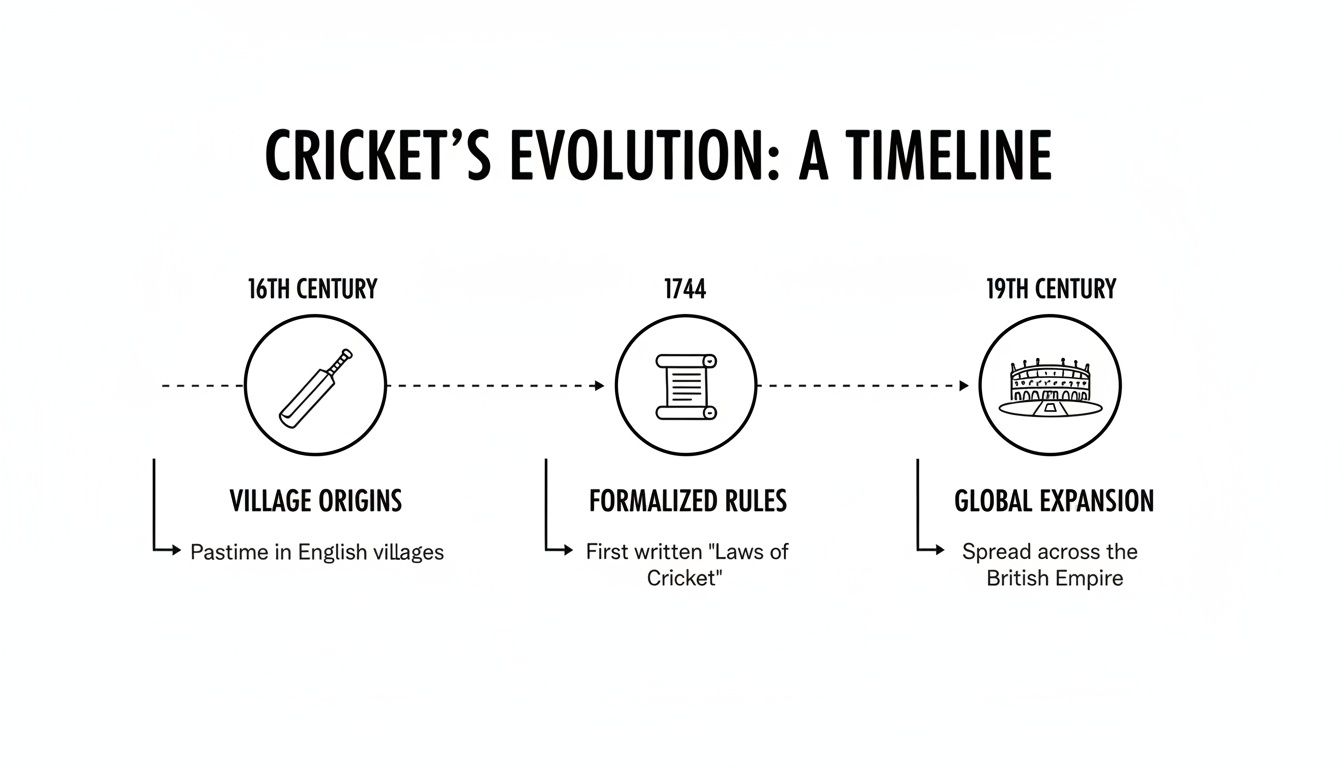
As you can see, codifying the rules was the critical step between informal games and international competition—a lesson every scaling business needs to learn.
With a solid rulebook in place, cricket was ready to grow. Its expansion map followed the contours of the British Empire, spreading to new territories and embedding itself in different cultures. This was cricket’s first international market expansion—onboarding new "users" across the globe.
This colonial spread gave birth to Test cricket and brought new powerhouse nations into the fold.
The game had to adapt to new cultures, and in turn, those cultures shaped the game right back.
The lesson for founders is clear: a strong, well-defined core product is essential for entering new markets. Your MVP must be solid enough to maintain its identity while being flexible enough to resonate with local audiences, whether in Riyadh, Dubai, or Cairo.
Next Action: Take a hard look at your startup's "rulebook." Are your core processes, value proposition, and key metrics clearly defined? Ask your team: "If we had to launch in a new country next month, is our operational playbook clear enough for us to pull it off?" This simple audit can expose critical gaps in your foundation for scaling.
A great product solves a specific problem for a specific audience. But what happens when that audience changes, or when you spot a chance to grab an entirely new market? Your product has to adapt.
For any founder in the MENA region, cricket’s evolution offers one of the best case studies in how to reinvent a product. The sport's journey from five-day marathons to three-hour blockbusters is a masterclass in market segmentation and finding product-market fit.

For over a century, Test cricket was the only "product." It was a slow-burn, strategic contest lasting up to five days, made for purists. As the world sped up, however, this traditional format faced a massive challenge: a shrinking audience with less time and a growing hunger for faster entertainment.
This is a classic founder's dilemma: your core product is loved by a loyal base, but it isn’t pulling in new customers. Do you stick with what works for the few, or do you innovate to capture the many? Cricket chose to innovate.
The first big shift came in the 1970s with One-Day International (ODI) cricket. The "problem" it solved was simple—modern audiences couldn't commit five full days to a single match. ODIs compressed the game into a single day, guaranteeing a result and creating a much more TV-friendly product.
This wasn't just a shorter version; it was a total redesign.
This new format pulled in a broader family audience and unlocked huge commercial opportunities through television rights. It was a smart pivot that expanded the market without killing the original product. For more on this, you can find some great lessons from UAE startup pivots that highlight the importance of adaptability.
While ODIs were a hit, the 21st century brought an even more demanding audience. Cricket's answer was its most radical move yet: Twenty20 (T20) cricket.
Launched in 2003, T20 was built to attract a completely new demographic: the casual sports fan who wanted non-stop entertainment in a three-hour window. This wasn't just another iteration; it was a disruption.
Think of each format as a solution designed for a different user need:
The T20 format was a brilliant piece of product design. It stripped away the game's slower moments, dialed up the most exciting parts, and packaged it all into a short, intense experience. Its success led to the creation of domestic franchise leagues like the Indian Premier League (IPL), which transformed the sport's economic landscape.
Next Action: Map your product suite against your customer segments. Are you offering a single, one-size-fits-all solution? Ask your team: "What is the 'T20 version' of our product? A lighter, faster, or more accessible offering that could capture a new audience?"
Just like a modern startup, today's cricket would be unrecognizable without technology. The game's evolution offers a perfect parallel for founders on how to build a more reliable product, improve the user experience, and make smarter, data-driven decisions. This shift from gut-feel to evidence-based strategy has been a game-changer in both sport and business.
The most obvious change has been in officiating. For decades, umpiring decisions were based on human judgment, which led to endless controversies. Cricket had a 'user trust' problem. The introduction of tools like the Decision Review System (DRS) was the sport's answer to quality assurance.
DRS pulls together several technologies to make the game more accurate and fair. Think of it as a founder using A/B testing and user feedback loops to fine-tune a product.
By bringing in these tools, cricket created a system of accountability. It gave players (the 'users') a way to challenge potential mistakes, dramatically improving trust in the final result. The lesson is clear: embedding tech to ensure fairness and consistency is fundamental to building long-term customer loyalty.
Beyond getting calls right, data reshaped how the game is played. Cricket teams used to run on intuition. Today, every decision is backed by data, much like how a modern UAE startup uses analytics to fuel its growth. You can see more on how AI drives growth in UAE startups in our detailed guide.
This pivot to analytics means teams track everything. They analyze a batter's scoring zones, a bowler's most effective deliveries, and even player fitness metrics.
This data-first mindset is identical to a startup using metrics to understand customer behavior. A team analyst pinpointing a batter's weakness is no different from a founder finding a drop-off point in their conversion funnel and fixing it. Both are using data to find a competitive edge.
This focus has created new roles like performance analysts and data scientists, whose sole job is to turn raw numbers into winning strategies.
The final piece of the tech puzzle was broadcasting. Televising matches live, and later streaming them, was cricket's masterclass in scalable content distribution. It took a product confined to a stadium and delivered it into millions of homes, creating a massive, untapped audience.
The rise of dedicated sports channels and digital streaming platforms let cricket reach fans everywhere. This opened up enormous new revenue streams from media rights, which are now the financial backbone of the sport. For a founder, this highlights the power of a multi-channel distribution strategy to move past geographical limits and scale your product's reach.
Next Action: Do a quick 'tech audit' of one key business process. Where are you still relying on intuition instead of data? Pick one area—it could be customer support, marketing attribution, or product development—and ask your team: "What one piece of technology or data could we introduce here to reduce errors, build user trust, or make a smarter decision next week?"

While T20 cricket opened the door to a new audience, it was the business model built on top of it that turned the sport into a financial juggernaut. The Indian Premier League (IPL), launched in 2008, wasn’t just another tournament. It was a brilliantly designed ecosystem blending sport, celebrity, and city-based rivalries.
For founders in the UAE and MENA, the IPL is a powerful playbook on how to build a brand, ignite massive demand, and monetize a passionate community.
The genius was shifting focus from national allegiances to city-based franchises. This created a new layer of tribalism, turning neighbors into rivals and giving fans a local team to support. This model, borrowed from American sports, instantly created valuable, investable assets: the teams themselves.
This framework was built for scale. It established a repeatable structure that could pull in huge private investment, transforming team ownership from a passion project into a serious commercial enterprise. To understand the money flowing into the sport, it helps to know the Indian investment landscape, which sits at the heart of cricket's economy.
The IPL's financial engine runs on several well-oiled pistons. For any founder looking to build a business with multiple income streams, this structure is a fantastic blueprint.
The model’s core revenue streams are:
This hybrid model—part centralized income, part individual hustle—creates a powerful financial flywheel.
The IPL’s greatest lesson is in ecosystem building. It created a platform where multiple stakeholders—broadcasters, sponsors, players, and franchise owners—could all generate immense value simultaneously. It wasn’t just a tournament; it was a marketplace.
The IPL’s runaway success created a template that was quickly copied all over the world. Its franchise model proved to be a scalable way to monetize the T20 format.
Even newer leagues in places like the UAE are following this blueprint. This teaches a core lesson for founders: a winning business model should be documented, repeatable, and adaptable. If you're building your own business ecosystem, you might find ideas in our guide on creating a Silicon Valley in Dubai.
Next Action: Map out your business's ecosystem (customers, partners, suppliers). Ask your team: "Are we just selling a product, or are we building a platform where our partners can create value, too?" Brainstorm one new revenue stream you could launch by better serving a partner in your ecosystem, just as the IPL did for broadcasters and sponsors.
The most successful businesses don’t just serve their current customers; they get obsessed with finding new ones. Cricket’s push into new territories and demographics is a masterclass in capitalizing on untapped opportunities.
Two examples drive this point home: the emergence of the UAE as a global cricket hub and the explosion in popularity of the women’s game. Both show how to create massive value by focusing on previously overlooked markets.
For a long time, the UAE was barely a footnote on the world cricket map. But a perfect storm of world-class infrastructure, a prime geographic location, and a huge South Asian expat community created an unmissable opportunity. The region carved out a niche as a reliable, high-quality neutral venue, especially when political issues made it impossible for teams to play at home.
This smart move turned the UAE, particularly Dubai and Abu Dhabi, into an essential part of the global cricket machine. Major tournaments, including parts of the IPL and the T20 World Cup, have been staged there flawlessly. The lesson for founders is clear: you can build something incredibly valuable by becoming the stable, go-to solution in an otherwise unpredictable market.
This strategic positioning has also sparked local interest beyond expat communities. Cricket participation is surging across the MENA region. In Saudi Arabia, for instance, local leagues now boast over 8,000 players. You see a similar story in Dubai, where thriving domestic leagues and international matches are pulling in Emirati nationals alongside the established fanbase. You can find more details on the rise of sports across the MENA region here.
The second, and arguably bigger, growth story is the rise of women's cricket. For decades, the women's game was starved of funds and ignored by broadcasters—a massive, untapped market hiding in plain sight.
Everything changed when governing bodies finally started putting real money and effort into it. This was a combination of moves:
The results have been spectacular. The 2020 Women's T20 World Cup final in Melbourne pulled in a crowd of 86,174 people. The WPL’s media rights for its first five years sold for a staggering $116.7 million, a clear signal of massive commercial confidence.
For founders, the lesson is direct. Your next major growth opportunity might not be in a new country but in a demographic your industry has historically ignored. Serving an underserved audience with a product they love can unlock enormous loyalty and commercial value.
Next Action: Run a "blind spot" analysis on your own market. Get your team together and ask two brutally honest questions:
Challenge those assumptions. The most rewarding markets are often the ones your competitors have already written off.
Cricket's journey from village green to global stadium is a masterclass in evolution. For founders, it’s full of lessons on how to adapt, innovate, and find new markets. Here are the core changes that tell the story.
Cricket has branched into three distinct formats, each designed for a different audience. Think of it like a product line that adapted for modern attention spans.
The growth was slow at first, then explosive. Between 1928 and 1932, the game welcomed the West Indies, New Zealand, and India as Test-playing nations, with Pakistan joining in 1952.
It took 84 years to play the first 500 Test matches. The next 500? Just 23 years. That’s the institutional momentum that happens when a product finds its market. You can track cricket's global spread in more detail on Wikipedia.
It took 84 years to reach 500 Tests, but only 23 years to hit 1,000—a perfect example of hitting an inflection point in growth.
Technology didn't just add bells and whistles; it fundamentally improved the integrity and strategic depth of the game. It’s like adding an analytics suite to your startup.
The future is about tapping into new markets and making the game more inclusive—a smart play for any business looking for its next growth phase.
These quick-hit questions give you a snapshot of cricket's journey. Use them to spark ideas for your own venture—whether you're pivoting your product, adopting new tech, or breaking into a new market.
Ready to connect with peers who face similar scale challenges? Join Founder Connects to access curated founder groups, regular accountability sessions, and targeted introductions. Visit https://www.founderconnects.com to start your membership.


