

How Founders Prepare for UAE Startup Exits

Building in MENA? You don't have to do it alone.
Join 300+ founders in the Founder Connects Residency. Monthly squad calls, warm intros, $3M+ in perks, and much more. All for less than your monthly coffee budget.

Exiting a startup in the UAE is a process that demands early planning, strong governance, and financial discipline. Founders aiming for acquisitions, mergers, or IPOs must align their business models with investor priorities, comply with UAE regulations, and leverage the local ecosystem for mentorship and networking opportunities.
Key Takeaways:
- Early Planning: Build scalable operations, diversify risks, and minimize founder dependency to attract buyers.
- Governance & Compliance: Maintain clear financial records, adhere to UAE Corporate Tax and IFRS standards, and ensure proper licensing.
- Ecosystem Support: Use platforms like DIFC FinTech Hive or Hub71 for mentorship, funding, and investor connections.
- Regulatory Adherence: Address sector-specific rules, tax obligations, and legal structures to avoid deal delays.
For UAE founders, preparing for an exit isn’t just about selling a business - it’s about positioning it for maximum value while contributing to the region’s growing startup ecosystem.
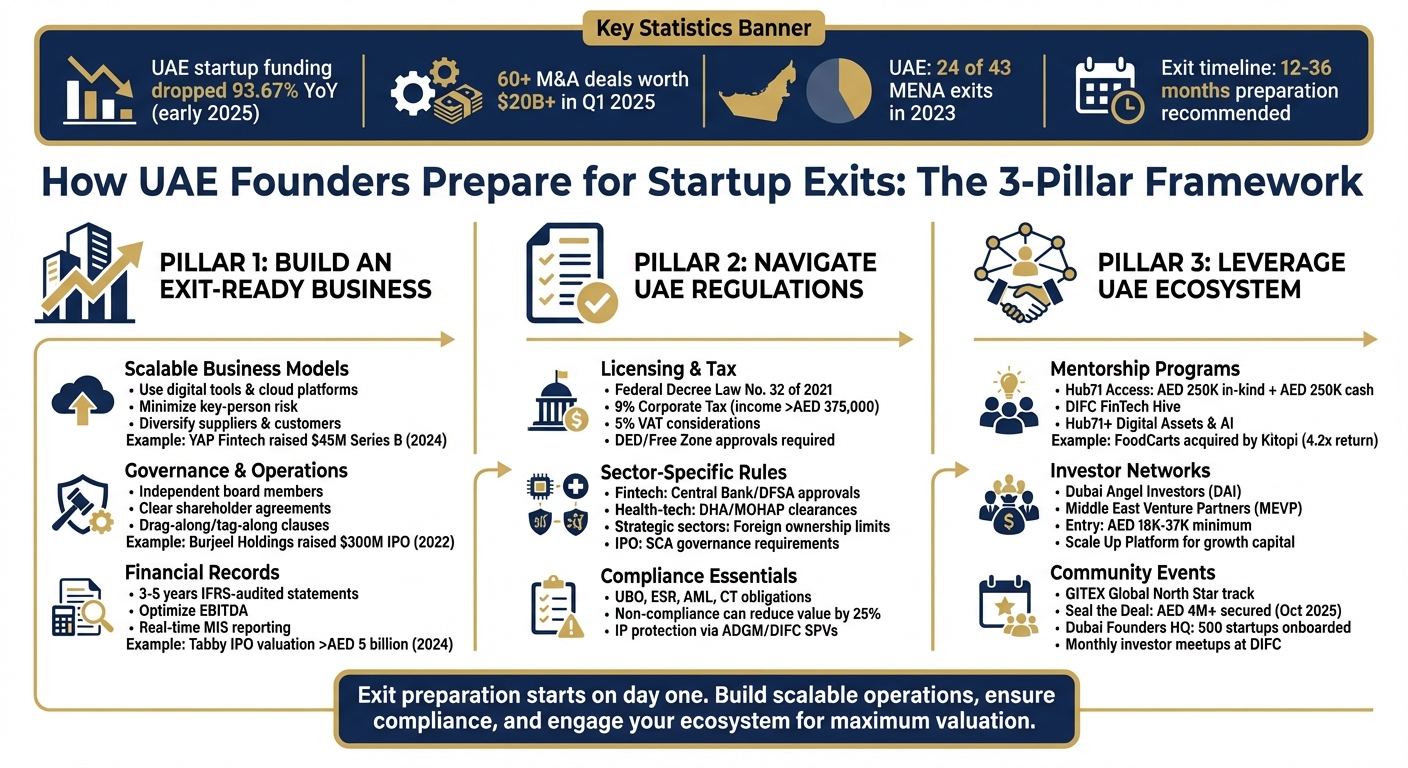
UAE Startup Exit Preparation Roadmap: 3 Key Pillars for Founders
Building an Exit-Ready Business
As mentioned earlier, planning for an exit early on shapes every operational decision. For startups, being prepared for an exit isn’t just a goal - it’s a necessity in today’s competitive environment. Especially in the UAE, where startup funding dropped by a staggering 93.67% year-on-year in early 2025 [6], investors are laser-focused on businesses that demonstrate strong financial discipline and solid market traction. This makes having a scalable model, clear governance, and well-maintained financial records a must.
Creating Scalable Business Models
Scalability is a top priority for anyone looking to buy a business. Buyers want operations that can grow revenues without a matching increase in costs - and they prefer businesses that don’t rely heavily on the founder to function.
Digital tools play a key role in proving scalability. Using cloud-based platforms and management information systems (MIS) can highlight revenue growth potential and improve profit margins, directly boosting valuation [8]. A great example is YAP Fintech, which raised $45 million in a Series B round in 2024. The company used a DIFC SPV structure for pre-IPO planning and attracted global investors by showcasing its scalable tech infrastructure and data-driven approach [3].
Minimising key-person risk is critical. Buyers will closely examine whether a business can run without the founder. Building a strong, independent team and moving away from informal management practices is essential [3][4]. Standardising processes not only makes the company more appealing to buyers but also simplifies post-acquisition integration [7].
Diversification strengthens appeal. Relying too much on one supplier or customer can scare off potential buyers. Diversifying both your supplier relationships and customer base demonstrates resilience and reduces perceived risks [3].
Setting Up Governance and Operations
Scalable operations are just part of the equation. Strong governance is equally important for attracting buyers and meeting regulatory standards. Startups with clear oversight, formal decision-making processes, and compliance with international regulations stand out.
A well-structured board and clear shareholder agreements inspire confidence. Independent board members and formal agreements provide oversight and reassure investors [3][2]. For IPOs, the Securities and Commodities Authority (SCA) requires startups to have robust internal controls and governance frameworks [2]. Exit-focused governance measures, like drag-along and tag-along clauses, can prevent minority shareholders from blocking a sale [3][5]. Additionally, restructuring to remove problematic shareholders before a deal can save time and headaches later [5].
Regulatory compliance is non-negotiable. UAE startups must fully adhere to requirements like Ultimate Beneficial Ownership (UBO), Economic Substance Regulations (ESR), Anti-Money Laundering (AML) protocols, and Corporate Tax (CT) obligations [3][2]. Ignoring these legal areas can slash a business’s value by as much as 25% [4].
Take Burjeel Holdings, for instance. The company raised $300 million during its October 2022 IPO on the ADX after undergoing extensive internal restructuring to clean up its governance and address legacy family ownership issues [3]. Similarly, Al Ansari Exchange raised AED 773 million ($210 million) in 2023 by introducing professional board oversight and transparent financial reporting while retaining family control [3].
Intellectual property (IP) protection is another must. Centralising IP and key assets within clean holding structures, such as ADGM or DIFC SPVs, simplifies valuation and transfer processes [3]. Informal IP arrangements or unregistered trademarks are red flags that can derail deals during due diligence [4][5].
Maintaining Clear Financial Records
Transparent and accurate financial records are the bedrock of a successful exit. Buyers and IPO underwriters will scrutinise financials in detail, and any inconsistencies can either derail the deal or significantly lower the valuation.
IFRS compliance is essential. Businesses need to maintain three to five years of audited financial statements in line with International Financial Reporting Standards (IFRS) [3][2][4]. This is especially critical for IPOs, as exchanges like the DFM and ADX require strict adherence to these standards.
Optimising EBITDA can make a big difference. Adjusting for non-recurring costs - like personal expenses or one-off legal fees - can provide a clearer picture of the company’s true earnings potential [3][5].
Real-time reporting adds credibility. Regular MIS reports not only help founders manage their businesses better but also give buyers confidence in the company’s financial health [3].
Tax compliance is increasingly important. With the introduction of UAE Corporate Tax, businesses must ensure proper transfer pricing policies for intercompany transactions. Poor tax planning can hurt valuation during due diligence [3]. Documenting these transactions with clear, arms-length pricing policies is essential, especially for companies operating across multiple jurisdictions [3].
Preparing a digital data room well in advance - 12 to 24 months before the planned exit - can streamline the buyer’s review process. This should include all material contracts, trade licences, and IP registrations [5][4].
"The businesses that sell well are the ones that are built to sell." - ADEPTS Chartered Accountants [3]
A great example of success is Tabby, which achieved a valuation of over AED 5 billion during its 2024 IPO on the DFM. This was made possible through strong pre-IPO funding rounds and strict adherence to local governance and financial reporting standards [2]. Even fast-growing fintech startups can meet the rigorous demands of public markets when they focus on building a solid foundation.
sbb-itb-f597d8f
Understanding UAE Legal and Regulatory Requirements
Strong governance and financial discipline are essential for a successful business exit, but navigating the UAE's legal and regulatory landscape is just as critical. Founders must tackle a maze of licensing, tax, and sector-specific regulations, all of which can significantly impact the outcome of a transaction. With over 60 M&A deals worth more than $20 billion completed in Q1 2025 alone, the stakes are high, and careful legal preparation is a must [2].
Meeting Licensing and Tax Requirements
Understanding your company structure is the first step to licensing compliance. Most onshore companies are governed by Federal Decree Law No. 32 of 2021, which regulates mergers, acquisitions, and corporate transformations [9]. For mainland Limited Liability Companies (LLCs), shareholders hold statutory pre-emption rights on share transfers. These rights can only be waived if all shareholders agree at the time of transfer [10][11]. Addressing these potential hurdles early on is crucial.
Share transfers also require formal approvals and updated licences. The Department of Economic Development (DED) or the relevant Free Zone authority must approve the transaction, and all related documents must be notarised or officially translated. A share sale is only legally completed once the commercial licence is updated [10][11]. For corporate parties executing documents outside the UAE, ensure powers of attorney are notarised and legalised by the UAE Ministry of Foreign Affairs well in advance to avoid delays that could disrupt timelines [10].
Tax compliance is another critical aspect. Since June 2023, the UAE Corporate Tax regime applies a 9% tax rate on taxable income exceeding AED 375,000. Additionally, asset sales may attract Corporate Tax and 5% VAT unless classified as a Transfer of a Going Concern (TOGC). Poor tax planning can negatively impact your valuation during due diligence, so it's wise to engage tax advisors early to structure the deal effectively [2][3].
Antitrust regulations could also come into play for larger deals. For transactions exceeding specific revenue thresholds, notifying the Ministry of Economy for an antitrust review is mandatory. This process can extend timelines, so it's important to account for it in your planning if your business generates significant revenue or holds a notable market share [2].
Sector-Specific Regulations
In addition to general compliance, sector-specific rules may require extra clearances, potentially affecting your exit timeline.
Regulated sectors often face additional scrutiny. For example, fintech startups must secure approvals from the Central Bank of the UAE or Free Zone regulators like the Dubai Financial Services Authority (DFSA) in DIFC. Similarly, health-tech companies need clearances from the Dubai Health Authority (DHA) or the Ministry of Health and Prevention (MOHAP) [10][11]. Regulators will closely examine compliance history, governance practices, and operational controls before granting approval.
Foreign ownership restrictions still apply to certain industries. While most onshore businesses now allow 100% foreign ownership, strategic sectors such as security, defence, banking, insurance, and telecommunications remain subject to restrictions under the "Strategic Impact List" [10][11]. If your company operates in one of these areas, you'll need to negotiate with local partners or restructure ownership well in advance of any sale.
IPO candidates face even more stringent requirements. The Securities and Commodities Authority (SCA) mandates that companies demonstrate a verified financial history, strong corporate governance, and robust internal controls [2]. This includes presenting three to five years of audited financial statements prepared under International Financial Reporting Standards (IFRS) [2][3][4]. For instance, in 2024, Tabby successfully listed on the Dubai Financial Market with a valuation exceeding AED 5 billion, thanks to its adherence to these strict standards [2]. The company’s financial transparency and governance were key to attracting public investors.
Immigration and labour compliance are equally important. When closing or restructuring, you must cancel residency visas for all employees - except the General Manager - and close their labour cards [12]. Clearance certificates from the Ministry of Human Resources and Emiratisation (MOHRE) are required to confirm all labour obligations are met [12]. In asset sales, employees do not transfer automatically, so you'll need to negotiate their contracts, including end-of-service benefits, to avoid triggering immediate payouts that could affect the purchase price [13].
Using the UAE Startup Ecosystem for Exit Preparation
Once you’ve established strong governance and financial discipline, tapping into the UAE startup ecosystem becomes a powerful way to prepare for a successful exit. The UAE’s vibrant ecosystem provides practical tools like mentorship programmes, investor networks, and community events. These resources not only help founders build key relationships but also equip them with the expertise to handle complex transactions. It’s all about creating opportunities for targeted guidance and strategic networking.
Finding Mentorship and Expert Guidance
Accelerator programmes in the UAE offer structured mentorship that directly addresses the challenges of exit preparation. Take, for example, Hub71’s Access Programme in Abu Dhabi. This three-month initiative, powered by Techstars, provides tailored advice to help startups grow and prepare for an exit. It also offers AED 250,000 in-kind support and AED 250,000 in cash through a SAFE note arrangement [15]. For more specialised guidance, founders can explore niche hubs like DIFC FinTech Hive, Hub71+ Digital Assets, or Hub71+ AI [15][17].
Peer-to-peer mentoring is another invaluable resource. Learning from founders who have already navigated exits can provide game-changing insights. The Founders Network in Dubai, for instance, supports entrepreneurs at every stage, from pitch practice to investor introductions [19]. A great example of this is the story of Bassel Bakdounes, a Syrian entrepreneur who raised seed funding for his startup, FoodCarts, through the Dubai Angel Investors (DAI) network. Beyond capital, the network connected him with logistics experts, enabling FoodCarts to scale across three emirates in just 18 months. By 2022, FoodCarts was acquired by cloud kitchen unicorn Kitopi, delivering a 4.2x return for early angel investors [16]. These kinds of experiences highlight how combining peer insights with proactive investor engagement can significantly strengthen your exit strategy.
Building Investor and Peer Networks
Building relationships with the right investors early on can make all the difference when it comes to exits. Angel networks like Dubai Angel Investors (DAI) and Middle East Venture Partners (MEVP) provide founders with access to experienced investors who have a proven track record of successful exits [16]. These investors often go beyond simply providing funding - they frequently join advisory boards, offering strategic guidance that can enhance your company's exit potential. Some syndicate platforms allow entry-level investments starting at AED 18,000–AED 37,000 ($5,000–$10,000), while more established networks like DAI may require an annual commitment of AED 184,000+ ($50,000+) [16].
Government initiatives also play a crucial role in connecting startups with growth capital and strategic partnerships. For example, the Ministry of Economy’s Scale Up Platform acts as a one-stop shop for high-growth SMEs. It provides access to debt and equity funding through public-private partnerships while offering consulting on global expansion. This initiative focuses on helping startups achieve digital transformation and international growth, making them more appealing for acquisition [18]. Additionally, platforms like Founder Connects facilitate networking through virtual masterminds, curated introductions, and exclusive events, allowing UAE founders to connect with investors and peers familiar with the exit process.
Joining Community Platforms and Events
Community events and platforms are excellent for connecting with potential acquirers. Major events like GITEX Global, particularly its North Star track, serve as hubs for investor and buyer connections. They feature opportunities like the Supernova Challenges and private briefings with industry leaders [14][17]. In October 2025, Sharjah’s "Seal the Deal" initiative, organised by SRTIP and Sheraa, brought together nine startups to pitch their ideas to investors. The event secured over AED 4 million in investment commitments for ventures in AI, robotics, and sustainability, with H.H. Sheikha Bodour bint Sultan Al Qasimi in attendance [20].
"The Seal the Deal initiative has become a vital bridge between academia, investors, and the private sector. It transforms scientific research and innovative ideas into sustainable business ventures."
- Hussain Al Mahmoudi, CEO, Sharjah Research, Technology and Innovation Park [20]
Co-working spaces and physical hubs also play a role in fostering strategic partnerships. For instance, Dubai Founders HQ, launched in late 2025 at the 25Hours Hotel at One Central, has already onboarded 500 startups and around 30 partners, including venture capital firms and academic institutions [21]. Led by Hadi Badri, CEO of Dubai Economic Development Corporation, this platform uses a "hub and spoke" model, offering both physical co-working environments and a digital knowledge hub to help SMEs scale toward unicorn status [21]. Additionally, monthly investor meetups at locations like DIFC, Dubai Silicon Oasis, and Dubai Internet City provide further opportunities to build relationships ahead of an exit or funding round [16].
Conclusion: Exit Preparation for UAE Founders
Preparing for an exit isn't something to leave until the last minute - it’s a process that should begin from day one, paving the way for a business that’s ready to exit within 12 to 36 months [3]. The key to a successful exit lies in having a business model that can scale, solid governance practices, and actively engaging with the local startup ecosystem. In 2023, the UAE startup ecosystem accounted for 24 of the 43 exits across MENA, proving that the region offers clear opportunities for founders who focus on three critical areas: establishing scalable operations backed by strong governance, ensuring compliance with UAE-specific regulations like Corporate Tax and IFRS-aligned financials, and tapping into local resources for mentorship and investor networks by joining a founder community [1]. This structured approach creates a foundation for growth while meeting regulatory expectations, both of which are crucial for a seamless exit.
For founders aiming to achieve the best outcomes, exit preparation should be seen as an ongoing process rather than a last-minute rush. Whether the goal is an IPO on the Abu Dhabi Securities Exchange (ADX), a strategic trade sale, or exploring dual-track options, the fundamentals remain the same. Keeping financial records clean, mitigating key-person risk, and structuring the business properly - often through jurisdictions such as ADGM or DIFC - sends a clear message to potential buyers: your business is ready for its next chapter [3].
FAQs
How can UAE startup founders effectively prepare for a successful exit?
Preparing for a successful exit in the UAE's vibrant startup scene takes thoughtful planning and smart execution. The first step is deciding on the ideal exit strategy - whether that’s a merger, acquisition, or IPO - and ensuring your business goals align with that choice. It’s equally important to comply with local regulations and streamline your operations to make your company more appealing to potential buyers or investors.
To stand out, focus on key areas like consistent growth, financial transparency, and a strong corporate culture. Highlighting your business’s scalability and relevance in the market is another crucial factor for attracting interest. Early preparation and strategic positioning can make all the difference, especially in the UAE’s fast-evolving tech and fintech sectors, where opportunities for a lucrative exit are abundant.
What steps should founders take to comply with UAE regulations when planning a startup exit?
To navigate UAE regulations during a startup exit, founders need to prioritise legal and financial readiness. Start by ensuring that all licenses and permits are current, especially in regulated sectors like fintech, AI, or space tech. It's essential to review compliance requirements thoroughly, covering areas such as corporate governance, financial reporting, and tax filings, to prevent any delays or penalties.
Accurate, well-prepared financial statements and properly organised legal documents are crucial for satisfying both investor and regulatory expectations. Collaborating with UAE authorities, such as the Abu Dhabi Global Market (ADGM) or Dubai International Financial Centre (DIFC), can help align your processes with local standards. Additionally, working with legal or tax advisors experienced in UAE corporate laws can simplify the process and protect shareholder interests.
How does the UAE startup ecosystem help founders prepare for successful exits?
The startup ecosystem in the UAE offers an energetic and resource-rich platform for entrepreneurs aiming to achieve successful business exits. Founders here benefit from a growing network of investors, mentors, and incubators, alongside tools and resources designed to help businesses expand, refine their strategies, and secure opportunities for acquisitions or IPOs.
With strong funding opportunities, government-supported programmes, and a flourishing community of tech and AI startups, the UAE is solidifying its position as a key destination for high-value exits. These exits not only reward entrepreneurial efforts but also recycle capital back into the ecosystem, sparking more innovation and growth.
Related Blog Posts

Building in MENA? You don't have to do it alone.
Join 300+ founders in the Founder Connects Residency. Monthly squad calls, warm intros, $3M+ in perks, and much more. All for less than your monthly coffee budget.
Popular posts





Founder Connects is a premium MENA tech founder community. Meetups in Dubai and across MENA, Residency Squads of 8–10, and 400+ vetted WhatsApp founders (apply and screened).