

Ready to take your UAE-based startup global? A well-executed event is one of the fastest ways to make an impact, but planning across different countries and cultures is a whole new challenge. This isn't just about scaling up; it's about translating your local wins for a worldwide audience—whether that's a virtual summit reaching people from San Francisco to Singapore or a hybrid product launch streamed live from Dubai.
This guide gives you practical, actionable frameworks to make better decisions and turn your global event into real progress for your startup.

Before you book a flight or design a landing page, you need a strategy. For a founder in the UAE, a global event isn’t a party; it’s a strategic play to hit a specific business target. A solid strategy stops you from booking a massive conference hall when you really needed an intimate dinner for investors. It keeps you from burning thousands on marketing in a region where your ideal customer simply isn't looking.
To get started, frame your thinking around a few core pillars. These questions force your team to get specific and align on what truly matters before you get lost in the logistics. For a deeper dive, check out this complete guide to event management.
| Strategic Pillar | Key Question To Ask Your Team | Example For A UAE FinTech Founder |
|---|---|---|
| Primary Goal | If this event achieves only one thing to move our startup forward, what would it be? | Secure 10 one-on-one meetings with pre-seed investors in London. |
| Audience Focus | Who are the exact people we need in the room (or on the stream) to hit our goal? | VPs of Product at UK challenger banks, not just general "FinTech professionals." |
| Regional Fit | Why is this specific region (e.g., Europe, SEA) the right place for this event right now? | The UK's Open Banking regulations create a timely opportunity for our API-first product. |
| Format & Feel | What kind of experience will best serve our goal and our audience? | An exclusive, high-touch roundtable is better for relationship-building than a large, impersonal webinar. |
By thinking through these pillars, you lay a foundation that connects every decision back to a tangible business outcome.
What's the single most important thing this event needs to accomplish? Resist the urge to say "everything." A focused objective leads to a focused, more effective event. Vague ambitions like "build brand awareness" aren't good enough; your goal must be a measurable KPI.
Next Action: Ask your team this simple question: "If this event achieves only one thing to move our startup forward, what would it be?" The answer is your primary objective.
Once you know why, you have to nail down who it's for. Don't fall back on basic demographics. For great global event management, you need to understand the psychographics—the real motivations, challenges, and goals of your target attendees in different parts of the world.
A CTO in Germany will likely want data-heavy case studies. A marketing leader from the US might be more drawn to high-level networking and brand storytelling. Your event needs to speak to these different expectations. For more on this, our guide on how to master global networking for UAE startups offers great insights.
The UAE offers a phenomenal launchpad for global ambitions. Major events like GITEX Global have firmly placed the region on the map for world-class global event management.
For instance, Dubai Expo 2020 facilitated over 25,000 business matchmaking sessions and generated deals projected to be worth more than $50 billion. This shows how strategic events in the UAE can drive serious economic impact and create an environment ripe for global growth.
A successful global event must feel intensely personal to every attendee. It’s not about being generic enough for everyone; it’s about being specific enough for each person. Simply translating your landing page isn't enough. Real localisation means redesigning the entire experience so every international guest feels like you planned it just for them.
As a founder in the UAE, this should feel familiar. You're already navigating a business world built on different cultures and communication styles. The trick is to apply that same mindset to your event. The direct marketing style that works in the US might come across as pushy to a German audience. A stunning design aesthetic that works in Dubai might not land the same way in Tokyo.
A one-size-fits-all agenda is a guaranteed way to lose your audience's attention. Think of your global event as a collection of curated experiences running under one banner. The goal is local relevance on a global stage.
Localisation isn't a final step; it's a strategic thread you weave through every part of your event, from the initial concept. It means digging deeper than just language.
Humour is almost impossible to translate well—what's hilarious in one culture can be confusing or offensive in another. The same goes for visuals. Colours and symbols carry heavy cultural weight, and a simple icon choice could have completely unintended meanings in another market.
This isn't a list of "nice-to-haves." These are critical details to bake into your strategy from day one.
Start by mapping your key audience segments by region. Then, get your team together and work through these questions for each one. This simple exercise will help you avoid major cultural blunders.
| Localisation Area | The Key Question to Ask | Example: Targeting Saudi Arabia vs. The UK |
|---|---|---|
| Communication | What's the right tone here—formal or informal? Direct or indirect? | In KSA, lean towards more formal titles and a respectful tone. For a UK audience, a professional but slightly more relaxed style often works better. |
| Scheduling | What are the standard workdays and hours? Are there any major local holidays we need to sidestep? | For KSA, scheduling a key session on a Friday is a non-starter. In the UK, be wary of August, when many decision-makers are on holiday. |
| Marketing Imagery | Do our visuals genuinely reflect the audience we're trying to reach in this region? | For the KSA market, use imagery that is culturally appropriate and respectful. For the UK, showcase a diverse group of professionals. |
| Speaker Selection | Are our speakers credible and relatable to this specific audience? | Feature a respected Saudi founder for a session aimed at the KSA market. A well-known London-based VC will have more pull with a UK audience. |
Next Action: Pull your team together and start working through this framework for your top three target countries. This level of attention doesn't just fill seats; it builds powerful brand trust.
Picking the right tools and deciding whether to go virtual, in-person, or hybrid isn’t just a box to check—it’s a strategic choice that will shape everything from audience engagement to your final ROI.
Don't get swayed by trends. A flashy, high-cost virtual platform is a waste of money if a simple Zoom webinar achieves your goal. On the other hand, trying to run a major global launch on a basic tool can damage your brand’s reputation. The right choice is always tied to your strategic goals.
Each format brings its own strengths. Your decision should come down to what you’re trying to accomplish.
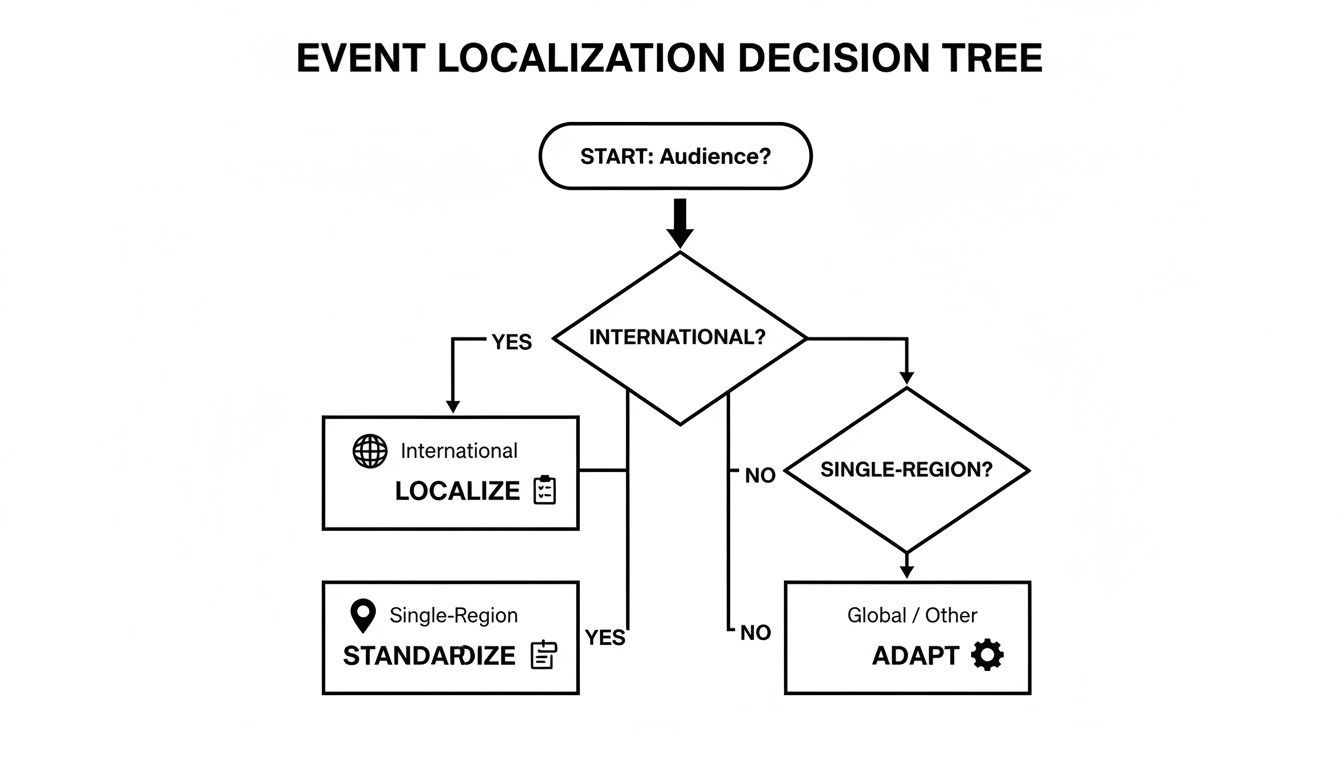
This matrix breaks down which format aligns best with specific business goals.
| Decision Factor | Virtual | Hybrid | In-Person |
|---|---|---|---|
| Primary Goal | Broad lead generation, maximum reach, brand awareness | Both wide reach and deep relationship-building | High-value networking, closing deals, building trust |
| Budget | Low to Medium | High | High |
| Audience Location | Globally dispersed | Both local hub and global audience | Primarily local or regional (or willing to travel) |
| Complexity | Low | High | Medium |
| Best For | Webinars, product demos, top-of-funnel content | Major conferences, product launches, company kick-offs | Investor dinners, C-suite roundtables, VIP experiences |
Use this as a starting point to have a clear framework when weighing your options.
Once you've landed on a format, you need the right tech. Focus on the features that will directly help you hit your event goals.
Next Action: Create a simple comparison spreadsheet. Pick your top 3 platform choices and score them from 1-5 on the features that matter most to your event. It cuts through the marketing noise.
Here's what to look for:
The UAE's mastery of global event management is clear at events like Dubai Startup Week 2026. This B2B/B2C hybrid event brought together 10,000 founders, investors, and operators over five days, sparking 3,500 introductions and playing a role in a $3.5 billion MENA funding spike that September.
By aligning your tech and format choice with your core business objectives from the start, you're setting the stage for a high-impact event that delivers real, measurable results.
The agenda is the single biggest factor that separates a forgettable event from a game-changing one. A great agenda turns passive listeners into active participants, sparking real conversations and creating tangible value. For founders, this is where you deliberately create "high-signal" moments that move the needle for your attendees and your business.
The days of endless, back-to-back keynotes are gone. Modern audiences have limited attention spans. Your agenda needs to be built for engagement, not endurance.
The goal isn't to cram every minute with content. It's to create an environment where key ideas can land and human connections can drive business forward.
While unstructured time is crucial, your agenda also needs carefully facilitated interactions. This is a core pillar of effective global event management. Facilitating the right introductions is key, especially for founders in the MENA region.
Look at the benchmark set by Abu Dhabi Finance Week in 2026. The event brought in over 5,000 delegates but capped individual sessions at 500 people to keep things intimate. The result? Over 1,200 one-on-one connections were made. This curated model is being adopted across the region, with some founder-focused events reporting that 45% of their attendees secure investor meetings after attending. You can get a deeper dive into the MENA startup funding scene from this insightful report.
Here’s a sample structure for a half-day hybrid summit run from the UAE, with attendees from MENA and Europe. It respects everyone's energy levels and time zones.
| Time (GST) | Session Type | In-Person Experience | Virtual Experience |
|---|---|---|---|
| 1:00 PM | Networking & Welcome | Coffee and light snacks, facilitated icebreakers. | Virtual networking lounge with topic-based tables. |
| 2:00 PM | Opening Keynote | 20-minute talk, followed by live Q&A. | Livestream of keynote, Q&A via chat moderator. |
| 2:30 PM | Interactive Breakouts | Moderated peer discussions in small groups. | Facilitated virtual breakout rooms with digital whiteboards. |
| 3:30 PM | Networking Break | Structured networking with a clear objective. | 1-on-1 speed networking based on profile matching. |
| 4:00 PM | Panel Discussion | 30-minute panel with audience polls. | Livestreamed panel, interactive polls, dedicated Q&A tab. |
| 4:30 PM | Closing Remarks | Key takeaways and a clear call to action. | Summary of key moments and post-event resources. |
Next Action: Pull up your draft agenda. Highlight every session longer than 30 minutes. Challenge your team: can you shorten it or break it up with an interactive element like a poll, a Q&A, or a quick discussion?
This is where the rubber meets the road. Getting the operational side right separates a smooth, professional experience from a chaotic, costly disaster. Your budget is more than a spreadsheet; it's your guide to reality.
The biggest threat to any global event budget isn't the big-ticket items, but the hidden costs: currency conversion fees, customs duties, and surprise taxes or VAT in different countries. Be prepared.
Finding reliable people on the ground is one of the toughest parts of global event management. You're not just looking for a vendor; you're hunting for a partner who can execute flawlessly when you can't be there.
A tough vetting process is non-negotiable. Always ask for references from clients who’ve run events at a similar scale. A vendor might be a star at a local gathering but may not have handled a large hybrid conference with a global virtual audience.
The most important question to ask a potential global vendor isn't about price. It's about their problem-solving process. Ask: "Tell me about a time an international event went wrong and how you fixed it." Their answer tells you more than any sales pitch.
When paying international teams, familiarize yourself with banking essentials like the Codul SWIFT BT to avoid delays and headaches.
Once you’ve picked your partners, get everything in writing. Clear contracts and Service Level Agreements (SLAs) are your best defense against miscommunication. Never rely on emails or verbal promises.
Your contracts need to be crystal clear on:
For more on structuring your finances, see our guide on startup budget allocation strategies.
For founders in the UAE, running global events means stepping into a new legal world. Pleading ignorance isn't an option.
Pay close attention to these key areas:
Managing these operational details is the foundation that allows you to execute with confidence on the world stage.
The event isn't over until you can measure its impact. We need to move beyond vanity metrics like registration numbers and zero in on what actually moves the needle: return on investment (ROI). This is where you connect the dots back to your original strategy. Did you generate qualified leads? Did you influence the sales pipeline? That's the real measure of success.
It's time to get ruthless with your metrics. Big attendance numbers look great but tell you nothing about quality or revenue. While research shows 70% of B2B marketers use engagement to measure impact, many still can't connect the dots to the bottom line.
The only question that matters post-event isn't "How many people showed up?" but "What business did we close?" This is the mindset shift that separates logistics from revenue generation.
To make your next event better, you need honest, unfiltered feedback. A sharp, well-designed post-event survey is your best friend. Keep it quick, focused, and easy to complete.
This feedback is gold. It reveals what resonated and whether you delivered on your promise of value.
Next Action: Build your post-event survey using these questions. Send it within 24 hours of your event wrapping up. Use the insights to create a report that showcases genuine business impact, not just attendance stats.
When you're a founder in the UAE or MENA, taking your events global can feel like a huge leap. Here are some straight-talking answers to the big questions.
Give yourself 9-12 months for any significant global event, whether virtual or hybrid. That buffer is crucial for nailing your strategy, locking in high-demand speakers, and running marketing campaigns that land with global audiences. For smaller, focused virtual events, you might get away with 4-6 months, but rushing is a surefire way to burn cash and damage your brand's reputation.
Thinking translation is the same as localisation. It's the most common and costly mistake. Real localisation is about adapting your entire approach to local cultural norms, marketing channels, payment methods, and professional etiquette.
A close second is failing to create two distinct, equally compelling experiences for virtual and in-person attendees at a hybrid event. It almost always leaves one group feeling like an afterthought.
Think "lean." Focus your resources on a smaller, high-signal virtual event to control variables and deliver a polished experience.
The goal isn't a massive, disengaged crowd. It's to create an unforgettable experience for a smaller, highly relevant group that will become your biggest advocates.
At Founder Connects, we help founders in the UAE and MENA build high-signal relationships through curated peer groups and intentional events. Avoid the noise and build your network with us. Learn more about Founder Connects.


