

You've probably done this already. You went to a founder meetup in Dubai, shook twenty hands, added a few people on LinkedIn, sat through vague panel talk, and left with nothing you could use on Monday morning.
That's the core problem behind a lot of searches for good new network. Some people mean the media brand Good News Network. But many founders are looking for something more practical: a network that produces good outcomes, useful introductions, honest feedback, and less wasted time.
That distinction matters in the UAE and wider MENA. The top search results for “Good News Network” mostly point to an uplifting news site, while founders often need clarity on what makes a professional network credible and useful. That gap is sharper in a market where trust in news in the UAE sits at 43% according to the Reuters Institute's 2025 Digital News Report, as noted in the verified brief tied to Good News Network context. If trust is mixed, you shouldn't join communities on branding alone either.
A generic networking event usually gives you access without direction. You meet people, but you don't know who matters to your stage, who can help, or who will remember you next week. For early founders, that isn't harmless. It burns energy that should go into customers, hiring, fundraising, or product decisions.
In the UAE, this gets amplified because the market is relationship-driven. Many rooms look impressive. Fewer are built to create trust quickly.
The common assumption is simple: more events means more opportunity. In practice, more events often means more noise.
A room full of founders, operators, agencies, investors, and “ecosystem people” sounds useful. It isn't, unless someone has shaped that room with intent. If the organiser hasn't filtered for relevance, the burden shifts to you. You have to sort signal from noise in real time.
Generic networking rewards whoever talks most. Good networks reward whoever fits.
That's why a lot of standard advice on relationship-building only works when paired with curation. Broad playbooks can still help, especially if you need to improve your basics around follow-up and relationship maintenance. For that, Chicago Brandstarters has a practical piece on networking strategies for business growth that's useful as a foundation. But strategy alone won't rescue a low-quality room.
When founders search good new network, the better question is not “Where can I meet more people?” It's “Which network will change the quality of my decisions and introductions?”
Use that lens from the start:
If a network can't tell you who it's for, how it runs, and what members do together, it's probably just selling access theatre.
A good founder network is not a contact list. It's a system.
The easiest way to think about it is this. A weak network is like a public library. There's a lot inside, but you have to find everything yourself. A strong network is closer to a PhD cohort. People are selected for fit, they're working through similar problems, and the structure forces useful interaction.
That difference matters because over 60% of MENA founders say their personal and professional network is their most valuable non-financial asset, according to Wamda Capital coverage in the verified brief. If your network is that important, you can't treat membership as a vanity decision.
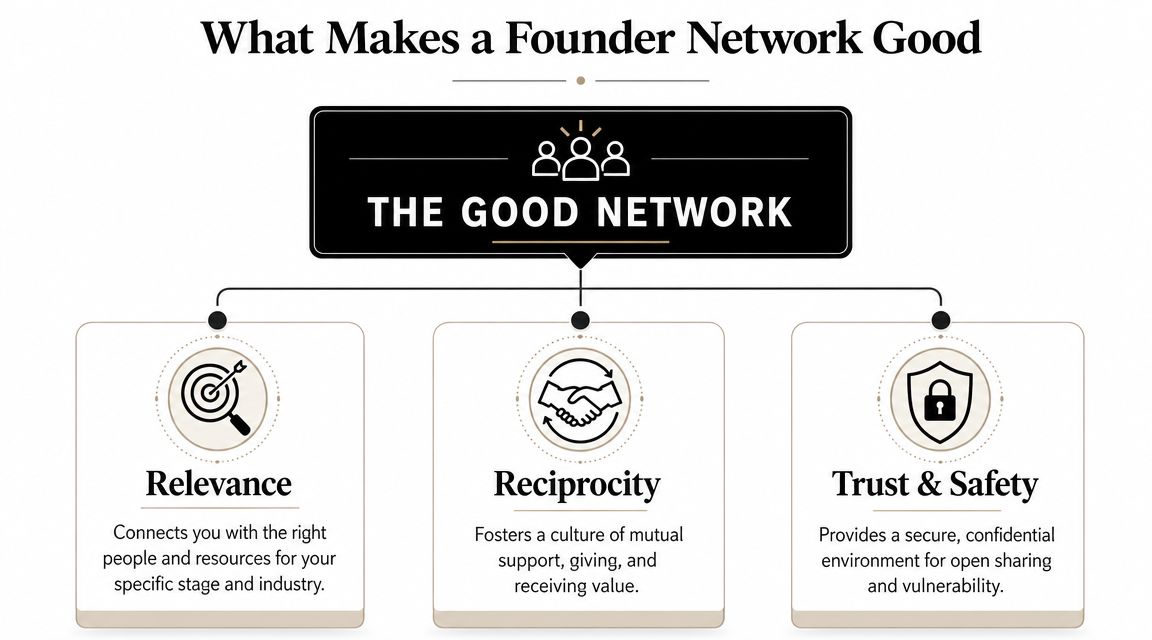
I use three tests.
This is the first filter. The network should connect you with people who match your stage, market, and current problem.
A first-time founder validating an idea needs different conversations than a post-revenue founder hiring a sales lead. If both are thrown into the same community without structure, one person gets overwhelmed and the other gets bored.
Look for signs such as:
Some communities are built around extraction. Everyone wants intros, advice, distribution, or investor access. Few contribute anything back.
That doesn't hold for long. Strong groups create a habit of exchange. Members share operator lessons, templates, warnings, candidate referrals, and customer insight. That's when the network starts saving time.
If you want a useful outside perspective on how communities create participation loops, LearnStream's guide to communities is worth reading. The principles apply directly to founder groups, especially around repeat engagement and shared value.
Founders don't need more public posturing. They need places where they can say, “My co-founder relationship is strained,” or “I'm not sure this investor is the right fit,” without worrying that it'll travel around the ecosystem.
That requires confidentiality, moderation, and social norms that discourage performative behaviour.
Practical rule: If members can't safely discuss mistakes, the network will only surface polished nonsense.
A structured founder community differs from random event attendance. A network built around moderated peer groups and intentional introductions is usually more useful than a loose social channel. If you want to see one example of how that model is framed in Dubai, this overview of a Dubai business network shows what curated founder networking can look like in practice.
Founders often evaluate communities on vibe. That's a mistake. Use a scorecard instead.
The UAE market runs heavily on relationships, and that makes warm access more valuable than broad access. A 2026 Dubai Chamber of Commerce report noted that 78% of successful investment deals involved a warm introduction from a trusted source within the founder's network, according to the Dubai Chamber reference in the verified brief. So don't ask whether a network looks active. Ask whether it consistently creates trusted paths.
You don't need inside access to assess quality. Most signals are visible if you know where to look.
A strong network tells you who belongs there and who doesn't.
Check for:
If the community is proud of being “open to everyone,” be careful. Inclusiveness is good for public events. It's usually bad for high-signal founder support.
A founder network should create motion, not just conversation.
Look for evidence of:
A WhatsApp group with occasional chatter is not accountability. It's a noticeboard.
Many networks overpromise. They say they offer access when they really mean visibility.
Real access looks different:
Warm intros beat open directories because they transfer a little trust with the connection.
| Network Type | Curation Level | Accountability Mechanism | Access Quality |
|---|---|---|---|
| Free meetups | Usually low. Broad attendance and mixed intent | Minimal. Mostly event-based with little follow-up | Variable. You can meet people, but relevance is inconsistent |
| Accelerator cohorts | Usually high during programme period | Strong while the programme is active | Often strong, especially within mentor and investor circles |
| Paid founder communities | Depends on operator discipline and membership filter | Can be strong if peer groups and moderation exist | Good when intros are curated, weak when value stops at member directory |
| Industry associations | Moderate. More role-based than founder-stage based | Often limited unless working groups are active | Useful for partnerships and market context, less useful for founder candour |
| Informal founder WhatsApp groups | Low to moderate | Weak unless someone actively runs it | Fast but messy. Helpful for quick asks, unreliable for deeper support |
Before you join, ask three blunt questions:
If the answers stay abstract, walk away. A serious network can answer all three in plain language.
Most founder communities look better from the outside. Their landing pages are polished, their photos look busy, and every testimonial sounds positive. None of that tells you whether the group will help you make better decisions.
Start with a small due diligence process. It doesn't need to be complicated.

Structured ecosystem connection isn't just a nice-to-have. According to the 2025 Global Startup Ecosystem Report, MENA startups that are highly connected to the local ecosystem through structured networks show a 2.5x higher growth rate than less-connected peers, based on the Startup Genome report reference in the verified brief. If connection quality can shape growth, membership should be treated like any other business decision.
Your best information source is not the community manager. It's current or former members.
Speak to two or three people if you can. Don't ask, “Is it good?” That gets you polite, useless answers. Ask for specifics.
Use questions like these:
A strong answer has detail. A weak answer sounds like general satisfaction with no concrete memory attached.
If the network hosts public sessions, go to one. Treat it like a trial.
Watch the room carefully:
One useful comparison point is the way structured referral organisations frame participation and accountability. This breakdown of Business Network International and similar models is helpful for understanding how formal networking systems differ from founder-focused peer communities.
Here's a short explainer that's useful if you want to think more critically about evaluating business communities before joining:
Even if there's a membership fee, the bigger cost is attention. So test the network against your next month, not your vague future.
Ask yourself:
Don't join because the network sounds good. Join because you can already see how you'll use it next month.
If you can't answer those questions, wait.
You can save a lot of time by learning to disqualify networks fast.
Most bad communities don't fail in subtle ways. They show the warning signs early. Founders ignore them because the room looks active, the organisers know people, or the branding feels premium.
If the value proposition is “connect with leaders”, that tells you almost nothing.
A founder network should state who it serves, what members do together, and what outcomes it is designed to support. Vagueness usually hides weak curation.
Some groups are basically marketplaces where everyone is selling to everyone else. You pay, show up, give your pitch, and hope something lands.
That isn't a founder support network. It's a rotating sales floor.
Unmoderated communities drift quickly. The loudest people dominate. Useful questions get buried. Self-promotion rises. Serious founders go quiet.
When nobody shapes behaviour, the culture degrades on its own.
If the organiser can't protect attention, they can't protect value.
Be careful when a community keeps talking about member count, event count, or social reach, but says little about how people help one another.
Big numbers create social proof. They don't create trust.
Common examples include:
That sounds generous. For founder problem-solving, it usually means the opposite of useful.
A network built for investors, agencies, startup employees, students, mentors, founders, and “innovation enthusiasts” all at once rarely serves founders well. Each group has different needs and incentives.
You can feel this within minutes. People scan your title, funding stage, and potential usefulness before deciding how long to stay in the conversation.
That's normal in some business settings. It's a poor basis for founder trust. If every interaction feels like someone is qualifying you, the network won't become a place for honest problem-solving.
Joining the right network only solves half the problem. The rest depends on how you use it.
Founders who get the most value don't enter with a passive mindset. They don't wait for magic introductions, hidden opportunities, or someone to notice them. They show up with context, make specific asks, and contribute before they need something.
That matters for performance and for resilience. Founder isolation is real. A landmark Harvard Business Review study found that founders active in a peer support group are 50% less likely to report burnout and professional loneliness, according to the Harvard Business Review reference in the verified brief. Good networks help with growth, but they also help you stay steady enough to keep building.

A simple rule works well: give context, give value, then ask clearly.
That looks like this:
If you also want your external presence to reinforce the credibility you're building in private communities, this guide on how to build your LinkedIn brand can help. A clear public profile makes it easier for new contacts to understand your company and where you fit.
The best founder networks usually have systems you can lean on. Peer circles, curated intros, topic sessions, moderated check-ins, or focused founder meetups all work when members use them intentionally.
For example, Founder Connects is built around moderated peer groups and curated one-to-one introductions for founders in the UAE and wider MENA, which makes it more useful for targeted problem-solving than a loose event-only format. That same principle applies to any serious founder community. Structure only works if you enter it prepared.
For a deeper look at the habits founders build in these environments, this piece on skills founders build in mastermind groups is a useful companion.
The network doesn't create value on its own. Members create value by using the structure well.
If you join a promising good new network, use your first month properly.
That rhythm works because it balances receiving and contributing. It also lets you test quickly whether the network has substance or just surface activity.
If you're a UAE or MENA founder who wants a private community built around curated peer groups, practical introductions, and founder-level conversations, take a look at Founder Connects. It's designed for founders who want more than event attendance. They want clearer decisions, stronger relationships, and steady progress.


