

Hiring in MENA usually breaks in the same places. You find candidates with decent CVs but weak execution. You meet graduates who interview well but need too much hand-holding. Or you build a team fast, then realise half the team can't work across functions, clients, and ambiguity.
That's why smart founders shouldn't look at a university as a brand badge. They should look at it as a talent supply line, a project partner, and a signal about who's ready for real work.
When founders ask about gulf university of science and technology, the wrong question is whether it looks reputable on paper. The useful question is simpler. Can it help you hire better people, run sharper collaborations, and get closer to Kuwait's emerging startup and innovation network?
That's the lens worth using. If you're validating a hiring market, refining what junior talent should know, or shaping an internship track, start with better discovery prompts. A practical set of customer insight survey questions can help your team test what employers, interns, and student candidates really need before you build another generic campus programme.

If you're building in the UAE or wider Gulf, you already know the pattern. Everyone wants talent with English fluency, technical discipline, commercial awareness, and enough regional context to operate without weeks of translation between “strategy” and “execution”.
That mix is rare. It's why universities matter more than founders like to admit.
GUST deserves attention because it can be useful, not because it's famous. For Kuwait-facing hiring, cross-border internships, and applied projects, it sits in a category founders should take seriously. Not every university can produce graduates who are trained in globally benchmarked programmes and also shaped by local market realities. GUST appears closer to that middle ground than many institutions that sell prestige but offer weak employer relevance.
There's also a second-order opportunity here. Universities that move beyond classroom delivery often become platforms for recruitment, applied research, and ecosystem access. That matters if you need analysts, developers, operations hires, or business graduates who can join a startup team and contribute early. It also matters if you want a local partner for pilots, sustainability work, or problem-led student projects.
A founder shouldn't approach GUST like a parent choosing a campus. You should approach it like an operator evaluating an asset.
Use this filter:
If you're exploring how universities support startup formation more broadly, this guide on university accelerators and academic institution support programmes is a useful companion.
Practical rule: Don't wait until you have an urgent hiring gap. Build university relationships before you need them.
A founder opening hiring in Kuwait needs to answer one question fast: is this university worth your team's attention, or is it just another name on a CV?
GUST is worth screening seriously.
It sits in a useful position for operators. GUST was founded in 2002, is widely recognised as Kuwait's first private university, and began as a four-year liberal arts institution with 11 undergraduate degree programmes and 1 graduate degree programme, according to Times Higher Education's institutional profile. It also follows a four-year American-model structure. For founders, that combination matters more than ranking chatter. It points to an institution built to serve a newer private-sector economy, with English-medium teaching and a stronger bias toward employer-facing education than many legacy public systems.
| Metric | Details |
|---|---|
| Institution | Gulf University for Science and Technology |
| Founding year | 2002 |
| Market position | Widely recognised as Kuwait's first private university |
| Early academic footprint | Started with 11 undergraduate degree programmes and 1 graduate degree programme |
| Education model | Four-year, American-model institution |
| Why founders should care | Early mover in Kuwait's private higher education sector, with a structure that tends to produce graduates more familiar with English-language instruction and private-sector norms |
The timing matters.
A university launched in the early private higher education phase of Kuwait's market usually develops different instincts from an older public institution. It tends to pay closer attention to employability, parent expectations, international benchmarks, and business-facing credibility. That does not guarantee startup-ready graduates. It does make the institution more relevant if you are hiring for analyst, marketing, operations, finance, or junior product-adjacent roles.
Kuwait is a smaller talent market than the UAE or Saudi Arabia, but founders make a mistake when they treat it as isolated. Gulf hiring is regional. People study in one country, intern in another, and build careers across Kuwait, the UAE, Saudi Arabia, and Bahrain.
That is why GUST matters beyond Kuwait itself. It sits inside the broader Gulf shift toward private, internationally oriented higher education. Some universities in that category are polished on paper and weak in execution. GUST is more interesting because of its place in Kuwait's education history and its potential role as a repeat talent source, not just a brand name.
If you track how technology is reshaping higher education across the region, this analysis of AI and UAE edtech transforming learning gives useful context for how founders should evaluate universities as talent infrastructure, not just degree providers.
Put GUST on your shortlist if you need one of three things:
Treat GUST as a strategic asset candidate. The right use case is not prestige hunting. The right use case is building a repeatable pipeline for junior talent and campus-level partnerships in a Gulf market that many founders still underuse.
The hiring question isn't “what does GUST teach?” It's “what kind of junior operator can I expect to get?”
That's where programme quality matters. Not because founders need academic theory, but because strong programmes leave traces in how graduates think, communicate, and solve problems.
Public listings state that GUST is accredited by Kuwait's Ministry of Higher Education and that several programmes hold international accreditations including AACSB and ABET, according to Educatly's university profile.
From a founder's perspective, those labels matter in plain business terms:
That combination is useful if you're screening candidates quickly. A founder can't audit every syllabus. Accreditation is not a substitute for testing skills, but it's a reasonable starting filter.
If you're hiring junior technical talent, ask less about GPA and more about what they built, debugged, presented, or shipped under constraints.
Founders often underrate business-school hiring because they imagine generic management graduates. That's lazy thinking.
For startups, business graduates are valuable when they can work in operations, finance, sales support, market research, partnerships, customer success, and analyst roles. An AACSB-backed environment makes that pool more credible because it suggests discipline in training and assessment, not just classroom attendance.
Use GUST business graduates when you need people who can:
The mistake founders make is hiring these graduates into vague “business development” titles with no structure. Don't do that. Give them a narrow scope first, then expand.
The stronger founder use case may be in technical hiring.
ABET-accredited engineering and computing programmes suggest students are being trained within systems that value learning outcomes, technical standards, and resource quality. That doesn't guarantee startup speed or product sense. It does improve the odds that a graduate has gone through more rigorous technical formation than a founder gets from a random stack of unverified CVs.
Here's the practical interpretation:
| Hiring need | What to probe in a GUST candidate |
|---|---|
| Junior developer | Code samples, debugging habits, version control discipline |
| Product support or QA | Structured testing mindset, documentation quality, clarity in bug reporting |
| Data or analyst track | Comfort with logic, spreadsheets, basic modelling, communication of findings |
| Technical operations | Reliability, process thinking, ability to work across engineering and business teams |
If your company works in AI, edtech, or technical product environments, compare GUST talent against graduates shaped by newer digital learning models too. This piece on AI in UAE edtech and transforming learning is useful context for how founder expectations around graduate readiness are changing.
A lot of founders ignore arts and sciences talent until they need content, communications, research, policy support, or customer-facing roles.
That's shortsighted. In early-stage companies, some of the best hires come from people who can write clearly, research quickly, present well, and learn fast. If the university environment rewards communication and interdisciplinary thinking, those graduates can outperform technically stronger candidates in roles that involve clients, communities, or cross-functional coordination.
Look for these markers:
Don't recruit from GUST as a single pool. Segment it.
Then test for startup fit with live tasks, not just interviews. Give candidates a short case, a mini build, a research brief, or a mock client scenario. That's how you separate accreditation signal from actual execution.
Most founders skip admissions and cost details because they think that's student territory. That's a mistake. Admissions and affordability shape who enters the institution, how competitive the environment feels, and what kind of students are likely to be available for internships or graduate hiring.

Even without relying on unsupported cut-off numbers, you can still use admissions as strategic intelligence.
A university like GUST, built around an American-style private model, typically attracts students who are intentionally opting into a private, English-medium path rather than defaulting into a public route. That alone tells you something. These students and families are often making an active market choice around employability, international standards, and professional positioning.
For a founder, that can mean a candidate pool more likely to care about:
That doesn't guarantee grit. It does mean you're not hiring from a passive pipeline.
Cost affects student behaviour. Students who invest heavily in private education often take internships, employer networking, and practical experience more seriously because they're looking for a clearer return on that investment. Scholarship structures matter too, because they help a university attract strong students who might otherwise choose different institutions.
Founders should ask direct questions when engaging the university:
Those questions tell you more than a glossy prospectus ever will.
Decision lens: Don't just ask who gets admitted. Ask which students self-select into internships, competitions, and practical work.
You're trying to understand the student body, not admire the campus.
If a university attracts students who value international alignment and private-sector exposure, you can usually build stronger employer programmes there. If scholarship support broadens the intake, that can improve the talent mix by bringing in stronger candidates from different backgrounds. If the institution communicates clearly with employers, that's another positive sign.
Founders considering executive education, team upskilling, or even a later-stage MBA should use the same filter. Ask whether the ecosystem rewards applied work or mostly rewards credentials.
A quick video can help you get a feel for the institution's environment before you spend time on outreach:
Before you invest time in a partnership, get answers to these:
| What to check | Why it matters |
|---|---|
| Student motivation | Tells you whether candidates are likely to pursue internships seriously |
| Employer responsiveness | Shows whether the university can actually execute a partnership |
| Scholarship and support structures | Hints at how the institution attracts strong applicants |
| Academic expectations | Helps you estimate baseline discipline and communication quality |
If you're hiring at pace, these signals help you avoid wasting a quarter on the wrong campus relationship.
You hire a bright graduate for an operations or partnerships role. Two weeks later, the problem is not intelligence. It is follow-through, communication, and judgment under pressure. That gap is usually shaped long before the interview.
For founders, campus life matters because it is where students learn how to operate around other people. Deadlines, conflict, presentations, leadership, and accountability rarely come from lectures alone. They come from clubs, team projects, student initiatives, competitions, and the daily social pressure of working with peers who do not think the same way.
That is the right lens for GUST.
If you are assessing GUST as a talent source, look for signs that students have spent time in environments that reward initiative, public communication, and execution. Those signals matter more than polished CV language. A university can have respectable academics and still produce graduates who need too much hand-holding. Founders should care about the opposite outcome. People who can enter a small team and become useful fast.
Large companies can absorb hesitation. Startups cannot.
Early-career hires in founder-led teams need to write clearly, handle ambiguity, speak to clients or partners without freezing, and recover from mistakes without drama. Students who have already led events, managed peer expectations, presented work publicly, or built something outside class usually ramp faster.
This is one reason to compare universities by student experience, not just by programme names. If you have looked at other regionally relevant institutions such as the German University of Technology as a founder talent benchmark, the useful question stays the same. Does the campus produce people who wait for instructions, or people who move?
Drop generic labels. Screen for behaviour you can verify.
The campus experiences that tend to produce better startup hires usually map to four outputs:
These are hiring signals, not nice extras. In small teams, they decide whether a graduate saves your time or consumes it.
Ask for proof, not personality claims. Strong candidates can describe the project, the conflict, their role, and the result without hiding behind buzzwords.
GUST is a better fit for founders who need adaptable generalists than for founders expecting fully formed specialists on day one. That is normal for university talent in the region. The opportunity is in roles where communication, coordination, and learning speed matter.
The strongest fits are often:
A student with meaningful extracurricular exposure, team-based work, and public-facing responsibilities often outperforms a higher-GPA candidate who has operated only inside coursework.
Use interview questions that force specifics.
Founders who hire well from universities do one thing consistently. They test for evidence of action. If a GUST candidate can point to clear examples from campus life, student leadership, projects, or community activity, you are looking at someone with a stronger chance of contributing early.
You are hiring in Kuwait, need junior talent in the next quarter, and do not have time for ceremonial university meetings. That is the right frame for approaching GUST.
Treat GUST as a working channel for talent, scoped projects, and targeted introductions into sectors that matter in Kuwait. Founders who show up with vague collaboration language usually get polite conversations and little else. Founders who arrive with role briefs, project scopes, and a timeline get traction faster.
As noted earlier, external review commentary points to work-based projects tied to real industry and business problems. GUST also now has added relevance through SDSN Kuwait, which strengthens its position as a meeting point for academia, government, civil society, and private sector actors.
For a founder, that changes the question. You are not just asking whether GUST is a respectable university. You are asking whether it can produce hires, useful project work, and relationships that reduce your market-entry or hiring friction in Kuwait. On that basis, it is worth serious attention.
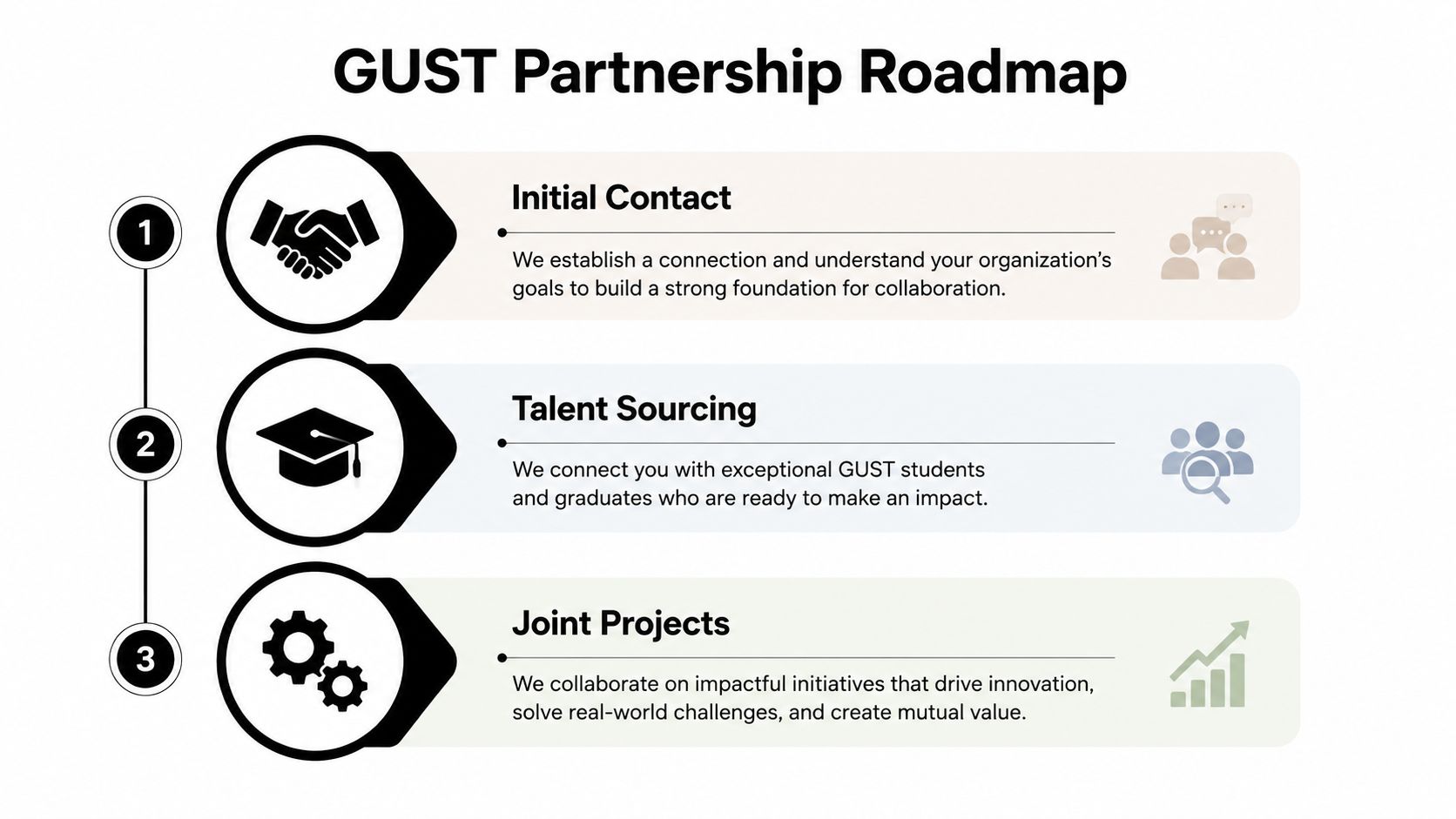
Start here.
You do not need a broad institutional agreement to get value from GUST. You need a reliable route into career services, employer engagement staff, and relevant departments. Ask for the shortest path to students and recent graduates for internships, analyst roles, junior engineering support, and operations positions.
Send a tight brief. Include:
University teams respond better to operational clarity than startup charisma.
This channel is underused.
GUST can be useful if you bring a problem that is small enough to manage and real enough to matter. Good project areas include customer research, market mapping, onboarding analysis, process improvement, sustainability-related analysis, and business model validation. Keep sensitive IP out of scope. Keep the question narrow. Ask for a deliverable you can use.
| Better project brief | Why it works |
|---|---|
| Map competitor positioning in Kuwait for one product category | Clear research scope |
| Analyse user onboarding friction and suggest improvements | Tied to a live business need |
| Build a structured market-entry snapshot for a new segment | Useful for strategy without exposing core IP |
This matters most for startups near sustainability, education, public services, regulated markets, or policy-linked sectors.
GUST is more useful here as a convener than as a pure recruiting source. If your company needs introductions, visibility, or credibility across institutional stakeholders in Kuwait, that role has value. Do not overcomplicate it. Start with one concrete collaboration and judge the relationship by output.
A small internship cohort or a sharply defined student project will usually outperform a flashy MOU.
Keep the outreach brief and specific. Long founder narratives are a waste of everyone's time.
Use this structure:
If you are benchmarking GUST against other regional institutions, this profile of the German University of Technology in Oman is a useful comparison point for founder-led hiring and partnership strategy.
Do not rely on the university channel alone. Pair formal outreach with founder-to-founder intelligence.
Founder Connects is useful here as a factual reference point for operators comparing university relationships across MENA. That kind of peer context helps you judge whether a campus partnership is likely to produce hires, project output, or just more meetings.
It can be, if you hire with role clarity.
The strongest founder case for GUST is not “prestige hiring”. It's structured junior hiring across business, technical, and cross-functional roles. The quality signals around accreditation help narrow the risk, and the university's applied orientation makes it more relevant than purely theoretical institutions. But you still need work-sample tests. Don't outsource judgement to a university name.
Three groups should move first.
Founders hiring in Kuwait. Founders expanding from the UAE into nearby Gulf markets. Founders working on industry problems that fit student projects, sustainability work, or cross-sector engagement. If you run a startup that needs polished senior operators tomorrow, GUST is not the answer. If you need a repeatable junior talent channel and a practical academic partner, it's worth your time.
Both can work, but for different reasons.
Business graduates can be effective in operations, finance support, market research, partnerships, and commercial coordination. Technical graduates are worth serious testing for engineering, computing, QA, product support, and structured analytical roles. The mistake is treating all graduates the same. Segment by function, then test on real tasks.
Use a narrow ask.
Don't approach with a general “partnership discussion”. Start with one of these: an internship pipeline, a scoped applied project, participation in a career event, or a request to meet the department most relevant to your hiring needs. Keep your brief short, operational, and tied to a business outcome. Universities respond far better when they can see exactly where a company fits.
Yes, especially for Gulf founders who think regionally.
Talent, partnerships, and employer signals increasingly move across MENA markets. A founder in Dubai, Abu Dhabi, or Riyadh may still benefit from knowing which Kuwait institutions produce credible graduates and useful collaboration opportunities. GUST matters because it sits inside that wider Gulf talent conversation, not just because of local recognition.
If you want a purely traditional university experience, there are many options. If you want a university that appears more connected to practical projects, industry-facing work, and cross-sector collaboration, GUST deserves serious consideration.
The smarter student question is not “is this university good?” It's “will this environment make me more employable and more useful in modern organisations?” That's the bar that matters.
If you're building in the UAE or wider MENA and want sharper founder-to-founder insight on hiring channels, university partnerships, and real ecosystem moves, Founder Connects is a practical place to continue the conversation.


