

AI in UAE EdTech: Transforming Learning

Building in MENA? You don't have to do it alone.
Join 300+ founders in the Founder Connects Residency. Monthly squad calls, warm intros, $3M+ in perks, and much more. All for less than your monthly coffee budget.

The UAE is reshaping education with artificial intelligence (AI), making it mandatory in public schools from kindergarten to Grade 12 starting the 2025–2026 academic year. This move aims to equip students with future-ready skills like critical thinking and problem-solving while moving away from rote learning. AI-driven platforms, such as Blend-ed, Sana Labs, K2 Think, and Disprz, are leading this shift by offering tailored learning experiences, bilingual support, and tools for educators and enterprises.
Here’s what stands out:
- Blend-ed: Tracks student progress and offers bilingual resources, increasing engagement by 54%.
- Sana Labs: Personalises content using adaptive technology and generative AI, addressing individual learning gaps.
- K2 Think: Developed by MBZUAI, this tool focuses on advanced reasoning and open-source AI for STEM education.
- Disprz: Combines learning management and content creation for workforce training, with bilingual support for UAE businesses.
The UAE’s Vision 2031 strategy positions AI as a core skill, alongside reading and writing, with USD 125 million allocated to AI initiatives, including USD 32 million for EdTech. Over 40% of schools are already testing AI tools, highlighting the nation's commitment to building a knowledge-based economy.
Key takeaway: AI is not just modernising education in the UAE but aligning it with national development goals, preparing students and professionals for a tech-driven future.
1. Blend-ed
AI Capabilities
Blend-ed reflects the UAE's forward-thinking approach to education, using intelligent learning systems to adapt to students' needs in real time. Features like Ask Dhabi, an intelligent tutoring system, provide instant support, which has led to a 54% increase in student engagement [1]. By tracking individual progress and pinpointing areas where students struggle, Blend-ed customises content delivery to ensure learners stay both motivated and supported.
Arabic Localisation
Understanding the bilingual nature of education in the UAE, Blend-ed is rolling out Arabic integration in phases, starting in 2026 - its second year of implementation. This approach focuses on delivering high-quality localisation rather than rushing translations [3][6]. From the beginning, the platform has been designed to accommodate bilingual classrooms, offering resources in both English and Arabic. Created in the UAE, Blend-ed aligns with the region’s educational and cultural context, ensuring it meets local needs effectively. This bilingual support strengthens the platform’s appeal for widespread use across diverse classrooms.
Scalability for UAE Needs
Blend-ed is built to grow alongside the UAE's education sector, serving both public and private schools. Its cloud-based infrastructure ensures smooth expansion across the emirates while maintaining consistent performance and quality. This scalability supports the UAE’s commitment to leveraging advanced education technology across the nation.
Alignment with UAE Vision 2031
Blend-ed plays a key role in advancing Vision 2031 by embedding AI literacy into everyday learning and equipping students with skills for the future. This aligns with the UAE National Strategy for Artificial Intelligence 2031 [3][7]. By integrating practical AI skills into various subjects, Blend-ed helps drive digital innovation and supports the UAE’s ambition to remain a global leader in AI [7]. The platform goes beyond theory, preparing students to apply AI knowledge in real-world scenarios and contribute to a tech-savvy workforce.
sbb-itb-f597d8f
UAE to begin teaching AI in schools
2. Sana Labs

Sana Labs is making waves in the UAE's education sector with its advanced tools that bring a personalised touch to learning.
AI Capabilities
Sana Labs employs adaptive learning technology to tailor content based on how well a learner is performing in real time [9]. By analysing cognitive profiles, it identifies the most effective format for each student - whether that’s text, video, or interactive exercises. On top of that, its generative AI creates customised practice questions and additional materials to address specific learning gaps [8].
The platform also offers an intelligent tutoring system that’s available 24/7. This system provides contextual help and uses Socratic questioning to guide learners, making it especially useful for those who need extra support outside of the classroom [9]. Educators benefit from detailed analytics that track student mastery, enabling targeted interventions where they’re needed most.
Arabic Localisation
Sana Labs doesn’t just offer bilingual content in English and Arabic - it takes it a step further by tracking mastery in each language separately [9]. This means that students’ progress in Arabic is monitored just as closely as their progress in English, ensuring balanced development in both languages. The AI tutors also provide personalised assistance that’s culturally relevant, making the learning experience more meaningful for Arabic-speaking students.
Alignment with UAE Vision 2031
Sana Labs goes beyond improving individual learning outcomes - it aligns its goals with the UAE’s broader vision for the future [3][2]. By embedding AI-powered education into schools, the platform supports the UAE’s aim to foster AI literacy and build a knowledge-based economy. This effort ties directly into the National Strategy for Artificial Intelligence 2031, showcasing how AI can transform education and prepare students for the workforce of tomorrow.
3. K2 Think
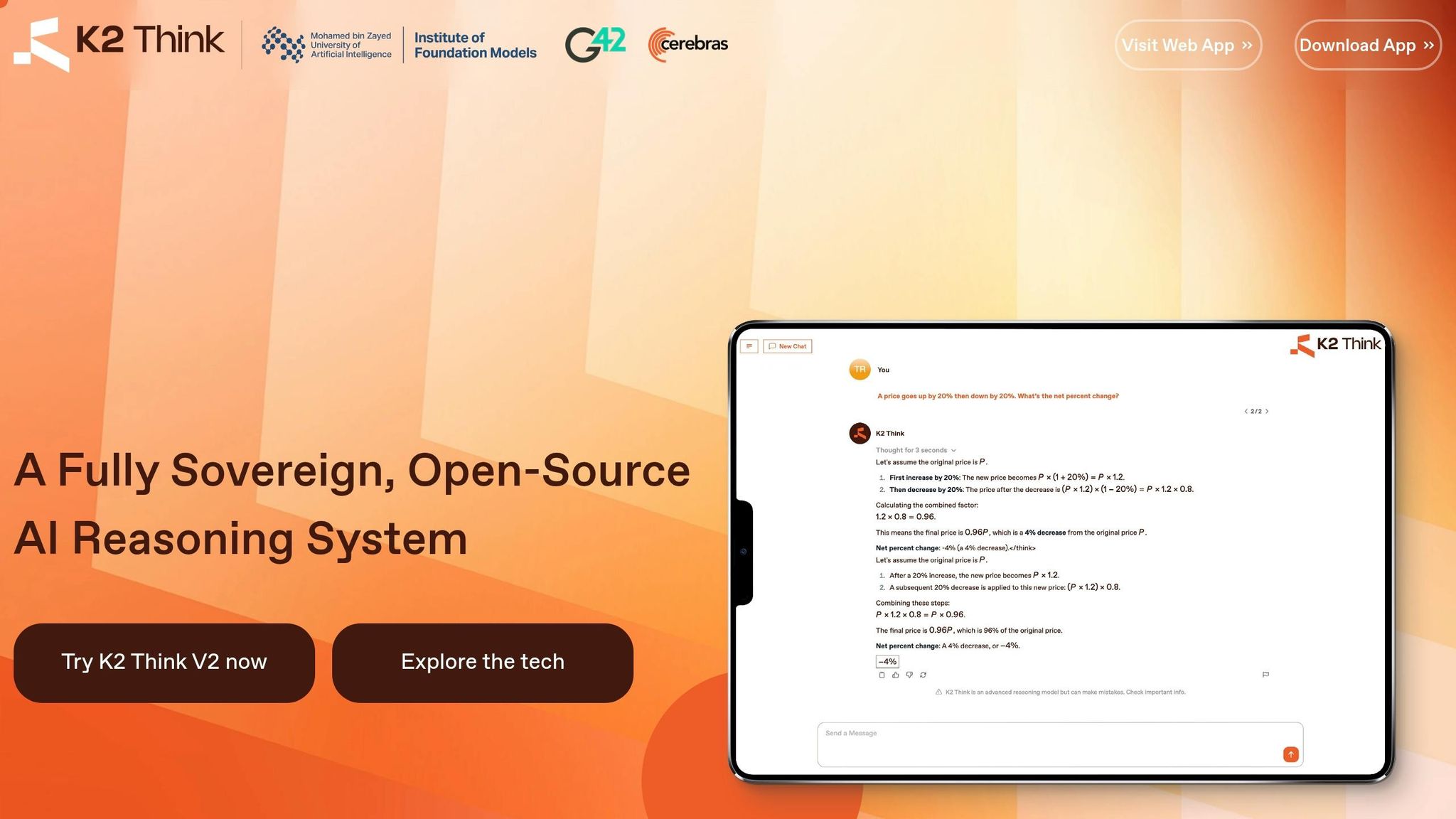
K2 Think is reshaping the UAE's AI landscape, offering transparent, research-driven solutions that address complex challenges in fields like mathematics, science, coding, and logic. Created by the Mohamed bin Zayed University of Artificial Intelligence (MBZUAI) in partnership with G42, this open-source reasoning tool represents a major step forward for the UAE's AI ambitions.
AI Capabilities
Built with 70 billion parameters, K2 Think V2 delivers exceptional performance while remaining efficient, rivaling or surpassing larger models in its class [10]. Its standout feature is its ability to handle long-context reasoning, making it ideal for processing large amounts of information during multi-step problem-solving sessions. This capability is crucial for mastering intricate subjects. The model has also excelled in challenging reasoning benchmarks, including AIME2025, GPQA-Diamond, and HMMT [10].
"K2 Think is one of the landmark breakthroughs to boost AI-driven learning and research in the region."
- Eric Xing, President of MBZUAI [11]
Another key feature is its 360° transparency. Researchers in the UAE can fully customise the model, while its accessibility via web and mobile platforms ensures it can be widely adopted across institutions. Every stage of its development, from pre-training to evaluation, is open for scrutiny, adding to its credibility and usability [10]. This combination of technical strength and openness positions K2 Think as a cornerstone in national AI strategies.
Alignment with UAE Vision 2031
K2 Think also plays a crucial role in advancing the UAE's Vision 2031. By offering a fully sovereign, open-source AI framework, it supports the nation's goal of becoming a global AI powerhouse. This tool not only enhances innovation in STEM education but also empowers local researchers and startups to build upon its transparent design. The result is a more personalised and innovative approach to education, aligning with the UAE's broader educational transformation goals.
"K2 Think puts the UAE on the global stage with USA and China, and proves performance need not be sacrificed when striving for efficiency."
- Hector Liu, Director of MBZUAI's Silicon Valley lab [12]
Through its unique combination of efficiency, transparency, and accessibility, K2 Think solidifies the UAE's position among the world's leading AI innovators, standing shoulder-to-shoulder with global leaders like the United States and China.
4. Disprz
Disprz offers a comprehensive AI-powered solution for workforce development in the UAE, combining an LMS, LXP, and Content Hub into a single platform. With a global reach of over 4 million learners and 1 million active monthly users, it has become a vital tool for enterprise learning [13]. This all-in-one platform integrates advanced AI features to support modern workforce needs.
AI Capabilities
Disprz applies a dual-layered AI approach to enhance learning experiences. Agentic AI focuses on personalising upskilling, automating assessments, and managing intricate learning paths. On the other hand, Generative AI accelerates content creation, summarisation, and translation, which is especially beneficial for bilingual enterprises in the UAE [13]. This blend enables organisations to pinpoint skill gaps and align training efforts with business KPIs, moving beyond simple course completion metrics.
Arabic Localisation
Generative AI within Disprz addresses the linguistic diversity of the Middle East by offering automated translation and summarisation tools [14]. For UAE businesses operating in both Arabic and English, this feature simplifies content delivery, eliminating the need for manual translations and ensuring smoother communication across teams.
Scalability for UAE Needs
In October 2025, Disprz joined forces with the Dubai-based LEORON Institute to extend its reach across the Middle East. LEORON, known for delivering over 1,300 training programmes annually and serving 50,000+ professionals across the EMEA region, brings critical regional expertise to the partnership. This collaboration ensures the platform is tailored to meet the specific needs of local enterprises [13].
"Together, we aim to empower enterprises in the region to transform how they develop, measure, and sustain workforce capabilities" [13]. - Subramanian Viswanathan, Co-Founder and CEO of Disprz
Alignment with UAE Vision 2031
Disprz aligns its corporate learning strategy with the UAE's Vision 2031, which emphasises AI-driven innovation and a knowledge-based economy. By providing personalised, AI-driven learning experiences, the platform helps organisations build future-ready skills while tying educational efforts to measurable business outcomes and employee development. This approach supports the nation's broader goals of fostering innovation and driving workforce transformation [14].
Platform Comparison: Strengths and Weaknesses
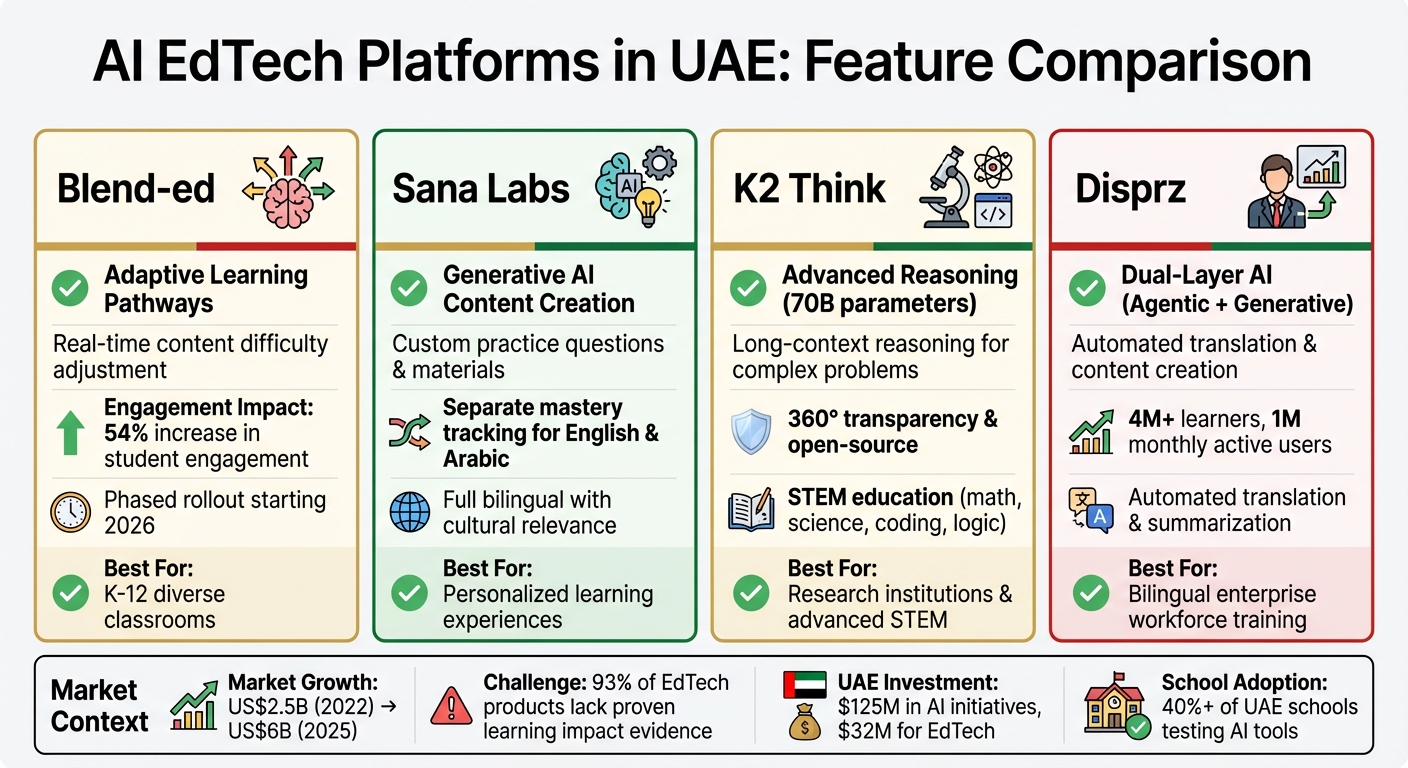
Comparison of Top 4 AI EdTech Platforms in UAE: Features and Capabilities
Each platform contributes distinct advantages to the UAE's EdTech landscape. Blend-ed stands out with its adaptive learning pathways, which adjust content difficulty in real time based on student performance. This feature is particularly effective in accommodating diverse classroom environments [8][16]. Sana Labs, on the other hand, utilises generative AI to craft customised learning materials, such as practice questions for challenging topics and enrichment content for advanced students [8]. Meanwhile, K2 Think provides real-time tracking and predictive insights, helping teachers identify learning gaps and intervene proactively [16]. Lastly, Disprz offers tools like automated translation and summarisation, catering to bilingual enterprises and supporting multilingual learning environments.
Arabic language support adds another layer of differentiation. Platforms like Alef Education and School Hack enhance regional relevance through specialised tools and native language models [4][7]. For instance, Alef Education incorporates tools like Abjadiyat for native Arabic speakers and Arabits for non-native learners [4]. Similarly, School Hack (AIREV) integrates Jais, the world's largest Arabic open-source Large Language Model, through its partnership with Core42, ensuring cultural relevance for the UAE’s diverse population [7].
Scalability is another area where platforms vary significantly. Infrastructure partnerships and regulatory alignment play a key role here. Since its launch in February 2023, School Hack has expanded to over 2 million users across 100+ countries, including 145,000 students in the UAE. It has processed 63 million queries and generated 35 billion AI-powered words [7]. Despite these successes, a broader issue persists: approximately 93% of EdTech products in low- and middle-income markets lack evidence of proven learning impact [17]. This could pose challenges for long-term institutional adoption.
Beyond performance metrics, aligning with national priorities is vital. While individual platforms focus on specific educational enhancements, their strategic direction must also align with the UAE's broader goals. For example, corporate learning solutions offered by Disprz focus on measurable business outcomes and workforce transformation, while K–12 platforms like K2 Think emphasise hybrid learning models, integrating cloud computing and AI dashboards [16]. The market for AI-driven educational tools is also expected to grow from US$2.5 billion in 2022 to US$6 billion by 2025 [15]. Platforms that collaborate closely with government entities to ensure regulatory compliance and safe AI integration are better positioned to support the UAE’s vision of becoming a global AI leader [7].
Conclusion
The UAE's EdTech sector illustrates how AI personalisation aligns with national education goals while meeting the needs of a multilingual and diverse student population. AI has moved beyond being a futuristic concept to becoming a transformative force in UAE classrooms, as seen in improved learning outcomes and strategic collaborations. This progress mirrors the broader UAE startup ecosystem, where EdTech platforms are attracting international investment through partnerships with major tech players like Microsoft and Core42 [19][18]. A notable example is Alef Education's migration to Microsoft Azure in June 2025, which highlights how integrating sovereign cloud solutions supports data security and scalability while aligning with the nation's digital innovation objectives [19].
While K–12 platforms focus on delivering customised learning experiences, corporate solutions like Disprz are reshaping workforce training. Companies such as K2 Think and Alef Education stand out for their use of adaptive learning and predictive analytics, enabling educators to identify and address learning gaps early. On the corporate side, Disprz caters to the UAE's bilingual workforce with features like automated translation and tools that tie learning to measurable business outcomes. The market for AI-powered educational tools is expected to grow from US$2.5 billion in 2022 to US$6 billion by 2025 [15], showcasing the commercial potential of these advancements.
Platforms that deliver measurable results are increasingly favoured for long-term adoption by institutions. Success in the public sector is already paving the way for private sector expansion, as demonstrated by recent partnerships deploying AI-driven platforms across multiple campuses [5]. However, a key challenge persists: around 93% of EdTech products in low- and middle-income markets still lack evidence of proven learning impact [17].
From adaptive K–12 tools to corporate training solutions that address language and skill gaps, AI-driven platforms are making a significant impact in UAE EdTech. By combining personalised learning, Arabic language support, and transparent analytics, these innovations align with national priorities and drive the growth of a knowledge-based economy. Community initiatives like Founder Connects further empower UAE startups by fostering connections among innovators and sustaining progress in AI education. Together, these advancements solidify the UAE's position as a global leader in AI-enabled education.
FAQs
How will mandatory AI in UAE public schools be taught in practice?
The UAE's mandatory AI curriculum for public schools is designed with structured lesson plans, activities, and resources to support both teachers and students. Spanning Key Stage 1–3 (Years 1–9), it aligns with the UAE AI Strategy 2031 and global standards, ensuring hands-on and engaging learning experiences. Teachers are provided with specialised training, while Arabic-language resources cater to diverse learners, encouraging creativity and problem-solving skills from an early age.
What student data do AI learning platforms collect, and how is it protected in the UAE?
AI learning platforms in the UAE gather data such as attendance records, interaction habits, assessment outcomes, and engagement levels. This information is used to tailor learning experiences, offering personalised pathways and support for students.
To ensure the safety of this data, the UAE enforces stringent privacy protocols. These include using trusted platforms, implementing governance frameworks, and maintaining safeguards to uphold data sovereignty and integrity. These measures are in line with the country's policies on responsible AI use and data privacy.
How can schools prove AI tools actually improve learning, not just engagement?
Schools can assess the success of AI tools by applying thorough evaluation techniques that go beyond simple engagement statistics. In the UAE, programmes like Alef Education highlight this approach, demonstrating a 22% improvement in performance through AI-powered tools. Methods such as analysing real-time data, performing controlled studies, and comparing results before and after implementation provide clear evidence of academic progress. Additionally, gathering feedback from teachers and students ensures these AI solutions effectively tackle learning challenges and improve results in a meaningful way.
Related Blog Posts

Building in MENA? You don't have to do it alone.
Join 300+ founders in the Founder Connects Residency. Monthly squad calls, warm intros, $3M+ in perks, and much more. All for less than your monthly coffee budget.
Popular posts





Founder Connects is a premium MENA tech founder community. Meetups in Dubai and across MENA, Residency Squads of 8–10, and 400+ vetted WhatsApp founders (apply and screened).