

A founder in Dubai signs a distributor in Europe, starts shipping, then hits the first real obstacle. The contract wording is vague, payment timing gets disputed, and each side assumes a different standard for what “commercially reasonable” means. Nothing about that problem feels academic when stock is sitting in a warehouse and cash is tied up.
That's where institutions like the International Chamber of Commerce stop looking abstract. They shape the rules, norms, dispute pathways, and policy language that sit underneath cross-border business. If you're building in the UAE, especially in trade-heavy sectors, understanding International Chamber of Commerce careers isn't just useful for candidates. It helps founders hire sharper people, read the market better, and avoid costly mistakes.
Most startup teams only look at chambers and trade institutions when they need an introduction, a document, or a crisis fix. That's too late. The smarter move is to understand the people inside these systems before you need them. If your company is already thinking about export contracts, international payments, supplier agreements, or digital trade compliance, the talent shaped by this ecosystem matters. If you're planning broader market entry, this guide on global expansion tips for UAE startups adds useful commercial context, and this Model Diplomat resource on cyber security in international commerce is worth reviewing because trade risk now includes digital process risk, not just legal wording.
Founders often treat trade rules as background noise until something breaks. A shipment gets delayed because documentation doesn't match. A reseller interprets exclusivity differently. A service contract spans more than one jurisdiction and no one on your team can explain which standard should guide the dispute.
In the UAE, that problem shows up early because many startups go cross-border faster than they expect. You might be local in headcount and office footprint, but your suppliers, customers, investors, or payment flows usually aren't.
The common mistake is assuming global trade capability means hiring a general operations lead or a lawyer with a broad commercial background. That helps, but it often misses the actual work. Cross-border business runs on process discipline, documentation quality, stakeholder coordination, and an understanding of how international institutions influence business norms.
Practical rule: If a role touches contracts, market entry, distribution, compliance, or dispute risk across borders, it's not a generic admin or sales support function.
That matters because the people who build careers around institutions like the ICC are trained to think in systems. They don't just ask, “Can we sign this deal?” They ask, “What standard will govern this relationship when something goes wrong?”
A founder who understands this ecosystem gains three things:
For UAE startups, this isn't niche. It's part of building a company that can operate beyond one market without recreating basic trade mistakes each time.
The easiest way to think about the ICC is this. It works like an operating system for global trade. It doesn't run your company, but it influences the rules, processes, and institutional pathways that many companies rely on when business crosses borders.
The ICC's public materials centre on rule-setting, dispute resolution, and policy advocacy, and that mix is why it matters to founders. One part of the institution helps shape how trade works in practice. Another part helps resolve commercial conflict. Another works on the policy layer that affects how markets coordinate around global commerce.
The ICC isn't a small advocacy group. Its careers page shows openings at its Global Headquarters in Paris and specialist offices in Hong Kong, New York, and Singapore, alongside internship and specialist policy opportunities in its archive on the ICC careers site. For additional organisational context, RocketReach lists ICC as founded in 1919, with 2,114 employees and $19.3 million in revenue, which gives founders a sense of institutional scale and longevity.

That history matters in the Gulf. In Dubai and Abu Dhabi, demand for internationally oriented legal, policy, and operations talent is tied directly to cross-border commerce. ICC-style roles tend to sit close to trade, arbitration, policy, and dispute resolution. Those are not fringe functions in the UAE. They sit close to how serious regional business gets done.
The first takeaway is that ICC careers are usually specialised rather than volume-driven. This is not a mass hiring ecosystem. It rewards multilingual ability, stakeholder management, policy literacy, and comfort operating across jurisdictions.
The second is that these profiles are often more valuable to a startup than founders assume. A person who understands institutional trade frameworks can help a business:
| Founder need | Why ICC-style talent helps |
|---|---|
| Cross-border contracting | They recognise wording, escalation risks, and process gaps early |
| Market entry planning | They understand policy and trade friction beyond sales strategy |
| Complex partner management | They're used to dealing with stakeholders who don't share the same incentives |
| Reputation-sensitive expansion | They know how formal institutions communicate and document decisions |
For a deeper membership-side view of how this ecosystem connects with companies, this overview of International Chamber of Commerce members is useful.
Founders don't need to become trade-policy specialists. They do need to know when their business has outgrown purely informal ways of operating across borders.
Many considering International Chamber of Commerce careers often imagine one vague category of “international policy jobs”. That's too broad to be useful. The primary value lies in understanding the functional teams and what those people do all day.

This group usually includes roles such as policy officers, trade analysts, and specialists focused on issue areas like sustainability or governance. Their day-to-day work often involves tracking policy developments, preparing briefings, coordinating working groups, and turning technical business concerns into positions that institutions can act on.
For a startup, this type of person is valuable when you need someone who can translate a regulatory change into a commercial response. In fintech, logistics, AI-enabled trade tools, or climate-linked businesses, that matters more than founders expect. A strong policy profile won't just tell you what changed. They'll tell you what action to take, who to speak with, and what internal process needs to tighten.
These are the profiles most founders only notice after a problem starts. Think legal counsels, case management professionals, and specialists involved in dispute processes.
They're trained around precision. They care about records, procedure, submissions, timelines, and making sure a multi-party process doesn't collapse into confusion. In startup terms, these people are useful far beyond litigation. They can improve contract hygiene, escalation pathways, partner governance, and documentation discipline.
If your company is signing larger regional distribution, licensing, or supply agreements, someone with dispute-resolution exposure can save far more value in prevention than in crisis response.
ICC-related organisations also hire communications specialists and partnership-facing professionals. Outsiders often underestimate these roles. They're not just writing press releases. They're managing institutional messaging, aligning stakeholders with different agendas, and making technical material legible to external audiences.
A startup hiring from this background gets someone who can work with senior counterparts, draft carefully, and avoid sloppy external communication in sensitive contexts. That's especially useful if your business deals with regulators, chambers, large enterprise buyers, or public-facing partnerships.
Then there's the engine room. Programme coordinators, operations staff, and support professionals keep specialist teams moving. They manage workflows, scheduling, submissions, archives, and internal process integrity.
Founders sometimes dismiss this as generic operations. It isn't. In institutional environments, good operations people are trained to handle complex, formal workflows with low tolerance for error. That discipline travels well into startups scaling cross-border partnerships or compliance-heavy commercial processes.
Compensation and employer sentiment also tell you something about the quality of this talent pool. Indeed's ICC intern salary data in the United States shows estimates of $20.89 per hour and $23.49 per hour, described as 6% to 16% above the national average depending on the estimate shown on Indeed's ICC intern salary page/salaries/Intern). Glassdoor also reports that 75% of employees would recommend working at ICC to a friend, based on 96 anonymous reviews, as referenced in the same verified data set.
For founders, the point isn't to map U.S. intern pay directly onto UAE hiring. It's to recognise that even entry-level ICC pathways appear to be positioned as paid, professional-grade roles, not token experience lines. ICC's published openings also include role examples such as “Internship – Sustainability and Governance, Global Policy”, which tells you these early-career profiles may already have substantive exposure.
The strongest ICC-adjacent candidates are rarely pure specialists in one narrow lane. The market is moving towards hybrid profiles. In the UAE and wider MENA region, the most useful people often combine trade, policy, legal, and digital process capability.
That shift matters because trade and dispute workflows are becoming more digitised. ICC career content highlights roles including policy officers, trade analysts, legal counsels, communications specialists, and digital economy experts, and that mix points to a hiring pattern that rewards people who can combine domain knowledge with digital transformation work, as outlined in this ICC career guide.
A candidate becomes much stronger when they can show evidence in areas like:
In the UAE, candidates with experience in e-signature governance, structured data handling, or adjacent digital trade processes stand out because businesses need people who can reduce friction in multi-jurisdiction work.
Most CVs claim communication, leadership, and stakeholder management. Ignore the labels and look for evidence.
Use interview questions that force specificity:
| Claimed skill | Better founder question |
|---|---|
| Stakeholder management | “Tell me about a time you had to align legal, commercial, and external parties with different priorities.” |
| Cross-cultural communication | “Describe a project where parties in different jurisdictions interpreted the same issue differently.” |
| Negotiation | “What did you change in your approach when the other side cared more about process than speed?” |
| Writing ability | “Show me a memo, board note, or policy brief you've written and explain the decision it supported.” |
A strong candidate won't hide behind role titles. They'll explain process, constraints, trade-offs, and how they documented decisions.
What works:
What doesn't:
If someone is trying to present themselves well on paper, this practical guide on how to land interviews with strong skills is useful. For founders, it's also a reminder that polished wording is easy to manufacture. Demonstrated judgment is harder to fake.
A candidate in the UAE often has stronger raw relevance for ICC-type roles than they realise. The issue isn't lack of fit. The issue is poor translation. Too many applicants describe local experience in local terms and assume recruiters will connect the dots.
They often won't.
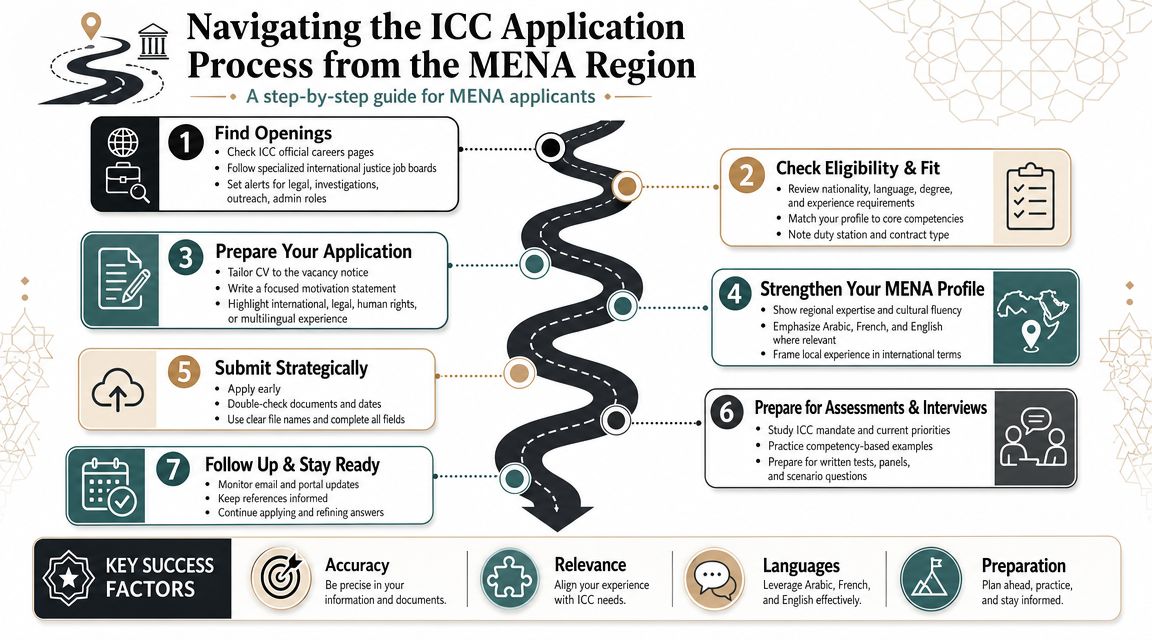
ICC public materials emphasise rule-setting, dispute resolution, and policy advocacy, and the job examples point to specialist functions rather than broad corporate roles. The practical gap is that many candidates don't know whether experience in free-zone regulation, arbitration, trade compliance, or public-policy analysis will be read as relevant enough for these paths. That's exactly where MENA applicants need to be sharper, especially because the UAE is a major trade and logistics hub and there is a real regional talent pool, as summarised in the background framing on the International Chamber of Commerce overview.
The strongest applications reframe local experience into globally legible capability. For example:
For founders, this section matters because it tells you how to read talent from the region more intelligently. If you're evaluating candidates with local institutional or trade backgrounds, don't screen them out because they haven't worked in Paris or Singapore. Look at the operating signals underneath the job title.
A related local benchmark for comparison is this look at Dubai Chamber careers, which helps show how chamber-adjacent institutional roles can translate into business-relevant capability.
This short video can help candidates think about positioning and preparation before they apply.
Use this checklist before sending an application:
Start with role matching
Don't apply on title alone. Match your experience to policy, legal, dispute, communications, or programme work based on actual tasks you've handled.
Rewrite local jargon
Replace internal or region-specific terms with language a global recruiter will recognise. Keep the substance. Change the framing.
Show proof, not interest
“Passionate about international trade” is weak. A redacted policy note, consultation summary, stakeholder map, or contract process improvement example is stronger.
Use sharper keywords
Useful terms include trade compliance, arbitration support, policy analysis, stakeholder engagement, contract workflow, structured reporting, and regulatory coordination.
Prepare for institutional interviews
Expect questions about process rigour, writing quality, diplomacy, and how you work with conflicting priorities.
Candidates from the region often lose on packaging, not substance. Founders make the same mistake when they under-read regional institutional experience.
A founder doesn't need to chase an ICC-branded hire for the sake of prestige. That's the wrong lesson. The core question is simpler. Where does your business touch the global trade system, and who on your team is equipped to handle that properly?
If your answer is “our general counsel can manage it” or “our operations lead will figure it out”, that may be enough for now. It may also be a blind spot.

First, audit your exposure. List every place your company depends on cross-border rules, formal contracting, structured trade processes, or multi-jurisdiction relationships. Most founders discover that the risk sits in more places than expected.
Second, tighten one role description. If you're hiring in operations, commercial, legal, or partnerships, add the capabilities that matter. Ask for evidence of contract process discipline, policy translation, stakeholder coordination, and cross-border execution.
Third, build one institutional relationship. Attend one relevant chamber or trade-facing event, or ask for one introduction to someone who has worked in this ecosystem. The point isn't networking theatre. It's better market intelligence.
Use this filter:
Founders who have built their own business history sometimes struggle to present that experience in a formal hiring context. If that applies to you when rewriting your own profile or evaluating an operator who has worked independently, this StoryCV self-employed resume guide is a practical reference.
The companies that handle cross-border growth well usually aren't the boldest. They're the most organised.
International Chamber of Commerce careers matter because they reveal where serious global trade capability sits. For a founder in the UAE or wider MENA region, that's useful in two ways. It tells you how to hire. It also tells you how the trade system around your company really works.
If you want sharper founder conversations around hiring, expansion, and operating in the UAE ecosystem, Founder Connects is built for that. It brings founders into high-signal peer groups, curated introductions, and practical discussions that help turn questions like these into better decisions.


