

Your Founder's Guide to an International Marketing Group

Building in MENA? You don't have to do it alone.
Join 300+ founders in the Founder Connects Residency. Monthly squad calls, warm intros, $3M+ in perks, and much more. All for less than your monthly coffee budget.

For a busy UAE founder, an international marketing group isn't just another agency. It's your strategic partner for growth, acting as your brand's 'diplomatic corps' to navigate new countries, establish your presence, and de-risk your expansion.
Think of them as the team you hire to figure out how to win in a market you don't yet understand.
What an International Marketing Group Actually Does for a UAE Startup

Let's get practical. Imagine your startup has found product-market fit in Dubai and you're eyeing expansion into Saudi Arabia. A standard agency might just translate your existing campaigns.
An international marketing group starts from a different place. They don’t just translate words; they transcreate your entire strategy. This means adapting your core message, value proposition, and go-to-market plan to fit the unique cultural, economic, and regulatory environment of a new market like KSA.
Their core job is to provide the local intelligence needed to make smart decisions, fast.
How They Differ From a Standard Agency
It's easy to get the two confused, but their focus is fundamentally different. A standard agency executes in a market you already know. An international marketing group gets you into markets you don't.
Here's a simple framework to clarify the difference:
CapabilityStandard Marketing AgencyInternational Marketing GroupPrimary GoalExecute campaigns in an existing market.Unlock growth in new international markets.Core SkillCampaign management & optimisation.Market entry strategy & cultural adaptation.ApproachApplies proven tactics locally.Validates and localises strategy for each new country.ResearchFocuses on audience and channel data.Conducts deep cultural, legal, and competitive analysis.ContentCreates content for a known audience.Transcreates messaging to ensure cultural resonance.Success MetricROAS, CPL, conversions in one market.Speed to traction and profitability in new markets.
While a standard agency helps you win at home, an international marketing group gives you the playbook to win abroad, preventing costly mistakes.
Solving Critical Expansion Problems
For a founder in the UAE, expanding across MENA or beyond comes with specific hurdles. An international marketing group is built to tackle these head-on.
Their work revolves around three key areas:
- Deep Market Research & Validation: They go beyond generic reports to find on-the-ground intelligence. This means understanding local consumer habits in Riyadh, competitive blind spots in Cairo, and which payment gateways people actually trust—a critical detail in a region with vastly different payment adoption rates.
- Localised Go-to-Market Strategy: They build a custom playbook for each market. This isn't about applying a generic "global" template. It's about figuring out the right channels (e.g., Snapchat in KSA vs. Facebook in Egypt), messaging, and pricing that will connect with local customers.
- Cross-Border Campaign Execution: They handle the practicalities of launching campaigns in other countries. This includes navigating tricky advertising regulations, managing multi-currency ad budgets, and producing content that feels genuinely local, not like a bad translation.
An international marketing group acts as your outsourced team of local experts, bringing the cultural fluency and market-specific knowledge you don't have the time to build from scratch.
Global Strategy vs. Local Adaptation
It’s vital to understand the difference between this localised approach and a one-size-fits-all "global marketing" strategy. A global strategy often pushes a single, uniform message across all markets. That can work for massive brands like Coca-Cola, but it's a risky bet for a startup.
An international marketing group works on smart adaptation. They know a campaign that succeeds in the UAE could fall flat—or even be culturally offensive—in another market. For example, a message celebrating bold individualism might work in one culture, while a message focused on community and family could be far more powerful in another. This nuanced understanding prevents you from burning cash and speeds up your path to traction.
Why UAE Startups Must Think Globally Now

For an ambitious founder in the UAE, local success isn’t the finish line—it’s the launchpad. The MENA startup scene is buzzing with funding, government support, and talent. But while winning your home market is a huge milestone, the path to major scale almost always leads across borders.
Thinking about international expansion from day one isn't a distraction; it's a core strategy.
A Perfect Storm for Global Ambition
There has never been a better time for a UAE-based startup to go global. We’re seeing a unique convergence of capital, talent, and infrastructure.
The numbers speak for themselves. The UAE's startup ecosystem is booming, recently seeing a 32% year-on-year increase in ecosystem growth, ranking #21 globally and cementing its spot as the second-largest funding market in MENA. For founders, that’s a clear signal: the momentum is here. You can dig into more data on the UAE startup funding landscape.
This rush of capital means more founders have the runway for a serious international play. An international marketing group ensures you spend that capital wisely when you land in a new country.
For today's UAE founder, thinking globally isn't about leaving your home base. It’s about leveraging local success and the region's robust ecosystem to build a business with a much larger addressable market.
Beyond the Home Market Advantage
The UAE is an incredible home base, but relying on it alone limits your potential. A multi-market strategy is critical for building a resilient company.
- Builds Resilience: Relying on one market leaves you vulnerable to local economic hiccups or regulatory changes. Expanding spreads that risk.
- Unlocks New Revenue: New countries open up completely new customer bases and revenue opportunities that can eventually dwarf your home market.
- Creates a First-Mover Advantage: Being one of the first from our region to plant a flag in a new market creates powerful brand recognition. It forces everyone else to play catch-up.
Think about a FinTech startup that has nailed its model in Dubai. By working with an international marketing group, they could quickly test and adapt that model for Saudi Arabia or Southeast Asia, grabbing market share before a local competitor gets off the ground.
Your Next Action
Making the jump from local champion to global player demands a mental shift.
Next Action: In your next leadership meeting, ask your team this question: "If we had to launch in one new country in the next 12 months, which would it be and why?"
This one question forces the conversation from abstract ambition to concrete action. It's the first real step toward turning your local success into a global story.
Choosing the Right Service Model
Deciding to work with an international marketing group is a big move. To get it right, you need to know exactly what you’re buying. Picking the wrong model for your startup's stage can be an expensive lesson.
Let’s unpack the three common service models. This will help you align your budget and goals with the right kind of partner.
The Full-Service Retainer Model
This is the all-in option, like hiring an outsourced global marketing department. You pay a fixed monthly fee, and they handle your international marketing from strategy to execution.
- Best for: Well-funded scale-ups ready for aggressive, multi-market expansion.
- Typical Cost: A significant monthly retainer, often starting from AED 50,000 - 150,000+ plus ad spend.
- Commitment: High, typically a 6-12 month minimum contract.
The Project-Based Model
This is perfect for a specific, time-bound goal, like launching in a single new market. You hire a group to complete a single project with a clear beginning and end.
- Best for: Startups testing international waters for the first time with a single-market launch. Our guide on the best marketing channels for UAE startups can help you brainstorm options.
- Typical Cost: A fixed project fee, agreed on upfront.
- Commitment: Medium, tied to the project timeline (usually 2-4 months).
The Advisory or Consultancy Model
Here, the group provides high-level strategic guidance, but your internal team handles execution. You’re paying for their expertise and strategic brainpower to build the plan and gut-check your decisions. This is about buying wisdom, not extra hands. To explore how these frameworks compare, see these digital marketing outsourcing models.
- Best for: Early-stage startups with a capable in-house team that lacks specific international experience.
- Typical Cost: A smaller monthly retainer, hourly rate, or a one-off fee for a strategy workshop.
- Commitment: Low and flexible.
How to Choose the Right International Partner
Picking the wrong partner can set your global ambitions back by years. This isn't just about hiring another agency; it’s about finding a co-pilot for your most critical growth phase. You need to ask tough questions that reveal real capability, not just a polished pitch deck. One of the first decisions is always deciding between an in-house team and a marketing agency, and it's even more critical when crossing borders.
This decision tree can help you map out which model makes the most sense.

Your choice should link directly to your primary objective, whether it's building a strategy, executing a launch, or outsourcing the entire function.
Key Evaluation Criteria
Before you even look at a proposal, any potential international marketing group needs to pass these checks:
- Proven Track Record in Your Target Markets: Don't settle for vague claims of "global experience." Ask for specific case studies and references from the exact countries you want to enter. If you’re expanding to KSA, they need to have succeeded there before.
- Relevant Industry Expertise: A group that’s great at B2C e-commerce in Europe might be lost with B2B SaaS in the GCC. Your partner must understand your business model and customer.
- Genuine Cultural and Team Fit: This is often overlooked. Do they communicate clearly? Match your urgency? Do they feel like an extension of your team, or just another vendor?
Founder's Vetting Checklist for Global Partners
Use this checklist to get past the sales pitch and uncover how a potential partner really operates.
Evaluation AreaKey Question to AskWhat to Look ForExperience & Honesty"Walk me through a campaign in [Target Country] that didn't go as planned. What went wrong, and what did you learn?"Honesty and clear learnings. A partner who claims they've never failed is a red flag.Strategic Thinking"How would you adapt our current UAE strategy for the Egyptian market? What are the first 3 things you'd change?"Specific, actionable insights that show they understand market nuances, not generic answers.Operational Model"What does your on-the-ground team in [Target Country] look like? Are they full-time staff or freelancers?"Clarity on who is doing the work and how stable that team is. Vague answers are a red flag.Accountability & KPIs"How will we measure success in the first 90 days? What are the top 3-5 KPIs you would track?"A focus on business outcomes (e.g., qualified leads, CPA) over vanity metrics (e.g., impressions).Transparency"Can you show me an example of a performance report you've sent to another client?"Willingness to share their work. Pushback or heavily redacted reports are a major warning sign.
A solid vetting process isn't about being difficult; it's about setting the partnership up for success.
Key MENA Considerations for Your Expansion
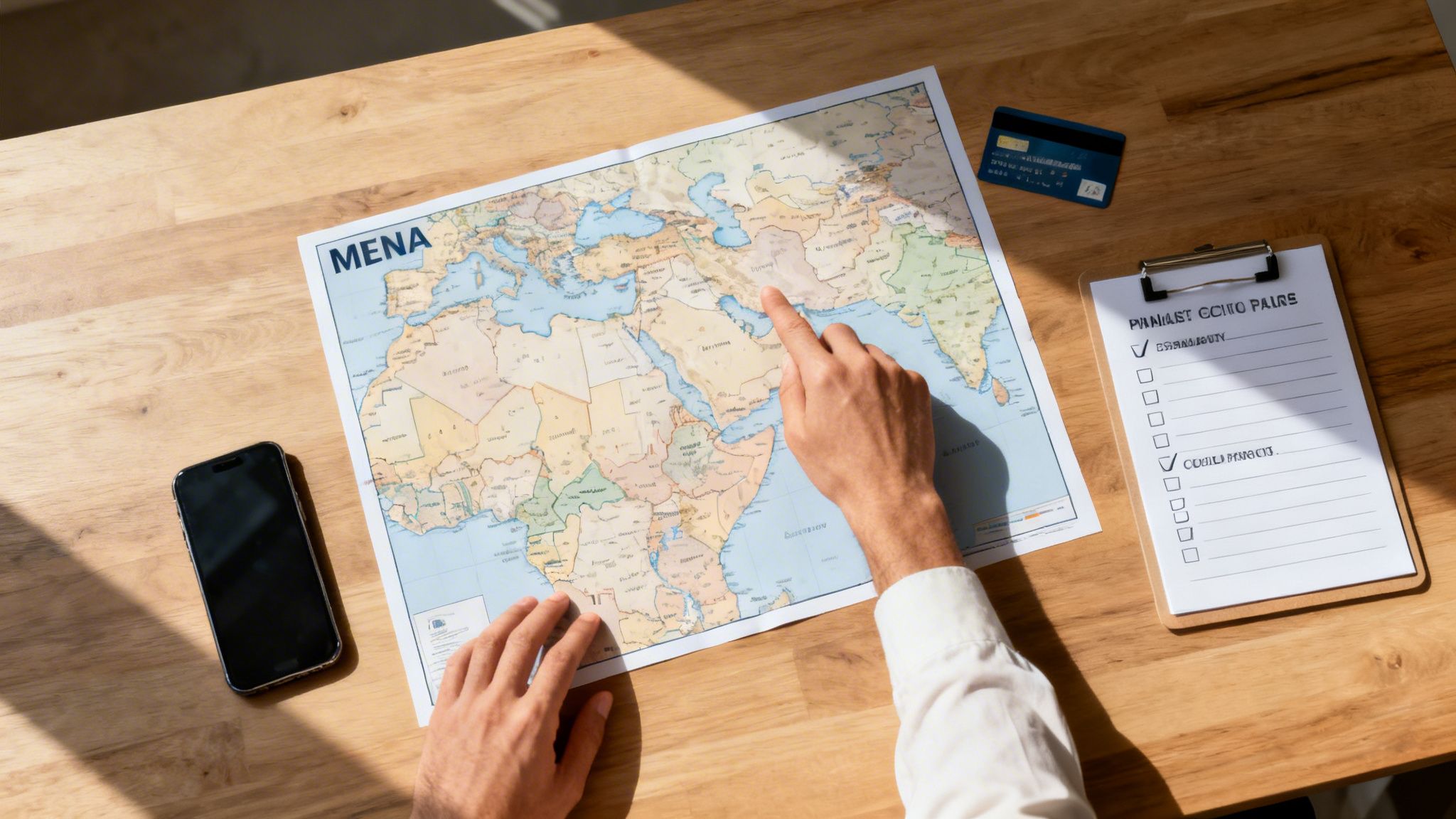
Let’s be direct: most global expansion advice is useless for a founder in Dubai or Abu Dhabi. While the UAE is an incredible launchpad, crossing borders—even into neighbouring MENA countries—demands a specific, localised playbook.
Your home advantage is real. Abu Dhabi's startup scene is ranked #3 in MENA, with Hub71-backed companies raising $2.17 billion as of 2024. These startups also exit faster, averaging 8.5 years versus the global 11.2 years. You can see the full breakdown in Startup Genome's latest report.
But this strong foundation doesn’t guarantee success next door. An expert international marketing group with boots on the ground becomes your most important ally.
The Myth of the "MENA Market"
One of the fastest ways to fail is by treating the MENA region as a single market. The "Arab consumer" doesn't exist. A campaign that works in Dubai will almost certainly fail with a price-conscious student in Cairo or a family-focused buyer in Riyadh.
Each country has its own cultural DNA:
- Saudi Arabia (KSA): A huge market transforming under Vision 2030. Consumers are digital-first with a growing pride in local brands. Your marketing must respect tradition while being modern on platforms like TikTok and Snapchat.
- Egypt: A volume game with over 100 million people. Price sensitivity is key, and trust is often built through community engagement and offline events.
- Kuwait: High disposable income and a hunger for premium, novel international brands. Local social media influencers are incredibly powerful.
Ignoring these differences is a surefire way to burn your marketing budget. For a closer look, see our guide on the key differences between Middle Eastern and Western markets.
Navigating Local Regulations and Payments
Beyond culture, the operational side of expanding in MENA is fragmented. What's standard in the UAE can be a non-starter one border away.
A great partner is your guide through this complex web of local laws and preferences:
- Regulatory Frameworks: Rules for advertising, product labelling, and business licensing vary wildly. Influencer marketing disclosures, for instance, are tightly regulated in the UAE but might be looser elsewhere.
- Payment Gateways: While the UAE has high credit card usage, other markets lean heavily on cash-on-delivery (COD) or local digital wallets. Launching without the right payment options is a deal-breaker.
- Data Privacy Laws: The UAE has its PDPL, but other GCC countries have their own unique and evolving regulations. Your partner must know how to handle customer data compliantly everywhere you operate.
Your Next Action
Forget generic expansion plans. Success comes from asking sharp, specific questions.
Next Action: Grab a notebook and list your top two target markets. For each, write down your top three unanswered cultural or regulatory questions.
This small exercise forces you to admit what you don’t know. Those questions are the perfect starting point for a conversation with a potential international marketing partner.
Your Action Plan for Global Growth
So, you’ve got the theory down. Let's turn information into a concrete roadmap for your global launch. This is about the practical next steps you need to take.
First, though, look inward. Before you spend a single dirham on a partner, you have to be brutally honest about your own readiness.
Your Internal Readiness Checklist
Are you actually prepared for global expansion? Run through this quick checklist. A "no" to any of these is a red flag to pause and strengthen your foundation.
- Product-Market Fit: Have you nailed product-market fit in your home market (e.g., the UAE)? Is your customer acquisition model predictable?
- Financial Runway: Do you have 9-12 months of cash set aside purely for an international launch, separate from your operating budget?
- Team Capacity: Can your leadership team handle the distraction of a new market without taking their eye off the core business?
If you can confidently say "yes" to all three, it's time to find the right partner.
The best introduction to a proven international marketing group will almost never come from a Google search. It will come from a warm referral inside your founder network.
The Three-Step Action Plan
For founders in the UAE and MENA, finding a partner you can trust is about diligence and community. Here’s a simple plan:
- Leverage Your Founder Network: Your first move is to tap into your peer group. Ask other founders in communities like Founder Connects: "Who did you use for your international launch? Who do you trust?" This gets you straight to vetted partners.
- Use the Vetting Checklist: Once you have a shortlist, use the checklist from the previous section. Ask the hard questions about their past failures, on-the-ground team, and how they measure success.
- Get a Peer Sanity Check: Before signing, take the proposal back to your founder group. Talk through the terms and strategy. Getting feedback from others who’ve been where you are is invaluable.
This process turns finding an international marketing group from a risky gamble into a calculated, strategic move.
To get even more prepared, dive into our detailed guide on global expansion tips for UAE startups.
Frequently Asked Questions
Going global is a huge step. Here are quick, straight-to-the-point answers for founders in the UAE and MENA.
When should my startup hire an international marketing group?
The right time is after you’ve nailed product-market fit and have a predictable revenue stream in your home market. A good signal is when you have enough cash to fund a 6-12 month market entry campaign without putting your core business at risk. A common mistake is jumping the gun while still tweaking your core product.
What's a realistic budget for international market entry?
It's a major investment. A full launch in a competitive market like Saudi Arabia could cost anywhere from AED 150,000 to over AED 500,000 for the first 3-6 months. This needs to cover agency fees, ad spend, content localisation, and any on-the-ground events. Be wary of any group that promises guaranteed results for a low, fixed price. A true partner will create a phased budget, starting small to test and learn before scaling spend.
Should I hire a local team instead of using a group?
Hiring your own team gives you total control, but it’s a much slower and riskier path for your first international leap. An international marketing group is an instant "team-in-a-box," giving you immediate access to vetted experts who know the market. This dramatically cuts your time-to-market. A hybrid approach often works best long-term: use a group to launch fast, then build your own local team once you have traction.
How is the ROI of an international marketing group measured?
Define success before you sign anything. For an initial market entry, focus on leading indicators that prove you're gaining traction, not immediate revenue.
Track these metrics first:
- Brand Awareness: Growth in brand searches and social media mentions.
- Qualified Leads: Prospects that fit your ideal customer profile.
- Cost Per Acquisition (CPA): How it compares to your home market.
- Website Traffic: Volume and quality of visitors from the new country.
As the campaign matures, shift focus to metrics like customer lifetime value (CLV) and total revenue. A great partner will build this phased measurement plan with you.
At Founder Connects, we believe the best advice comes from founders who have faced the same challenges. Our private community is built for founders in the UAE and MENA to share honest insights, get practical support, and build businesses together. If you're planning your global expansion, tap into a network that's been there. Join the conversation at Founder Connects.

Building in MENA? You don't have to do it alone.
Join 300+ founders in the Founder Connects Residency. Monthly squad calls, warm intros, $3M+ in perks, and much more. All for less than your monthly coffee budget.
Popular posts





Founder Connects is a premium MENA tech founder community. Meetups in Dubai and across MENA, Residency Squads of 8–10, and 400+ vetted WhatsApp founders (apply and screened).