

Your network is your startup’s central nervous system. You usually feel that only when it starts failing.
The office Wi-Fi drops in the middle of an investor call. Your remote team cannot get stable VPN access. A new hire joins, but nobody has clean rules for device access, file permissions, or cloud connectivity. Suddenly, “IT” is not a back-office problem. It is slowing sales, product work, hiring, and basic execution.
That is why searching for “it networking companies near me” should not end with the closest provider or the cheapest quote. In the UAE, founders need a partner that can handle your current stage. Your first office has very different needs from a startup rolling out branch sites, securing investor data rooms, or connecting teams across cloud environments.
There is also a regional gap worth recognising. Existing search results for this topic often miss the UAE completely and lean on US provider roundups instead, which is not useful for a founder here. At the same time, UAE startup funding is significant and growing, which means more teams are hitting infrastructure decisions earlier and under more pressure.
If you need broader full IT services, networking should still sit near the top of your shortlist. It touches uptime, security, collaboration, and scale.
Here are seven UAE-relevant options, ranked less like a directory and more like a practical founder vetting guide.

Alpha Data is the kind of provider founders call when they want one local partner to own the network stack properly. That usually means office networking, Wi-Fi, LAN and WAN design, security layers, collaboration tools, and the operational support around them.
For a startup moving from ad hoc setup to formal infrastructure, that matters. You do not want one vendor for access points, another for firewalls, and a freelancer trying to keep it all working.
Alpha Data makes the most sense when you are opening or upgrading a real office footprint, or when your hybrid team has outgrown consumer-grade networking decisions.
It is also a sensible option if your leadership team wants fewer handoffs. Founders often underestimate how much drag appears when networking, security, and collaboration live with separate providers.
If you are building in Dubai’s startup ecosystem, this is the stage where conversations about office readiness start to overlap with talent, infra, and growth planning. This piece on launching a tech startup in Dubai gives useful context around that wider operating environment.
What works
What does not
Ask Alpha Data to show how they would phase your network over the next two growth steps, not just the current office. Good partners design for the next move.

GBM is a regional heavyweight. If your startup is moving into a multi-site setup, facing procurement scrutiny from enterprise customers, or operating in a regulated environment, GBM belongs on the shortlist.
This is not the nimblest choice for every founder. It is one of the safer choices when failure carries bigger consequences.
GBM is strong when the networking brief is larger than “fix our office internet.” Think branch rollouts, mature managed services, cloud networking, and governance that stands up in front of auditors, large customers, or internal boards.
I would put GBM in the “prepare for serious scale” bucket. If your startup is winning larger contracts, your buyers may start asking tougher questions about resilience, access controls, managed support, and incident handling. Providers with mature processes help you answer those questions credibly.
Founders who are also sorting through operational partners beyond infrastructure may find it useful to compare networking providers with the broader search for a business consultant near me. The buying mistake is often the same. Choosing polish over fit, or choosing price over delivery discipline.
GBM’s strength is process. That is also where some startups feel pain.
Choose GBM if you need
Look elsewhere if you need
A practical test during vendor calls. Ask who owns design, deployment, support escalation, and post-launch optimisation. With larger firms, the answer should be very clear.

MDS Dubai sits in a useful middle ground for founders who need enterprise-grade infrastructure thinking, but want a partner with long experience delivering UAE projects across networking, data centre environments, business continuity, and cybersecurity.
If your startup is becoming infrastructure-dependent, MDS is worth a serious look.
The clearest reason to bring MDS into the mix is when network design is starting to overlap with continuity and recovery planning.
A lot of founders delay that conversation until after the first serious outage, security issue, or failed migration. That is late. Once you are serving customers with uptime expectations, your network is part of your brand promise.
MDS is more suitable for teams that want the option to grow from office and cloud networking into broader resilience planning without changing partners.
There is another practical angle in the UAE. Founders often discover providers and stack partners through industry events rather than search alone. If you are evaluating vendors around major ecosystem moments, this overview of GITEX exhibition Dubai is useful context for how these buying conversations often start locally.
Ask direct questions in these areas:
The good part of an MDS-style integrator is capability breadth. The risk is that smaller startups can get pulled into a bigger programme than they need.
If a provider keeps steering you toward a large transformation project when you need a clean office, secure remote access, and support coverage, the fit is wrong even if the provider is strong.
Use MDS when your roadmap is clearly moving toward more complexity. If not, you may be paying for optionality you will not use yet.

CNS Middle East is one of the more practical options for founders who want managed outcomes rather than an in-house networking operation.
That distinction matters. Some startups should build internal infrastructure capability. Many should not. If your product is not infrastructure, building your own mini-NOC too early is usually a distraction.
CNS leans into managed services, proactive monitoring, service desk structure, and continuity. For a founder, that translates into fewer “who owns this?” moments when the wireless network, firewall rules, user access, and incident queue start overlapping.
This is often the right fit for SMEs and mid-market teams that need stability but do not want a huge enterprise-style transformation.
A few practical advantages stand out:
Managed operations mindset
You are not just buying hardware deployment. You are buying response processes.
Service desk maturity
Incident and change management matter once your team depends on stable access every day.
Security and network together
That setup reduces finger-pointing when a policy change breaks access or performance.
The challenge with CNS is not capability. It is commercial clarity.
Service-heavy providers often quote through retainers, SLAs, and bundled support structures that can be harder to compare side by side with project-based firms. Founders should push for plain answers.
Ask:
The broader UAE founder context makes this more important. A Dubai Chamber survey found that many founders report isolation and poor networking quality. In practice, that means many founders do not have enough trusted peers to sanity-check vendor proposals. When you cannot compare notes easily, managed service contracts become easier to overbuy.
CNS is a good option if you value operational hand-holding and service continuity. Just make them define the edges clearly before signing.

Help AG is the security-first choice on this list. If your networking decision is being driven by risk, not just connectivity, move them up the shortlist fast.
This is especially relevant for startups handling investor materials, customer-sensitive workloads, regulated data, or a growing mix of cloud services and remote users.
Most networking providers can sell you connectivity. Fewer can build the environment around secure access, Zero Trust thinking, managed cyber operations, and tighter control of how users and applications connect.
That is Help AG’s lane.
For founders, the practical question is simple. Are you trying to make the network work, or make it secure enough for where the business is going next?
Help AG becomes more attractive when you need:
You will likely pay more than you would with a basic MSP.
That is not automatically a bad deal. It becomes a bad deal when the startup is too early to use what is being bought. A team of ten with low-risk workflows rarely needs the same architecture as a scale-up serving regulated customers.
There is, however, a regional signal behind the security-and-scale conversation. Search results on IT networking tend to miss this, even though MENA firms are seeing a significant rise in AI adoption, which pushes more teams toward cloud-heavy, distributed setups that raise new access and policy questions.
If your team is adopting more AI tools, more APIs, and more cloud services, review network access and identity rules before you add another point solution. Complexity builds.
Choose Help AG when security requirements are already shaping revenue conversations, due diligence, or enterprise sales. For general office networking alone, it is likely more provider than you need.
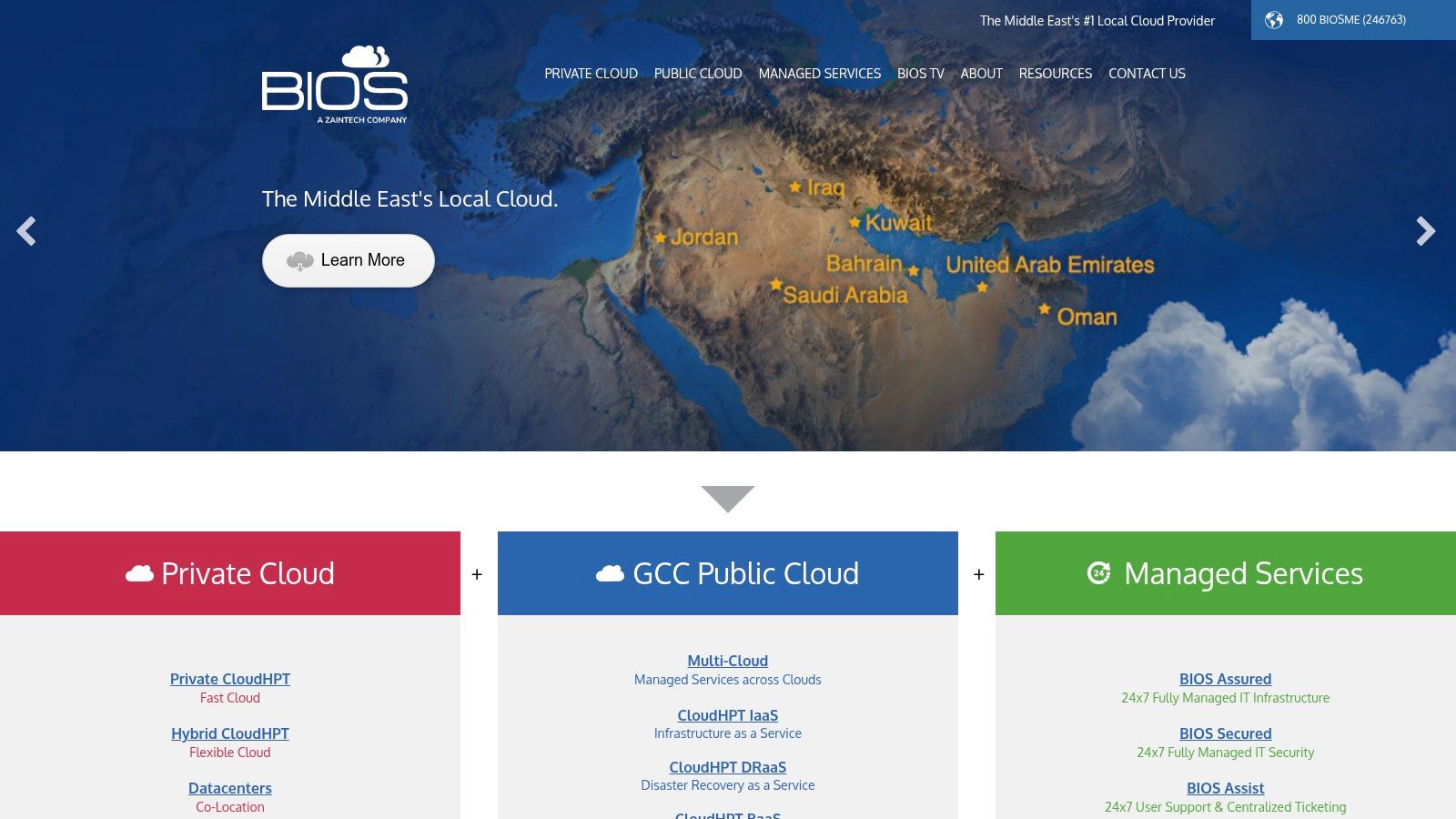
BIOS Middle East is one of the more founder-friendly names here if you care about speed, managed delivery, and an OPEX-style approach instead of building everything from scratch.
That makes it a strong contender for startups that need reliable branch or hybrid connectivity without hiring specialist network engineers internally.
BIOS offers Network-as-a-Service built around managed SD-WAN. In plain English, that means the provider handles the design, edge equipment, orchestration, monitoring, and ongoing support.
For founders, the appeal is obvious:
This model is especially useful when the business is growing faster than your internal ops capability.
Another reason this category matters in the UAE is infrastructure readiness. Dubai’s data centre capacity is growing, which supports more cloud-heavy operating models locally. That does not automatically solve network design, but it makes managed cloud-network combinations more practical than they were for earlier-stage teams.
BIOS is not the most flexible choice if you are determined to standardise on a different vendor stack. If a provider’s managed offer is built around a specific platform, you need to decide whether convenience outweighs vendor optionality.
That is the core buying question here.
Good fit
Less ideal
BIOS works best when speed and operational simplicity matter more than maximum customisation.
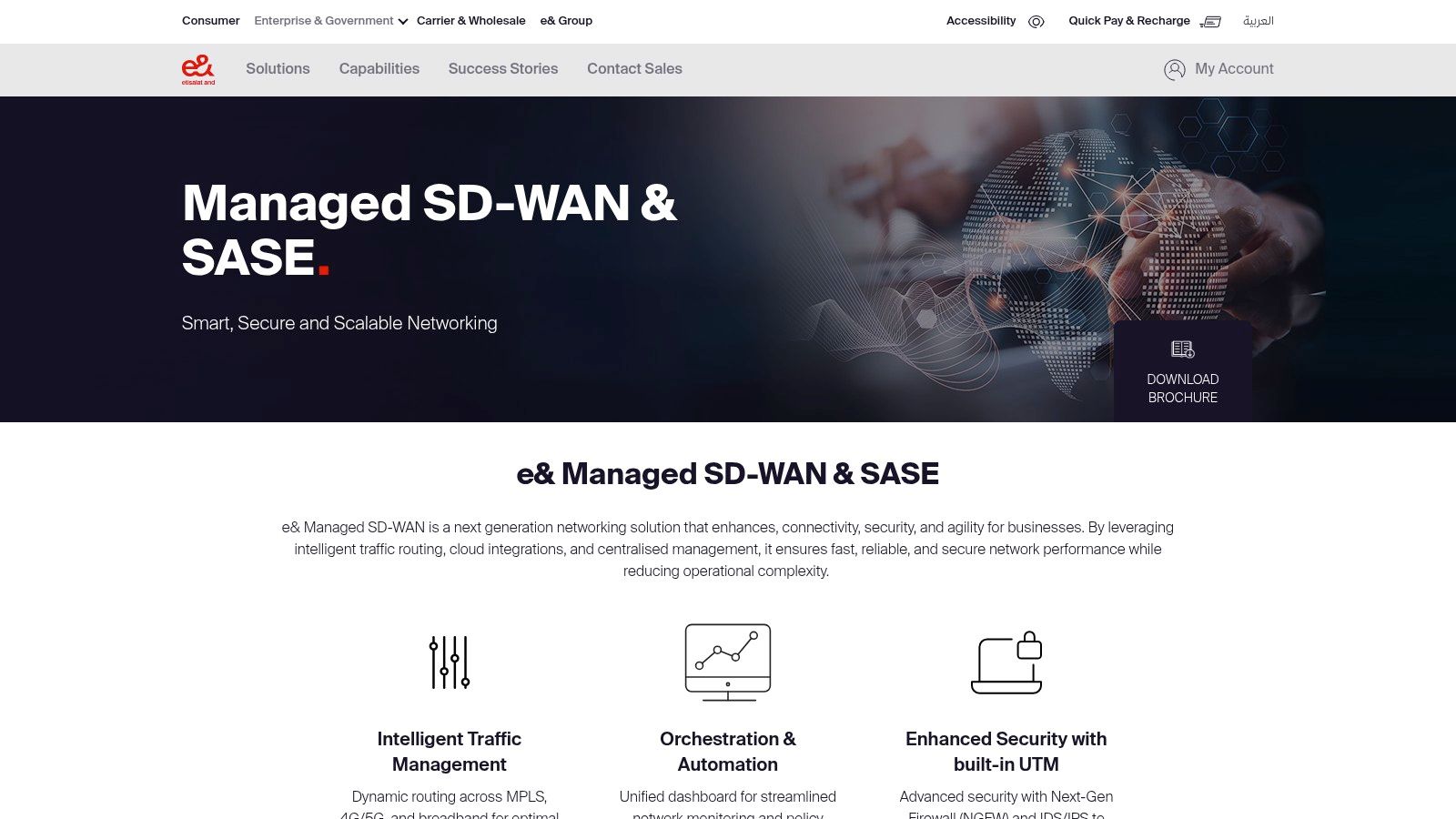
e& managed SD-WAN is the shortlist option for founders who want a single provider handling connectivity, last-mile access, and managed network services together.
There is a practical comfort in that model. One bill. One service relationship. Fewer places to point fingers when a site has issues.
If your startup is opening sites across the UAE, standardising connectivity policies, or trying to avoid stitching together multiple telecom and networking relationships, e& can be the cleanest operational choice.
That is the strongest reason to consider a telco-led provider.
The other founder-side benefit is coverage. For teams that care less about boutique service and more about nationwide reach, this model can simplify operations.
There is also a wider demand signal behind hybrid collaboration. In the UAE and MENA, many early-stage founders seek hybrid virtual and in-person events without crowded mixer inefficiencies. While that statistic is about founder interaction rather than office networking, it reflects the same operating reality. Teams increasingly need infrastructure that supports distributed work cleanly, not just a single office LAN.
Telco processes can feel slower than specialist MSPs or integrators. Commercial cycles, changes, support routing, and configuration updates may involve more structure than a founder wants.
That does not mean poor service. It means different service.
I would shortlist e& when these matter most:
I would look elsewhere if you need:
e& is not the most flexible option. It is often the most straightforward if you want telecom and network management under one roof.
| Provider | Implementation complexity 🔄 | Resource requirements ⚡ | Expected outcomes ⭐ / 📊 | Ideal use cases | Key advantages 💡 |
|---|---|---|---|---|---|
| Alpha Data | Medium: full‑stack, multivendor design & deployment | Moderate: certified engineers, vendor licenses, project team | ⭐ Enterprise‑grade network and managed operations; 📊 scalable uptime | Scaling offices or hybrid teams needing a single local integrator | Local presence, multivendor certifications, end‑to‑end delivery |
| Gulf Business Machines (GBM) | High: governance‑heavy, complex multi‑site rollouts | High: large delivery bench, formal procurement and SLAs | ⭐ Mature delivery processes; 📊 strong SLA and timeline adherence | Regulated environments or rapid multi‑site expansion | Scale, Cisco depth, regional Gulf footprint |
| MDS Dubai (Midis Group) | High: data‑centre and enterprise‑class projects | High: 24/7 support, vendor alignment and project resources | ⭐ Proven large‑project delivery; 📊 continuous support and DR readiness | Enterprise data‑centre, DR/business continuity and campus networks | Vendor alignment, backed by Midis Group, scalable support |
| CNS Middle East | Medium: managed operations with ITIL processes | Moderate: managed NOC/service desk; SLA/retainer model | ⭐ Service continuity and predictable incident handling; 📊 improved uptime | SMEs to mid‑market preferring outsourced NOC and managed services | ITIL‑aligned service desk, balanced managed outcomes |
| Help AG | High: security‑first designs (SASE/Zero‑Trust) and SOC ops | High: 24x7 SOC, specialized security engineers and tooling | ⭐ Strong security posture and compliance; 📊 strong threat protection | Security‑driven workloads (investor rooms, regulated data, multi‑cloud) | Regional SOC coverage, telco integration, security specialization |
| BIOS Middle East (CloudHPT) | Low: managed NaaS/VMware SD‑WAN with orchestration | Low: OPEX subscription, CPE and managed monitoring | ⭐ Rapid deployment and predictable OPEX; 📊 fast branch/cloud connectivity | Founders needing quick, OPEX‑friendly multi‑site connectivity | OPEX model, regional POPs, fast time‑to‑value |
| e& (etisalat by e&) | Medium: telco integration with managed SD‑WAN | Moderate: last‑mile circuits, telco procurement cycles | ⭐ Telco‑grade reach and centralized management; 📊 nationwide SLAs | Nationwide multi‑site deployments requiring single billing and reach | Single provider for circuits+SD‑WAN, nationwide coverage and guarantees |
Choosing among IT networking companies is not a procurement task to delegate blindly. For a startup, it is an operating decision that affects how your team works every day, how secure your business becomes, and how painful your next stage of growth will feel.
The first mistake founders make is buying for the current headache only. The Wi-Fi is bad, the VPN is unstable, the office move is urgent. So they choose the provider who can patch the immediate problem fastest. Sometimes that is fine. Often it creates a second problem six months later when the team grows, cloud use expands, or customer security requirements get sharper.
The second mistake is overbuying. A polished enterprise proposal can make a startup feel “future ready,” but expensive complexity is still complexity. If your need is secure remote access, reliable office networking, and responsive support, do not let a vendor sell you a giant transformation programme.
A practical way to decide:
Then pressure-test your shortlist with three questions:
This is also where peer input matters more than marketing. Founders often get the clearest view of hidden costs, support quality, and rollout friction from other operators who have already lived through the same decision. That is particularly important in a market where generic search results still miss local startup realities.
If you are also reviewing access providers alongside managed networking, this guide to finding the best internet service provider near you can help you separate connectivity decisions from broader network management decisions.
The right outcome is not a vendor list. It is a partner you can trust when the business is under pressure.
If you want sharper feedback before signing with any provider, join Founder Connects. It is built for UAE and MENA founders who want practical peer input, warm introductions, and honest conversations that help you avoid expensive mistakes, including infrastructure and ops decisions like this one.


